AI Generated Quiz
Secondary 3 Biology Evolution Diversity Quiz
Free Sec 3 Biology Evolution Diversity quiz, HY3 AI version, with questions, answers, and O Level-style practice for Singapore students.
These static practice materials are generated from the site's syllabus and paper-generation workflow, with source and model context shown so students and parents can evaluate the material before use.
Questions
Free quiz and exam paper access
Enter your details to view this paper
Your access is remembered on this device.
Answers
Secondary 3 Biology Quiz - Evolution Diversity: Answer Key
Total Marks: 40
Topic: Evolution Diversity (syllabus-first practice, not past-year derived)
Section A Answers (1 mark each)
1. B
Teaching note: A species is defined as a group of organisms that can interbreed and produce fertile offspring. Option A describes a habitat group, C is false (DNA differs), D is false (appearance can vary).
2. B
Teaching note: Charles Darwin proposed natural selection in "On the Origin of Species" (1859). Mendel worked on genetics, Pasteur on microbes, Watson on DNA structure.
3. C
Teaching note: The nucleus contains chromosomes (DNA) which carry hereditary information. Ribosomes make proteins, mitochondria release energy, vacuoles store substances.
4. B
Teaching note: Variation arises from differences in genes (inheritance) and environmental effects. Cloning and identical DNA would remove variation.
5. B
Teaching note: Fossils show sequences of changing forms over geological time, supporting evolution. They do not show simultaneous appearance (A) or deny extinction (C).
Section B Answers (2 marks each)
6. Continuous variation shows a range (e.g., height); discontinuous variation has distinct groups (e.g., blood type). [2]
Marking: 1 mark for correct attribute of continuous, 1 mark for discontinuous.
7. Natural selection is the process where individuals with advantageous traits survive and reproduce more, passing those traits on. [2]
Marking: 1 mark for survival/reproduction advantage, 1 mark for inheritance of traits.
8. (i) Fossils (ii) Comparative anatomy / DNA / embryos [2]
Marking: 1 mark each, any two valid types.
9. Forelimb of human and bat (or whale); shows common ancestor. [2]
Marking: 1 mark structure, 1 mark groups.
10. Adaptation is an inherited characteristic that increases an organism's chance of survival in its environment. [2]
Marking: 1 mark inherited trait, 1 mark survival advantage.
11. Random mutation creates resistant individuals; they survive antibiotics and reproduce. [2]
Marking: 1 mark mutation, 1 mark survival/reproduction.
12. A and B [2]
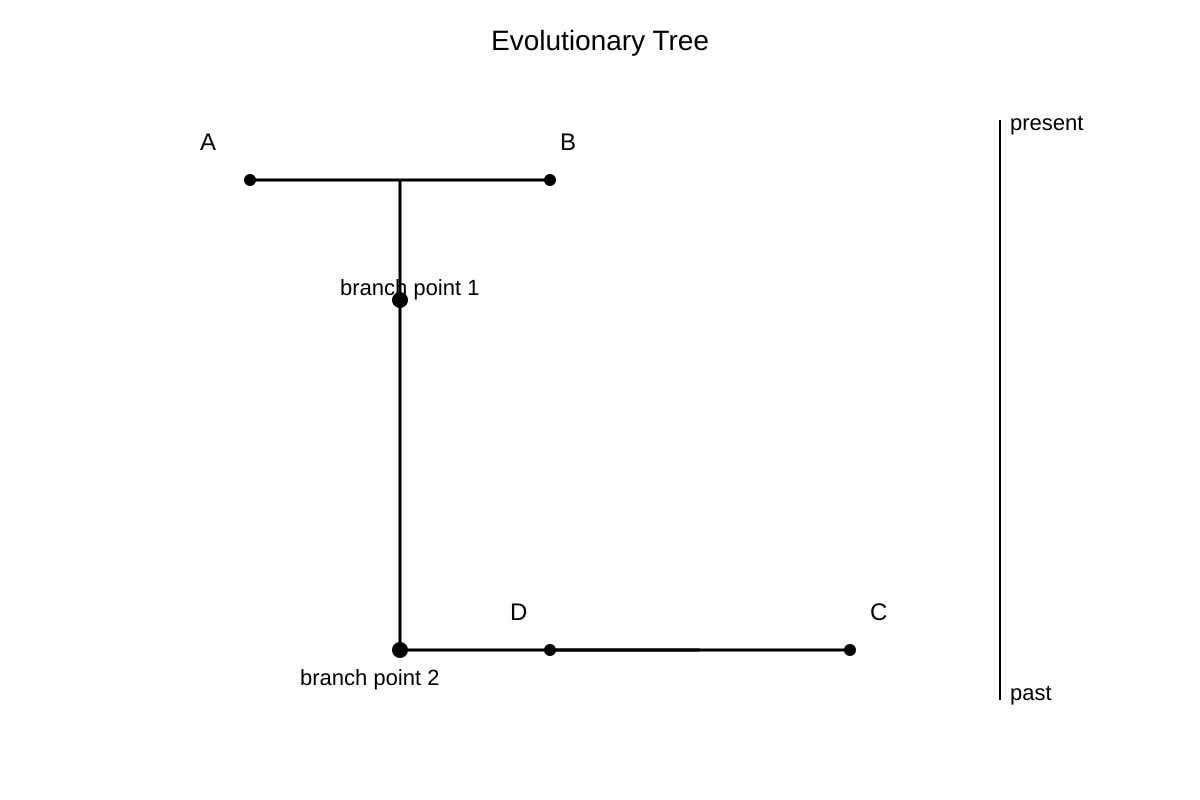
Teaching note: From the placeholder tree, A and B share the most recent branch point (branch point 1), so they are most closely related.
Marking: 2 marks for correct pair; common mistake: choosing C and D (also related but less recent than A-B if tree shows A-B as sister group).
13. Greater variation means some individuals likely have traits suited to new conditions, so they survive and reproduce. [2]
Marking: 1 mark for some suited, 1 mark for survival/reproduction.
14. Artificial selection (selective breeding). [2]
15. Rapid reproduction and mutation allow drug-resistant strains to appear and spread. [2]
Marking: 1 mark rapid reproduction/mutation, 1 mark spread/resistance.
Section C Answers (4 marks each)
16. [4]
- Fossils show chronological change (e.g., horse leg bones become longer over layers). [1]
- Comparative anatomy shows similar bone structures in different species (e.g., human arm, whale flipper). [1]
- Both suggest common ancestry. [1]
- Example: Archaeopteryx fossil shows bird-reptile mix. [1]
Teaching note: Link fossil sequence with structural similarity to show descent with modification.
17. [4]
- Before industry: light moths camouflaged on clean trees, dark rare. [1]
- Soot darkened trees: dark moths now camouflaged, light eaten by birds. [1]
- Dark moths survived and reproduced more. [1]
- Over generations, dark form became common – selection by predation. [1]
18. [4]
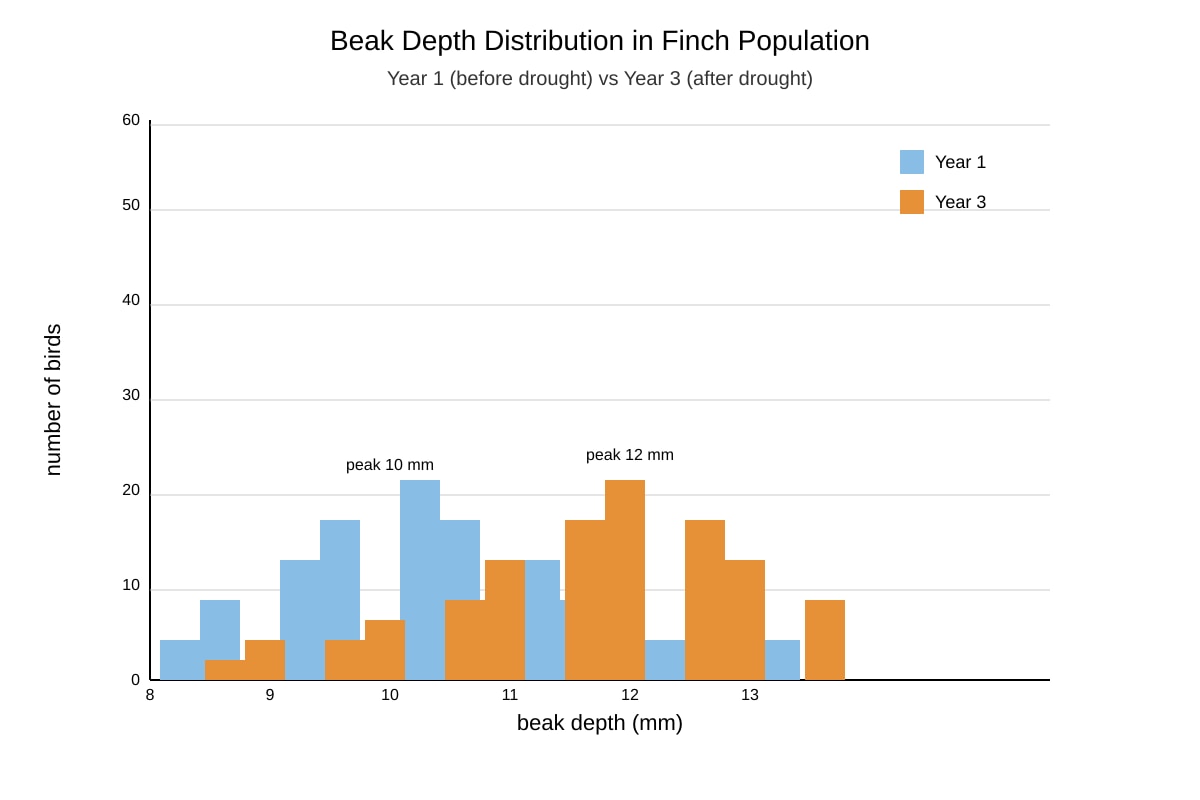
- After drought, large-beak birds could crack hard seeds; small-beak birds died. [1]
- Graph shows shift from peak 10 mm (Year 1) to 12 mm (Year 3). [1]
- Survivors with larger beaks bred, passing trait. [1]
- This is directional selection – population mean changed. [1]
Teaching note: Image must show bars shifted right; use legend to distinguish years.
19. [4]
- Convergent: unrelated species evolve similar traits (e.g., dolphin and shark shape). [2]
- Divergent: related species become different (e.g., finches on islands). [2]
20. [4]
- Benefit: traits useful to humans (e.g., herding, companionship). [2]
- Problem: reduced genetic diversity, inherited diseases (e.g., hip dysplasia). [2]
Marking descriptors: clear link to artificial selection; balanced view.