From Real Exams Quiz
Secondary 3 Biology Plant Biology Quiz
Free Sec 3 Biology Plant Biology quiz, Kimi2.6 Exam version, with questions, answers, and O Level-style practice for Singapore students.
These static practice materials are generated from the site's syllabus and paper-generation workflow, with source and model context shown so students and parents can evaluate the material before use.
Questions
Free quiz and exam paper access
Enter your details to view this paper
Your access is remembered on this device.
Answers
Secondary 3 Biology Quiz - Plant Biology: Answer Key
Total Marks: 40 marks
Section A: Multiple Choice (Questions 1–5)
1. C) Large central vacuole
- Explanation: The large central vacuole contains cell sap (a concentrated solution of salts, sugars, and pigments). When water enters by osmosis, the vacuole swells and pushes the cytoplasm against the cell wall, creating turgor pressure. This pressure gives plant cells their rigid shape and supports non-woody tissues. The cell wall provides structural support but does not regulate turgor directly; the vacuole stores the water that generates turgor. (1 mark)
2. B) To reduce water loss by transpiration
- Explanation: The cuticle is a waterproof, waxy layer secreted by epidermal cells. Being hydrophobic (water-repelling), it prevents water from evaporating directly from leaf surfaces. This is crucial for terrestrial plants to conserve water, but it also means gases cannot pass through it—hence the need for stomata for gas exchange. (1 mark)
3. B) Thylakoid membranes
- Explanation: The light-dependent reactions require chlorophyll and other pigments arranged in photosystems, which are embedded in the thylakoid membranes (specifically the grana, which are stacks of thylakoids). Here, light energy is captured and converted into chemical energy (ATP and NADPH). The stroma is where the light-independent reactions (Calvin cycle) occur. (1 mark)
4. B) The lower surface is cooler, reducing water loss while still permitting gas exchange
- Explanation: The lower epidermis is shaded and generally cooler than the upper surface exposed to direct sunlight. This reduces the water potential gradient between leaf and air, slowing transpiration. However, gas exchange can still occur efficiently because the underside is well-ventilated. This is a key adaptation of dorsiventral (bifacial) leaves. (1 mark)
5. C) Cambium — Produces new xylem and phloem through secondary growth
- Explanation:
- A is incorrect: xylem transports water and mineral salts, not organic nutrients.
- B is incorrect: phloem transports organic nutrients (sucrose, amino acids), not water and minerals.
- D is incorrect: the epidermis is protective; photosynthesis in stems occurs in the cortex or is carried out by chlorophyll-containing cells in young stems, not the epidermis.
- The cambium (lateral meristem) contains dividing cells that produce secondary xylem (wood) inwardly and secondary phloem outwardly, increasing stem girth. (1 mark)
Section B: Structured Questions (Questions 6–14)
6. (a) Any two of: (2 marks: 1 mark per correct mineral + role)
| Mineral | Role |
|---|---|
| Nitrogen | Component of amino acids, proteins, nucleic acids, chlorophyll |
| Phosphorus | Component of ATP, nucleic acids, phospholipids in membranes |
| Potassium | Required for protein synthesis, enzyme activation, stomatal function |
| Magnesium | Component of chlorophyll molecule |
| Calcium | Component of cell walls (middle lamella), cell signaling |
(b) Nitrogen is essential for synthesizing amino acids, which are the building blocks of proteins. It is also a component of chlorophyll (in the porphyrin ring). A nitrogen deficiency would cause:
- Stunted growth (reduced protein synthesis, so less cell division and expansion)
- Yellowing of older leaves (chlorosis) because nitrogen is mobile—plants mobilize it from older to younger tissues; without adequate supply, chlorophyll breaks down and is not replaced (1 mark)
7. (a)
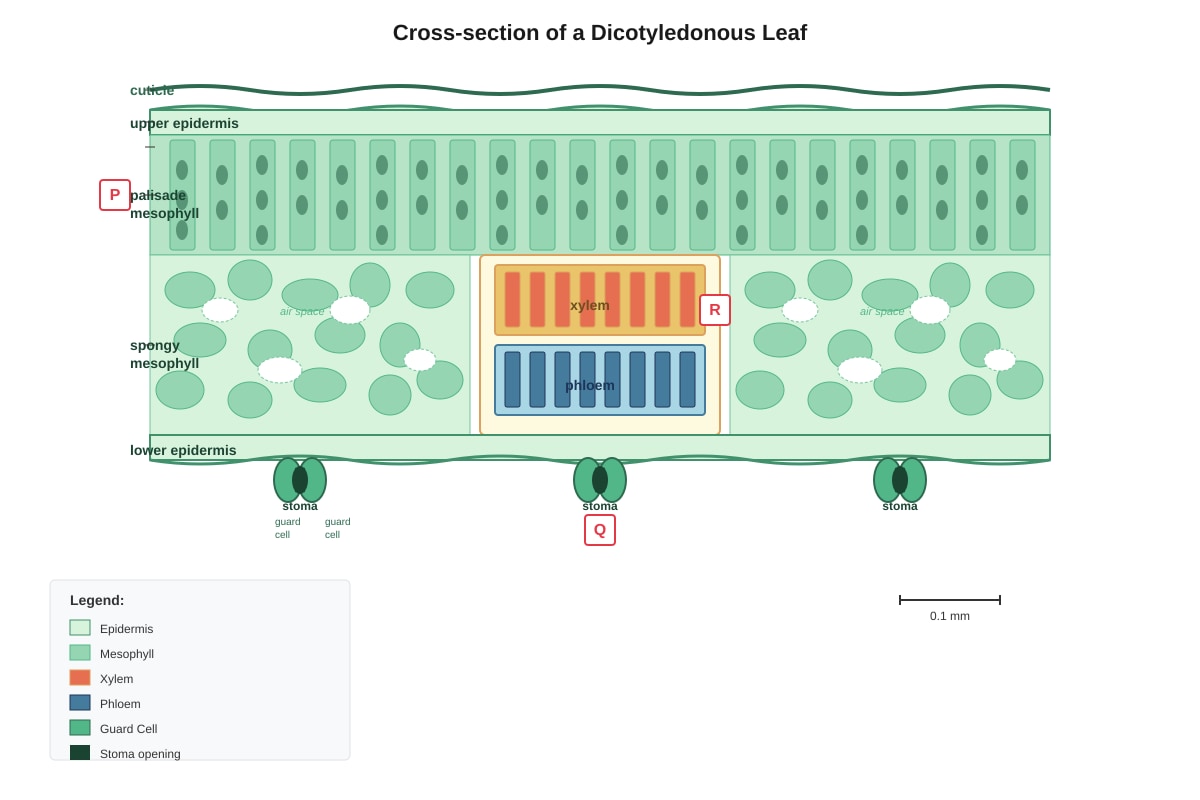
- P = Palisade mesophyll (1 mark)
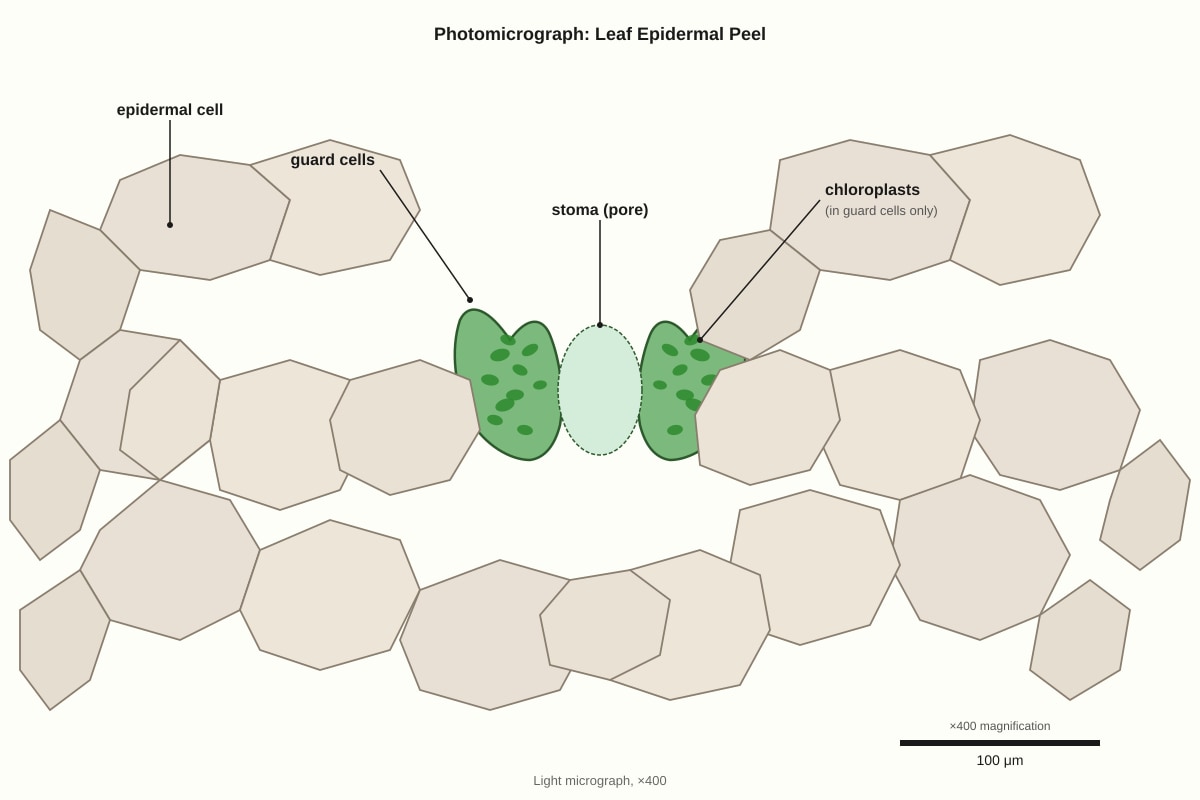
- Q = Stoma / guard cells (1 mark)
- R = Xylem (1 mark)
(b) Palisade mesophyll cells are adapted for photosynthesis because:
- They are cylindrical and arranged vertically with minimal air spaces between them, maximizing the number of cells that can fit in the upper layer where light is strongest (1 mark)
- They contain large numbers of chloroplasts (often 30–50 per cell), packed mainly at the top of the cell to maximize light absorption (1 mark)
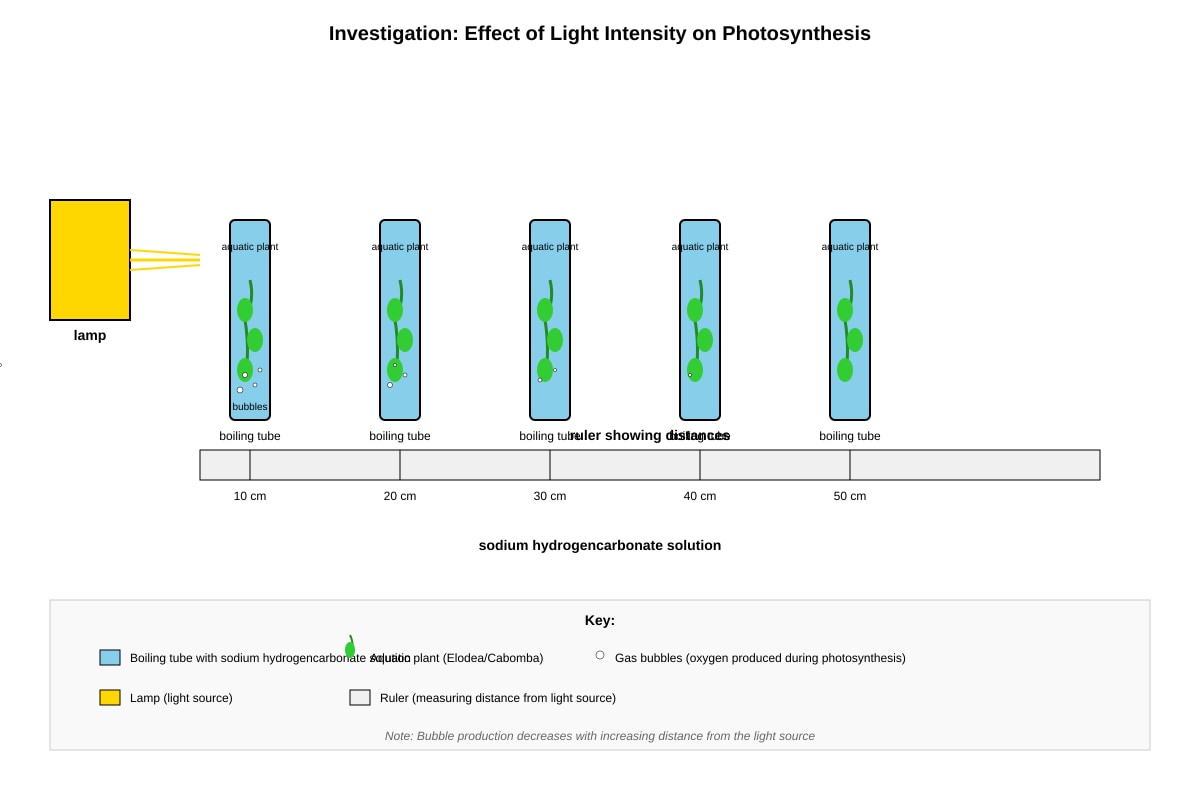
8. (a) Sodium hydrogencarbonate dissociates to provide carbon dioxide (a reactant for photosynthesis) in solution. Pure water contains very little dissolved CO₂, which would limit the rate of photosynthesis and make it difficult to measure reliably. (1 mark)
(b) Any two of: (2 marks)
- Temperature (kept constant using water bath or thermostat)
- Volume/concentration of sodium hydrogencarbonate solution
- Mass/length of plant material used
- Same species/age of plant
- Time allowed for equilibration before counting
(c) Light intensity follows the inverse square law with distance—it decreases as the square of the distance increases. Moving the lamp further away reduces the number of photons reaching the chloroplasts per unit time. This means:
- Fewer excited electrons in photosystem II per second
- Less ATP and NADPH produced in the light-dependent reactions
- The light-dependent reactions become the rate-limiting step, so the overall rate of photosynthesis (measured by O₂ production/bubble release) decreases (2 marks: 1 for reduced light intensity, 1 for effect on photolysis/ATP production)
9. (a) Transpiration is the loss of water vapour from aerial parts of a plant, primarily through stomata in leaves. It is essentially evaporation of water from mesophyll cell walls into intercellular spaces, followed by diffusion out through stomata, driven by a water potential gradient. (2 marks: 1 for defining as water vapour loss, 1 for specifying it occurs through stomata from aerial parts)
(b) (i) Sunken stomata are located in pits or grooves below the general epidermal surface. This creates a microclimate of humid, still air around the stomatal pore. Water vapour accumulates in this pit, reducing the water potential gradient between the leaf interior and the outside air, which slows the diffusion of water vapour out of the leaf. (1 mark)
(ii) Rolled leaves enclose the lower epidermis with its stomata inside the roll. The inner surface becomes a humid chamber with reduced air movement, maintaining high humidity around stomata. This reduces the water potential gradient and transpiration rate. Additionally, the exposed outer surface is often waxy (cuticle) with few or no stomata, further reducing water loss. (1 mark)
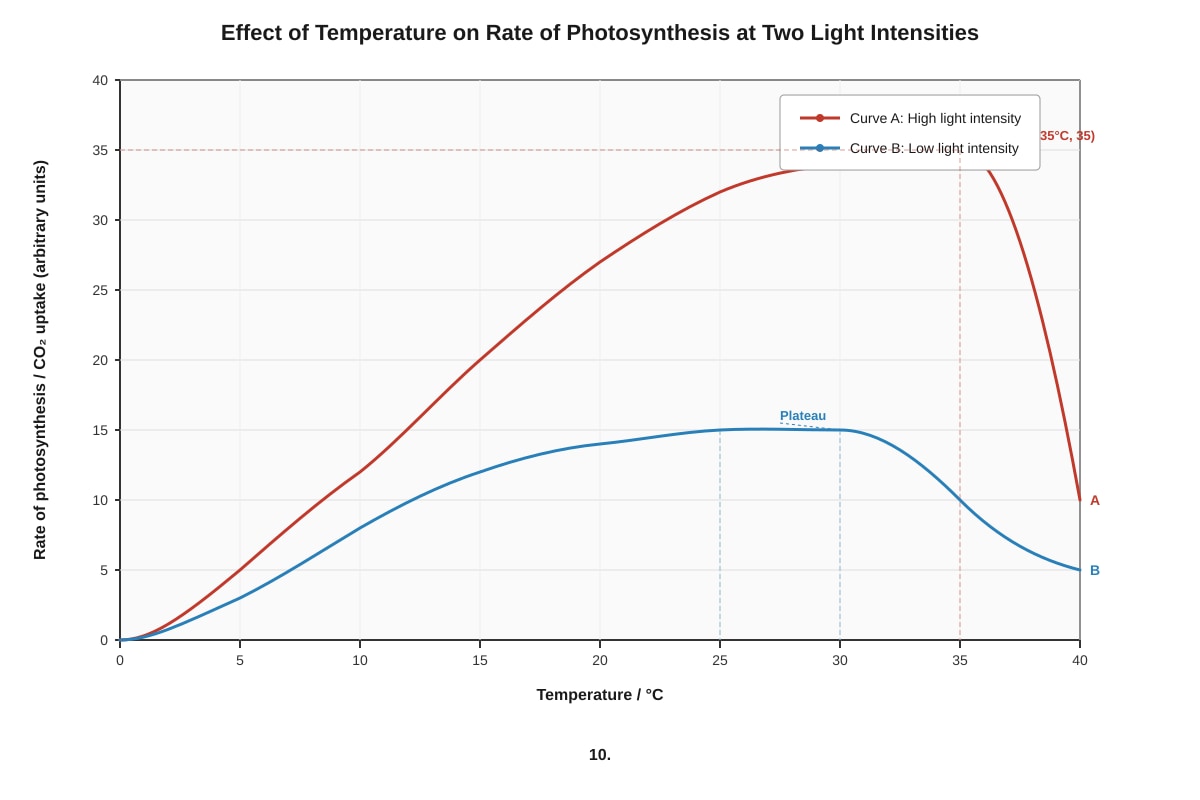
10. (a) 35°C (1 mark)
(b) Above 35°C, enzymes involved in photosynthesis (particularly rubisco and others in the Calvin cycle) begin to denature. Their active sites change shape, reducing their ability to bind substrates and catalyze reactions. Additionally, increased temperature raises stomatal closure (to prevent excessive water loss), which limits CO₂ availability, and increases photorespiration at high temperatures. (2 marks: 1 for enzyme denaturation, 1 for stomatal closure/photorespiration)
(c) At low temperatures (below ~25°C), both curves are low and Curve B remains below Curve A. This indicates that even with more light (Curve A), the low temperature restricts the rate—light is acting as the difference between the two curves. However, above 30°C, Curve B plateaus and does not rise further despite increasing temperature. The light intensity is now insufficient to drive more reactions; the system is saturated with light but limited by other factors (temperature, CO₂). At these higher temperatures, both curves would be limited by other factors, but Curve B specifically shows its maximum is set by its lower light intensity throughout. (2 marks: 1 for identifying low temperature comparison, 1 for explaining saturation/plateau at higher temperatures)
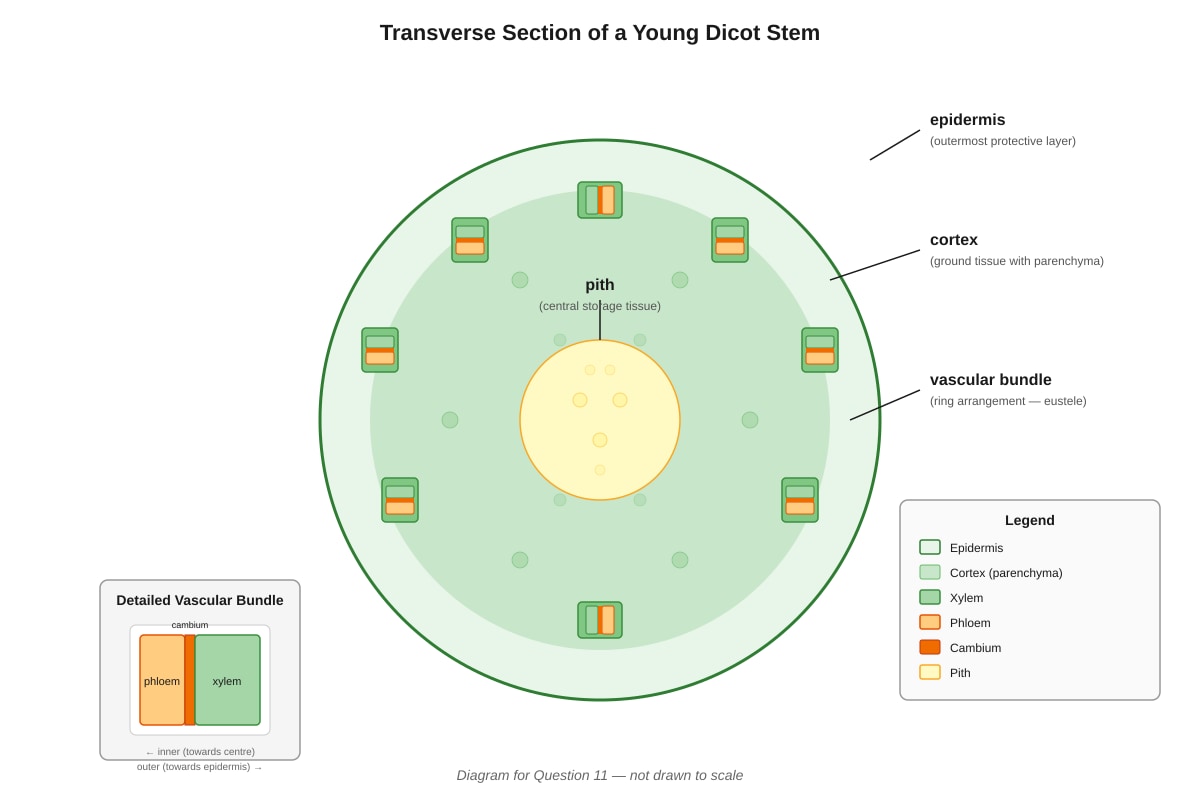
11. (a) The cambium produces new xylem cells (to the inside) and new phloem cells (to the outside) through cell division, enabling secondary growth (increase in girth/thickness). (1 mark)
(b) Dicot stems have vascular cambium between xylem and phloem in discrete bundles that soon form a complete ring. This cambium can divide indefinitely, producing secondary xylem and phloem year after year. Monocot stems typically lack vascular cambium; their vascular bundles are scattered throughout the ground tissue with no cambium layer capable of secondary growth. The bundles are surrounded by a sheath of sclerenchyma, and no lateral meristem develops. (2 marks: 1 for dicot cambium description, 1 for monocot lack of cambium)
12. (a) Percentage retained = [(5 − 0.1) / 5] × 100 = 98% (2 marks: 1 for correct method, 1 for answer)
(b) The data shows that all minerals are more concentrated in the water entering than leaving, and most are strongly retained (especially nitrate, potassium, magnesium). This indicates selective uptake against a concentration gradient—the minerals are absorbed even when their concentration in soil water is lower than in root cells. Active transport using energy (ATP) is required to move substances against their concentration gradient, confirming that root mineral uptake is active, not passive. (2 marks: 1 for referencing concentration gradient/retention, 1 for linking to active transport/energy requirement)
13. (a) Red blood cells contain haemoglobin; chloroplasts contain chlorophyll. Both are pigments that carry out the function of energy transfer/capture—haemoglobin transports oxygen (which releases energy in respiration), chlorophyll captures light energy for photosynthesis. Alternatively, both are involved in energy processes at the cellular level. (2 marks: 1 per correct pigment; both must be named correctly)
(b)
- Haemoglobin obtains its functional energy from chemical bonds — it binds oxygen in the lungs (where oxygen partial pressure is high) and releases it in tissues (where partial pressure is low). The energy for oxygen transport comes from concentration gradients and blood circulation, not from light.
- Chlorophyll captures light energy (photons) directly through its porphyrin ring structure, exciting electrons that are passed through an electron transport chain to generate ATP and NADPH. The energy source is electromagnetic radiation, not chemical gradients. (2 marks: 1 per correct description; key distinction is light vs. chemical/gradient energy)
14. (a) Stoma opens when:
- Guard cells take up water by osmosis and become turgid, causing the thin outer walls to stretch while the thicker inner walls bend outward, widening the pore (1 mark)
- Photosynthesis in guard cell chloroplasts produces sugars and malate, lowering water potential and drawing in more water; also potassium ions actively accumulate, further reducing water potential (1 mark)
(b) Most epidermal cells are transparent and colourless to allow light transmission to the photosynthetic mesophyll beneath. They lack chloroplasts because their primary role is protection and light transmission, not photosynthesis. Having chloroplasts would absorb light needed by the palisade cells below and is unnecessary for their function. (1 mark)
Section C: Data Analysis and Extended Response (Questions 15–20)
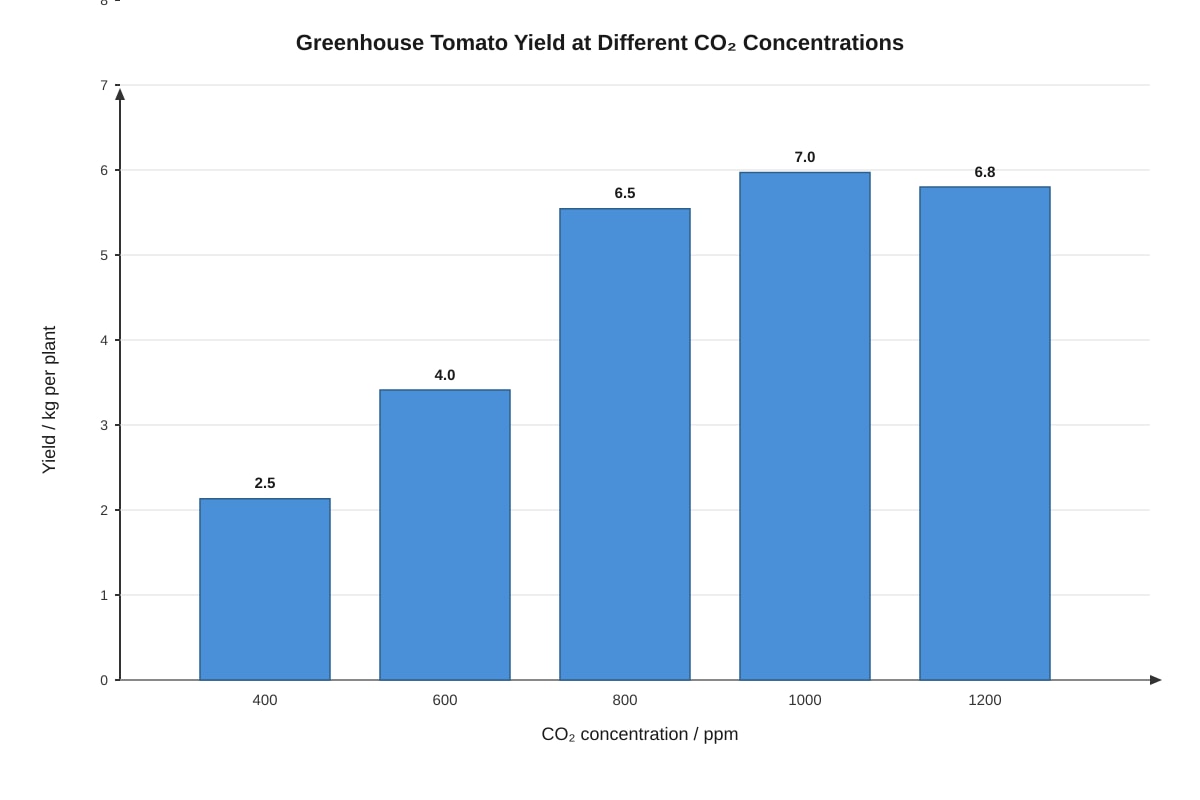
15. (a) 1000 ppm (1 mark)
(b) Below 1000 ppm: Carbon dioxide is a limiting factor for photosynthesis. As CO₂ concentration increases, more substrate is available for rubisco to fix in the Calvin cycle, so the rate of carbohydrate production increases. More sugars mean more resources for fruit development, increasing yield. (1 mark)
At 1000 ppm: The system reaches saturation — other factors become limiting (light intensity, temperature, nutrient availability, or enzyme capacity of the plant's metabolic pathways). (1 mark)
Above 1000 ppm: Yield decreases slightly because very high CO₂ can cause stomatal closure, reducing transpiration and potentially causing heat stress. Additionally, metabolic costs of maintaining high photosynthetic rates, or disruption to gas exchange and pH balance in cells, may reduce efficiency. Alternatively, excessive CO₂ without corresponding increases in other factors creates metabolic imbalance. (1 mark)
16. (a) 45 ÷ 8 = 5.625 times (or approximately 5.6 times or 6 times if rounded) (2 marks: 1 for correct division, 1 for answer with unit)
(b) The data shows a positive correlation between surface area to volume ratio and water loss. Plant X has a higher SA:V ratio (12:1) and loses much more water (45 g/day) than Plant Y (3:1 ratio, 8 g/day). A larger surface area relative to volume means more surface exposed to the atmosphere for transpiration, and typically more stomata per unit volume of tissue, facilitating greater water vapour loss. The spiny reduced leaves of Plant Y minimize surface area, reducing sites for transpiration. (2 marks: 1 for stating correlation, 1 for explaining mechanism)
(c) Any two of: (2 marks)
- Thick cuticle (waxy layer reducing evaporation)
- Sunken stomata in pits (reducing water potential gradient)
- CAM photosynthesis (stomata open at night, closed during day)
- Extensive root system (maximizing water absorption to match any loss)
- Hairy leaves (trapping humid air, reducing transpiration gradient)
17. (a) Xylem vessels are adapted because they are:
- Elongated, hollow tubes with no end walls (cells are dead at maturity), providing an uninterrupted pathway for water flow with minimal resistance (1 mark)
- Lignified walls with pits, providing structural support to withstand the tension/negative pressure generated during transpiration pull, while allowing lateral water movement (1 mark)
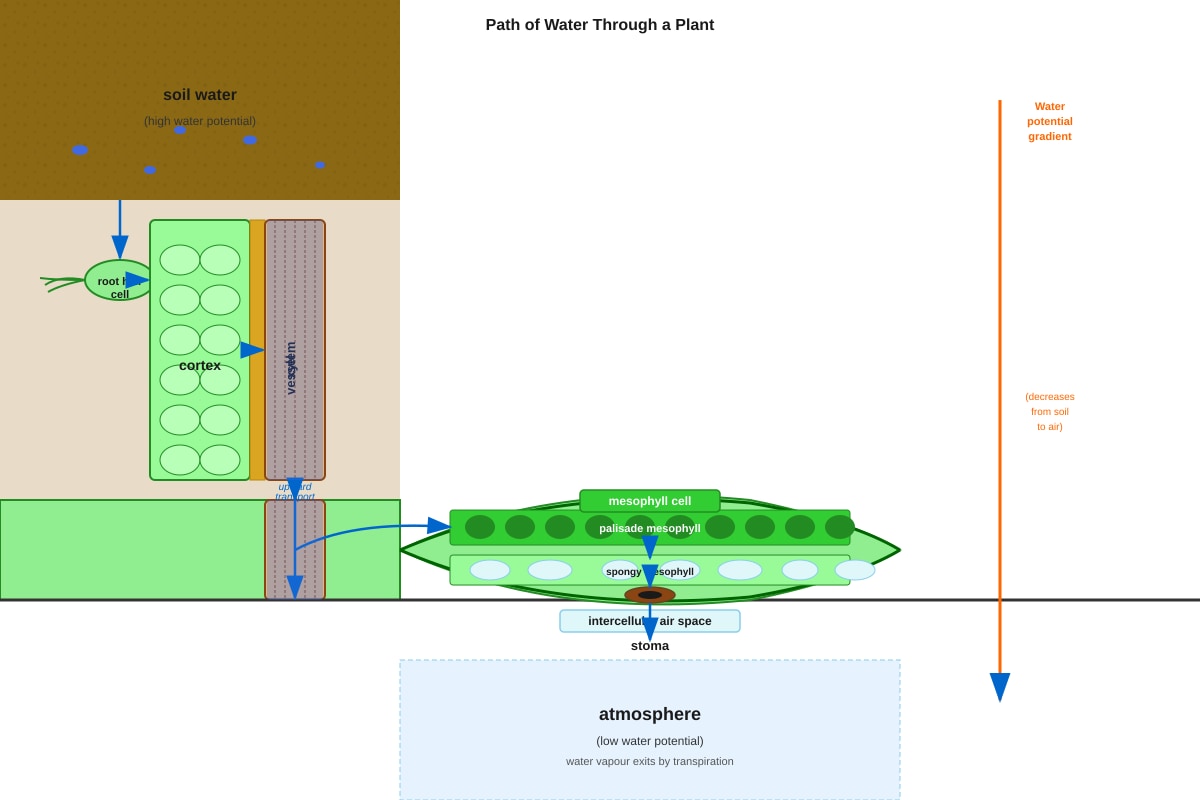
(b) Water moves from xylem to mesophyll by osmosis along a water potential gradient. The xylem has higher water potential (less negative) than mesophyll cells. Mesophyll cells lose water by evaporation into intercellular air spaces, their water potential becomes more negative, drawing water from xylem. Water in intercellular spaces then evaporates into air spaces and diffuses out as water vapour through stomata, maintaining the gradient. (2 marks: 1 for osmosis from xylem to mesophyll, 1 for evaporation/diffusion to air spaces)
(c) On a hot, windy day: Water potential gradient steepens — the air outside has very low relative humidity (hot air holds more water vapour, so vapour pressure deficit increases), and wind removes the humid boundary layer around leaves. This increases transpiration rate.
Effect on water uptake: The increased transpiration pull creates greater tension in the xylem, which increases the rate of water uptake from soil through roots, maintaining the cohesion-tension flow. However, if water loss exceeds uptake, wilting may occur. (2 marks: 1 for describing steeper gradient, 1 for effect on uptake/wilting)
18. (a) The C₄ pathway concentrates CO₂ in bundle-sheath cells, effectively eliminating photorespiration. PEP carboxylase has a much higher affinity for CO₂ than rubisco and does not bind O₂, so even when stomata partially close in hot conditions (to conserve water), CO₂ is still efficiently captured and concentrated around rubisco. This allows continued photosynthesis at high temperatures and light intensities where C₃ plants would lose efficiency. (2 marks: 1 for CO₂ concentration/concentrating mechanism, 1 for PEP carboxylase advantage/reduced photorespiration)
(b) As temperature rises above 30°C:
- Rubisco's affinity for CO₂ decreases relative to O₂ — the enzyme's active site increasingly binds oxygen instead of carbon dioxide
- This initiates photorespiration: oxygenation of RuBP instead of carboxylation, releasing CO₂ without producing ATP or sugars
- The solubility of CO₂ relative to O₂ decreases in the aqueous environment of the chloroplast stroma, further favouring the oxygenase reaction
- Net result: apparent rate of carbon fixation falls as energy is wasted in photorespiratory cycle (2 marks: 1 for increased oxygenation, 1 for explanation of photorespiration/efficiency loss)
19. (a) Cell A = Xylem vessel element / tracheary element. The structure relates to function because:
- Lack of nucleus and organelles at maturity (protoplast digested) creates a hollow, unobstructed tube for water flow (1 mark)
- Lignified walls provide strength to withstand negative pressure during transpiration; pits allow water movement between vessels (1 mark)
(b) Tissue: Phloem. Substance transported: Organic nutrients / sucrose / assimilates. Cell B with chloroplasts but no nucleus at maturity describes a companion cell in some interpretations, but more precisely with chloroplasts and no nucleus at maturity, this matches a sieve tube element with its associated companion cell. The tissue is phloem, transporting sucrose and other organic compounds (amino acids, hormones) from sources to sinks. (2 marks: 1 for tissue, 1 for substance)
(c) Cell C has a large central vacuole containing cell sap, which is characteristic of parenchyma/unspecialised plant cells. This structure makes it unsuitable for water transport in xylem because:
- The vacuole and protoplasm would block the lumen, impeding continuous water flow (1 mark)
- Living protoplasm means end walls/cross walls remain intact, unlike the perforation plates of vessel elements that allow efficient bulk flow. Additionally, the vacuolar membrane and cytoplasm create resistance to water movement compared to the hollow, dead xylem vessels. (1 mark)
20. (a)
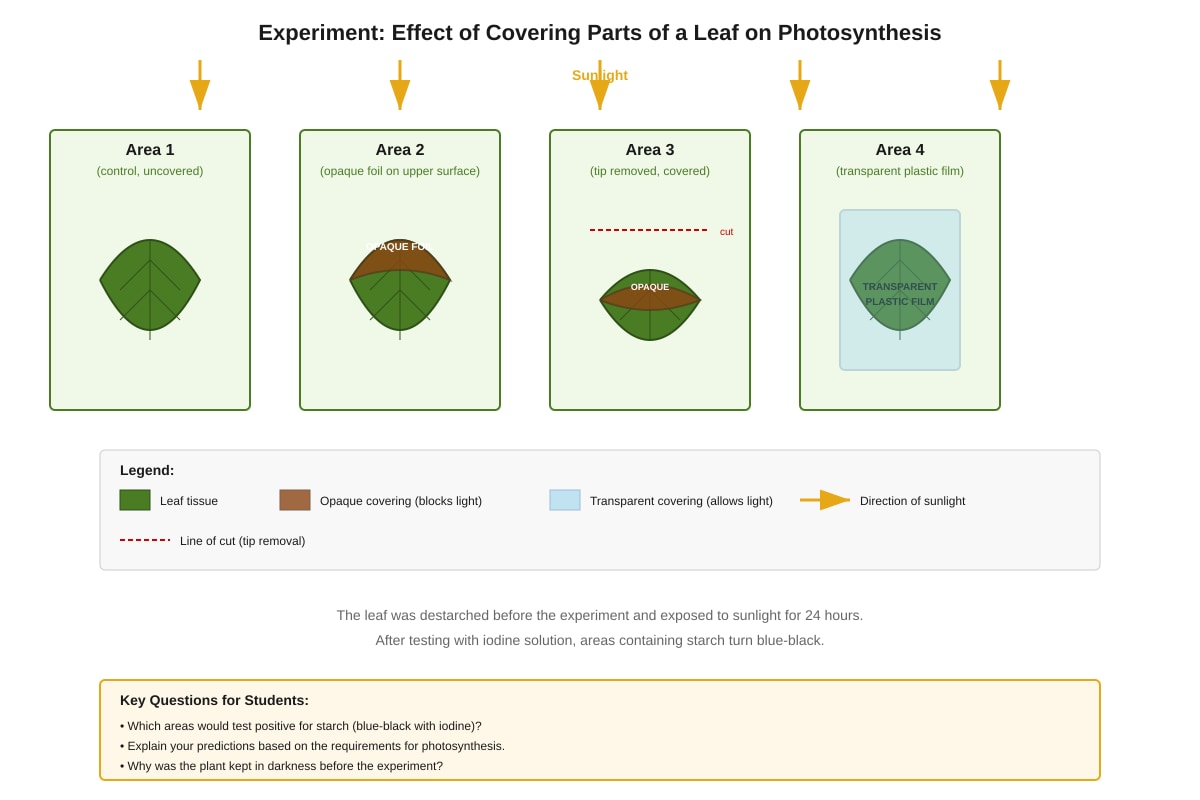
- Area 1 (control, uncovered): POSITIVE — receives full light, photosynthesis produces starch (1 mark)
- Area 2 (opaque foil on upper surface): NEGATIVE — no light reaches chloroplasts; photosynthesis cannot occur; no starch produced (1 mark)
- Area 3 (tip removed, covered): NEGATIVE — no leaf tissue remains to photosynthesize; or if interpreted as remaining tissue is covered, same reasoning as Area 2. The key is the physical absence of leaf tissue or covering prevents light capture. (1 mark)
(b) The destarching period (24 hours in darkness) ensures that:
- Any pre-existing starch in the leaf is used up (respired or converted to sugars and transported away) (1 mark)
- This provides a valid baseline — any starch detected after the experiment can be confidently attributed to photosynthesis during the experimental period, not stored reserves from before. (1 mark)
(c) A variegated leaf has green (chlorophyll-containing) and white/yellow (lacking chlorophyll) areas naturally. After destarching and light exposure:
- Green areas turn blue-black with iodine (positive starch test)
- White areas remain brown/yellow (negative)
Advantage: This eliminates experimental disturbance from applying materials to the leaf surface; it is a natural genetic variation showing the same principle without potential damage to the leaf or altered gas exchange that coverings might cause. It also provides an internal control within the same leaf, matching genetic background perfectly. (2 marks: 1 for describing variegated leaf mechanism, 1 for advantage)
TOTAL: 40 marks