From Real Exams Quiz
Secondary 3 Biology Plant Biology Quiz
Free Sec 3 Biology Plant Biology quiz, HY3 Exam version, with questions, answers, and O Level-style practice for Singapore students.
These static practice materials are generated from the site's syllabus and paper-generation workflow, with source and model context shown so students and parents can evaluate the material before use.
Questions
Free quiz and exam paper access
Enter your details to view this paper
Your access is remembered on this device.
Answers
Secondary 3 Biology Quiz - Plant Biology (Answer Key)
Total Marks: 40
Questions: 20
Section A: Multiple Choice
1. B [1]
Root hair cells are specialised epidermal cells with long extensions that increase surface area for water absorption from soil. Xylem transports water upward but does not absorb from soil. Phloem transports food. Guard cells control stomata.
2. B [1]
Carbon dioxide () is taken in via stomata for photosynthesis. Oxygen is released. Nitrogen is not used directly in photosynthesis.
3. B [1]
Phloem transports sucrose and other assimilates from source (leaf) to sink. Xylem transports water/minerals.
4. B [1]
Palisade mesophyll has the most chloroplasts to capture light for photosynthesis; located near upper surface for maximum light.
5. B [1]
Waxy cuticle is waterproof, reducing transpiration (water loss) from leaf surface.
Section B: Short Answer
6. [2]
- Adaptation: long hair-like projection / large surface area (1 mark)
- Explanation: increases surface area for osmosis of water from soil (1 mark)
Teaching note: Root hair cell extension into soil improves contact; water enters by osmosis down water potential gradient.
7. [2]
- Process: osmosis (1 mark)
- Definition: movement of water molecules from region of higher water potential to lower water potential through a partially permeable membrane (1 mark)
Teaching note: Soil usually has higher water potential than cell sap; membrane = cell membrane.
8. [2]
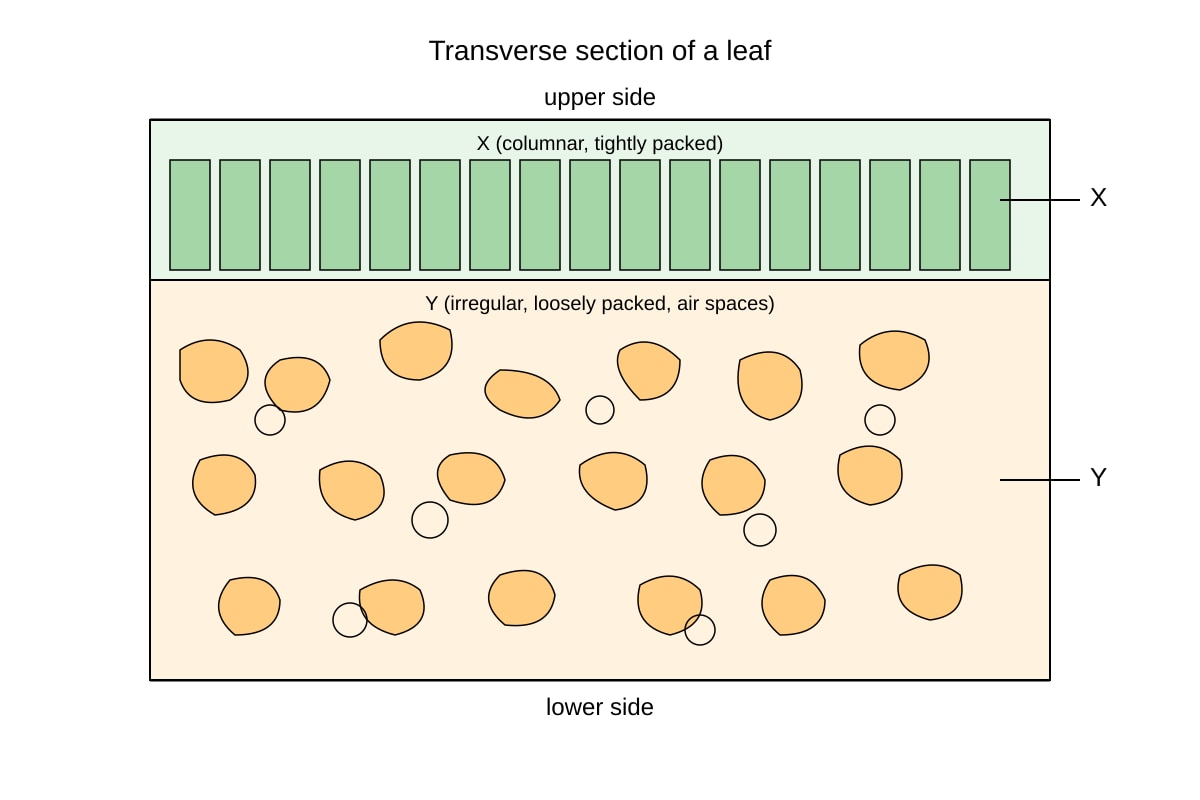
X: Palisade mesophyll cell (1 mark)
Y: Spongy mesophyll cell (1 mark)
Based on diagram: X tightly packed columnar near top; Y loose with air spaces.
9. [2]
- Upper side receives more light (1 mark)
- Palisade has many chloroplasts to absorb maximum light for photosynthesis (1 mark)
10. [2]
Any two:
- Contain chloroplasts (epidermal cells do not) (1)
- Kidney-shaped / unevenly thickened wall (1)
- Can change shape to open/close stoma (1)
[Max 2]
Section C: Data Interpretation
11. [3]
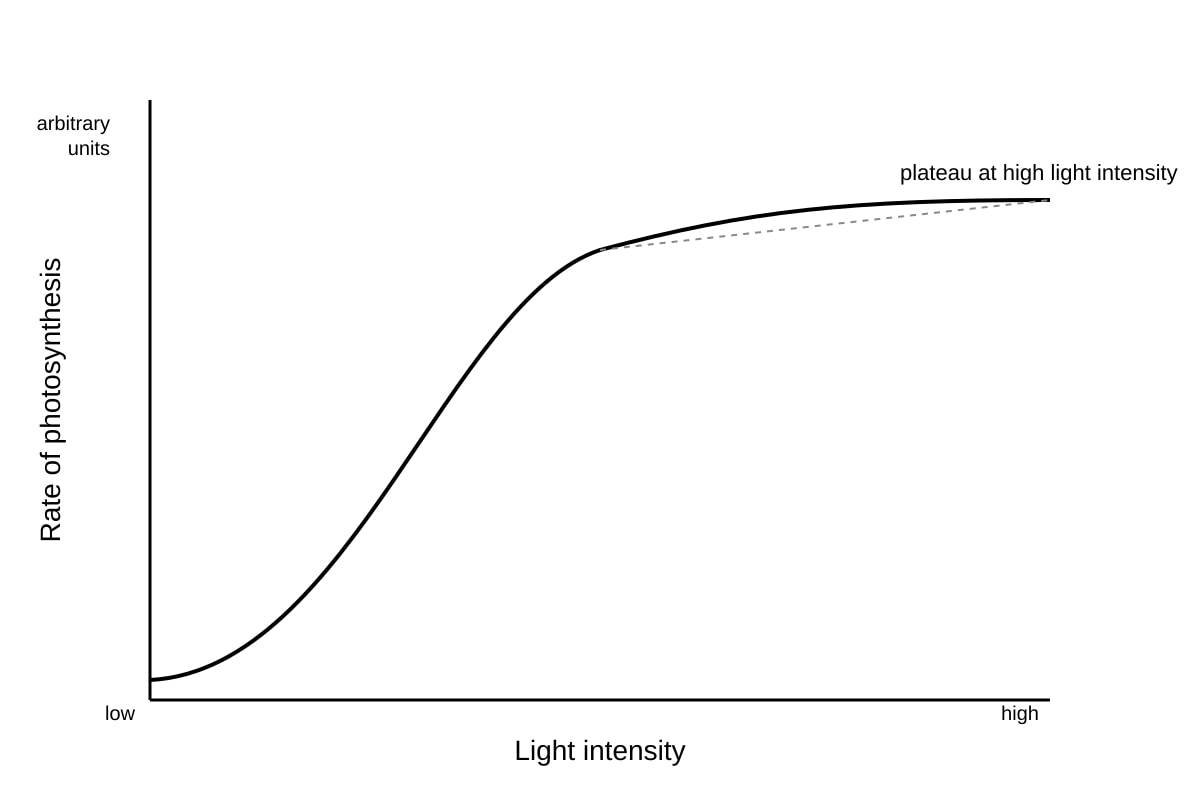
- As light intensity increases, rate of photosynthesis increases (1)
- Increase is steep at low light (1)
- Levels off (plateau) at high light because another factor limits rate, e.g. or temperature (1)
12. [3]
- Cobalt chloride paper blue→pink shows water vapour present (1)
- Plant loses water by transpiration (1)
- Water vapour collected inside sealed bag from leaf surface (1)
13. [3]
Soil → root hair cell (1) → cortex (1) → xylem (1) → leaf
Teaching: Water moves by osmosis then up xylem by transpiration pull.
14. [3]
- Starch made during photosynthesis from glucose (1)
- In dark, no light so no photosynthesis (1)
- No glucose produced, so no starch stored (1)
15. [4]
(a) Xylem: water and mineral salts; Phloem: sucrose/organic food (2)
(b) Xylem: one direction (roots to leaves); Phloem: both directions (source to sink) (2)
16. [4]
- Light needed for photosynthesis (1)
- Covered leaf no light → no starch (1)
- Iodine test: starch + iodine = blue-black (1)
- Uncovered made starch, covered did not (1)
17. [3]
Carbon dioxide + water → glucose + oxygen
(1 mark each for , , glucose + correctly placed)
Teaching: Light and chlorophyll required (not asked but context).
18. [3]
- Stomata open to let in, out (1)
- Open stomata also allow water vapour out (transpiration) (1)
- Guard cells close stomata in drought to reduce water loss (1)
19. [3]
- Chlorophyll is pigment in chloroplasts (1)
- Absorbs light energy (1)
- Converts light energy to chemical energy for photosynthesis (1)
20. [4]
Any two with explanation:
- Increase light intensity → more energy for photosynthesis (2)
- Increase level → more raw material (2)
- Optimal temperature (~25–30°C) → enzymes work best (2)
[Max 4]