From Real Exams Quiz

Secondary 3 Biology Genetics Inheritance Quiz

Free Sec 3 Biology Genetics Inheritance quiz with questions, answers, and O Level-style practice for Singapore students preparing for school assessments.

These static practice materials are generated from the site's syllabus and paper-generation workflow, with source and model context shown so students and parents can evaluate the material before use.

Secondary 3 Biology From Real Exams Generated by Kimi K2.6 Free Updated 2026-06-10

Questions

<!-- TuitionGoWhere generation metadata: stage=3-0; model=moonshotai/kimi-k2.6:free; model_label=Kimi K2.6 Free; generated=2026-06-10; Sources: Stage 2-1 real exam-derived templates and Stage 2-2 exam-enriched syllabus. -->

Secondary 3 Biology Quiz - Genetics Inheritance

Name: _______________________________
Class: ___________
Date: ___________
Score: ______ / 40 marks

Duration: 35 minutes
Total Marks: 40 marks

Instructions: Answer ALL questions. Write your answers in the spaces provided. Show all working for calculation questions.


Section A: Multiple Choice (Questions 1–5)

Choose the correct answer. Each question carries 2 marks.


1. Which of the following is the correct complementary base pairing in DNA?

AAdenine — Thymine; Guanine — Cytosine
BAdenine — Guanine; Thymine — Cytosine
CAdenine — Cytosine; Guanine — Thymine
DAdenine — Uracil; Guanine — Cytosine

Answer: _____________


2. A gene is best defined as:

Aa sequence of amino acids that forms a protein
Ba segment of DNA that codes for a specific protein or functional RNA
Cthe entire set of chromosomes in a cell
Da nitrogenous base attached to a sugar molecule

Answer: _____________


3. In humans, the allele for brown eyes (B) is dominant over the allele for blue eyes (b). If both parents are heterozygous, what is the probability that their first child will have blue eyes?

A0%
B25%
C50%
D75%

Answer: _____________


4. During meiosis, homologous chromosomes separate during:

Ainterphase
Bprophase I
Canaphase I
Danaphase II

Answer: _____________


5. Which process results in genetically identical daughter cells?

Ameiosis I
Bmeiosis II
Cmitosis
Dfertilisation

Answer: _____________


Section B: Short Answer and Structured Response (Questions 6–15)

Answer all questions in the spaces provided. Marks are shown in brackets.


6. Distinguish between a genotype and a phenotype. [2 marks]


7. Explain why it is impossible for two parents with blood group O to have a child with blood group A. [2 marks]


8. Define the term "homozygous recessive" and give an example using the letter 't' for a recessive allele. [2 marks]


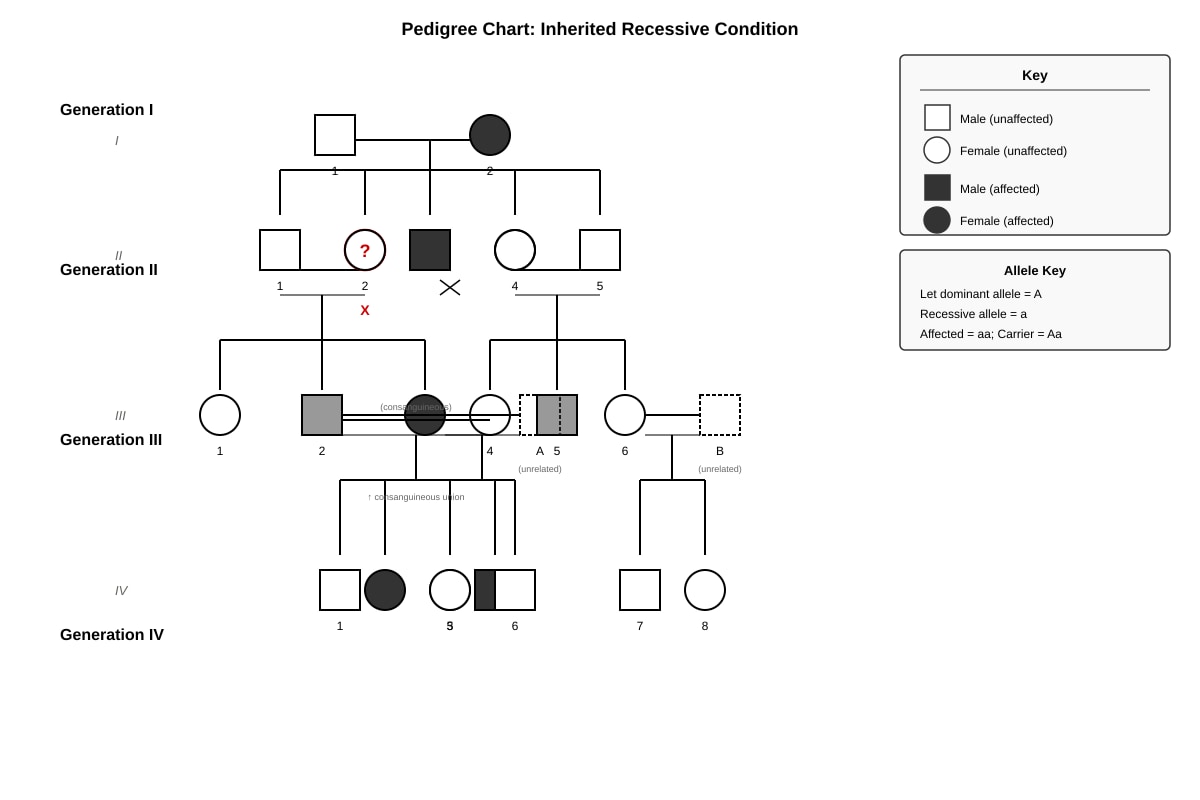
9. The diagram below shows a pedigree chart for a family with an inherited condition caused by a recessive allele.

<image_placeholder> id: Q9-fig1 type: diagram linked_question: Q9 description: Pedigree chart showing four generations of a family with an inherited recessive condition. Squares represent males, circles represent females. Shaded symbols indicate individuals affected by the condition. Generation I shows an unaffected male and affected female; Generation II shows their children including affected and unaffected males and females; Generations III and IV continue the pattern with some individuals having children together. labels: Generation I, II, III, IV; squares (male), circles (female); shaded (affected), unshaded (unaffected); lines showing relationships and offspring values: Specific relationships showing at least one consanguineous marriage in Generation III between two carriers must_show: Clear generational labels, consistent symbol coding, at least 3 affected individuals across generations, carrier relationships implied by affected offspring </image_placeholder>

Using the pedigree chart, explain how you can identify individual X in Generation II as a carrier of the recessive allele, even though they do not show the condition. [3 marks]


10. In garden peas, tall stem (T) is dominant over dwarf stem (t). A true-breeding tall plant is crossed with a dwarf plant.

(a) State the genotypes of both parent plants. [1 mark]

Parent 1 (tall): _____________
Parent 2 (dwarf): _____________

(b) Draw a genetic diagram (Punnett square) to show the possible offspring of this cross. [2 marks]

(c) State the phenotypic ratio of the offspring. [1 mark]


11. The table below shows the results of a genetic cross between two heterozygous guinea pigs for coat colour. Black coat (B) is dominant over white coat (b).

PhenotypeNumber of offspring
Black coat44
White coat16

(a) State the expected phenotypic ratio for this monohybrid cross. [1 mark]


(b) Calculate the expected number of black-coated and white-coated offspring if the total number of offspring was 60. Show your working. [2 marks]


(c) Suggest why the observed results differ from the expected ratio. [1 mark]


12. Explain how the process of crossing over during meiosis increases genetic variation in offspring. [3 marks]


13. A woman who is a carrier for haemophilia (X-linked recessive condition) has a child with a man who does not have haemophilia. The alleles are represented as: X<sup>H</sup> = normal, X<sup>h</sup> = haemophilia.

(a) State the genotypes of both parents. [1 mark]

Woman: _____________
Man: _____________

(b) Complete the genetic diagram to determine the probability of their son having haemophilia. [3 marks]

(c) Explain why males are more likely to show X-linked recessive conditions than females. [2 marks]


14. The karyogram below shows the chromosomes from a human cell.

<image_placeholder> id: Q14-fig1 type: diagram linked_question: Q14 description: Human karyogram showing 23 pairs of homologous chromosomes arranged in descending order of size, with chromosome pairs 1-22 as autosomes and pair 23 showing XX (female). Chromosomes are stained and photographed during metaphase, showing characteristic banding patterns. labels: Chromosome pairs numbered 1-23; sex chromosomes labeled X and X; autosome label; scale bar values: 46 total chromosomes arranged as 23 pairs; pair 23 = XX must_show: Clear homologous pairing, descending size order, visible centromeres, banding patterns, distinct separation of chromosome pairs, labels for autosomes and sex chromosomes </image_placeholder>

(a) State the total number of chromosomes shown in this karyogram. [1 mark]


(b) Determine the sex of the individual. Explain your reasoning. [2 marks]


(c) Explain why a karyogram is prepared using cells arrested in metaphase during mitosis. [2 marks]


15. Codominance occurs when both alleles in a heterozygote are fully expressed in the phenotype. In cattle, red coat colour (C<sup>R</sup>) and white coat colour (C<sup>W</sup>) show codominance. Heterozygous individuals have roan (mixed red and white) coats.

A roan bull is crossed with a red cow.

(a) State the genotypes of both parents. [1 mark]

Bull: _____________
Cow: _____________

(b) What is the expected phenotypic ratio of the offspring? [2 marks]


(c) Explain why this inheritance pattern is described as codominance rather than incomplete dominance. [2 marks]


Section C: Data Interpretation and Extended Response (Questions 16–20)

Answer all questions in the spaces provided.


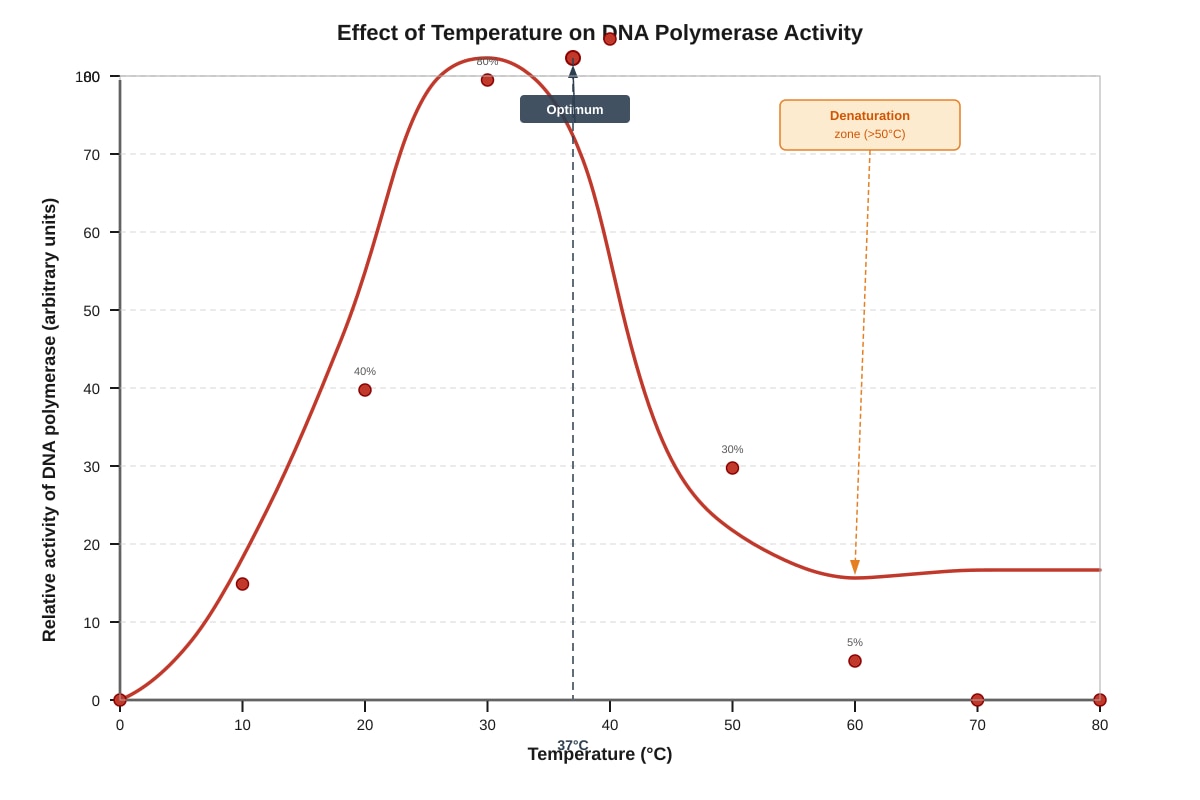
16. The graph below shows the results of an experiment investigating the effect of temperature on the activity of DNA polymerase, an enzyme involved in DNA replication.

<image_placeholder> id: Q16-fig1 type: graph linked_question: Q16 description: Line graph showing enzyme activity (relative rate of DNA synthesis, arbitrary units) on y-axis against temperature (°C) on x-axis from 0°C to 80°C. Curve rises from 0°C to optimum at approximately 37°C, then falls steeply to near zero at 60°C and remains flat to 80°C. labels: X-axis: Temperature (°C), scale 0, 10, 20, 30, 40, 50, 60, 70, 80; Y-axis: Relative activity of DNA polymerase (arbitrary units), scale 0-100 values: Optimum approximately 37°C; activity at 20°C ≈ 40%; activity at 50°C ≈ 30%; activity at 60°C ≈ 5%; activity at 70-80°C ≈ 0% must_show: Clear bell-shaped curve with peak at 37°C, gradual rise, steep decline after optimum, flat line at high temperatures, labeled axes with units, data points or smooth curve </image_placeholder>

(a) State the optimum temperature for DNA polymerase activity in this experiment. [1 mark]


(b) Explain why the enzyme activity decreases significantly at temperatures above 50°C. [2 marks]


(c) Suggest why this temperature optimum is significant for human DNA polymerase. [1 mark]


17. A scientist investigated the inheritance of seed shape and seed colour in pea plants. The table shows the results of a dihybrid cross between two heterozygous plants (RrYy × RrYy), where: R = round seeds (dominant), r = wrinkled seeds (recessive), Y = yellow seeds (dominant), y = green seeds (recessive).

PhenotypeObserved numberExpected ratio
Round, yellow3159
Round, green1083
Wrinkled, yellow1013
Wrinkled, green321
Total55616

(a) Calculate the expected number of round, green seeds if the total offspring is 556. Show your working. [2 marks]


(b) The scientist noticed that some observed numbers differ slightly from expected values. Explain why observed and expected ratios in genetic crosses rarely match exactly. [2 marks]


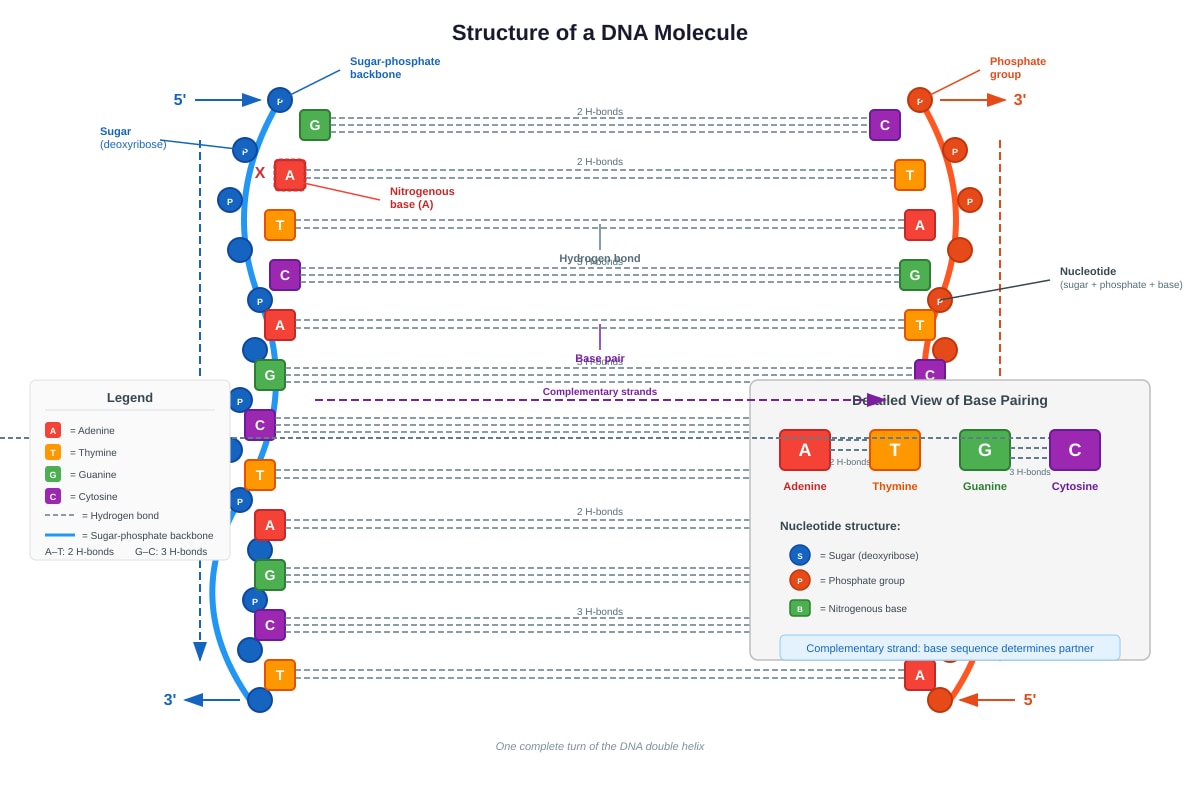
18. The diagram below shows the structure of a DNA molecule.

<image_placeholder> id: Q18-fig1 type: diagram linked_question: Q18 description: Simplified diagram of DNA double helix showing two antiparallel sugar-phosphate backbones with nitrogenous bases paired in the center. Shows one complete turn of the helix with detailed view of base pairing. Includes labels for key structural components. labels: 5' end, 3' end, sugar (deoxyribose), phosphate group, nitrogenous base (A, T, G, C), hydrogen bond, base pair, nucleotide, complementary strand indicator values: A-T pairing with 2 hydrogen bonds; G-C pairing with 3 hydrogen bonds; antiparallel orientation shown by arrow directions 5'→3' and 3'→5' must_show: Double helix structure, antiparallel strands, complementary base pairing, sugar-phosphate backbone location, hydrogen bonds between bases, clear labeling of all components, directionality of strands </image_placeholder>

(a) Identify the nitrogenous base labeled X if its complementary base is adenine. Explain your answer. [2 marks]


(b) Explain why the sequence of bases on one strand of DNA is described as "complementary" to the sequence on the other strand. [2 marks]


(c) A segment of DNA contains 24% adenine bases. Calculate the percentage of guanine bases in this segment. Explain your reasoning. [2 marks]


19. Cystic fibrosis is an inherited condition caused by a recessive allele. The normal allele (F) codes for a functional CFTR protein involved in chloride ion transport. The recessive allele (f) produces a non-functional protein.

(a) Explain how two parents who do not have cystic fibrosis can have a child with the condition. Use a genetic diagram in your answer. [3 marks]


(b) Newborn screening for cystic fibrosis involves testing for elevated levels of immunoreactive trypsinogen (IRT). Explain why early diagnosis through genetic screening is beneficial for individuals with cystic fibrosis, even though there is currently no cure. [2 marks]


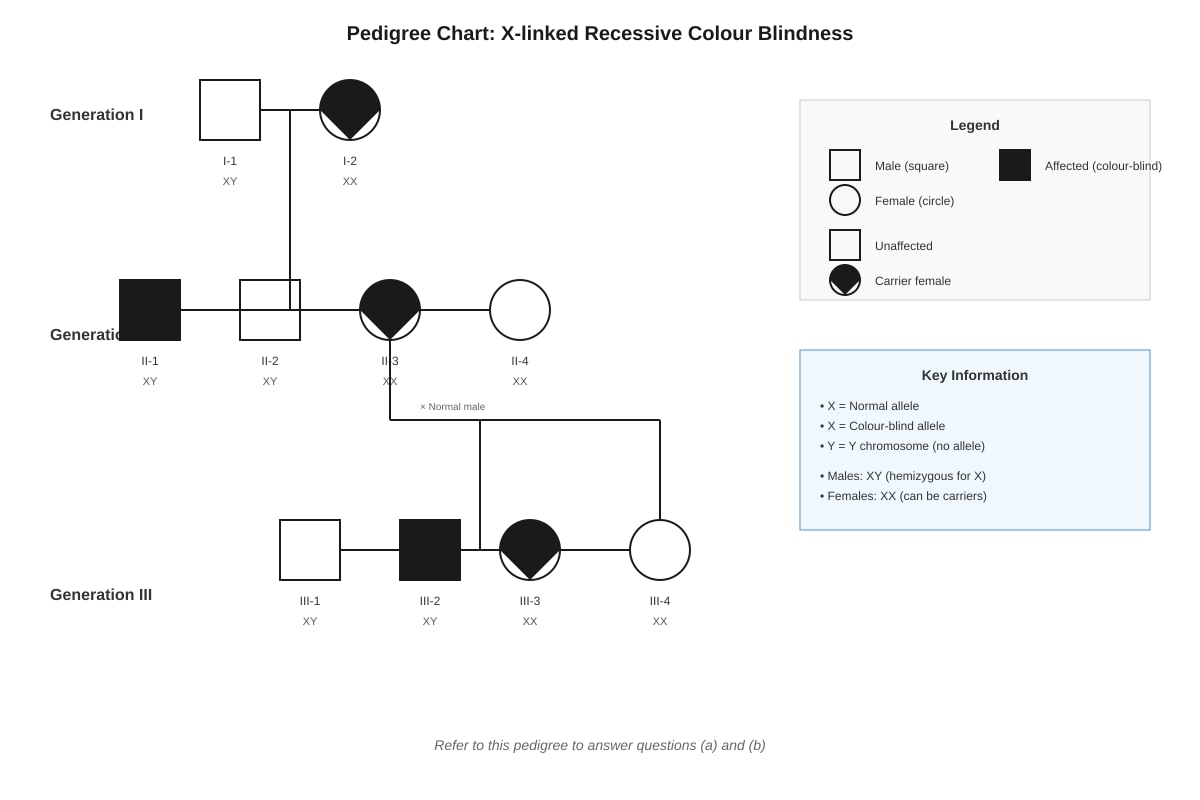
20. Sex-linked inheritance involves genes located on sex chromosomes. The following pedigree chart shows the inheritance of red-green colour blindness, an X-linked recessive condition, in a family.

<image_placeholder> id: Q20-fig1 type: diagram linked_question: Q20 description: Pedigree chart for X-linked recessive colour blindness showing three generations. Generation I: normal male (X^N Y) and carrier female (X^N X^n). Generation II: their children including normal male, colour-blind male, carrier female, and normal female. Generation III: offspring from carrier female and normal male, showing affected and unaffected males and females. labels: Generation I, II, III; squares (male), circles (female); filled symbols (colour-blind), half-filled symbols (carrier female), open symbols (unaffected); sex chromosome genotypes labeled for key individuals: X^N Y, X^N X^n, X^n Y, X^N X^N, etc. values: Specific genotypes shown: I-1 = X^N Y, I-2 = X^N X^n; II-1 = X^n Y (colour-blind), II-2 = X^N Y (normal), II-3 = X^N X^n (carrier), II-4 = X^N X^N (normal) must_show: Clear generational structure, correct symbol coding with partial fill for carriers, sex chromosome notation on key individuals, at least one colour-blind male in Generation II, proper inheritance pattern showing male-biased affected status </image_placeholder>

(a) State the genotype of individual II-1 (the colour-blind male in Generation II). [1 mark]


(b) Individual II-3 is a carrier female. With reference to the pedigree, explain how you can determine that she must be a carrier. [2 marks]


(c) If individual II-3 has a child with a normal male, calculate the probability that their daughter will be a carrier. Show your working using a genetic diagram. [3 marks]


(d) Explain why colour blindness is more common in males than in females in the general population. [2 marks]


END OF QUIZ

Answers

<!-- TuitionGoWhere generation metadata: stage=3-0; model=moonshotai/kimi-k2.6:free; model_label=Kimi K2.6 Free; generated=2026-06-10; Sources: Stage 2-1 real exam-derived templates and Stage 2-2 exam-enriched syllabus. -->

Secondary 3 Biology Quiz - Genetics Inheritance: Answer Key

Total Marks: 40 marks


Section A: Multiple Choice (Questions 1–5)

QuestionAnswerExplanation
1A2 marks — In DNA, adenine always pairs with thymine via two hydrogen bonds, and guanine always pairs with cytosine via three hydrogen bonds. This complementary base pairing is fundamental to DNA structure and replication. The base pairing A-U occurs in RNA, not DNA.
2B2 marks — A gene is a specific segment of DNA that contains the instructions for making a particular protein or functional RNA molecule. Option A describes a polypeptide/protein, not a gene. Option C describes a genome. Option D describes a nucleotide component.
3B2 marks — Both parents are Bb (heterozygous). A Punnett square shows: BB (brown, 25%), Bb (brown, 50%), bb (blue, 25%). The probability of blue eyes (bb) is 25% or 1 in 4.
4C2 marks — During anaphase I of meiosis, homologous chromosomes separate and move to opposite poles. In anaphase II, sister chromatids separate (like mitosis). This separation of homologous pairs is what reduces chromosome number by half.
5C2 marks — Mitosis produces two genetically identical daughter cells with the same chromosome number as the parent cell. Meiosis produces genetically different cells with half the chromosome number. Fertilisation combines gametes and doubles chromosome number.

Section A Total: 10 marks


Section B: Short Answer and Structured Response (Questions 6–15)


6. Genotype refers to the genetic makeup of an organism — the alleles present (e.g., Bb, homozygous dominant). Phenotype refers to the observable physical or biochemical characteristics of an organism (e.g., brown eyes, tall stem). [2 marks — 1 mark for each correct definition]


7. Blood group O has the genotype ii (homozygous recessive). Both parents can only contribute the i allele. Blood group A requires at least one I<sup>A</sup> allele, which neither parent possesses. Therefore, it is genetically impossible for two O parents to produce an A child. [2 marks — 1 mark for explaining parent genotypes, 1 mark for explaining they lack I<sup>A</sup> allele]


8. Homozygous recessive means having two identical recessive alleles for a particular gene. Example: tt — both alleles are the recessive 't' allele, so the recessive phenotype will be expressed. [2 marks — 1 mark for definition, 1 mark for correct example]


9. Individual X in Generation II must be a carrier because: [3 marks]

  • They have an affected parent (in Generation I), so must have inherited one recessive allele [1 mark]
  • They do not show the condition themselves, so must also have a dominant allele [1 mark]
  • They have affected children in Generation III, proving they passed on the recessive allele [1 mark]

Common mistake: Students may think individuals without the condition cannot be carriers. In recessive conditions, carriers are phenotypically normal but can pass on the allele.


10. (a) Parent 1 (tall): TT; Parent 2 (dwarf): tt [1 mark]

(b) Punnett square: [2 marks]

TT
tTtTt
tTtTt

All offspring are Tt (heterozygous tall). One mark for correct parent gametes, one mark for correct offspring genotypes.

(c) All offspring are tall (or 100% tall, or 4 tall: 0 dwarf) [1 mark]


11. (a) Expected ratio: 3 black : 1 white (or 3:1) [1 mark]

(b) Working: [2 marks]

  • Total parts = 3 + 1 = 4
  • Black: 3/4 × 60 = 45
  • White: 1/4 × 60 = 15

(c) Chance/random variation in fertilisation; the observed ratio is close to expected but not exact due to the random nature of which gametes fuse. Large numbers would approach the expected ratio (law of large numbers). [1 mark]


12. During prophase I of meiosis, homologous chromosomes pair up and non-sister chromatids exchange DNA segments at chiasmata. [1 mark] This creates new combinations of alleles on the chromatids. [1 mark] The resulting gametes contain chromosomes with allele combinations different from the parent, increasing genetic variation in offspring. [1 mark]


13. (a) Woman: X<sup>H</sup>X<sup>h</sup>; Man: X<sup>H</sup>Y [1 mark]

(b) Genetic diagram: [3 marks]

X<sup>H</sup>Y
X<sup>H</sup>X<sup>H</sup>X<sup>H</sup> (normal female)X<sup>H</sup>Y (normal male)
X<sup>H</sup>X<sup>H</sup>X<sup>h</sup> (carrier female)X<sup>h</sup>Y (haemophiliac male)

Probability of son with haemophilia = 1/4 or 25% overall, or 50% of sons. One mark for correct gametes, one mark for correct grid, one mark for correct probability.

(c) Males have XY sex chromosomes — they have only one X chromosome. [1 mark] If they inherit the recessive allele on that X, they have no second X with a dominant allele to mask it. Females need two recessive alleles (X<sup>h</sup>X<sup>h</sup>) to show the condition. [1 mark]


14. (a) 46 chromosomes (or 23 pairs) [1 mark]

(b) Female — the sex chromosomes are XX (two X chromosomes). [1 mark] Males would have XY. [1 mark]

(c) In metaphase, chromosomes are maximally condensed and lined up at the cell equator. [1 mark] They are easiest to identify by size, banding pattern, and shape when fully condensed and individually visible. [1 mark]


15. (a) Bull: C<sup>R</sup>C<sup>W</sup>; Cow: C<sup>R</sup>C<sup>R</sup> [1 mark]

(b) Expected phenotypic ratio: 1 roan : 1 red (or 50% roan, 50% red) [2 marks]

Working: C<sup>R</sup>C<sup>W</sup> × C<sup>R</sup>C<sup>R</sup> gives C<sup>R</sup>C<sup>R</sup> (red) and C<sup>R</sup>C<sup>W</sup> (roan) in 1:1 ratio.

(c) In codominance, both alleles are fully and independently expressed in the heterozygote — you see both red AND white hairs distinctly (roan). [1 mark] In incomplete dominance, the heterozygote shows an intermediate blended phenotype (e.g., pink from red and white). [1 mark]


Section C: Data Interpretation and Extended Response (Questions 16–20)


16. (a) 37°C (accept 35–39°C) [1 mark]

(b) Above 50°C, the tertiary structure of the enzyme is disrupted (denaturation). [1 mark] The active site shape is lost, so substrate (nucleotides) can no longer fit and bind effectively. [1 mark]

(c) 37°C is normal human body temperature, so the enzyme is adapted to function optimally at this temperature. [1 mark]


17. (a) Working: [2 marks]

  • Expected ratio for round, green = 3/16
  • Expected number = 3/16 × 556 = 104.25 (accept 104 or 104.3)

(b) Observed ratios differ due to random chance in which gametes fuse during fertilisation. [1 mark] With larger sample sizes, observed ratios approach expected ratios more closely (statistical probability). [1 mark]


18. (a) Thymine (T). [1 mark] Adenine always pairs with thymine via two hydrogen bonds in DNA. [1 mark]

(b) The bases on one strand determine the bases on the other strand due to specific base-pairing rules (A-T, G-C). [1 mark] The sequences are not identical but complementary — where one has A, the other has T, and so on. This enables DNA replication and repair. [1 mark]

(c) If A = 24%, then T = 24% (A-T pairing). [1 mark] Remaining = 100% - 48% = 52%; G = C = 26% each. Guane = 26%. [1 mark]

Check: 24 + 24 + 26 + 26 = 100% ✓


19. (a) Both parents are carriers (Ff) — phenotypically normal but each carries one recessive allele. [1 mark]

Genetic diagram:

Ff
FFF (normal)Ff (carrier)
fFf (carrier)ff (cystic fibrosis)

Probability of affected child = 25% or 1 in 4. [2 marks for complete correct diagram and explanation]

(b) Early diagnosis allows: [2 marks]

  • Early intervention with treatments (chest physiotherapy, enzyme supplements) to slow lung damage [1 mark]
  • Dietary and lifestyle management to improve quality of life and life expectancy; genetic counselling for family planning [1 mark]

20. (a) X<sup>n</sup>Y [1 mark]

(b) II-3 has a colour-blind son (X<sup>n</sup>Y). [1 mark] Males inherit their X chromosome only from their mother, so she must have contributed X<sup>n</sup>. Since she has normal colour vision, she must also carry X<sup>N</sup> — making her X<sup>N</sup>X<sup>n</sup>. [1 mark]

(c) Working: [3 marks]

X<sup>N</sup>Y
X<sup>N</sup>X<sup>N</sup>X<sup>N</sup> (normal female)X<sup>N</sup>Y (normal male)
X<sup>n</sup>X<sup>N</sup>X<sup>n</sup> (carrier female)X<sup>n</sup>Y (colour-blind male)

Probability of daughter being a carrier = 1/2 or 50% (of daughters) or 1/4 (of all children).

One mark for correct parent genotypes, one mark for correct Punnett square, one mark for correct probability.

(d) Males need only one recessive allele (X<sup>n</sup>Y) to show the condition. [1 mark] Females need two recessive alleles (X<sup>n</sup>X<sup>n</sup>), which is much less likely as they must inherit X<sup>n</sup> from both parents. [1 mark]


END OF ANSWER KEY

Grand Total: 40 marks