From Real Exams Quiz
Secondary 3 Biology Genetics Inheritance Quiz
Free Sec 3 Biology Genetics Inheritance quiz, HY3 Exam version, with questions, answers, and O Level-style practice for Singapore students.
These static practice materials are generated from the site's syllabus and paper-generation workflow, with source and model context shown so students and parents can evaluate the material before use.
Questions
Free quiz and exam paper access
Enter your details to view this paper
Your access is remembered on this device.
Answers
Secondary 3 Biology Quiz - Genetics Inheritance (Answer Key)
Total Marks: 40
Duration: 45 minutes
Section A: Multiple Choice
-
A [1]
Teaching note: A gene is a segment of DNA that contains the code for making a specific protein. Chromosomes are made of DNA, not genes themselves; organelles do not store genetic code in that way. -
A [1]
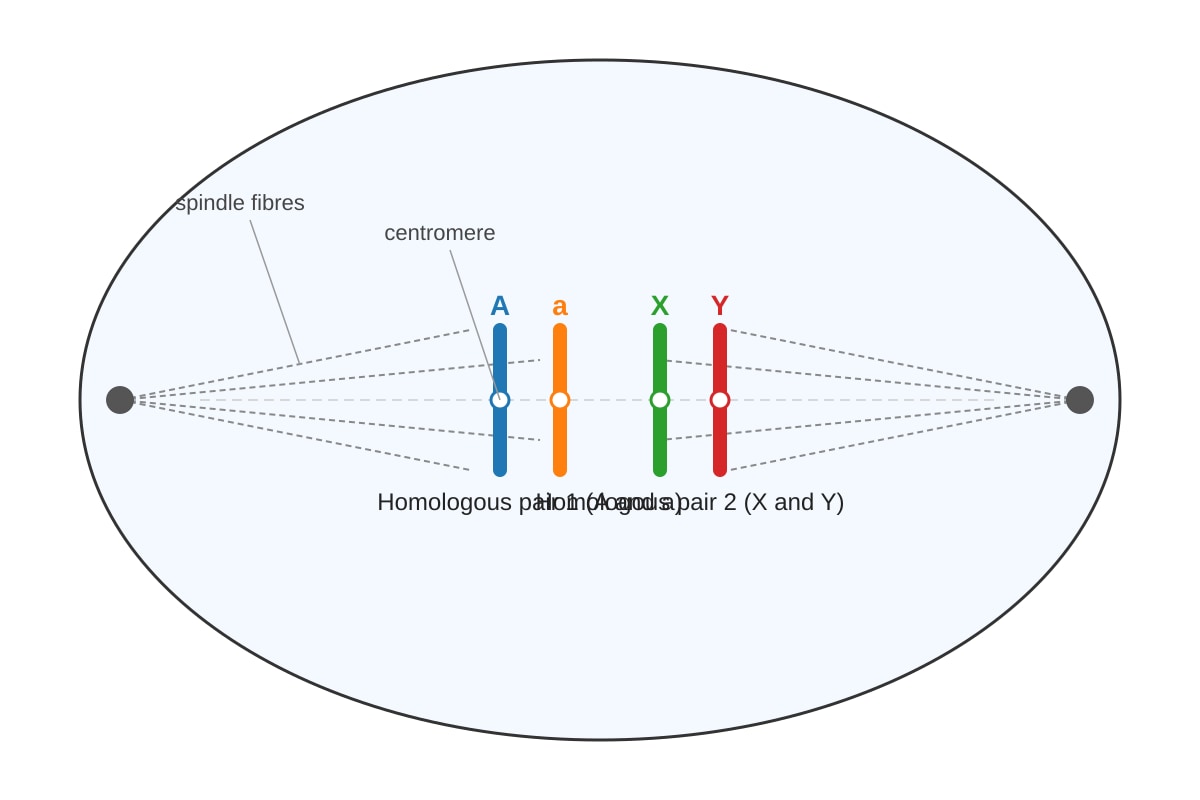
Teaching note: 46 chromosomes exist as 23 pairs of homologous chromosomes (one from each parent). Homologous pairs are matched in size and gene location. -
B [1]
Teaching note: T is dominant over t, so Tt expresses the tall phenotype. Dominant allele masks recessive in heterozygotes. -
C [1]
Teaching note: Mitosis produces two genetically identical diploid cells. Meiosis produces non-identical gametes; fertilisation combines gametes; mutation is a change, not a process of division. -
A [1]
Teaching note: A single base change in a non-coding region may have no effect. It does not always cause disease or cell death, and does not remove chromosomes.
Section B: Structured Questions
-
(a) An allele is a version of a gene (alternative form of a gene at a locus). [1]
(b) A dominant allele is expressed in both homozygous and heterozygous states; a recessive allele is only expressed when homozygous. [1] -
[3]
Parents: Hh × Hh
Gametes: H, h from each
Punnett square:H h H HH Hh h Hh hh Genotypes: 1 HH : 2 Hh : 1 hh Marking: 1 mark for parental genotypes, 1 mark for gametes/cross, 1 mark for correct offspring ratio. -
(a) Meiosis [1]
(b) 23 chromosomes [1]
Note: Meiosis reduces chromosome number by half; from diploid (46) to haploid (23). -
[2]
- Random assortment of homologous chromosomes during meiosis I.
- Fusion of genetically different gametes from two parents.
1 mark each.
-
(a) Bb [1]
(b) Probability = 25% (or 1/4) [2]
Cross: Bb × Bb → 1 BB : 2 Bb : 1 bb; white = bb = 1/4.
Marking: 1 for genotype cross, 1 for correct probability. -
(a) Having two identical alleles for a gene (e.g., AA or aa). [1]
(b) AA or aa [1] -
[2]
Child with group O must be ii (genotype). From IAi × IBi, child receives i from both → ii.
1 mark for genotype ii, 1 mark for reasoning from parents. -
[2]
Human insulin gene inserted into bacterial plasmid; bacterium cultured to produce insulin.
1 mark for method, 1 mark for example organism/product. -
(a) DNA (or chromosome) [1]
(b) Nucleus [1] -
(a) Pp × Pp → PP, Pp, Pp, pp [2]
(b) 3 purple : 1 white [1]
Section C: Extended Response
- [4]
- Meiosis: one DNA replication followed by two divisions (meiosis I and II). [1]
- Produces four haploid gametes. [1]
- Crossing over and independent assortment create new allele combinations. [1]
- Random fertilisation adds further variation. [1]
- [4]
- Man: tt (affected, recessive). Woman: Tt (carrier). [1]
- Cross: tt × Tt → 1/2 Tt (carrier, unaffected), 1/2 tt (affected). [2]
- Probability affected = 50%. [1]
- [4]
- Mitosis: 1 division; meiosis: 2 divisions. [1]
- Mitosis: diploid to diploid; meiosis: diploid to haploid. [1]
- Mitosis: identical daughter cells; meiosis: genetically different. [2]
- [4]
- Beneficial: antibiotic resistance in bacteria → survival. [1+example]
- Harmful: cystic fibrosis mutation → disease. [1+example]
- Neutral: silent mutation in non-coding DNA → no change. [1+example]
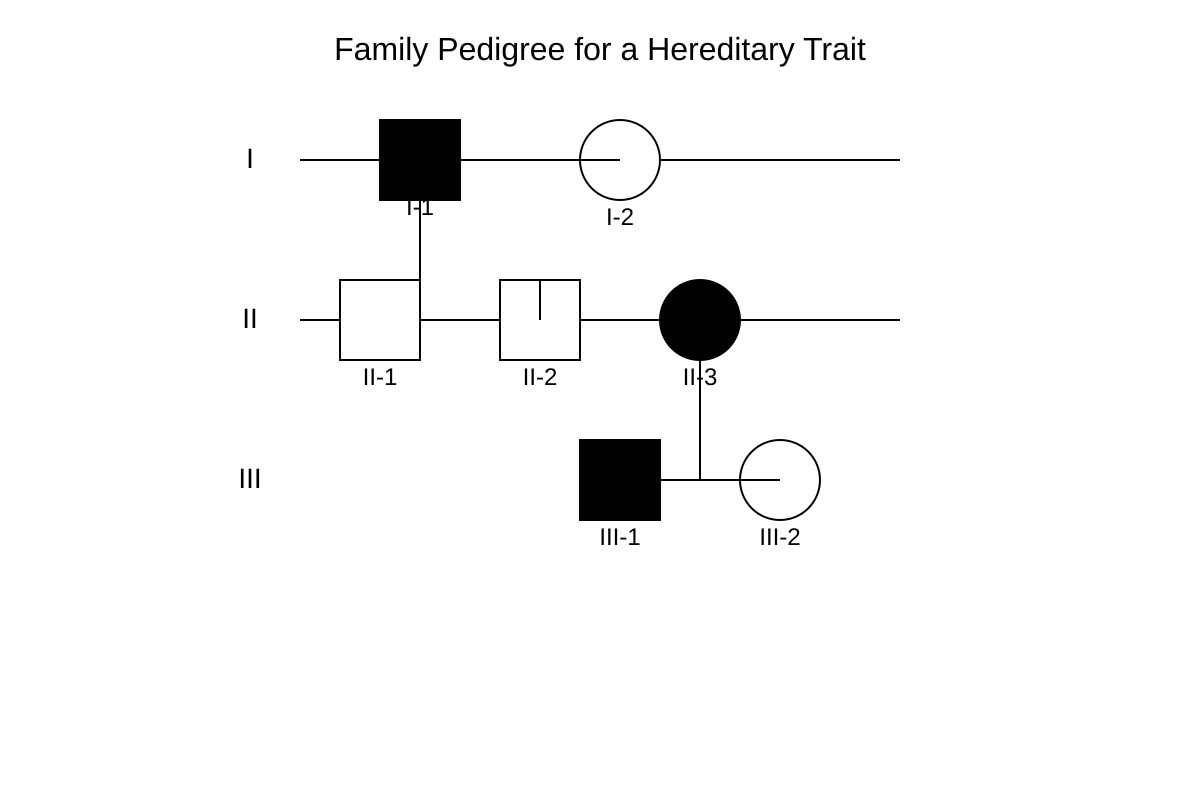
- (a) Recessive [1] because unaffected parents (I-1 affected but I-2 unaffected) have affected child (II-3) only if both carry allele; or affected appears in later generation skipping. [1]
(b) If recessive: II-3 = tt (affected). If dominant: impossible from unaffected parent; but if trait dominant and she affected, Tt or TT. Given chart, recessive fits: tt. [2]