From Real Exams Quiz
Secondary 3 Biology Evolution Diversity Quiz
Free Sec 3 Biology Evolution Diversity quiz, DeepSeek Exam version, with questions, answers, and O Level-style practice for Singapore students.
These static practice materials are generated from the site's syllabus and paper-generation workflow, with source and model context shown so students and parents can evaluate the material before use.
Questions
Free quiz and exam paper access
Enter your details to view this paper
Your access is remembered on this device.
Answers
Secondary 3 Biology Quiz - Evolution Diversity: ANSWER KEY
Total Marks: 40
Section A: Multiple Choice (5 marks)
1. C) They have a high degree of similarity in their DNA sequences. [1 mark] Marking note: DNA similarity is the most direct and reliable molecular evidence for common ancestry. Accept C only.
2. B) They evolved independently as adaptations for flight. [1 mark] Marking note: Analogous structures arise from convergent evolution, not common ancestry. Accept B only.
3. C) Natural selection [1 mark] Marking note: The scenario describes differential survival based on heritable variation in shell colour due to predation pressure. Accept C only.
4. B) Individuals with traits better suited to their environment are more likely to survive and reproduce. [1 mark] Marking note: This is the core definition of natural selection. Accept B only.
5. C) A vestigial structure [1 mark] Marking note: A vestigial structure is a remnant of an organ that had a function in an ancestor but is reduced or functionless in the current organism. Accept C only.
Section B: Structured Questions (25 marks)
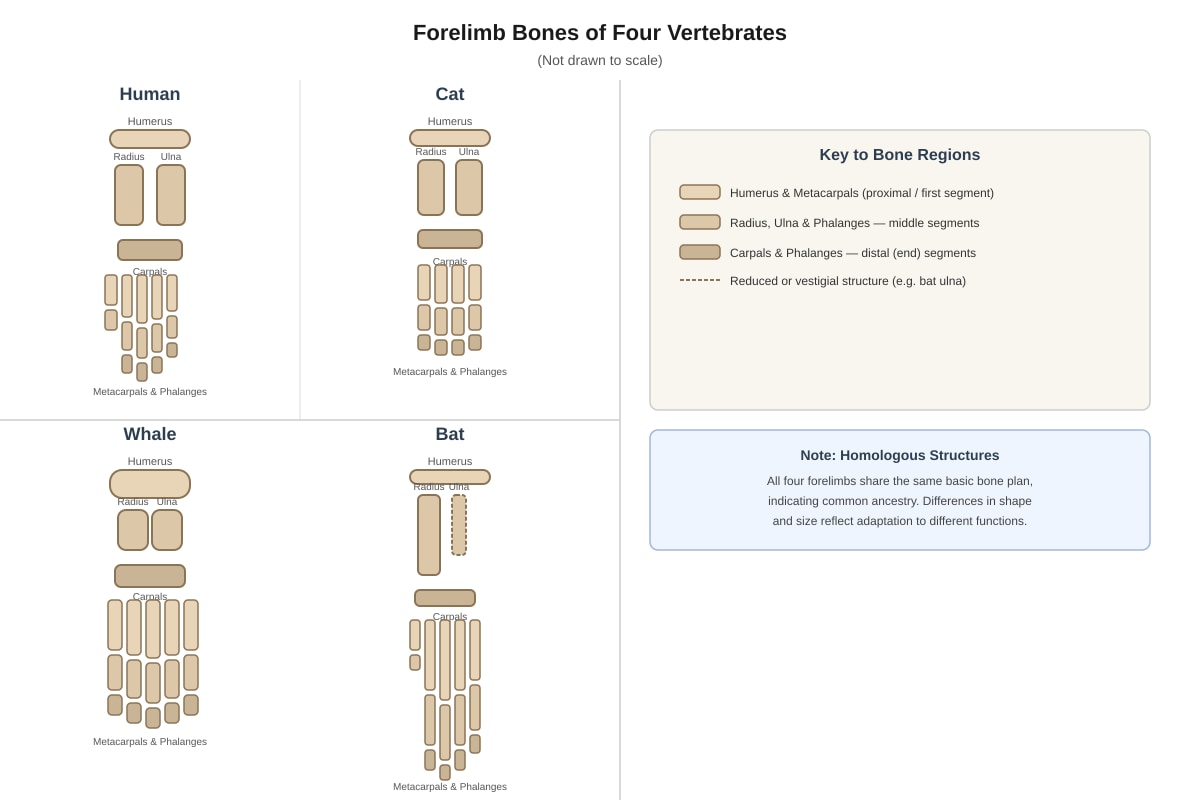
6. (a) Homologous structures. [1 mark] Accept: Structures that share a common basic plan/ancestry.
(b) Award up to 2 marks for:
- The forelimbs have a similar basic bone arrangement/pentadactyl limb structure [1 mark]
- This suggests they evolved from a common ancestor that possessed this basic limb structure [1 mark] Accept: The similarity in structure indicates divergent evolution from a common ancestor; the differences are due to adaptation to different functions/environments.
(c) Award 1 mark for:
- They are adapted for different functions (e.g., grasping in humans, swimming in whales, flying in bats, running in cats) / They live in different environments and have different modes of locomotion. Accept any reasonable explanation linking different functions/environments to different shapes.
7. (a) Award up to 2 marks for:
- Tree trunks were light-coloured/covered with lichen before the Industrial Revolution [1 mark]
- Light-coloured moths were camouflaged against the light tree trunks, making them less visible to predators (birds) [1 mark] Accept: Light moths had higher survival rate because they were better camouflaged.
(b) Award up to 3 marks for:
- Variation existed in the moth population (light and dark forms) [1 mark]
- When tree trunks became darkened by soot, dark moths were better camouflaged and less likely to be eaten by birds / light moths were more visible and more likely to be eaten [1 mark]
- Dark moths survived to reproduce and pass on their alleles/genes for dark colour to offspring; over generations, the proportion of dark moths increased [1 mark] Accept any clear description of the natural selection process: variation → selection pressure → differential survival → reproduction → change in population.
(c) Award 1 mark for:
- Mutation / random change in DNA/gene. Accept: Genetic mutation in the gene controlling wing colour.
8. (a) Award up to 2 marks for:
- Species A and B are most closely related [1 mark]
- They have the lowest percentage difference in DNA (2.5%), indicating the most recent common ancestor [1 mark] Accept: The smaller the DNA difference, the more closely related the species.
(b) Award up to 3 marks for:
- Correct branching order showing A and B as sister groups (branching from the most recent common ancestor) [1 mark]
- C branching off next (sharing a more distant common ancestor with A and B) [1 mark]
- D branching off first (sharing the most distant common ancestor with the other three) [1 mark]
Example acceptable cladogram:
    ┌─── A
  ┌─┤
  │ └─── B
──┤
  │ ┌─── C
  └─┤
    └─── D
Marking note: The order of branching must reflect the DNA difference data. A and B must be closest; D must be the outgroup (most distant). Award marks for correct topology, not artistic quality.
(c) Award up to 2 marks for:
- DNA sequences provide a direct record of evolutionary changes/mutations over time [1 mark]
- Physical characteristics can be influenced by environmental factors/convergent evolution, which may lead to misleading similarities (analogous structures) / DNA is less subject to convergent evolution [1 mark] Accept: DNA analysis is more objective and quantifiable; physical traits can be similar due to similar environments rather than common ancestry.
9. (a) Award up to 3 marks for:
- Genetic variation exists in the bacterial population; some bacteria possess alleles/genes that confer resistance to the antibiotic [1 mark]
- When the antibiotic is applied, it acts as a selection pressure: non-resistant bacteria are killed, while resistant bacteria survive [1 mark]
- Resistant bacteria reproduce and pass on the resistance alleles to their offspring; over generations, the proportion of resistant bacteria in the population increases [1 mark] Accept any clear natural selection explanation applied to antibiotic resistance.
(b) Award up to 2 marks for:
- Stopping early may leave some bacteria alive (especially those with partial resistance) [1 mark]
- These surviving bacteria can reproduce and the infection may return, and the bacteria may be more resistant to the antibiotic in future [1 mark] Accept: Completing the course ensures all bacteria are killed, reducing the chance of resistance developing.
10. (a) Award up to 3 marks for:
- The ancestral finch population showed variation in beak size and shape [1 mark]
- On different islands, different food sources were available; finches with beak shapes best suited to the available food had higher survival and reproductive success [1 mark]
- Over many generations, natural selection led to the divergence of the population into different species with distinct beak shapes adapted to specific food sources (adaptive radiation) [1 mark] Accept: Geographic isolation of populations on different islands, followed by natural selection acting on beak variation in response to different food sources.
Section C: Data-Based Question (10 marks)
11. (a) Award up to 2 marks for:
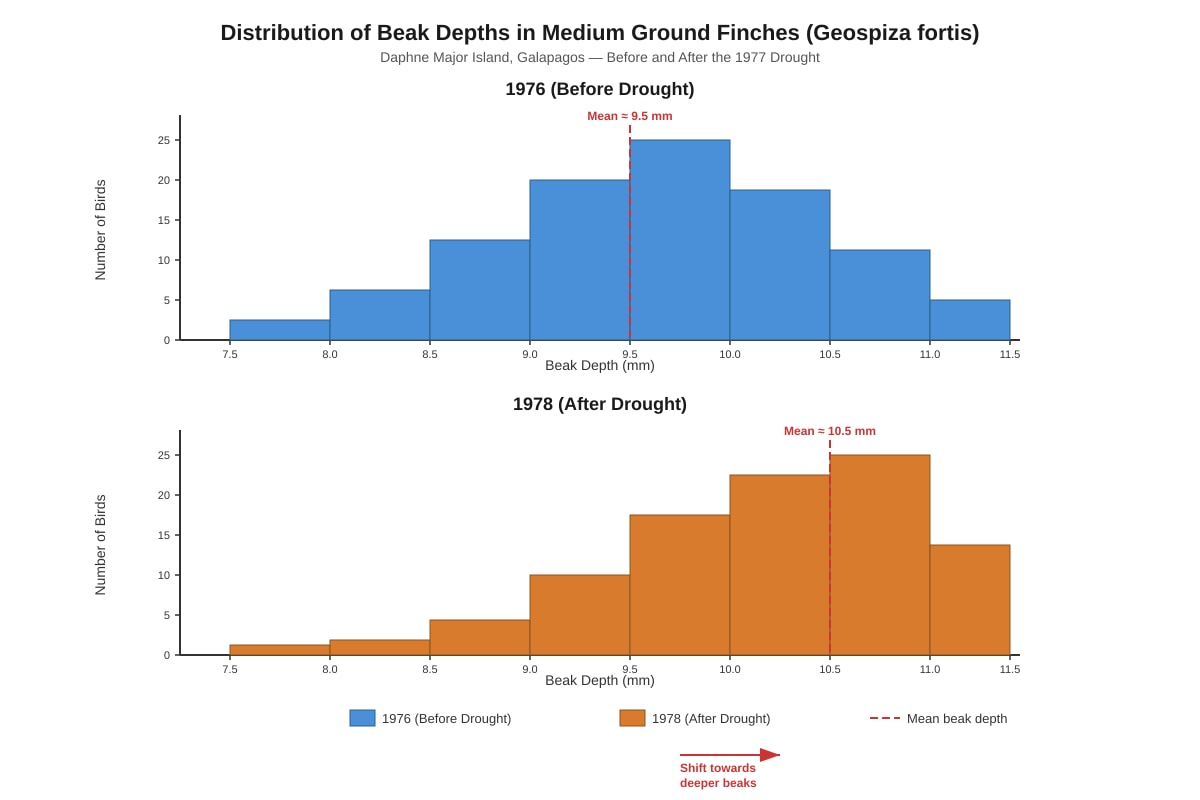
- The distribution shifted to the right / towards deeper beaks [1 mark]
- The mean/peak beak depth increased from approximately 9.5 mm to 10.5 mm / fewer birds with shallow beaks (below 9.0 mm) survived [1 mark] Accept any accurate description of the shift in the histogram.
(b) Award up to 3 marks for:
- The drought caused a shortage of small seeds; only large, hard seeds were available [1 mark]
- Finches with deeper beaks could crack open the large, hard seeds and obtain food [1 mark]
- Finches with shallower beaks could not feed effectively and died; deeper-beaked finches survived and reproduced, passing on their alleles for deep beaks [1 mark] Accept: The drought changed the food availability, favouring finches with deep beaks (directional selection).
(c) Award up to 3 marks for:
- The beak depth distribution would likely shift back towards shallower beaks / the mean beak depth would decrease [1 mark]
- An abundance of small, soft seeds would favour finches with smaller/shallower beaks, as they may be more efficient at handling small seeds [1 mark]
- Finches with smaller beaks would have higher survival and reproductive success, increasing the frequency of alleles for smaller beaks in the population [1 mark] Accept any reasonable prediction with explanation based on natural selection principles. Award marks for linking the change in food availability to a change in selection pressure and predicted evolutionary response.
(d) Award up to 2 marks for:
- There was variation in beak depth in the population; some individuals had deep enough beaks to survive [1 mark]
- These survivors reproduced and maintained the population / the population had sufficient genetic diversity to allow some individuals to survive the changed conditions [1 mark] Accept: Not all finches died; the survivors passed on their genes for deeper beaks, allowing the population to recover.
Section D: Application and Analysis (10 marks)
12. Award up to 3 marks for:
- Natural selection is the process whereby organisms better adapted to their environment tend to survive and produce more offspring [1 mark]
- Condition 1: There must be variation in traits within a population [1 mark]
- Condition 2: The variation must be heritable / There must be differential survival and reproduction based on the traits / There must be a selection pressure [1 mark] Accept any two valid conditions. Award marks for accurate definition and conditions.
13. Award up to 2 marks for:
- The fossil record shows a chronological sequence of organisms, with simpler forms in older rocks and more complex forms in younger rocks [1 mark]
- It shows transitional forms/intermediate species that link different groups, indicating gradual change over time [1 mark] Accept: Fossils show that organisms have changed over time; extinct species are found that are different from modern species.
14. Award up to 2 marks for:
- Low genetic variation means the population has less ability to adapt to environmental changes/new diseases [1 mark]
- If a new disease or environmental change occurs, there may be few or no individuals with resistant/adaptive alleles, leading to possible extinction [1 mark] Accept: Reduced evolutionary potential; inbreeding depression; accumulation of harmful recessive alleles.
15. Award up to 3 marks for:
- Variation existed in the insect population; some insects possessed alleles/genes that conferred resistance to the pesticide [1 mark]
- When the pesticide was applied, it killed susceptible insects, but resistant insects survived (selection pressure) [1 mark]
- Resistant insects reproduced and passed on resistance alleles to offspring; over generations, the frequency of resistance alleles increased, making the pesticide less effective [1 mark] Accept any clear natural selection explanation applied to pesticide resistance.
16. Award up to 2 marks for:
- Homologous structures share a common ancestral origin but may have different functions (e.g., forelimbs of vertebrates) [1 mark]
- Analogous structures have similar functions but different ancestral origins/evolved independently (e.g., wings of birds and insects) [1 mark] Accept any valid examples. Award 1 mark for each correct distinction with example.
17. Award up to 2 marks for:
- Humans and chimpanzees share a common ancestor; they did not evolve directly from one another [1 mark]
- Both lineages evolved separately from that common ancestor millions of years ago [1 mark] Accept: The evolutionary relationship is like a branching tree, not a linear chain.
18. Award up to 3 marks for:
- A population becomes separated by a geographic barrier (e.g., mountain, river, ocean) [1 mark]
- The separated populations experience different environmental conditions/selection pressures and accumulate different mutations [1 mark]
- Over many generations, the populations diverge genetically to the point where they can no longer interbreed to produce fertile offspring, forming new species [1 mark] Accept any clear description of allopatric speciation.
19. Award up to 2 marks for:
- Homologous structures share a common ancestral origin but have evolved different shapes and functions due to adaptation to different environments/ways of life [1 mark]
- The penguin wing adapted for swimming in water, while the eagle wing adapted for flying in air; both evolved from the forelimb of a common ancestor [1 mark] Accept: Divergent evolution leads to homologous structures with different functions.
20. Award up to 2 marks for:
- Compare DNA sequences / genetic analysis of the island lizard and mainland lizards [1 mark]
- Compare physical characteristics/morphology / Compare anatomical structures / Look for homologous structures [1 mark] Accept: Any two valid types of evidence (molecular, morphological, fossil, embryological). Award 1 mark per suggestion.