From Real Exams Quiz
Secondary 3 Biology Cells Biomolecules Quiz
Free Sec 3 Biology Cells Biomolecules quiz, HY3 Exam version, with questions, answers, and O Level-style practice for Singapore students.
These static practice materials are generated from the site's syllabus and paper-generation workflow, with source and model context shown so students and parents can evaluate the material before use.
Questions
Free quiz and exam paper access
Enter your details to view this paper
Your access is remembered on this device.
Answers
Secondary 3 Biology Quiz - Cells Biomolecules: Answer Key
Total Marks: 40
Topic: Cells Biomolecules
Section A: Multiple Choice
-
B) Rough endoplasmic reticulum [1]
Teaching note: Radioactive amino acids are used to build proteins. Protein synthesis starts at ribosomes on the rough ER (RER). The RER is the first site to show radioactivity, not the nucleus (which directs but does not assemble proteins) or Golgi (which modifies later). -
A) Cell → tissue → organ → organ system → organism [1]
Teaching note: Living things are organised hierarchically. Similar cells form tissues; tissues form organs; organs work in systems; systems make up the organism. -
C) Starch test [1]
Teaching note: Iodine solution turns blue-black in presence of starch. Benedict’s tests for reducing sugars, biuret for protein, ethanol for fats. -
B) Provide more space for haemoglobin [1]
Teaching note: Mature red blood cells lose their nucleus to maximise room for haemoglobin, the oxygen-carrying pigment. -
B) Maltose [1]
Teaching note: Amylase hydrolyses starch (a polysaccharide) into maltose (a disaccharide). Further enzymes break maltose to glucose.
Section B: Short Structured
-
Energy source / quick energy supply [1]
Teaching note: Carbohydrates are broken down during respiration to release energy. -
Mitochondrion (mitochondria) [1]
Teaching note: Mitochondria are the sites of aerobic respiration where ATP is produced. -
(a) Diffusion is the net movement of particles from a region of higher concentration to a region of lower concentration. [1]
(b) Oxygen moving from alveoli into blood capillaries / carbon dioxide leaving blood into alveoli [1]
Teaching note: Must mention movement down concentration gradient without energy. -
Vacuole shrinks (plasmolysis); water leaves cell by osmosis [2]
Marking: 1 mark for shrink/plasmolysis, 1 mark for reason (osmosis out to concentrated solution).
Teaching note: High external solute → lower water potential outside → water leaves via osmosis. -
Enzyme has active site complementary to substrate; substrate fits like key into lock; forms enzyme-substrate complex [2]
Marking: 1 mark shape specificity, 1 mark complex formation. -
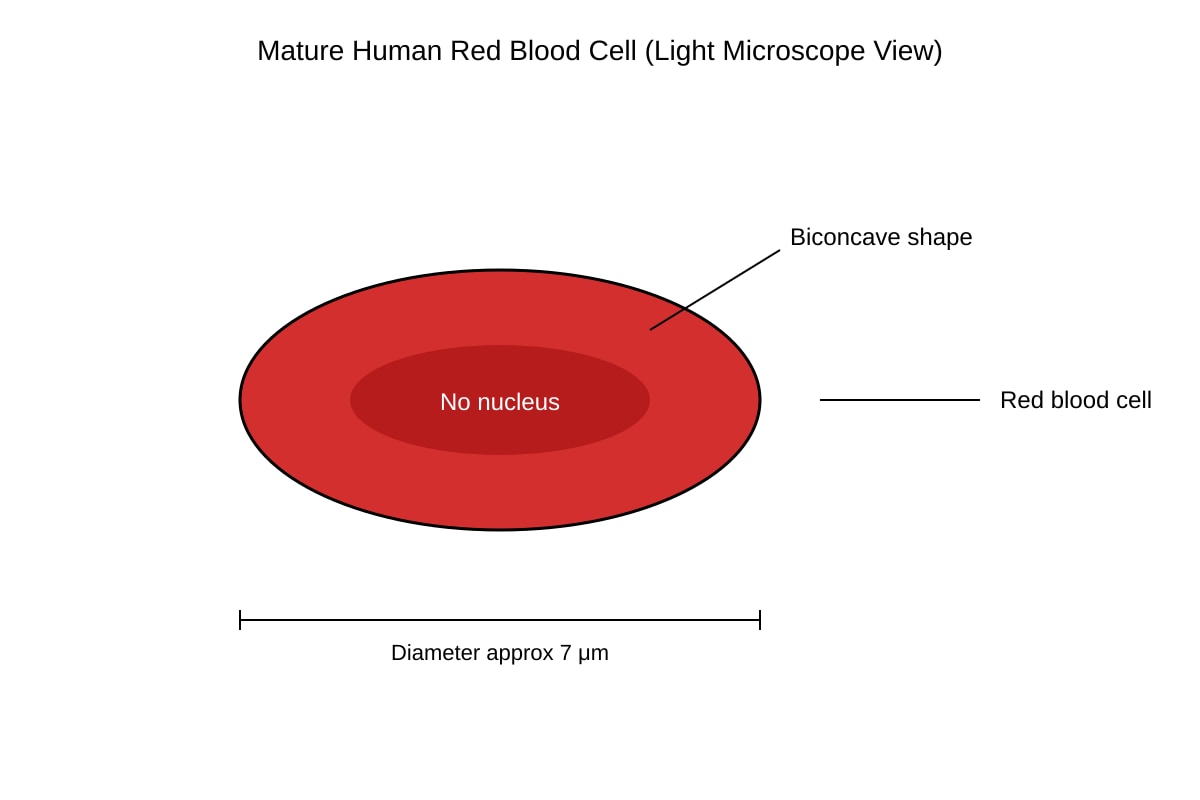
Cell type: Red blood cell [1]; Adaptation: Biconcave shape (increases surface area) / no nucleus [1]
Teaching note: Image shows biconcave disc without nucleus. Biconcave shape increases SA for gas exchange. -
[3]
- Starch: Blue-black [1]
- Protein reagent: Biuret solution [1]
- Reducing sugar reagent: Benedict’s solution, colour: Brick-red (on heating) [1]
-
Active transport moves substances against concentration gradient using ATP; diffusion is down gradient and needs no energy [2]
Marking: 1 mark each point. -
Process: Active transport [1]; Reason: Mineral ions often in lower concentration in soil than root cells, so must be pumped against gradient [1]
-
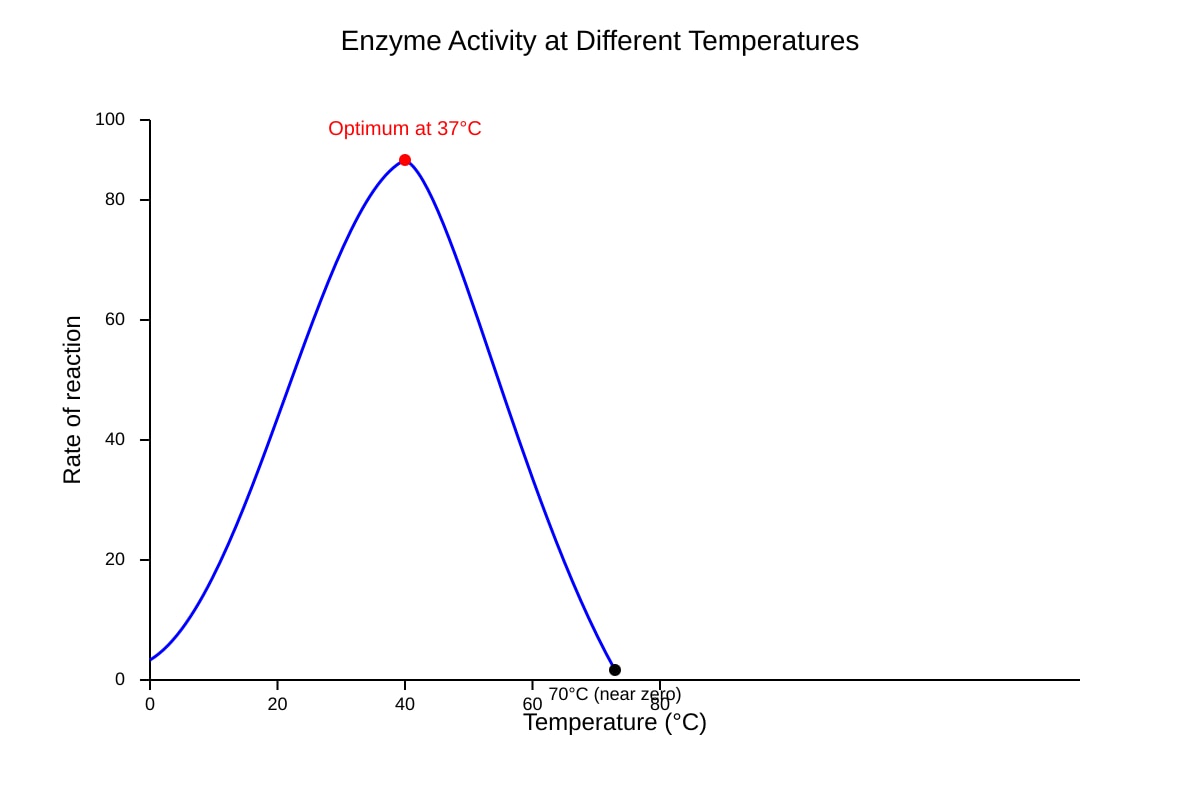
Optimum: 37°C [1]; Explanation: Above optimum, enzyme denatures (protein shape lost), active site destroyed, rate falls [1]
Section C: Extended Response
- [6]
Mark breakdown: 3 adaptations + explanations for each cell (1 mark each pair).
- Red blood cell: Function transport O₂. No nucleus → more haemoglobin space. Biconcave → increased SA. No organelles → streamlined. [3]
- Root hair cell: Function absorb water/minerals. Long hair → increased SA. Thin wall → short diffusion path. Vacuole → maintains gradient. [3]
- [4]
- Glucose enters cell by transport. [1]
- Taken to mitochondria for respiration. [1]
- Mitochondria break glucose to release ATP (radioactivity in CO₂/H₂O or intermediates). [1]
- Shows mitochondria are site of glucose utilisation. [1]
-
[4]
Differences: (1) Plant has cell wall, animal does not. (2) Plant has chloroplasts, animal none. (3) Plant has large central vacuole, animal small/no. (4) Animal has centrioles, plant none. [1 each, any 3+] -
[5]
- Enzymes are proteins with specific 3D shape. [1]
- Rise in temp increases kinetic energy, more collisions, faster rate up to optimum. [1]
- At optimum (≈37°C human), max rate. [1]
- High temp breaks H-bonds, denaturation, active site lost. [1]
- Beyond optimum, reaction stops. [1]
- [4]
- Boil leaf in water to kill, then ethanol to remove chlorophyll. [1]
- Rinse, add iodine. [1]
- Blue-black colour shows starch present (photosynthesis occurred). [1]
- Expected: leaf exposed to light tests positive. [1]