AI Generated Exam Paper
Secondary 3 Biology Practice Paper 5
Free Sec 3 Biology Practice Paper 5, HY3 AI version, with questions, answers, and O Level-style practice for Singapore students.
These static practice materials are generated from the site's syllabus and paper-generation workflow, with source and model context shown so students and parents can evaluate the material before use.
Questions
Free quiz and exam paper access
Enter your details to view this paper
Your access is remembered on this device.
Answers
TuitionGoWhere Practice Paper - Biology Secondary 3 (Answers)
Version: 5
Topic: Cells & Biomolecules
Total Marks: 40
Section A: Multiple Choice (8 marks)
1. B) Ribosome [1]
Teaching note: Ribosomes are the sites where proteins are made (protein synthesis). Mitochondria release energy, vacuoles store substances, nucleus controls the cell.
2. B) carbon [1]
Teaching note: Carbohydrates, fats, and proteins all contain carbon, hydrogen, and oxygen. Proteins also contain nitrogen; carbon is the common element in all three groups.
3. C) osmosis [1]
Teaching note: Osmosis is the movement of water from a dilute to a concentrated solution through a membrane. The cell loses water and shrinks (plasmolysis).
4. C) Starch test [1]
Teaching note: Iodine solution turns blue-black with starch. Benedict’s tests for reducing sugar, biuret for protein, ethanol for fat.
5. B) the substrate fitting into the active site of the enzyme [1]
Teaching note: Lock-and-key model: substrate fits exactly into the enzyme’s active site, like a key into a lock.
6. B) allow more space for haemoglobin [1]
Teaching note: No nucleus means more room for haemoglobin to carry oxygen.
7. C) Active transport of mineral ions into a root hair cell [1]
Teaching note: Active transport needs energy (ATP) to move ions against a gradient. Diffusion and osmosis are passive and need no energy.
8. C) glucose units [1]
Teaching note: Starch is a polysaccharide made of many glucose monomers joined together.
Section B: Structured Questions (16 marks)
9. Chloroplast [1]
Teaching note: Chloroplasts contain chlorophyll and are the site of photosynthesis in plant cells.
10. Controls what enters and leaves the cell (or maintains internal environment). [1]
Teaching note: The cell membrane is selectively permeable.
11. (a) Diffusion is the net movement of particles from a region of higher concentration to a region of lower concentration. [2]
(b) Oxygen moving from the alveolus into the blood / carbon dioxide leaving a cell. [1]
Teaching note: Definition must include movement down a concentration gradient without energy.
12. [3]
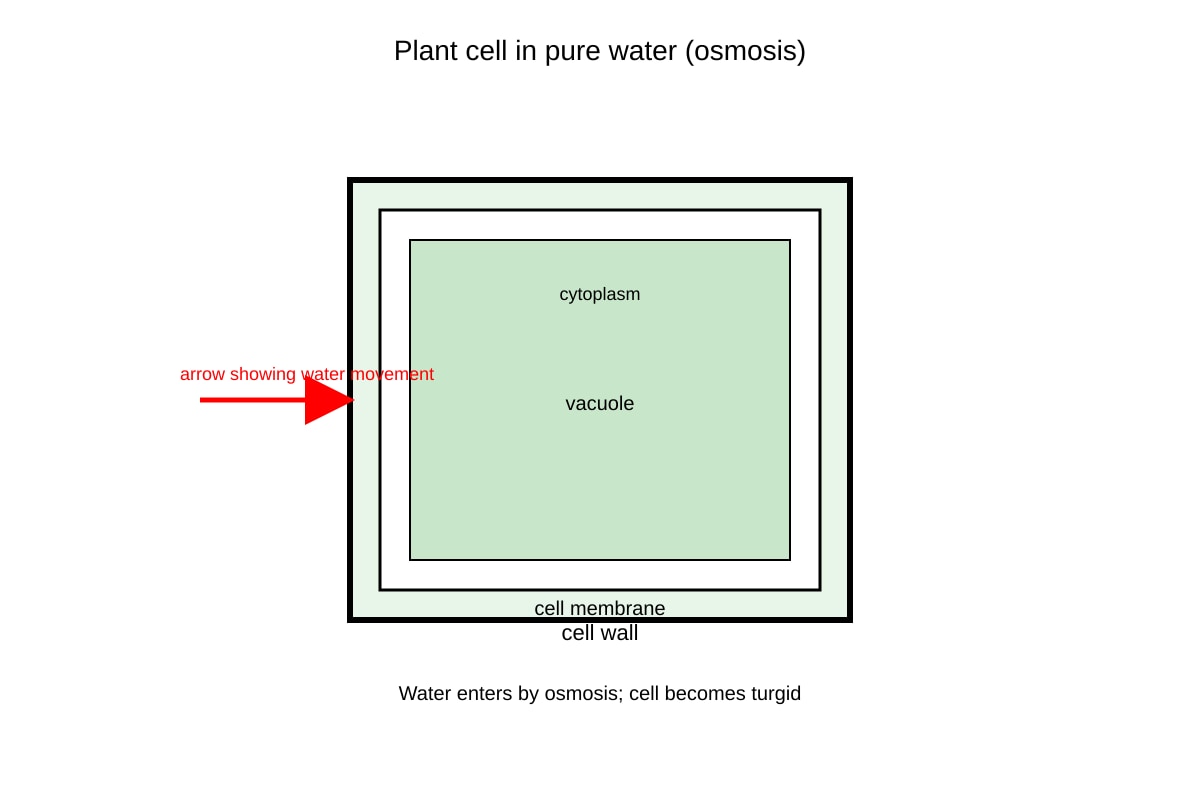
- Water enters by osmosis because the cell sap is more concentrated than pure water. [1]
- The vacuole swells and pushes the membrane against the wall. [1]
- The cell becomes turgid (firm). [1]
Teaching note: From the diagram, arrow shows water entering; the rigid wall prevents bursting.
13. (a) Reducing sugar. [1]
(b) Biuret test. [1]
Teaching note: Orange-red with Benedict’s after heating indicates reducing sugar. Biuret (blue to purple) confirms protein.
14. (a) pH 7. [1]
(b) At pH 11 the enzyme is denatured because the high pH changes the shape of the active site so the substrate no longer fits. [2]
Teaching note: Rate falls as enzyme structure is altered; 2 marks for linking pH to denaturation and loss of function.
15. (i) Osmosis needs no energy; active transport needs energy (ATP). [1]
(ii) Osmosis moves water down its gradient; active transport moves substances against their gradient. [1]
Teaching note: 1 mark each clear contrast.
Section C: Extended Response (16 marks)
16. [4]
- Long projection increases surface area for absorption. [1]
- Thin wall shortens diffusion distance. [1]
- Large vacuole for water uptake by osmosis. [1]
- Mitochondria provide energy for active transport of ions. [1]
Teaching note: Adaptations must link structure to function for full marks.
17. [4]
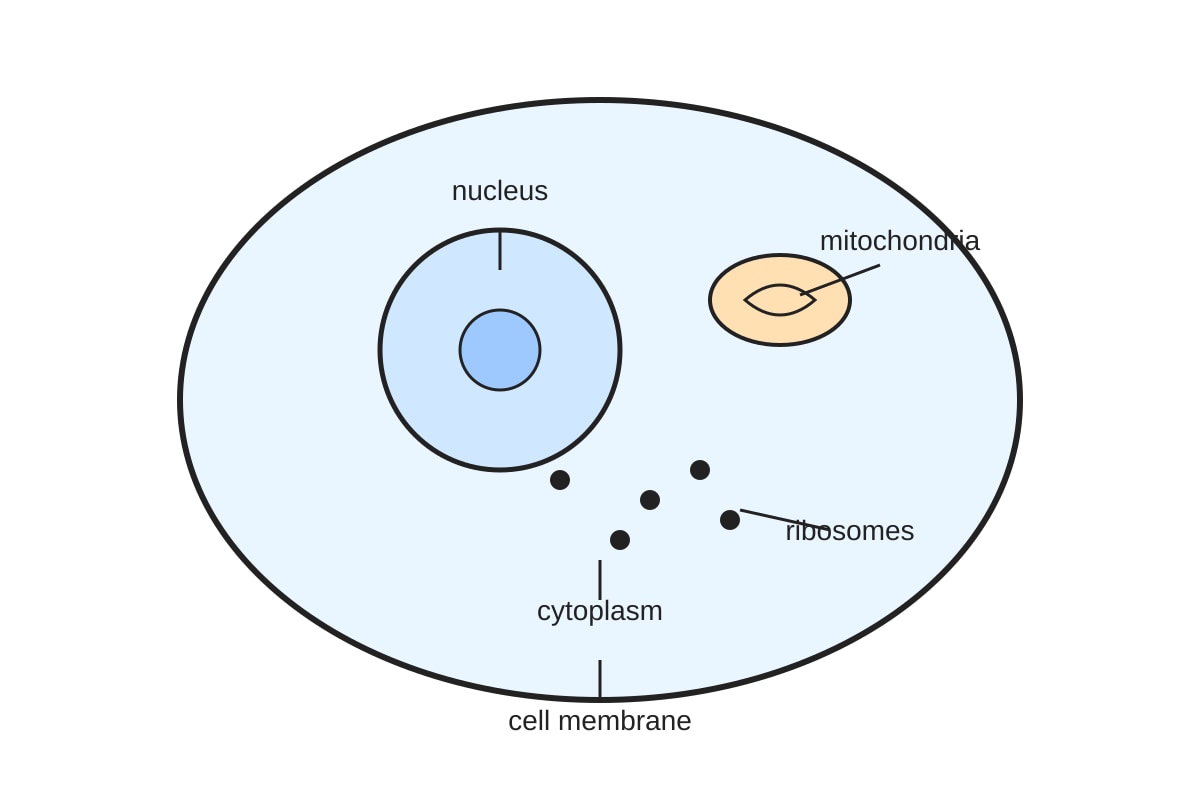
Example: Nucleus – controls cell activities / contains DNA. [2]
Mitochondria – release energy by respiration. [2]
(Other valid pairs: ribosomes – protein synthesis; cell membrane – controls entry/exit.)
Teaching note: 2 marks per structure: name + function.
18. [4]
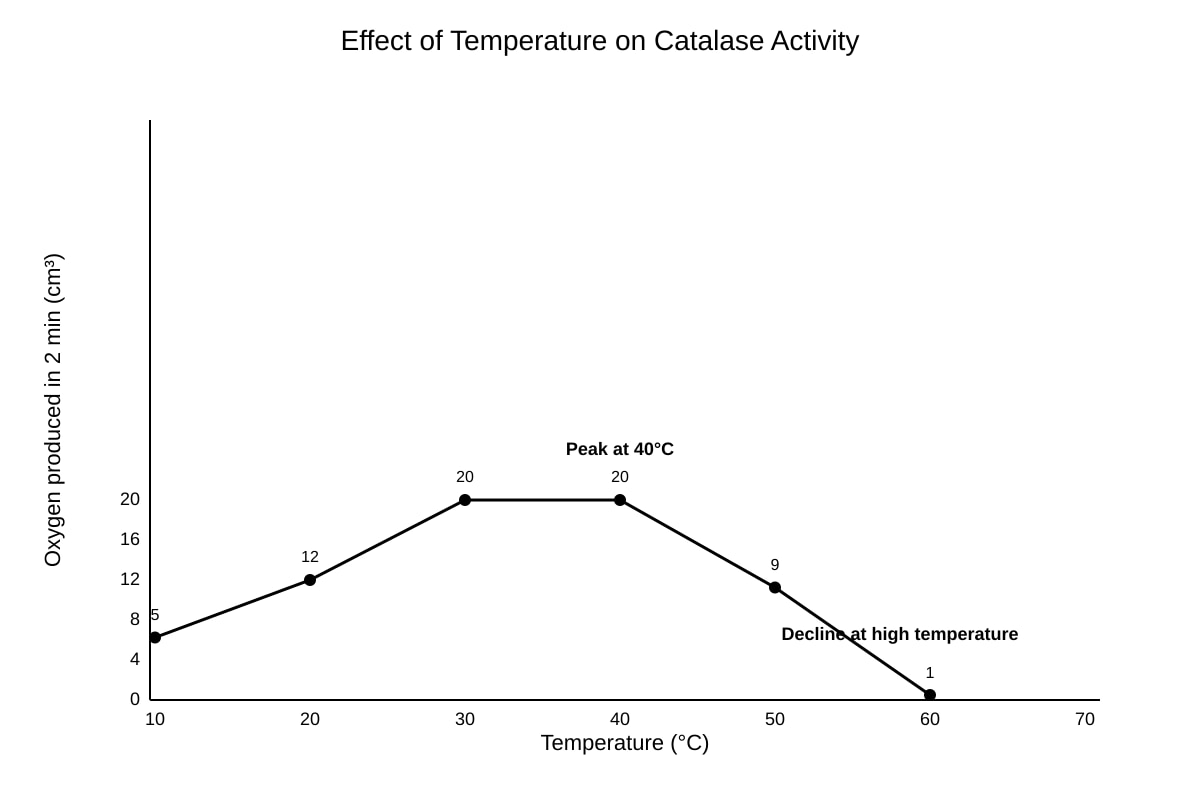
- 10–40°C: rate rises with temperature because molecules move faster and collide more often. [1]
- At 40°C: optimum temperature, fastest reaction. [1]
- 40–70°C: enzyme denatures, active site loses shape, rate falls. [1]
- At 70°C: little/no activity as enzyme fully denatured. [1]
Teaching note: Use graph values; explain molecular basis of temperature effect.
19. [6 – 3 per cell]
Red blood cell:
- Biconcave shape increases surface area for oxygen exchange. [1]
- No nucleus gives space for haemoglobin. [1]
- No organelles allow easy passage in capillaries. [1]
Palisade cell: - Many chloroplasts for photosynthesis. [1]
- Tall column shape packs many cells at top of leaf. [1]
- Thin walls let gases diffuse quickly. [1]
Teaching note: Must describe and explain adaptation for each cell.
20. (a) Rough endoplasmic reticulum (RER) / ribosome. [1]
(b) RER → Golgi body → secretory vesicle → cell membrane → out. [3: 1 each]
Teaching note: Amino acids are used at ribosomes on RER, modified in Golgi, packaged in vesicles and released.