AI Generated Exam Paper
Secondary 3 Biology Practice Paper 4
Free Sec 3 Biology Practice Paper 4, HY3 AI version, with questions, answers, and O Level-style practice for Singapore students.
These static practice materials are generated from the site's syllabus and paper-generation workflow, with source and model context shown so students and parents can evaluate the material before use.
Questions
Free quiz and exam paper access
Enter your details to view this paper
Your access is remembered on this device.
Answers
TuitionGoWhere Practice Paper Answers — Biology Secondary 3 (Version 4)
Total Marks: 40
Section A Answers (16 marks)
1. B [1]
Teaching note: Proteins are synthesised at ribosomes. Ribosomes attached to rough endoplasmic reticulum (RER) are the first site for secretory proteins. Golgi body modifies later; mitochondrion produces energy; nucleus stores DNA.
2. Carbon (C) [1]
Teaching note: Carbohydrates contain carbon, hydrogen, oxygen (CHO). Any one of these is acceptable; carbon is most fundamental.
3. More space for haemoglobin / carries more oxygen [1]
Teaching note: Lack of nucleus frees cytoplasmic space for haemoglobin, increasing oxygen-carrying capacity.
4. B [1]
Teaching note: Iodine turns blue-black with starch. Biuret for protein, Benedict’s for reducing sugar, ethanol for fat.
5. Diffusion is the net movement of particles from a region of higher concentration to a region of lower concentration. [2]
Marking: 1 mark for movement from high to low concentration, 1 mark for “net movement” or particles/molecules.
Teaching note: Diffusion is passive and does not need energy.
6. Active transport [1]
Teaching note: Mineral ions move from low soil concentration to higher root concentration, requiring ATP.
7. Chloroplast [1]
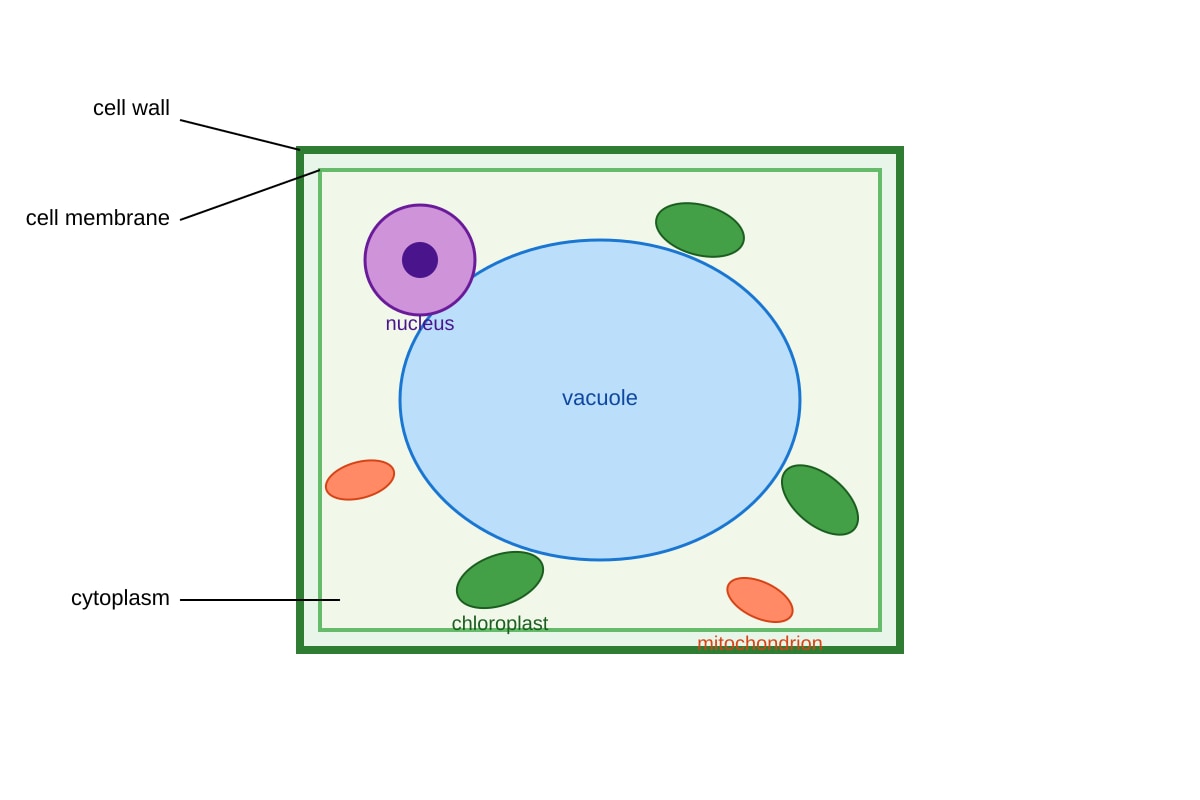
Teaching note: Chloroplasts contain chlorophyll for photosynthesis. In the diagram, green ovals are chloroplasts.
8. Biomolecule: reducing sugar; Colour change: blue to brick-red [2]
Marking: 1 mark each.
Teaching note: Benedict’s reagent heated with reducing sugar gives brick-red precipitate.
Section B Answers (16 marks)
9.
(a) Rough endoplasmic reticulum (RER) [1]
(b) Golgi body, then secretory vesicles [2]
Teaching note: Amino acids → RER ribosomes → Golgi for modification → vesicles to membrane.
10. [6]
Marking descriptors:
- Energy: osmosis passive (no ATP), active transport uses ATP (2 marks)
- Direction: osmosis water down gradient, active transport against gradient (2 marks)
- Example: osmosis – water into root hair; active – ion uptake by root hair (2 marks)
Sample:
| Feature | Osmosis | Active transport | |---------|---------|------------------| | Energy | No ATP | Uses ATP | | Direction | Water down gradient | Substances against gradient | | Plant example | Water uptake by root hair | Mineral ion uptake by root hair |
11.
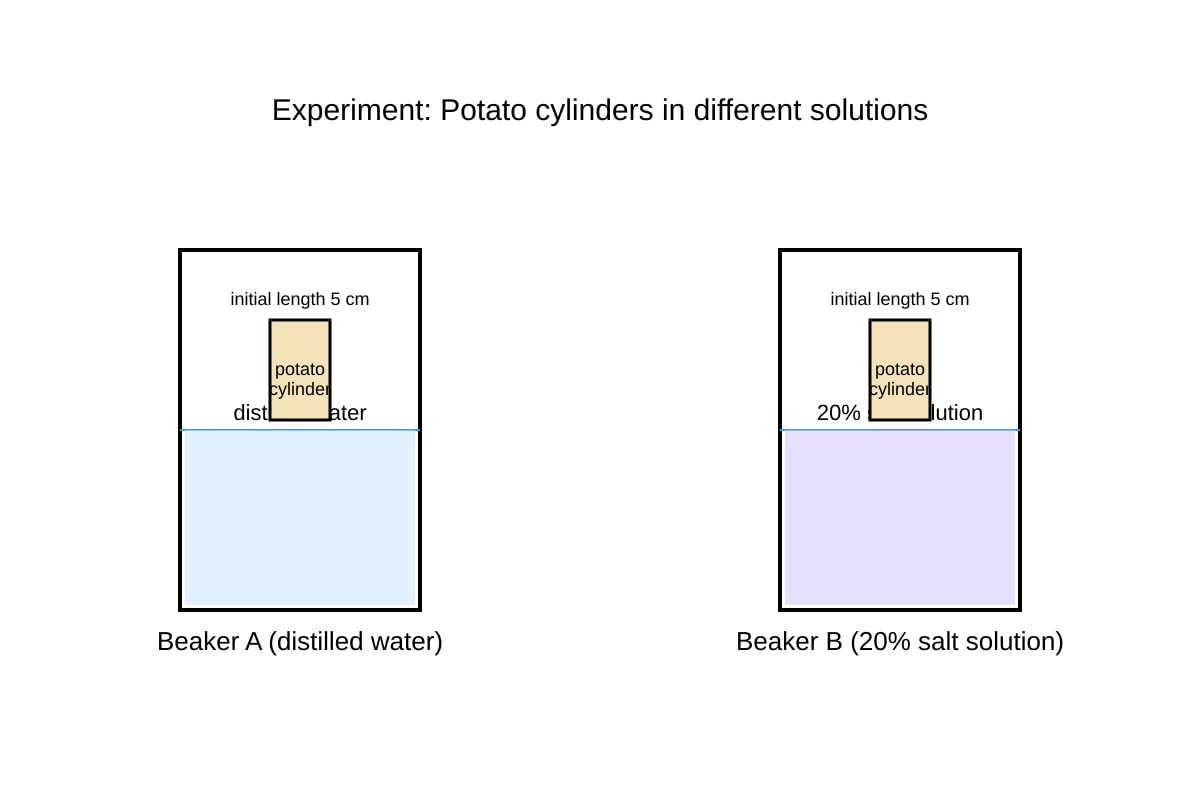
(a) Increases [1]
(b) Water moves into potato by osmosis because cell sap has higher solute concentration than distilled water. [2]
Teaching note: Osmosis is water diffusion across membrane to dilute solution.
12. Enzyme active site has specific shape matching substrate like key in lock; only correct substrate fits. [2]
Teaching note: Explains specificity; no reaction if shape mismatched.
13. Need energy for contraction; many mitochondria produce ATP. [2]
Teaching note: Muscle cells contract repeatedly, high respiration demand.
14. Units: amino acids; Bond: peptide bond [2]
Teaching note: Condensation reaction forms peptide bond, releasing water.
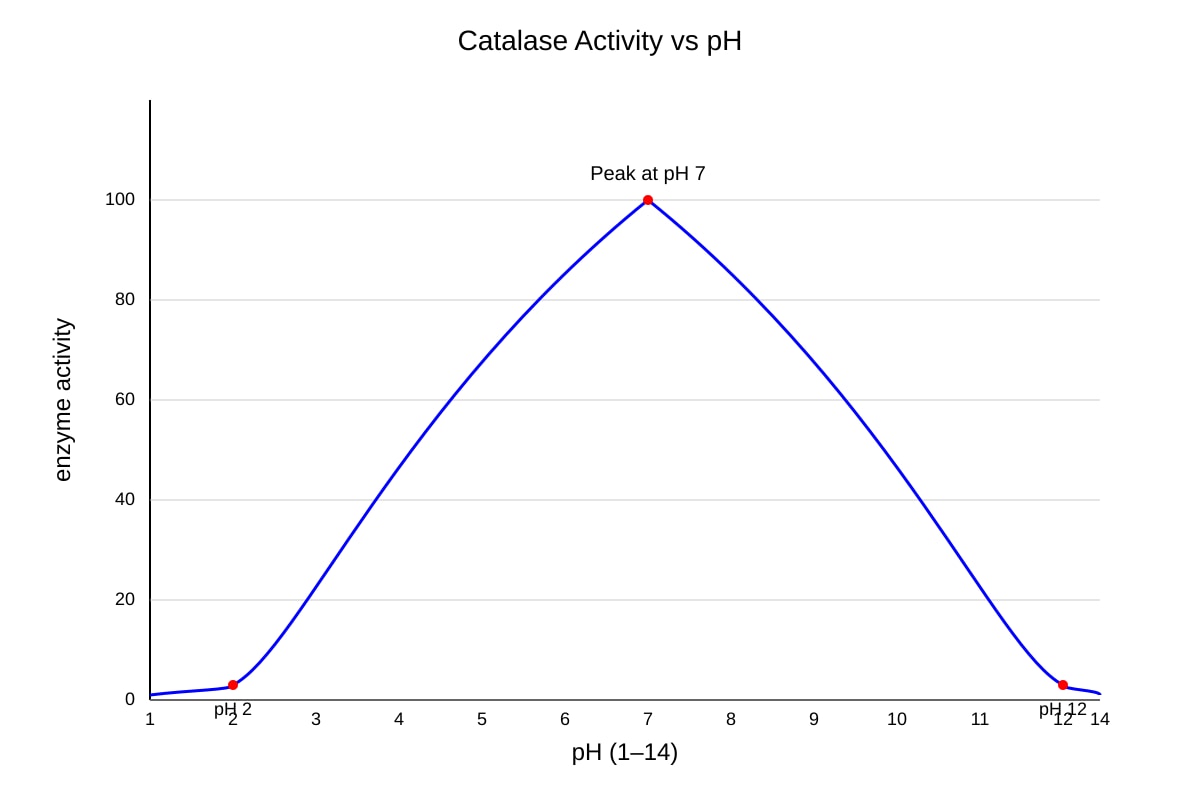
15. Optimum pH 7 [1]; At pH 2 enzyme denatured, active site shape changed, cannot bind substrate [1]
Teaching note: Extreme pH breaks H-bonds, alters shape.
Section C Answers (8 marks)
16. [6]
Marking: 3 marks per cell (1 structure, 1 function, 1 explanation).
- Red blood cell: transports O₂; biconcave shape increases SA; no nucleus more haemoglobin; no organelles streamline.
- Root hair cell: absorbs water/minerals; long extension increases SA; thin wall easy entry; vacuole maintains gradient.
Teaching note: Must link adaptation to function for full marks.
17.
(a) Time decreases from 20→37 °C (faster), then increases to 80 (slower/no reaction). [2]
(b) At 80 °C amylase denatured, active site destroyed, no catalysis. [2]
18. [4]
- Starch – iodine – blue-black
- Protein – biuret – purple
(Other valid: reducing sugar/Benedict’s/brick-red; fat/ethanol/cloudy)
1 mark each.
19. Speed up reactions without being used up, in living cells. [2]
Teaching note: Catalysts lower activation energy; enzymes are proteins.
20. Cell → tissue → organ → system → organism [1]; Example: muscle tissue / epithelial tissue [1]
Teaching note: Tissue = group of similar cells.
End of Answer Key