AI Generated Exam Paper
Secondary 3 Biology Practice Paper 3
Free Sec 3 Biology Practice Paper 3, HY3 AI version, with questions, answers, and O Level-style practice for Singapore students.
These static practice materials are generated from the site's syllabus and paper-generation workflow, with source and model context shown so students and parents can evaluate the material before use.
Questions
Free quiz and exam paper access
Enter your details to view this paper
Your access is remembered on this device.
Answers
TuitionGoWhere Practice Paper - Biology Secondary 3 (Answer Key)
Version 3 of 5 — Syllabus-first AI generated; not official past-year content.
Section A: Multiple Choice
1. B [1]
Teaching note: Radioactive amino acids are used to build proteins. Protein synthesis starts at ribosomes on the rough endoplasmic reticulum (RER). Therefore RER shows radioactivity first, before Golgi body or mitochondria. Common mistake: choosing Golgi body because it packages proteins — but it acts later.
2. C [1]
Teaching note: Fats (lipids) are built from glycerol and fatty acids. Starch is made of glucose, proteins of amino acids, glycogen of glucose, nucleic acids of nucleotides.
3. B [1]
Teaching note: Lack of nucleus frees space for haemoglobin, the oxygen-carrying pigment. More haemoglobin = more oxygen transport.
4. C [1]
Teaching note: Active transport needs ATP and moves substances from low to high concentration (against gradient). Diffusion/osmosis/facilitated diffusion are passive.
5. C [1]
Teaching note: Biuret reagent turns purple/violet in presence of peptide bonds (protein). Iodine = starch (blue-black), Benedict's = reducing sugar (green/red), ethanol = fat (cloudy white).
Section B: Short Answer and Structured
6. [2]
(a) Mitochondrion: site of aerobic respiration / produces ATP energy. [1]
(b) Ribosome: site of protein synthesis. [1]
7. [3]
- The plant cell loses water and becomes plasmolysed (membrane pulls away from wall). [1]
- Osmosis is the movement of water from a region of high water potential (inside cell) to low water potential (concentrated salt solution) through a partially permeable membrane. [1]
- Water leaves the cell, vacuole shrinks, protoplast detaches from cell wall. [1]
8. [4]
(a) Starch – iodine test – blue-black colour. [1]
(b) Reducing sugar – Benedict's test – green/orange/red precipitate after heating. [1]
(c) Protein – biuret test – purple/violet colour. [1]
(d) Fat – ethanol test – cloudy white emulsion. [1]
9. [2]
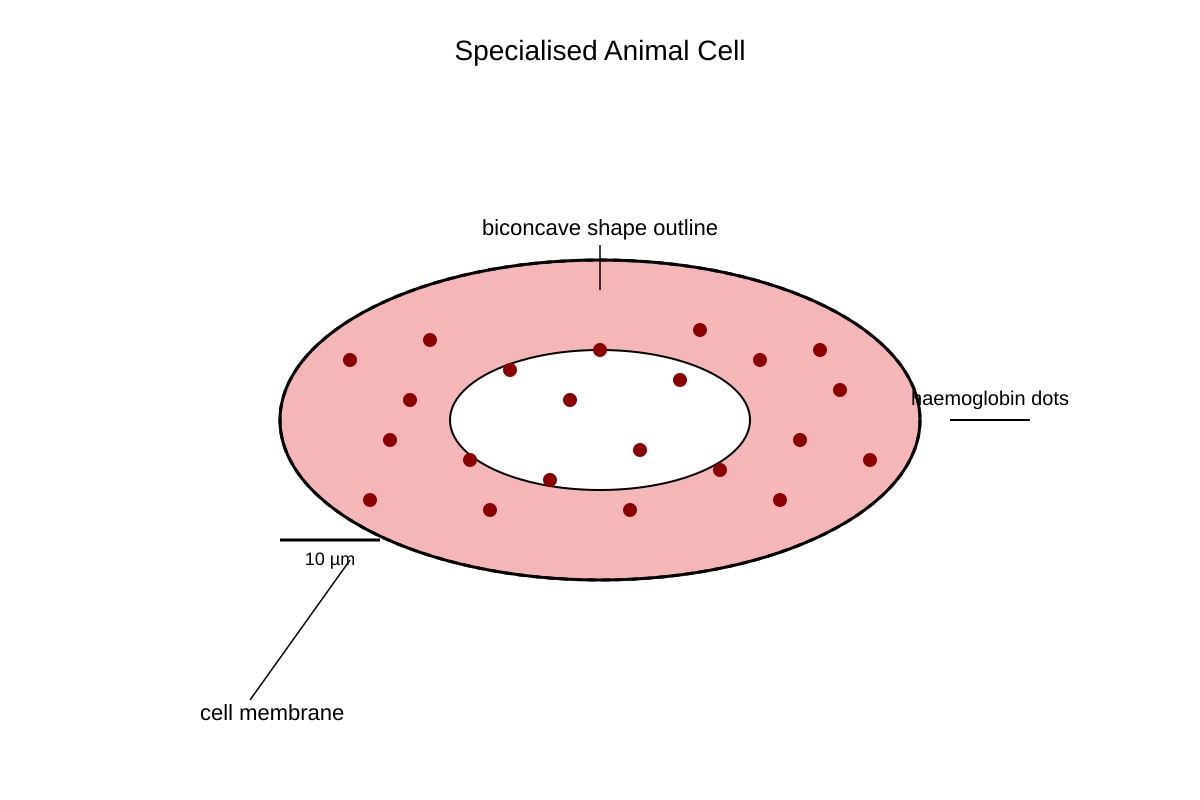
- Cell type: red blood cell (erythrocyte). [1]
- Adaptation: biconcave shape (visible in diagram) increases surface area for gas exchange; or no nucleus seen = more space for haemoglobin. [1]
10. [3]
- Enzyme has a specific active site with a fixed shape. [1]
- Substrate fits into active site like a key into a lock (enzyme specificity). [1]
- This forms enzyme-substrate complex, reaction occurs, products released; enzyme unchanged. [1]
11. [2]
- Green precipitate with Benedict's indicates a reducing sugar is present. [1]
- Green (not red) suggests a low to moderate concentration of reducing sugar. [1]
12. [4]
(i) Energy: Diffusion needs no ATP (passive); active transport requires ATP. [2]
(ii) Direction: Diffusion moves down concentration gradient (high→low); active transport moves against gradient (low→high). [2]
13. [2]
(a) Carbohydrate: C, H, O. [1]
(b) Protein: C, H, O, N (sometimes S). [1]
14. [2]
- Process: active transport. [1]
- Necessary because ions must be absorbed from dilute soil into more concentrated root cell sap to support growth and enzyme function. [1]
15. [2]
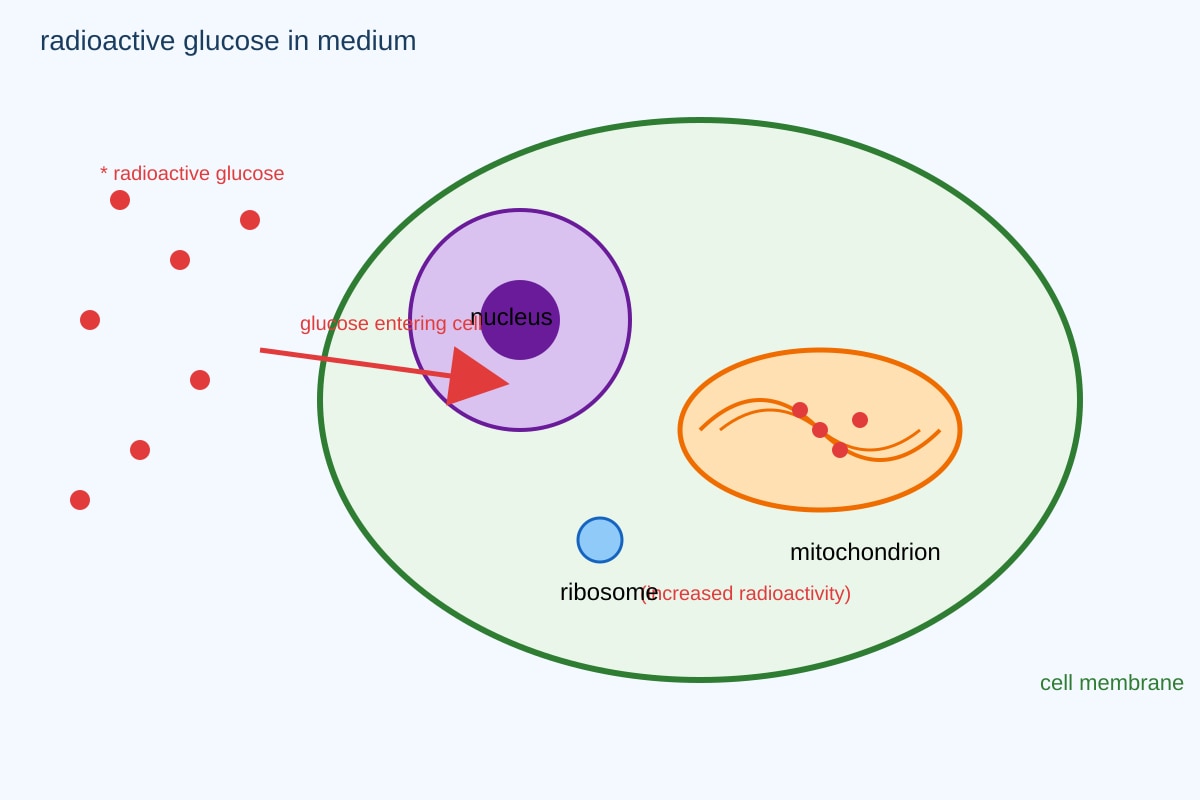
- Organelle: mitochondrion. [1]
- Radioactive glucose is respired in mitochondria to release energy; thus radioactivity accumulates there. [1]
Section C: Extended Response
16. [6 – 3 marks per cell]
Red blood cell:
- Function: transport oxygen. [1]
- Adaptation: biconcave shape → larger surface area for oxygen exchange. [1]
- No nucleus/organelles → more room for haemoglobin. [1]
Root hair cell:
- Function: absorb water and minerals from soil. [1]
- Adaptation: long hair-like projection → increased surface area for absorption. [1]
- Thin wall / many mitochondria → easy diffusion / active transport of ions. [1]
17. [4]
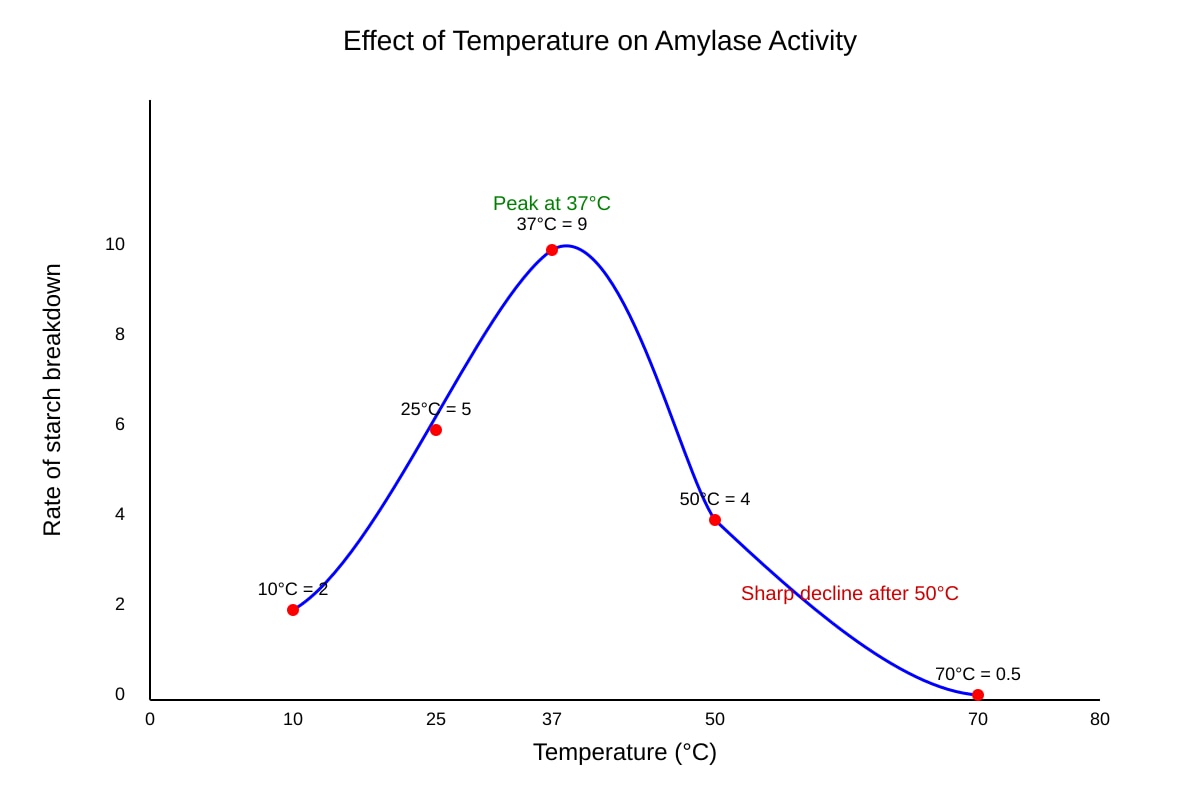
- 10–37°C: rate rises as temperature increases kinetic energy, more enzyme-substrate collisions; optimum at 37°C. [2]
- 37–70°C: above optimum, enzyme denatures, active site loses shape, rate falls sharply to near zero. [2]
18. [3]
- Carbohydrate: energy source (e.g., rice/bread). [1]
- Fats: energy storage, insulation (e.g., butter/oil). [1]
- Proteins: growth and repair (e.g., egg/meat). [1]
19. [3]
- Protein made at ribosome on rough ER. [1]
- Sent to Golgi body for modification/packaging. [1]
- Packed into vesicle, moves to membrane, released by exocytosis. [1]
20. [2]
- Plant cell. [1]
- Reasons: cell wall and chloroplasts are found in plant not animal cells; large vacuole also typical of plant cells. (Any two) [1]
Total Marks: 40