AI Generated Exam Paper
Secondary 3 Biology Practice Paper 2
Free Sec 3 Biology Practice Paper 2, HY3 AI version, with questions, answers, and O Level-style practice for Singapore students.
These static practice materials are generated from the site's syllabus and paper-generation workflow, with source and model context shown so students and parents can evaluate the material before use.
Questions
Free quiz and exam paper access
Enter your details to view this paper
Your access is remembered on this device.
Answers
TuitionGoWhere Practice Paper - Biology Secondary 3 (Answers)
Version 2 of 5 — Answer Key
Section A (8 marks)
1. Mitochondria [1]
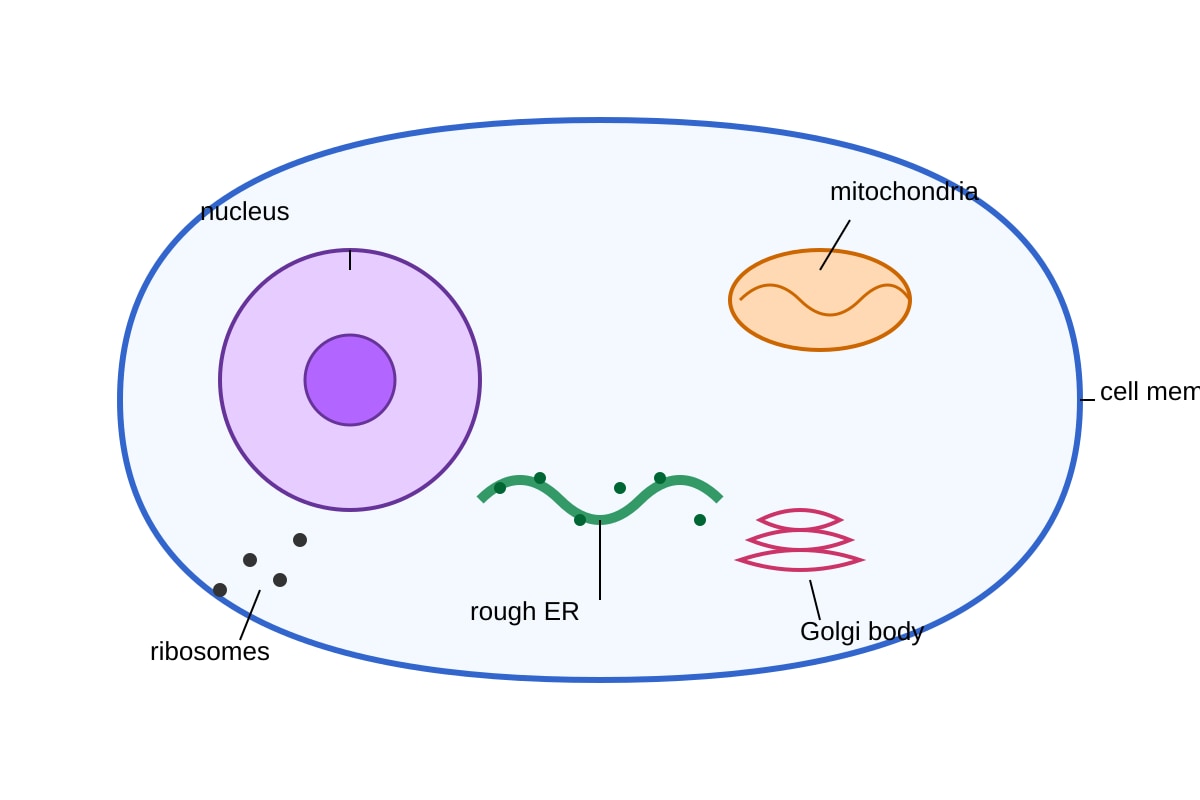
Teaching note: Mitochondria are the sites of aerobic respiration where glucose is broken down to produce ATP (energy). Common mistake: confusing with chloroplast (plant only, makes food).
2. Osmosis [1]
Teaching note: Osmosis is the diffusion of water across a selectively permeable membrane. It is a type of passive transport requiring no energy.
3. Iodine test [1]
Teaching note: Iodine solution turns from brown/yellow to blue-black in presence of starch.
4. Specialised cell (or differentiated cell) [1]
Teaching note: Specialisation allows cells to perform specific roles efficiently (e.g., nerve cell conducts impulses).
5. Nitrogen [1]
Teaching note: Proteins contain C, H, O, N (and sometimes S); carbohydrates have only C, H, O.
6. Ribosome [1]
Teaching note: Ribosomes are where amino acids are joined to form proteins. They may be free or on rough ER.
7. Active site [1]
Teaching note: The active site is the specific region with a shape complementary to the substrate (lock-and-key).
8. Fats (lipids) [1]
Teaching note: Fats store energy long-term and insulate; carbohydrates are short-term energy.
Section B (12 marks)
9. [2]
- No nucleus means more space in the cell (1 mark).
- Allows more haemoglobin to be packed, increasing oxygen-carrying capacity (1 mark).
Teaching note: RBC function is to transport O₂; loss of nucleus and organelles maximises room.
10. [2]
- Diffusion: does not require energy (passive) (1 mark).
- Active transport: requires energy from ATP (1 mark).
Teaching note: Diffusion is down gradient; active transport is against gradient using ATP.
11. [2]
- Organelle: Golgi body (1 mark).
- Function: modifies, sorts, and packages proteins into vesicles for secretion (1 mark).
Teaching note: Image shows stacked membranes; Golgi receives from ER.
12. [2]
- Indicates presence of reducing sugar (1 mark).
- Brick-red colour is positive result after heating with Benedict's (1 mark).
Teaching note: Blue = negative; green→red = increasing concentration of reducing sugar.
13. [2]
- Plant cell has rigid cell wall (1 mark).
- Cell wall prevents bursting by resisting turgor pressure when turgid (1 mark).
Teaching note: Animal cell lacks wall, so lyses in pure water.
14. [2]
Any two: optimum temperature, optimum pH, correct substrate concentration, presence of enzyme (2 marks, 1 each).
Teaching note: Enzymes denature outside optimum range.
Section C (20 marks)
15. [4]
- First structure: Rough endoplasmic reticulum (RER) shows radioactivity first (1 mark).
- Pathway: Amino acids taken up → ribosomes on RER synthesise protein (1 mark) → RER folds protein → transported to Golgi body for modification (1 mark) → packaged into secretory vesicles → exported from cell (1 mark).
Teaching note: Nucleus directs but does not assemble; ribosomes on RER are first site.
16. [4]
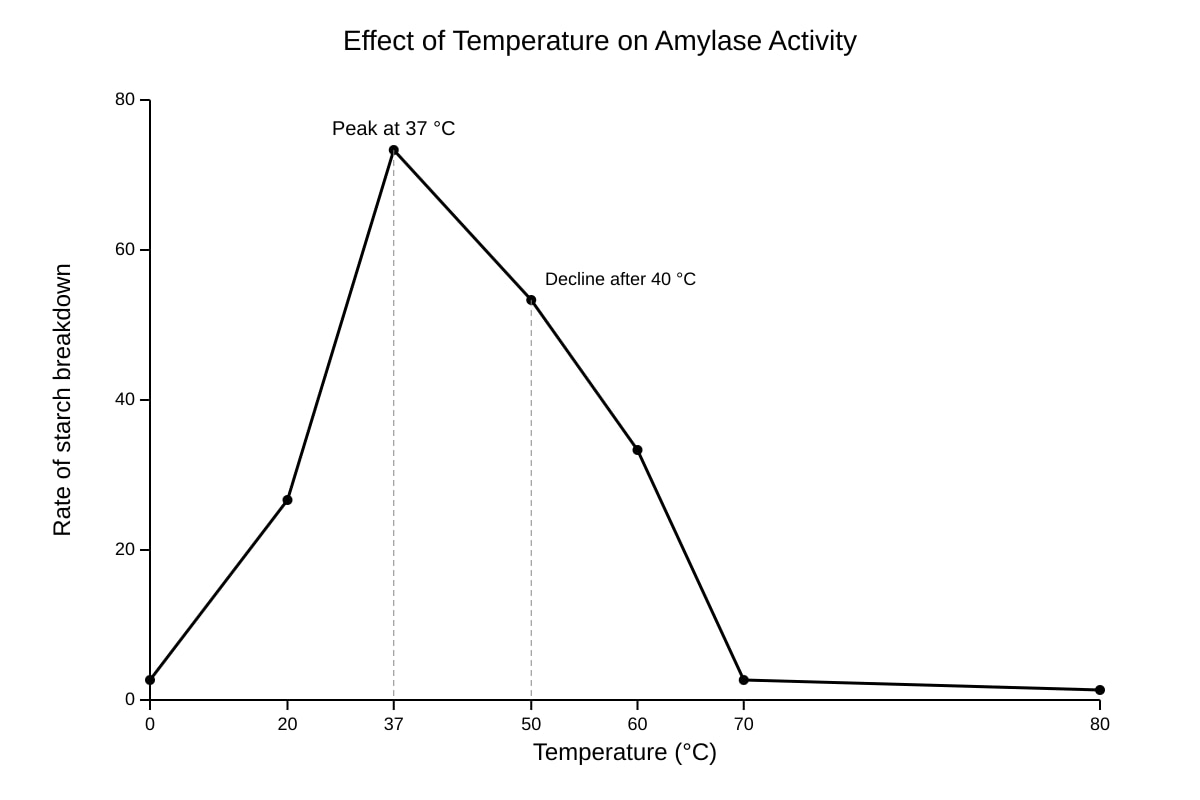
- 0–37 °C: rate increases with temperature because kinetic energy rises, more collisions between enzyme and starch (1 mark).
- At 37 °C: optimum temperature, max activity (1 mark).
- 37–60 °C: rate falls as enzyme denatures, active site changes shape (1 mark).
- 60–80 °C: little/no activity, enzyme fully denatured (1 mark).
Teaching note: Graph must show peak at 37 °C and decline; not inhibition.
17. [3]
- Long projection (root hair) increases surface area for water absorption (1 mark).
- Thin cell wall for short diffusion path (1 mark).
- Active transport of mineral ions via ATP (or many mitochondria) (1 mark).
Teaching note: Adaptation links structure to function.
18. [3]
- Water moves out of cell by osmosis to region of lower water potential (higher solute) (1 mark).
- Animal cell shrinks (crenates) as loses water (1 mark).
- Because no cell wall to prevent shrinkage (1 mark).
Teaching note: Hypertonic solution causes plasmolysis in plant, crenation in animal.
19. [4]
- Osmosis: water moves down water potential gradient (high to low) (1 mark). Example: water uptake by root hair (1 mark).
- Active transport: substances move against concentration gradient (1 mark). Example: mineral ion uptake by root hair from dilute soil (1 mark).
Teaching note: Both cross membranes but energy differs.
20. [4]
- P: reducing sugar (Benedict brick-red) and fat (ethanol cloudy) (1 mark).
- Q: protein (Biuret purple) (1 mark).
- R: none detected (all negative) (1 mark).
- S: starch (iodine black) (1 mark).
Teaching note: Iodine black = starch; Benedict red = reducing sugar; Biuret purple = protein; ethanol cloudy = fat.