AI Generated Exam Paper
Secondary 3 Biology Practice Paper 2
Free Sec 3 Biology Practice Paper 2, DeepSeek AI version, with questions, answers, and O Level-style practice for Singapore students.
These static practice materials are generated from the site's syllabus and paper-generation workflow, with source and model context shown so students and parents can evaluate the material before use.
Questions
Free quiz and exam paper access
Enter your details to view this paper
Your access is remembered on this device.
Answers
TuitionGoWhere Practice Paper - Biology Secondary 3
Answer Key and Marking Scheme
Paper: Practice Paper Version 2 of 5
Total Marks: 50
Section A: Multiple Choice and Short Answer (15 marks)
1. Which of the following organelles is responsible for modifying and packaging proteins for secretion from the cell?
Answer: C. Golgi body [1 mark]
Explanation: The Golgi body (apparatus) receives proteins from the rough endoplasmic reticulum, modifies them (e.g., by adding carbohydrate groups), and packages them into secretory vesicles for transport to the cell membrane. The RER synthesises proteins, ribosomes are the site of protein synthesis, and mitochondria produce energy.
2. An actively growing cell is supplied with radioactive amino acids. In which organelle would radioactivity first be detected?
Answer: C. Rough endoplasmic reticulum [1 mark]
Explanation: Amino acids are the building blocks of proteins. Protein synthesis begins at ribosomes, many of which are attached to the rough endoplasmic reticulum (RER). Therefore, radioactivity would first be detected in the RER, where the radioactive amino acids are incorporated into newly synthesised proteins. The pathway is: RER → Golgi body → secretory vesicles.
3. State one structural difference between a typical plant cell and a typical animal cell.
Answer: Any one of the following [1 mark]:
- Plant cells have a cell wall; animal cells do not.
- Plant cells have chloroplasts; animal cells do not.
- Plant cells have a large central vacuole; animal cells have small, temporary vacuoles (or no vacuole).
- Plant cells have a fixed/regular shape; animal cells have an irregular shape.
Marking note: Accept any valid structural difference. Do not accept functional differences alone.
4. Explain why red blood cells do not contain a nucleus.
Answer: [2 marks]
- Red blood cells do not contain a nucleus so that there is more space available to pack haemoglobin [1 mark].
- Haemoglobin is the protein that binds to and transports oxygen; having more haemoglobin increases the oxygen-carrying capacity of the blood [1 mark].
Marking note: Award 1 mark for stating "more space for haemoglobin" and 1 mark for linking this to increased oxygen transport. Accept "to maximise oxygen-carrying capacity" as a combined answer worth 2 marks.
5. A student placed potato strips in three different sucrose solutions...
(a) Name the process responsible for the change in mass of the potato strips.
Answer: Osmosis [1 mark]
(b) Explain why the potato strip in 0.8 mol/dm³ sucrose solution decreased in mass.
Answer: [2 marks]
- The 0.8 mol/dm³ sucrose solution has a lower water potential than the cytoplasm of the potato cells [1 mark].
- Water moves out of the potato cells by osmosis, from a region of higher water potential (inside the cells) to a region of lower water potential (the sucrose solution) [1 mark].
- The cells lose water, become flaccid, and the potato strip decreases in mass.
Marking note: Award 1 mark for identifying the water potential gradient and 1 mark for describing the direction of water movement by osmosis. Accept "water potential" or "concentration of water molecules."
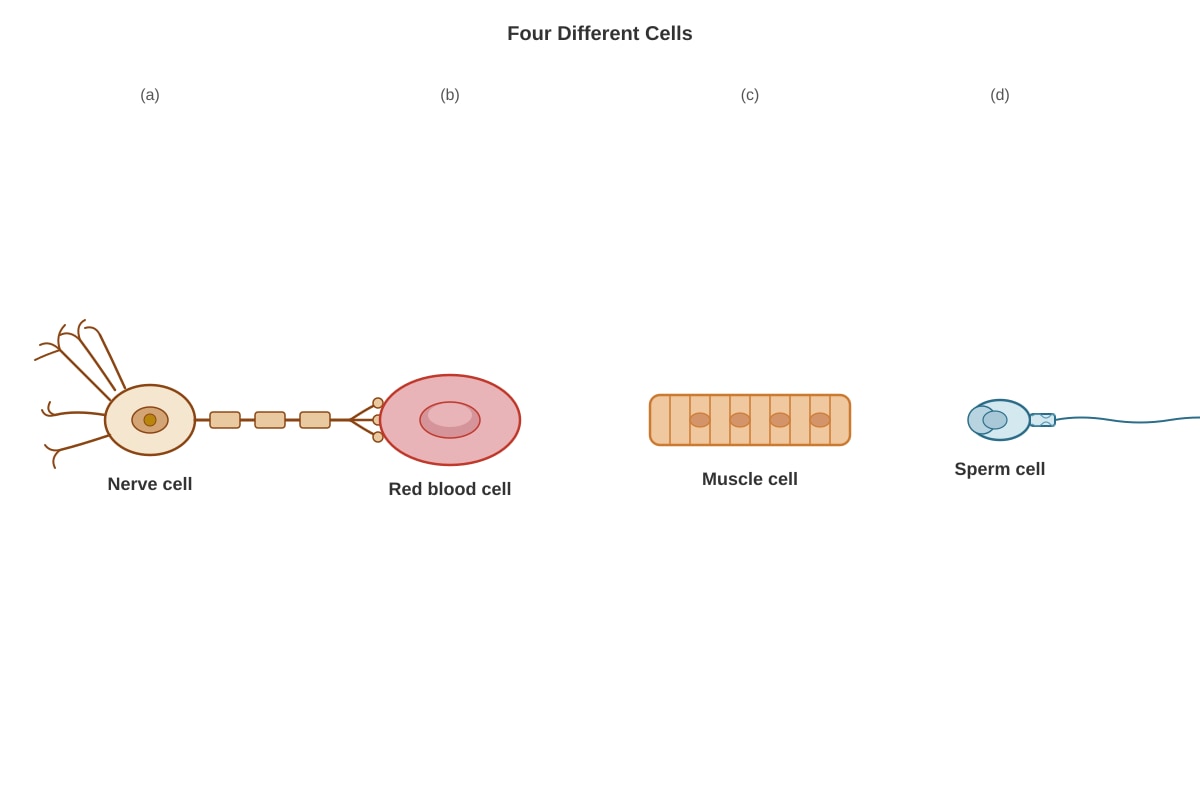
6. The diagram below shows four different cells...
Image pending generation for this question.
(a) Which cell is best adapted for rapid transmission of electrical signals?
Answer: Nerve cell (neurone) [1 mark]
(b) Explain one adaptation of the cell you identified in (a) that enables it to perform its function.
Answer: [2 marks] Any one of the following:
- The nerve cell has a long axon, which allows electrical impulses to be transmitted over long distances quickly [1 mark for structure, 1 mark for function].
- The nerve cell has branched endings (dendrites), which allow it to connect with many other nerve cells or effectors, enabling rapid communication [1 mark for structure, 1 mark for function].
- The nerve cell is covered with a myelin sheath, which insulates the axon and speeds up the transmission of electrical impulses [1 mark for structure, 1 mark for function].
Marking note: Award 1 mark for naming the structural adaptation and 1 mark for explaining how it aids rapid signal transmission. Do not award marks for adaptations of other cell types.
7. Identify the process by which each of the following substances moves:
(a) Carbon dioxide from respiring muscle cells into the blood
Answer: Diffusion [1 mark]
(b) Glucose from the small intestine into the villi
Answer: Active transport [1 mark]
Explanation: Carbon dioxide moves down its concentration gradient from respiring cells (high CO₂ concentration) into the blood (lower CO₂ concentration) by diffusion. Glucose is often absorbed against its concentration gradient from the small intestine into the villi, requiring energy in the form of ATP, hence active transport.
8. A student tested an unknown food sample and obtained the following results...
Answer: [2 marks]
- Starch is present [1 mark].
- The iodine test gave a blue-black colour, which is a positive result for starch. The Benedict's test remained blue (negative for reducing sugars) and the biuret test remained blue (negative for proteins) [1 mark].
Marking note: Award 1 mark for correctly identifying starch and 1 mark for explaining the reasoning with reference to the test results. Accept "starch only" or "starch is present; reducing sugars and proteins are absent."
Section B: Structured Questions (20 marks)
9. Figure 1 shows an electron micrograph of a pancreatic cell...
(a) Identify organelle X.
Answer: Rough endoplasmic reticulum (RER) [1 mark]
(b) State the function of organelle X.
Answer: Site of protein synthesis / transports proteins within the cell [1 mark]
(c) Explain why pancreatic cells contain large amounts of organelle X.
Answer: [2 marks]
- Pancreatic cells produce and secrete large amounts of digestive enzymes, which are proteins [1 mark].
- The RER provides a large surface area for ribosomes to synthesise these proteins, and the RER transports the proteins to the Golgi body for packaging and secretion [1 mark].
Marking note: Award 1 mark for linking pancreatic function to protein/enzyme production and 1 mark for explaining why abundant RER is needed (synthesis and transport).
10. A student investigated the effect of temperature on the activity of the enzyme catalase...
(a) Identify the optimum temperature for catalase activity.
Answer: 40°C [1 mark]
(b) Describe the trend in enzyme activity between 10°C and 40°C.
Answer: As temperature increases from 10°C to 40°C, the volume of oxygen produced increases / enzyme activity increases [1 mark].
(c) Explain why the volume of oxygen produced decreased significantly at 60°C.
Answer: [3 marks]
- At 60°C, the high temperature causes the enzyme catalase to be denatured [1 mark].
- The high temperature breaks the bonds (e.g., hydrogen bonds) that maintain the enzyme's specific three-dimensional shape [1 mark].
- The active site loses its specific shape, so the substrate (hydrogen peroxide) can no longer fit into the active site; the enzyme-substrate complex cannot form, and the reaction cannot be catalysed [1 mark].
Marking note: Award 1 mark for stating "denatured," 1 mark for explaining the change in shape/breaking of bonds, and 1 mark for linking this to the loss of active site function. Do not accept "enzyme is killed" or "enzyme dies."
11. Compare the adaptations of a red blood cell and a root hair cell for their respective functions.
Answer: [4 marks]
Red blood cell adaptations (any two, 1 mark each for structure + function link):
- Biconcave shape → increases surface area for rapid diffusion of oxygen
- No nucleus → more space for haemoglobin to carry oxygen
- Contains haemoglobin → binds to oxygen for transport
- Flexible/elastic membrane → allows it to squeeze through narrow capillaries
Root hair cell adaptations (any two, 1 mark each for structure + function link):
- Long, narrow extension (root hair) → increases surface area for absorption of water and mineral ions
- Many mitochondria → provide energy (ATP) for active transport of mineral ions
- Thin cell wall → reduces diffusion distance for water and mineral ions
- Large vacuole → stores water and maintains water potential gradient
Marking note: Award up to 2 marks for red blood cell adaptations and up to 2 marks for root hair cell adaptations. Each adaptation must include both the structural feature and the functional advantage. Maximum 4 marks total.
12. Describe the digestion of proteins in the human digestive system...
Answer: [4 marks]
- In the stomach, pepsin (a protease) breaks down proteins into smaller polypeptides [1 mark]. The stomach produces hydrochloric acid, which provides the acidic pH needed for pepsin to function [1 mark].
- In the small intestine, pancreatic protease (trypsin) continues the breakdown of polypeptides into shorter peptides [1 mark].
- Peptidases in the small intestine break down peptides into amino acids, which are the final products and are small enough to be absorbed through the villi into the bloodstream [1 mark].
Marking note: Award 1 mark for each correct stage with enzyme name and location. Accept "protease" for pepsin and trypsin if the location is correctly identified. The final product (amino acids) must be stated.
13. Figure 2 shows a diagram of a villus.
(a) Identify the structures labelled A and B.
Answer: [1 mark]
- A: Epithelium (one-cell thick wall) / Epithelial cell
- B: Blood capillary
Marking note: Award 0.5 marks for each correct identification. Accept "lacteal" for B only if the diagram shows a lacteal; otherwise, "blood capillary" is expected.
(b) Explain two ways in which the structure of the villus is adapted for efficient absorption of nutrients.
Answer: [2 marks] Any two of the following:
- The villus has a finger-like shape, which increases the surface area for absorption of nutrients [1 mark].
- The epithelium is one-cell thick, providing a short diffusion distance for nutrients to pass through [1 mark].
- The villus contains a dense network of blood capillaries, which rapidly transport absorbed nutrients away, maintaining a concentration gradient for continued absorption [1 mark].
- The epithelial cells have microvilli, which further increase the surface area for absorption [1 mark].
Marking note: Award 1 mark for each correct structural adaptation with explanation of how it aids absorption. Maximum 2 marks.
Section C: Data-Based and Extended Response Questions (15 marks)
14. A student investigated the effect of pH on the activity of amylase...
(a) State the optimum pH for amylase activity.
Answer: pH 7 [1 mark]
(b) Explain why no starch breakdown occurred at pH 2.
Answer: [2 marks]
- At pH 2, the highly acidic conditions cause the enzyme amylase to be denatured [1 mark].
- The extreme pH breaks the bonds maintaining the enzyme's three-dimensional shape; the active site loses its specific shape, so the starch substrate can no longer fit into the active site, and the reaction cannot be catalysed [1 mark].
Marking note: Award 1 mark for stating "denatured" and 1 mark for explaining the effect on the active site and enzyme-substrate binding.
(c) Describe how the student could modify the investigation to study the effect of temperature on amylase activity instead of pH.
Answer: [3 marks]
- Use water baths at different temperatures (e.g., 10°C, 20°C, 30°C, 40°C, 50°C, 60°C) instead of buffer solutions at different pH values [1 mark].
- Keep the pH constant (e.g., at pH 7) by using a buffer solution at the optimum pH for all test tubes [1 mark].
- Keep all other variables constant: same volume and concentration of starch solution, same volume and concentration of amylase solution, same equilibration time in the water bath before mixing [1 mark].
- Measure the time taken for starch to be completely broken down at each temperature (or measure the volume of product formed in a fixed time) [1 mark].
Marking note: Award 1 mark for using different temperatures, 1 mark for controlling pH, and 1 mark for controlling other variables or describing measurement. Maximum 3 marks.
15. Figure 3 shows the structure of a cell membrane.
(a) Name the main type of molecule that makes up the bulk of the cell membrane.
Answer: Phospholipids / Phospholipid bilayer [1 mark]
(b) The cell membrane is described as "partially permeable." Explain what this means and why it is important for the cell.
Answer: [2 marks]
- Partially permeable means the membrane allows some substances to pass through but not others [1 mark].
- This is important because it allows the cell to control which substances enter and leave, maintaining a constant internal environment (homeostasis) and preventing harmful substances from entering while allowing essential substances (e.g., nutrients, oxygen) to enter and waste products to leave [1 mark].
Marking note: Award 1 mark for defining "partially permeable" and 1 mark for explaining its importance to the cell.
(c) Explain how the structure of the cell membrane allows it to control the movement of substances into and out of the cell.
Answer: [3 marks]
- The cell membrane is composed of a phospholipid bilayer; the hydrophobic (water-repelling) tails face inwards, creating a barrier that prevents water-soluble substances (e.g., ions, glucose) from passing through freely [1 mark].
- Small, non-polar molecules (e.g., oxygen, carbon dioxide) can diffuse directly through the phospholipid bilayer [1 mark].
- The membrane contains protein channels and carrier proteins that allow specific substances (e.g., ions, glucose, amino acids) to pass through by facilitated diffusion or active transport, providing selective control over what enters and leaves the cell [1 mark].
Marking note: Award 1 mark for describing the phospholipid bilayer barrier, 1 mark for explaining how small molecules pass through, and 1 mark for explaining the role of proteins in selective transport. Maximum 3 marks.
16. A sports drink manufacturer claims that their product is the most effective at preventing dehydration during exercise...
Design an investigation to compare the effectiveness of three different sports drinks (A, B, and C) at maintaining hydration during exercise.
Answer: [3 marks]
Apparatus and materials:
- Three sports drinks (A, B, and C)
- Three groups of participants of similar age, fitness level, and body mass
- Treadmill or exercise bike
- Weighing scale
- Timer/stopwatch
- Measuring cylinder
Procedure:
- Weigh each participant before the exercise session and record their initial body mass.
- Each group drinks a fixed volume (e.g., 500 cm³) of their assigned sports drink (Group 1: Drink A, Group 2: Drink B, Group 3: Drink C).
- All participants perform the same exercise (e.g., running on a treadmill at the same speed) for the same duration (e.g., 30 minutes) under the same environmental conditions (temperature, humidity).
- After exercise, weigh each participant again and record their final body mass.
- Calculate the change in body mass for each participant (initial mass – final mass). The smaller the decrease in body mass, the more effective the drink is at maintaining hydration.
Ensuring fairness:
- All participants should be of similar age, fitness level, and body mass.
- The volume of drink consumed must be the same for all groups.
- The type, intensity, and duration of exercise must be identical.
- Environmental conditions (temperature, humidity) must be the same for all trials.
- Participants should not consume any other food or drink during the investigation.
Measuring and comparing results:
- Calculate the average change in body mass for each group.
- Compare the average mass loss: the drink resulting in the smallest average decrease in body mass is the most effective at maintaining hydration.
Marking note: Award 1 mark for a clear, logical procedure, 1 mark for describing how to ensure fairness (control variables), and 1 mark for explaining how to measure and compare results. Maximum 3 marks. Accept any reasonable experimental design that addresses the question.
END OF ANSWER KEY
© TuitionGoWhere 2025. This is AI-generated practice content based on the interpreted syllabus. It is not derived from past examination papers.