AI Generated Exam Paper
Secondary 3 Biology Practice Paper 1
Free Sec 3 Biology Practice Paper 1, HY3 AI version, with questions, answers, and O Level-style practice for Singapore students.
These static practice materials are generated from the site's syllabus and paper-generation workflow, with source and model context shown so students and parents can evaluate the material before use.
Questions
Free quiz and exam paper access
Enter your details to view this paper
Your access is remembered on this device.
Answers
Answer Key — TuitionGoWhere Practice Paper Biology Secondary 3 (Version 1)
Topic: Cells Biomolecules
Total Marks: 40
Section A
1. Ribosome [1]
Teaching note: Ribosomes are the organelles where amino acids are joined to make proteins. They may be free in cytoplasm or on rough ER.
2. Nitrogen (N) [1]
Teaching note: Carbohydrates contain C, H, O only. Proteins also contain N (and sometimes S). This is a key difference.
3. Starch test [1]
Teaching note: Iodine solution turns from brown/yellow to blue-black in presence of starch, a carbohydrate.
4. Diffusion is the net movement of particles from a region of higher concentration to a region of lower concentration. [1]
Teaching note: Must mention "net movement" and "down concentration gradient".
5. Osmosis [1]
Teaching note: Osmosis is a special type of diffusion for water across a partially permeable membrane.
6. Active transport [1]
Teaching note: Requires ATP; moves substances against gradient.
7. Active site [1]
Teaching note: The active site is the specific region of the enzyme with shape complementary to substrate (lock-and-key).
8. Nucleus [1]
Teaching note: In eukaryotes, DNA is inside the nucleus; in prokaryotes, it is free in cytoplasm.
9. Fats (lipids) [1]
Teaching note: Fats store more energy per gram than carbs and insulate.
10. Cell [1]
Teaching note: All living things are made of cells (cell theory).
Section B
11. (a) Reducing sugar [1] (b) Glucose (or monosaccharides such as glucose/fructose) [1]
Teaching note: Benedict's test: blue → green/yellow/orange/red indicates reducing sugars. Starch is non-reducing; the building blocks of starch are glucose units.
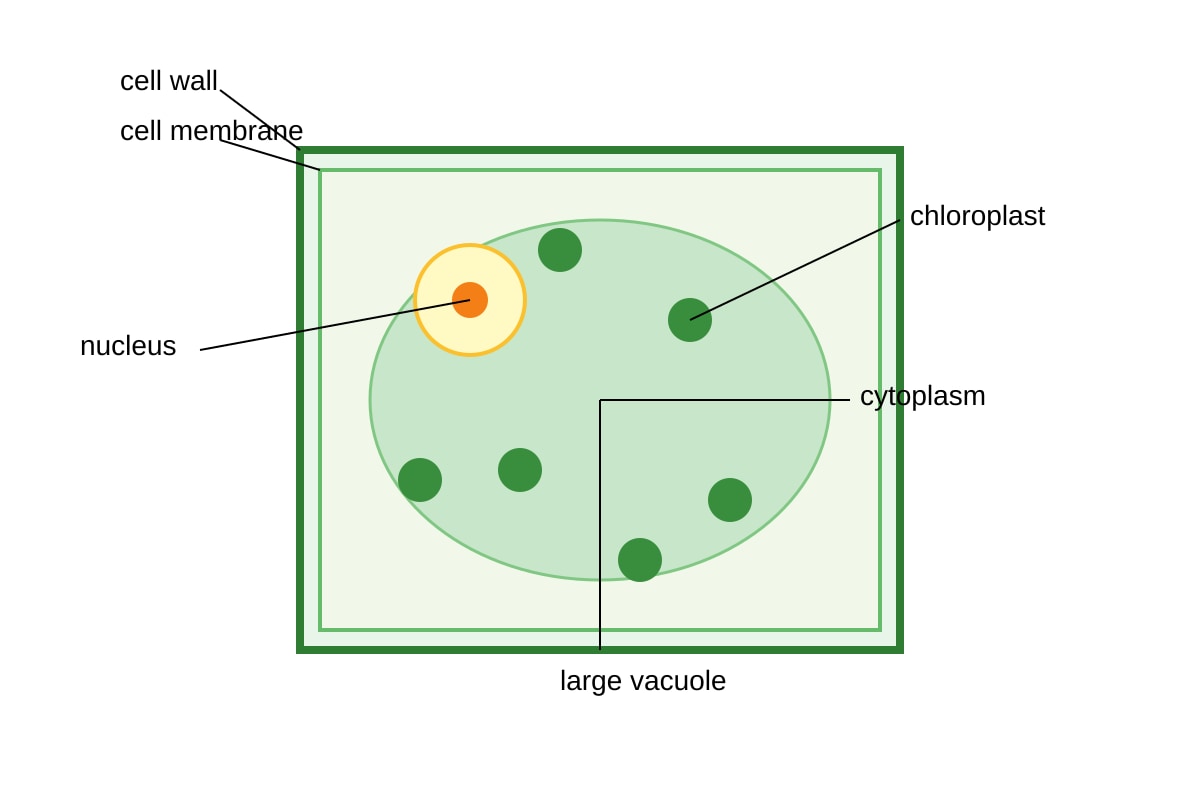
12. (a) Chloroplast [1] (b) Maintains cell turgor / stores water and dissolved substances [1]
Teaching note: From diagram, green organelles = chloroplasts (site of photosynthesis). Vacuole provides support via turgor pressure.
13. [2]
- Osmosis moves water only; diffusion can move any substance (gas, solute) [1]
- Osmosis does not require energy (passive); diffusion does not require energy either — both passive [1]
Marking: 1 mark for substance distinction, 1 mark for energy statement (both passive). Common mistake: saying osmosis needs energy.
14. [2] To allow more space for haemoglobin so it can carry more oxygen.
Marking: 1 mark no nucleus, 1 mark reason (more haemoglobin / more O₂ capacity).
Teaching note: Mature mammalian RBC ejects nucleus; also no organelles to maximise space.
15. Rough endoplasmic reticulum (RER), then Golgi body [2]
Marking: 1 mark each in correct order.
Teaching note: Amino acids → ribosomes on RER (protein synthesis) → Golgi for modification/packaging.
16. [2]
- Speed up chemical reactions / lower activation energy [1]
- Are not used up in the reaction (reusable) [1]
Teaching note: Catalysts are defined by these two properties.
Section C
17. [4]
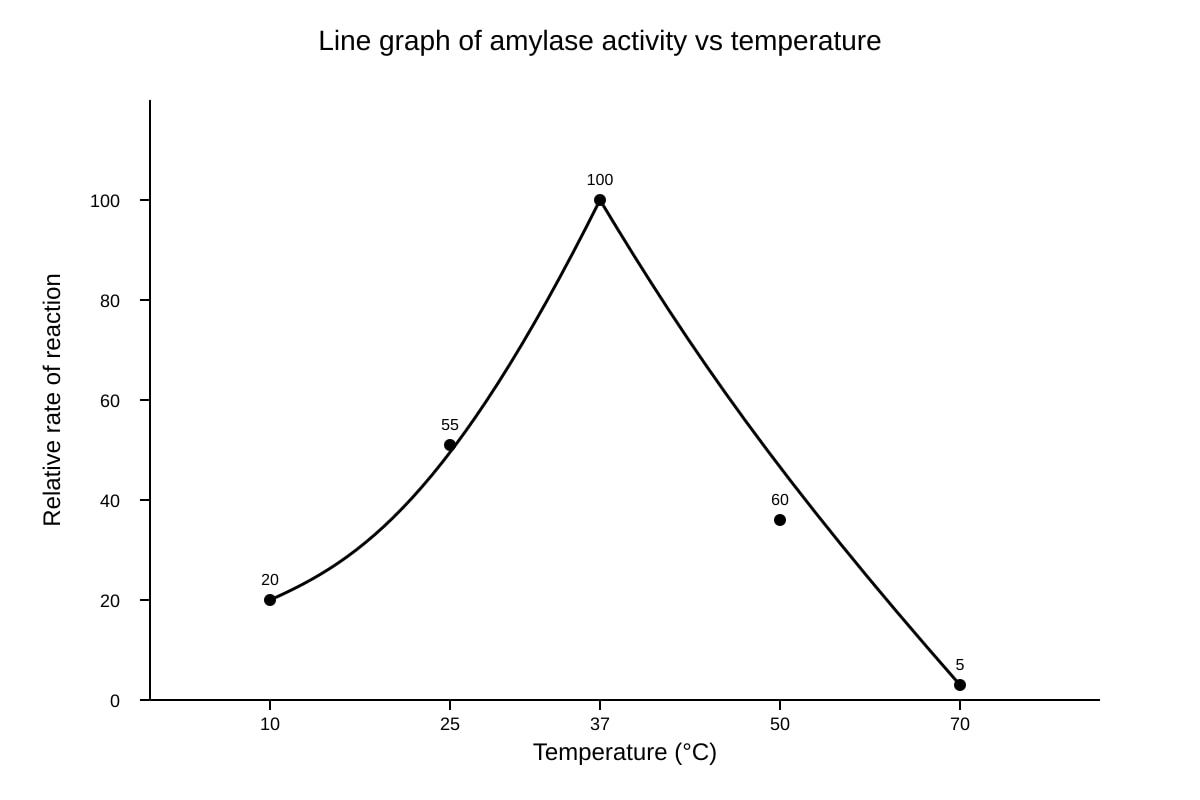
- 10–37 °C: rate increases with temperature because molecules have more kinetic energy → more frequent enzyme-substrate collisions [1]
- 37 °C: optimum temperature, max activity [1]
- 37–50 °C: rate falls as enzyme begins to denature, active site changes shape [1]
- 50–70 °C: rapid drop, enzyme fully denatured and non-functional [1]
Teaching note: Amylase is human enzyme, optimum ~37 °C. Denaturation is permanent change in 3D shape.
18. [3]
- Long projection (hair) increases surface area for absorption [1]
- Thin wall (short diffusion distance) for water entry by osmosis [1]
- Many mitochondria to provide ATP for active transport of mineral ions [1]
Marking descriptors: 1 mark per adaptation linked to function.
19. (a) Reducing sugar, protein, fat [2] — 1 mark for two correct, full for three. (b) Biuret turned purple, indicating peptide bonds of proteins [1]
Teaching note: Iodine negative = no starch. Benedict positive = reducing sugar. Biuret purple = protein. Ethanol cloudy = fat.
20. [4]
- Energy: diffusion passive (no ATP); active transport requires ATP [1]
- Direction: diffusion down gradient (high→low); active transport against gradient (low→high) [1]
- Example diffusion: oxygen entering cells from blood [1]
- Example active transport: root hair cells taking up nitrate ions from soil [1]
Marking: 1 mark per criterion. Common trap: giving same example for both.