From Real Exams Exam Paper
Secondary 3 Biology Semestral Assessment 2 (End of Year) Paper 5
Free Sec 3 Biology SA2 Paper 5, HY3 Exam version, with questions, answers, and O Level-style practice for Singapore students.
These static practice materials are generated from the site's syllabus and paper-generation workflow, with source and model context shown so students and parents can evaluate the material before use.
Questions
Free quiz and exam paper access
Enter your details to view this paper
Your access is remembered on this device.
Answers
TuitionGoWhere Exam Practice (AI) — Secondary 3 Biology SA2 Practice Paper (Version 5) Answer Key
Total Marks: 60
Section A: Multiple Choice
-
B) Nucleus [1]
Teaching note: Radioactive nucleotides are used to build DNA/RNA. DNA synthesis occurs in the nucleus, so radioactivity appears there first. Trap: students may pick ribosome (for amino acids) or mitochondrion (for glucose). -
B) Biconcave shape to increase surface area [1]
Teaching note: RBC adaptation = biconcave disc → larger SA for O₂ exchange; no nucleus, no organelles. Trap: plant cell features (vacuole, wall) do not apply. -
C) Active transport [1]
Teaching note: Active transport uses ATP from respiration to move substances against gradient. Diffusion/osmosis are passive. -
B) Amino acid [1]
Teaching note: Proteins are polymers of amino acids. Glucose → carbs; fatty acid → fats; nucleotide → nucleic acids. -
C) Iodine test [1]
Teaching note: Iodine + starch → blue-black. Benedict's → reducing sugar (brick red); Biuret → protein (purple); Ethanol → fat (cloudy). -
C) Spongy mesophyll [1]
Teaching note: Spongy layer has loose cells, air spaces for gas exchange. Palisade is tightly packed above. -
B) Osmosis of water out of the cell [1]
Teaching note: High external sugar → lower water potential outside → water leaves by osmosis → cell shrinks (plasmolysis in plant). -
B) Their active site shape depends on pH [1]
Teaching note: pH affects H-bonding and 3D shape of enzyme; extreme pH denatures it. -
C) Mitochondrion [1]
Teaching note: Aerobic respiration occurs in mitochondria (powerhouse). Chloroplast = photosynthesis. -
B) A tissue [1]
Teaching note: Group of similar insulin-producing cells = tissue (islets of Langerhans). Organ = pancreas (multiple tissues).
Section B: Structured Questions
11. [3]
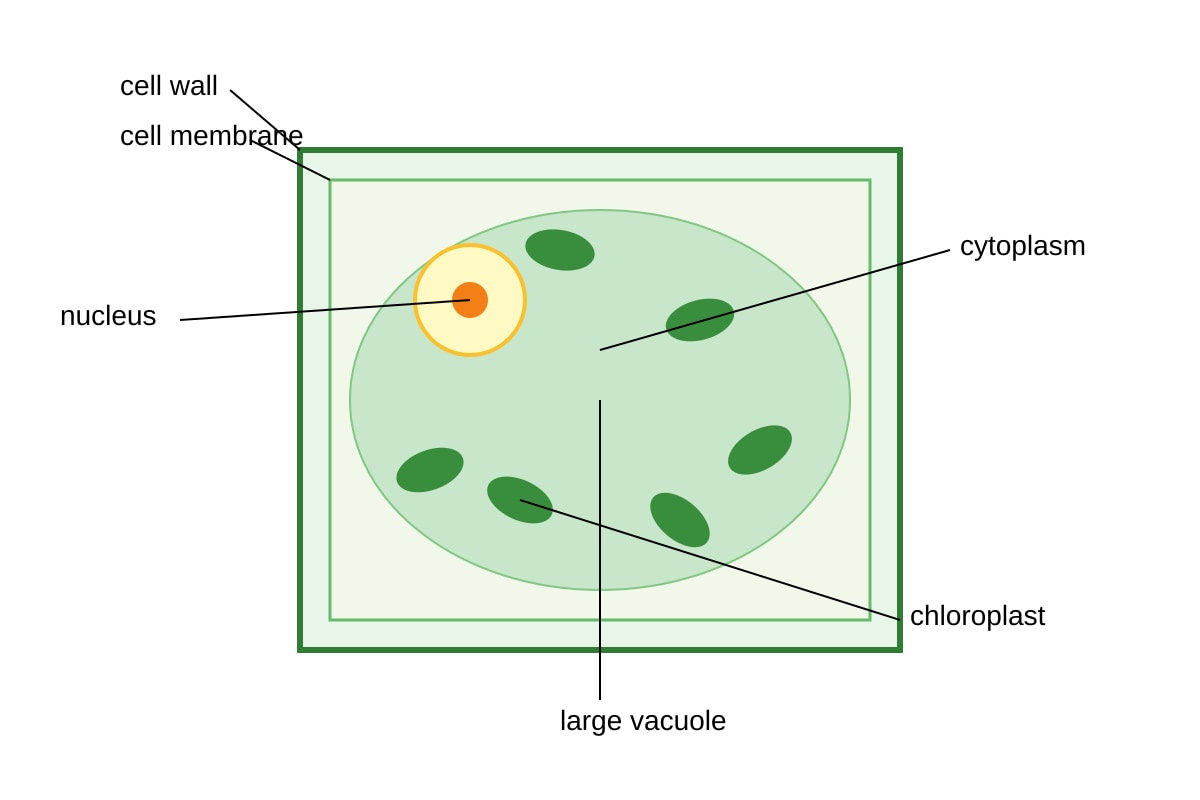
(a) X = chloroplast; Y = vacuole [2] (1 each)
(b) Site of photosynthesis / makes glucose using light energy [1]
Teaching note: From diagram, green organelle = chloroplast; large fluid space = central vacuole.
12. [3]
(a) Osmosis is the net movement of water molecules from a region of higher water potential to lower water potential through a partially permeable membrane. [2] (def + membrane)
(b) Solution A is less concentrated (hypotonic) than cell sap. [1]
Teaching note: Mass increase = water entered = outside dilute.
13. [4]
(a) Carbon, hydrogen, oxygen [1]
(b) Energy storage / insulation / protection of organs [1]
(c) Benedict's test; brick red (or orange-red) [2]
Teaching note: Carbs = C,H,O. Fats store energy long-term. Benedict's needs heating.
14. [3]
(a) Enzyme acts only on one (or few) specific substrate(s). [1]
(b) Lock-and-key: active site shape fits only a specific substrate; different substrate cannot bind → no reaction. [2]
Teaching note: Specificity due to complementary shape.
15. [4]
(a) Ribosome (on rough ER) [1]
(b) Ribosome (RER) → Golgi body → secretory vesicle → cell membrane → release [3] (1 each step)
Teaching note: Protein synthesis starts at RER-bound ribosomes.
16. [4]
(a) Q: Protein present; R: Reducing sugar present; S: Fat present [3]
(b) Q (protein building blocks = amino acids; enzymes are proteins) [1]
Teaching note: Biuret→protein; Benedict's→reducing sugar; Ethanol→fat.
Section C: Extended Response
17. [6]
Mark breakdown: 3 points each cell (structure + function link).
- Red blood cell: transports O₂. Biconcave → ↑SA. No nucleus → more haemoglobin. No organelles → fits capillaries. [3]
- Root hair cell: absorbs water/minerals. Long extension → ↑SA. Thin wall → easy entry. Many mitochondria → active transport. [3]
Teaching note: Must explain, not just list.
18. [6]
(a) Rough endoplasmic reticulum (RER); amino acids taken up by ribosomes on RER for protein synthesis. [2]
(b) RER → Golgi body (modify) → vesicle → membrane → exocytosis. [4] (1 each)
Teaching note: Radioactive amino acid pathway is classic SA2 pattern.
19. [8]
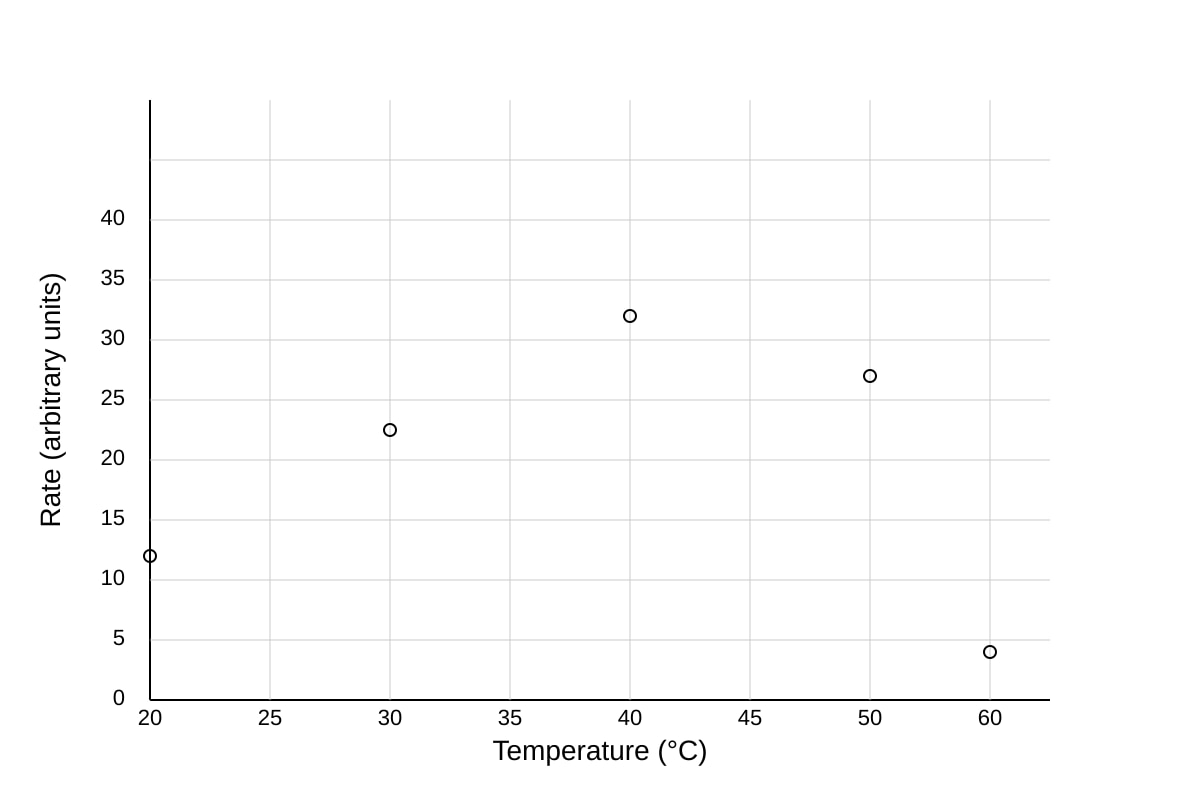
(a) Graph plotted: points (20,12),(30,25),(40,38),(50,30),(60,8) joined. [2]
(b) Optimum = 40 °C; rate rises then falls as enzyme denatures. [4] (2+2)
(c) At 60 °C enzyme denatured; active site lost; reaction fails. [2]
Teaching note: Peak rate at optimum; high T breaks bonds.
20. [8]
Mark descriptors: 2 marks per row.
- Energy: Diffusion = none (passive); Active = ATP needed.
- Direction: Diffusion = down gradient; Active = against gradient.
- Example: Diffusion = O₂ into blood; Active = root ion uptake.
Teaching note: Clear contrast shows understanding.