From Real Exams Exam Paper
Secondary 3 Biology Semestral Assessment 2 (End of Year) Paper 3
Free Sec 3 Biology SA2 Paper 3, HY3 Exam version, with questions, answers, and O Level-style practice for Singapore students.
These static practice materials are generated from the site's syllabus and paper-generation workflow, with source and model context shown so students and parents can evaluate the material before use.
Questions
TuitionGoWhere Exam Practice (AI) — SA2 Biology Secondary 3 (Version 3)
School: TuitionGoWhere Secondary School (AI)
Subject: Biology
Level: Secondary 3
Paper: SA2 Practice Paper (Version 3 of 5)
Duration: 60 minutes
Total Marks: 60
Name: ______________________
Class: _________
Date: ____________
Instructions:
- Answer all questions in the spaces provided.
- Section A: Multiple Choice (1 mark each). Choose the best answer.
- Section B: Structured Questions (total 30 marks). Show your working and explanations where required.
- Section C: Extended Response (total 20 marks). Write in full sentences and link structure to function.
- Use blue or black pen.
Section A: Multiple Choice (Questions 1–5, 1 mark each, Total 5 marks)
-
A growing cell is supplied with radioactive amino acids. Which cell component would first show an increase in radioactivity? [1]
A) Nucleus
B) Rough endoplasmic reticulum
C) Golgi body
D) Mitochondrion -
Which of the following best describes the insulin-producing cells in the pancreas? [1]
A) An organ in an organism
B) An organ system in an organism
C) A tissue made of similar cells
D) A single specialised organelle -
Which food test gives a brick-red precipitate after heating with the sample? [1]
A) Iodine test for starch
B) Benedict’s test for reducing sugar
C) Biuret test for protein
D) Ethanol test for fat -
The movement of water molecules from a region of high water potential to low water potential through a selectively permeable membrane is called: [1]
A) Diffusion
B) Active transport
C) Osmosis
D) Translocation -
Which organelle is the main site of energy release in a muscle cell? [1]
A) Ribosome
B) Chloroplast
C) Mitochondrion
D) Vacuole
Section B: Structured Questions (Questions 6–15, Total 30 marks)
-
(a) Name the process by which oxygen moves from the alveolus into the blood capillary. [1]
(b) Define this process. [2] -
A student carried out an experiment using a plant cell shown below.
Image pending generation: diagram for Q7.
(a) Name the structure labelled X (cell wall). [1]
(b) State what happens to the vacuole when the cell is placed in pure water. [2]
(c) Name the process shown by the arrows. [1]
-
(a) List the three chemical elements present in all carbohydrates. [1]
(b) State one main role of fats in the human body. [1]
(c) Name the smaller units that make up a protein. [1] -
A cell is viewed under an electron microscope. Identify the organelles described below:
(a) Site of protein synthesis, not membrane-bound. [1]
(b) Modifies and packages proteins into vesicles. [1]
(c) Controls cell activities and contains DNA. [1] -
Describe how a red blood cell is adapted for oxygen transport. Give two adaptations and explain each. [4]
(a) Adaptation 1: _______________________
Explanation: _______________________
(b) Adaptation 2: _______________________
Explanation: _______________________ -
The table shows results of food tests on sample X.
Test Reagent Observation 1 Iodine Blue-black 2 Benedict’s No change after heating 3 Biuret Lilac/purple (a) What biomolecule is present from Test 1? [1] (b) What biomolecule is present from Test 3? [1] (c) Is reducing sugar present? Give a reason. [2] -
Explain why active transport is needed for root hair cells to absorb mineral ions from soil. [3]
-
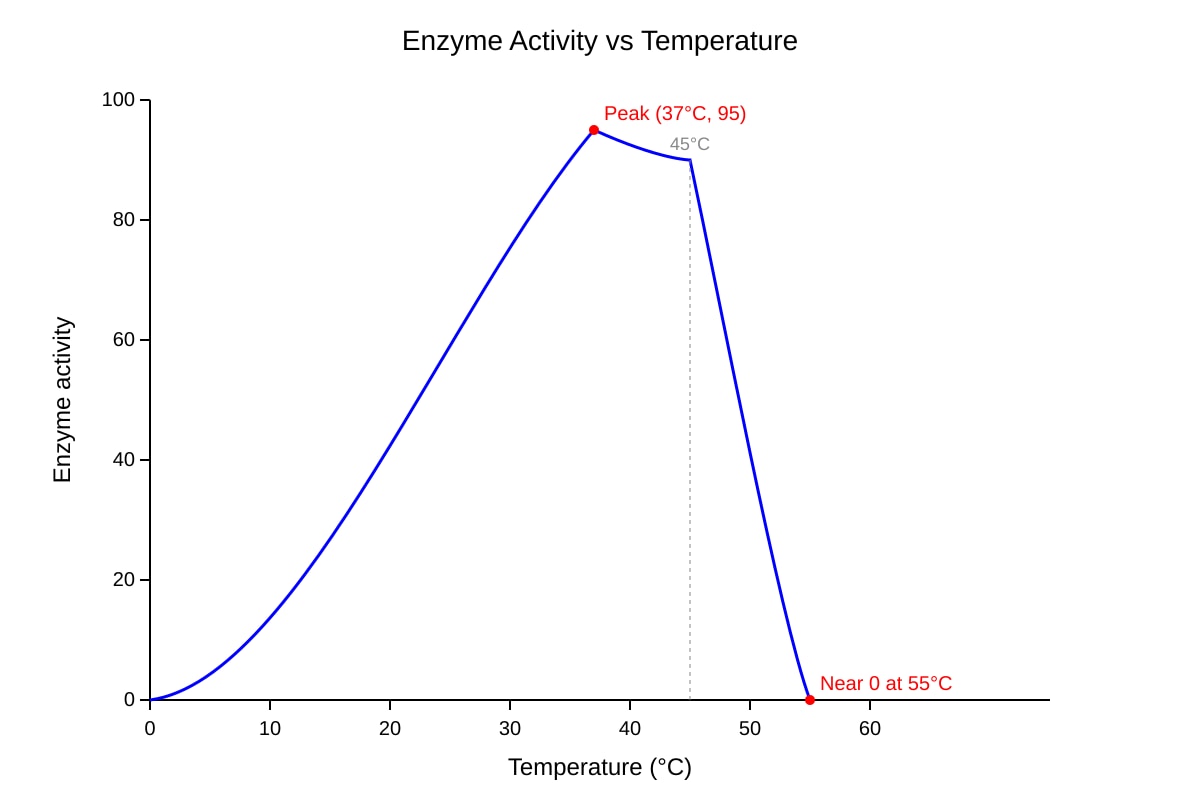
The graph shows enzyme activity at different temperatures.
Image pending generation: graph for Q13.
(a) At what temperature is the enzyme most active? [1]
(b) Suggest what happens to the enzyme above 45 °C. [2]
(c) Explain why enzyme activity decreases at very low temperature. [2]
14. Compare a typical animal cell and a typical plant cell. State two differences. [4]
(a) Difference 1: _______________________
(b) Difference 2: _______________________
- A cell is given radioactive glucose. Which organelle would show radioactivity during respiration? Explain. [2]
Section C: Extended Response (Questions 16–20, Total 20 marks)
-
Describe and explain how a red blood cell and a root hair cell are adapted to their functions. [6]
-
Explain the lock-and-key model of enzyme action. Include the terms active site and specificity. [4]
-
A student investigated osmosis using potato cylinders in different sugar solutions.
(a) Predict what happens to the mass of potato in very concentrated sugar solution. [2]
(b) Explain your prediction using the term water potential. [2] -
Compare diffusion and active transport. Give one similarity and two differences. [4]
-
A cell makes a protein for export. Trace the pathway of the protein from synthesis to release, naming three organelles. [4]
End of Paper
Answers
TuitionGoWhere Exam Practice (AI) — SA2 Biology Secondary 3 (Version 3) Answer Key
Total Marks: 60
Section A: Multiple Choice
-
B — Rough endoplasmic reticulum. [1]
Teaching note: Radioactive amino acids are used to build proteins at ribosomes on the rough ER, so it shows radioactivity first. Common mistake: choosing Golgi body (later step) or nucleus (holds DNA, not first site of protein synthesis). -
C — A tissue made of similar cells. [1]
Teaching note: Groups of similar insulin-producing cells = tissue (islets of Langerhans). Organ = multiple tissues; organ system = multiple organs. -
B — Benedict’s test for reducing sugar. [1]
Teaching note: Benedict’s reagent turns brick-red with reducing sugars after heating. Iodine = blue-black for starch; Biuret = lilac for protein; Ethanol = cloudy white for fat. -
C — Osmosis. [1]
Teaching note: Osmosis is diffusion of water through a selectively permeable membrane. Diffusion is for any substance; active transport needs energy. -
C — Mitochondrion. [1]
Teaching note: Mitochondria release energy via respiration. Muscle cells have many for contraction.
Section B: Structured Questions
-
(a) Diffusion [1]
(b) Diffusion is the net movement of particles from a region of higher concentration to a region of lower concentration. [2]
Marking: 1 for net movement, 1 for concentration gradient direction. -
(a) Cell wall [1]
(b) Vacuole swells / becomes turgid as water enters by osmosis. [2]
(c) Osmosis [1] -
(a) Carbon, hydrogen, oxygen (C, H, O) [1]
(b) Insulation / long-term energy storage [1]
(c) Amino acids [1] -
(a) Ribosome [1]
(b) Golgi body [1]
(c) Nucleus [1] -
[4] Mark breakdown: 2 adaptations × (1 structure + 1 explanation)
- Biconcave shape → increases surface area for oxygen exchange. [2]
- No nucleus → more space for haemoglobin. [2]
Common mistake: stating structure without explaining advantage.
-
(a) Starch [1]
(b) Protein [1]
(c) No. Benedict’s showed no change (no brick-red), so reducing sugar absent. [2] -
[3] Mineral ions in soil are often at lower concentration than inside root hair cell. Active transport uses energy to move ions against concentration gradient into the cell. This allows absorption even when soil is dilute.
-
(a) 37 °C [1]
(b) Enzyme denatures; shape of active site changes, activity lost. [2]
(c) Low temperature reduces molecular kinetic energy; fewer collisions with substrate, slower reaction. [2] -
[4] e.g. Plant cell has cell wall, animal does not. Plant has chloroplast, animal does not. (2 marks each with clear statement)
-
Mitochondrion. [1] Glucose is respired there to release energy. [1]
Section C: Extended Response
-
[6] 3 marks each cell.
Red blood cell: transports O₂; biconcave (SA increase); no nucleus (more Hb).
Root hair cell: absorbs water/minerals; long extension (SA increase); thin wall (short diffusion path). -
[4] Enzyme has specific active site (1). Substrate fits like key in lock (1). Only specific substrate binds (specificity) (1). Forms enzyme-substrate complex, reaction occurs (1).
-
(a) Loses mass / shrinks. [2]
(b) Sugar solution has lower water potential; water leaves potato by osmosis. [2] -
[4] Similarity: both move substances across membrane. Difference 1: diffusion no energy, active transport needs energy. Difference 2: diffusion down gradient, active transport against gradient.
-
[4] Ribosome (RER) synthesis → Golgi body packaging → vesicle to membrane release. (1 mark each + final release)
Free quiz and exam paper access
Enter your details to view this paper
Your access is remembered on this device.