From Real Exams Exam Paper
Secondary 3 Biology Semestral Assessment 2 (End of Year) Paper 2
Free Sec 3 Biology SA2 Paper 2, HY3 Exam version, with questions, answers, and O Level-style practice for Singapore students.
These static practice materials are generated from the site's syllabus and paper-generation workflow, with source and model context shown so students and parents can evaluate the material before use.
Questions
TuitionGoWhere Exam Practice (AI) — SA2 Biology Secondary 3
School: TuitionGoWhere Secondary School (AI)
Subject: Biology
Level: Secondary 3
Paper: SA2 Practice Paper (Version 2 of 5)
Duration: 60 minutes
Total Marks: 60
Name: ________________________
Class: ____________
Date: ____________
Instructions:
- Answer all questions in the spaces provided.
- Section A: Multiple Choice (10 questions, 1 mark each).
- Section B: Structured Questions (6 questions, total 24 marks).
- Section C: Extended Response (4 questions, total 26 marks).
- Use blue or black pen. Diagrams should be labelled clearly where required.
Section A: Multiple Choice (10 marks)
-
An actively dividing cell is supplied with radioactive nucleotides. Which cell structure would first show increased radioactivity? [1]
A) Ribosome
B) Nucleus
C) Mitochondrion
D) Golgi body -
Which of the following is a function of the cell membrane? [1]
A) Storage of genetic material
B) Control of substance entry and exit
C) Production of ATP
D) Synthesis of starch -
A cell placed in a concentrated salt solution shrinks. This is best explained by: [1]
A) Diffusion
B) Active transport
C) Osmosis
D) Fermentation -
Which biomolecule is made up of amino acids? [1]
A) Starch
B) Glucose
C) Protein
D) Fat -
The enzyme amylase digests starch into: [1]
A) Glucose
B) Maltose
C) Amino acids
D) Fatty acids -
Which cell adaptation increases surface area for absorption in roots? [1]
A) Thick cell wall
B) Root hair
C) Large vacuole
D) Chloroplasts -
Benedict's test is used to detect: [1]
A) Starch
B) Protein
C) Reducing sugar
D) Fat -
Which organelle is the site of aerobic respiration? [1]
A) Ribosome
B) Nucleus
C) Mitochondrion
D) Vacuole -
Active transport differs from diffusion because it: [1]
A) Requires no energy
B) Moves substances down a concentration gradient
C) Requires energy and moves against a gradient
D) Occurs only in dead cells -
A palisade mesophyll cell is adapted for photosynthesis by having: [1]
A) Many mitochondria
B) Many chloroplasts
C) A thick cell wall
D) No nucleus
Section B: Structured Questions (24 marks)
-
(a) State the function of the ribosome. [1]
(b) State the function of the Golgi body. [1] -
A student adds iodine solution to a piece of bread and it turns blue-black.
(a) What biomolecule is present? [1]
(b) Name the test used. [1] -
(a) Define osmosis. [2]
(b) State one difference between osmosis and diffusion. [1] -
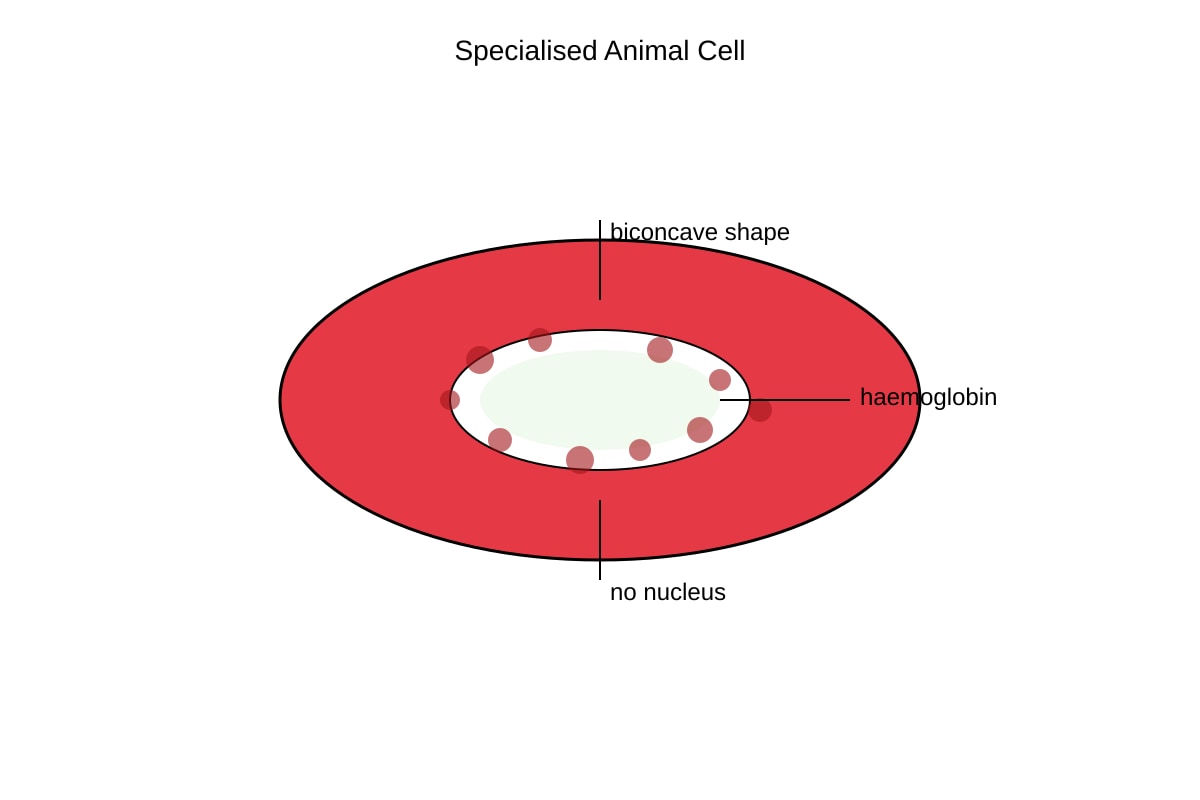
The diagram below shows a specialised animal cell.
Image pending generation: diagram for 14.
(a) Identify the cell type. [1]
(b) State one adaptation shown and explain its function. [2]
-
A practical uses Benedict's test on glucose solution, heated with the reagent.
(a) State the initial colour of Benedict's reagent. [1]
(b) State the colour after heating with reducing sugar. [1]
(c) What does a green precipitate indicate about sugar concentration? [1] -
(a) Name two chemical elements present in proteins. [1]
(b) State the main role of fats in the human body. [1]
(c) State one food test for fats. [1]
Section C: Extended Response (26 marks)
-
Describe and explain how a red blood cell and a root hair cell are adapted to their functions. [6]
-
Explain the lock-and-key model of enzyme action. Include how temperature affects enzyme activity. [6]
-
A cell is placed in distilled water and another in 10% sucrose solution.
(a) Predict the appearance of each cell after 30 minutes, assuming one is animal and one plant. [4]
(b) Explain your predictions using osmosis. [4] -
A student investigates the effect of pH on catalase activity using hydrogen peroxide.
(a) State a suitable independent variable, dependent variable, and control variable. [3]
(b) Describe how the rate of reaction could be measured. [3]
(c) Predict and explain the result at pH 2. [4]
Answers
TuitionGoWhere Exam Practice (AI) — SA2 Biology Secondary 3 (Version 2) Answer Key
Total Marks: 60
Section A: Multiple Choice
- B — Nucleus. Radioactive nucleotides are used for DNA/RNA synthesis in the nucleus. [1]
- B — Control of substance entry and exit. [1]
- C — Osmosis (water leaves cell to concentrated solution). [1]
- C — Protein. [1]
- B — Maltose. [1]
- B — Root hair. [1]
- C — Reducing sugar. [1]
- C — Mitochondrion. [1]
- C — Requires energy and moves against gradient. [1]
- B — Many chloroplasts. [1]
Section B: Structured
- (a) Protein synthesis. [1] (b) Modifies and packages proteins. [1]
- (a) Starch. [1] (b) Iodine test. [1]
- (a) Osmosis is the net movement of water molecules from a region of higher water potential to lower water potential through a partially permeable membrane. [2] (b) Osmosis involves water only; diffusion can be any substance. [1]
- (a) Red blood cell. [1] (b) Biconcave shape → increases surface area for oxygen exchange. [2]
- (a) Blue. [1] (b) Red/orange (or brick-red). [1] (c) Low concentration of reducing sugar. [1]
- (a) Carbon, hydrogen, oxygen, nitrogen (any two). [1] (b) Energy storage / insulation. [1] (c) Ethanol test. [1]
Section C: Extended
- [6] Red blood cell: transports O₂; biconcave → SA for loading; no nucleus → more haemoglobin; no organelles → narrow capillaries. Root hair: absorbs water/minerals; long extension → SA; thin wall → short diffusion path; large vacuole → osmotic gradient. (3 marks each cell: 1 structure, 1 function, 1 explanation)
- [6] Enzyme has active site complementary to substrate (lock-key). Specific. Temp rises → KE increases → more collisions until optimum; above denatures → shape lost. (3 marks model, 3 marks temperature)
- [8] (a) Animal in distilled: bursts (lysis); plant in sucrose: plasmolysis. [4] (b) Distilled: high WP outside → water in by osmosis; sucrose: low WP outside → water out. [4]
- [10] (a) IV: pH; DV: oxygen rate; CV: temp, H₂O₂ conc. [3] (b) Measure O₂ volume/time or bubble count. [3] (c) Low activity: enzyme denatured at acidic pH. [4]
Free quiz and exam paper access
Enter your details to view this paper
Your access is remembered on this device.