From Real Exams Exam Paper
Secondary 3 Biology Semestral Assessment 2 (End of Year) Paper 1
Free Sec 3 Biology SA2 Paper 1, HY3 Exam version, with questions, answers, and O Level-style practice for Singapore students.
These static practice materials are generated from the site's syllabus and paper-generation workflow, with source and model context shown so students and parents can evaluate the material before use.
Questions
Free quiz and exam paper access
Enter your details to view this paper
Your access is remembered on this device.
Answers
TuitionGoWhere Exam Practice (AI) — SA2 Practice Paper Answer Key (Version 1)
Subject: Biology
Level: Secondary 3
Paper: SA2 Practice Paper
Total Marks: 60
Section A: Multiple Choice
-
B) Nucleus [1]
Teaching note: Radioactive nucleotides are used to build DNA/RNA. The nucleus is where DNA is located and where RNA is synthesised, so it shows radioactivity first. Trap: students may pick ribosome (for proteins) or mitochondrion (for glucose). -
C) Tissue [1]
Teaching note: A group of similar cells (muscle fibres) working together is a tissue. Organ = multiple tissues; organ system = multiple organs. -
B) Starch [1]
Teaching note: Iodine solution turns blue-black in presence of starch. Benedict's = reducing sugar; biuret = protein; ethanol = fat. -
C) Active transport [1]
Teaching note: Active transport uses energy (ATP) to move substances from low to high concentration. Diffusion and osmosis are passive. -
B) Its active site matches only one substrate shape [1]
Teaching note: Lock-and-key model: enzyme active site is complementary to one substrate only → specificity.
Section B: Short Structured Questions
-
(a) Ribosome [1]
(b) Mitochondrion [1]
Teaching note: Ribosomes are the protein factories; mitochondria release energy via respiration. -
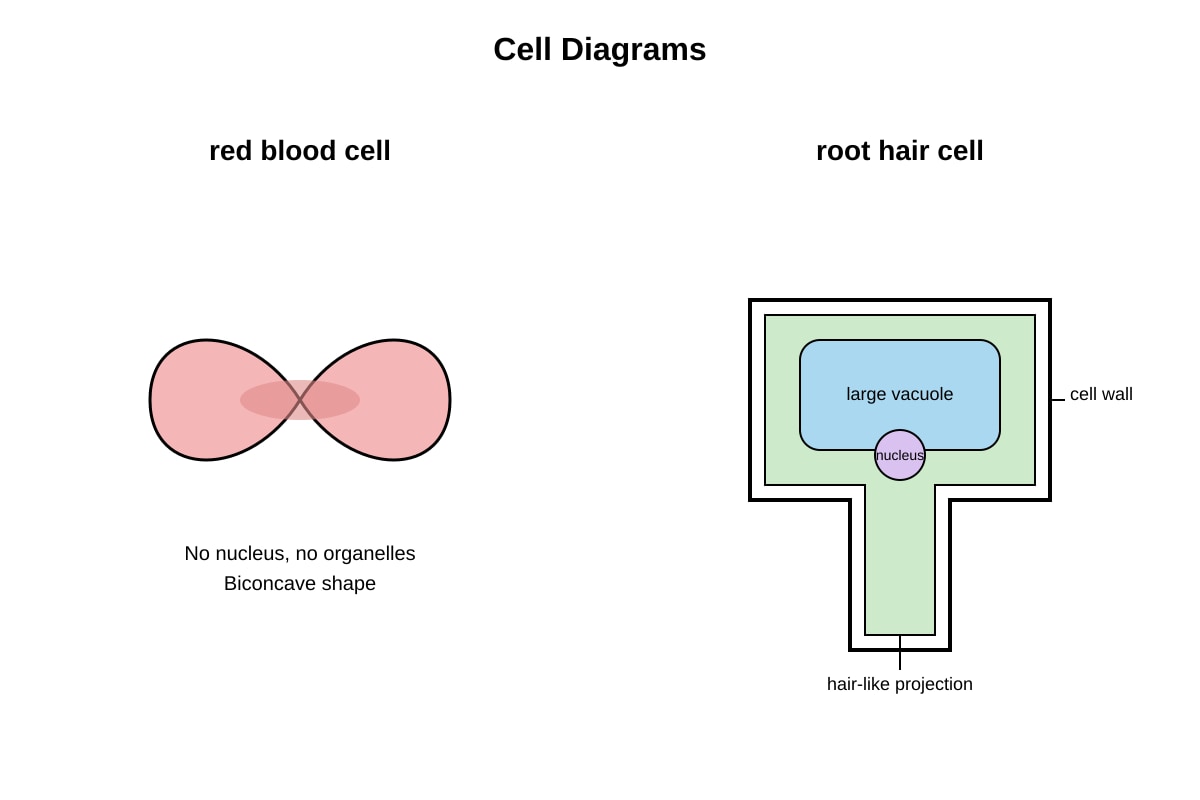
Adaptation: Biconcave shape (or no nucleus).
Explanation: Biconcave shape increases surface area for oxygen exchange / no nucleus allows more space for haemoglobin to carry oxygen. [2]
Marking: 1 mark structure, 1 mark function link. -
Biuret test procedure: [3]
- Add biuret Solution A (sodium hydroxide) to sample. [1]
- Add biuret Solution B (copper sulphate) drop by drop. [1]
- If protein present, solution turns purple/violet. [1]
Teaching note: No heating required (unlike Benedict's).
-
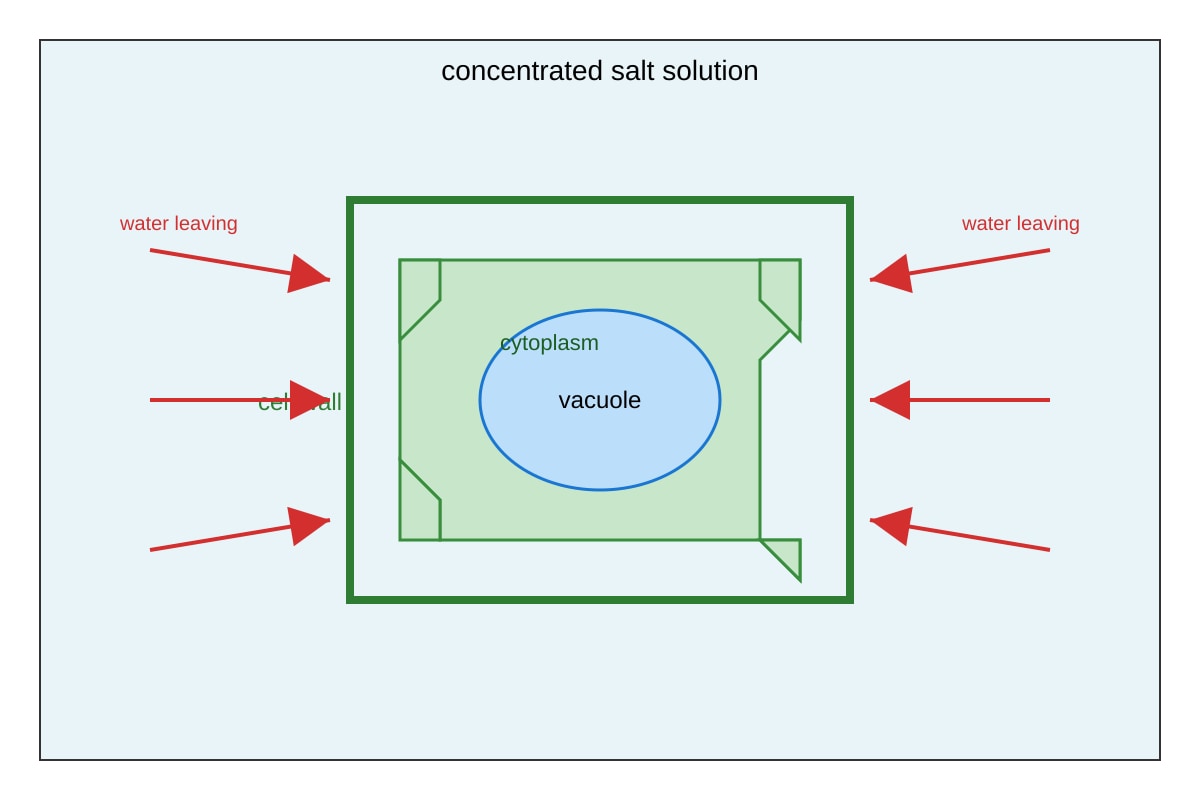
(a) Osmosis [1]
(b) Plasmolysis [1]
(c) Water moves out of cell by osmosis to the more concentrated (lower water potential) salt solution, causing cytoplasm to shrink from wall. [2]
Marking: 1 for water potential gradient, 1 for result. -
Pathway: Radioactive amino acids → ribosome on rough ER (protein synthesis) → rough ER (transport) → Golgi body (modify/pack) → secretory vesicles. [3]
Marking: 1 mark each for RER, Golgi, vesicles in correct order. -
Two differences: e.g. Plant cell has cell wall, animal does not. Plant has chloroplasts, animal does not. Plant has large central vacuole, animal small/no vacuole. [2]
Marking: 1 mark per correct difference. -
Orange-red = reducing sugar present (positive Benedict's at high concentration). [2]
Teaching note: Green/yellow = low; orange-red = high reducing sugar. -
Diffusion: Movement of particles from high to low concentration without energy. [1]
Example: Oxygen from alveoli to blood in lungs. [2]
Marking: 1 def, 1 example, 1 correct context. -
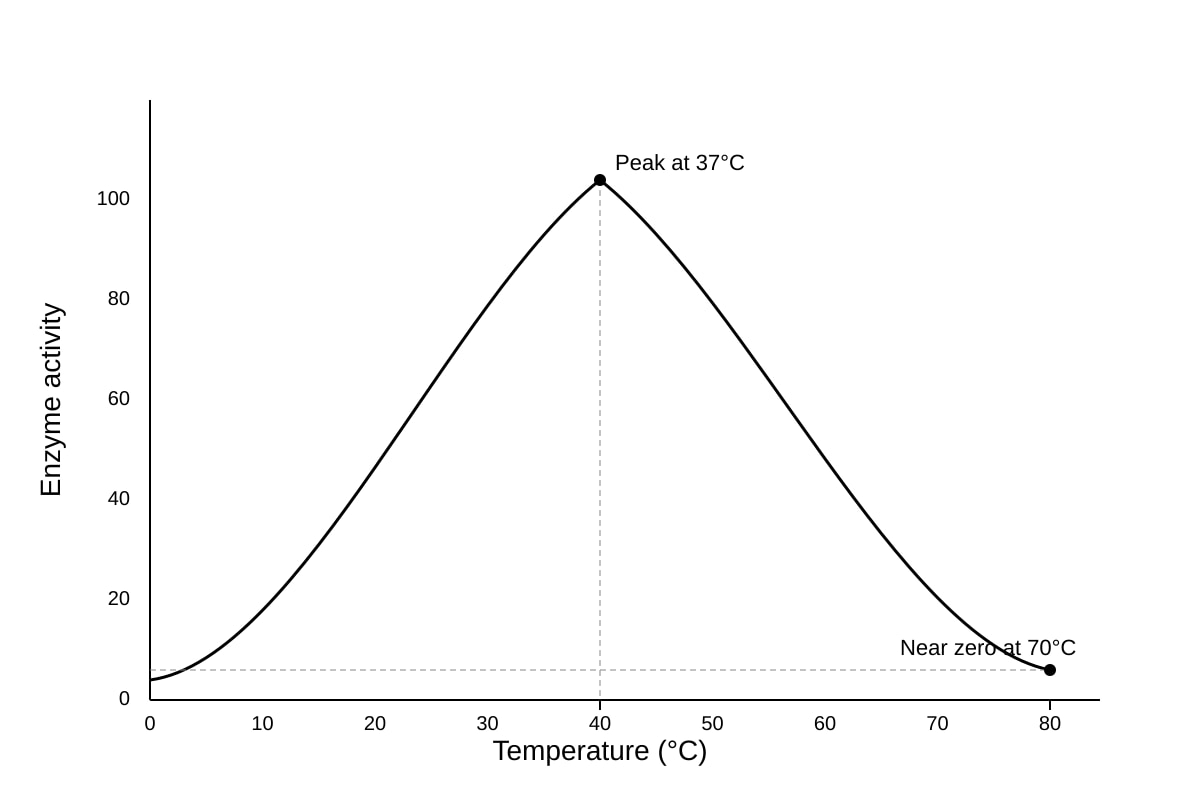
(a) 37°C [1]
(b) Above 40°C enzyme denatures; active site changes shape, substrate no longer fits, activity falls. [2] -
Carbon, hydrogen, oxygen (C, H, O) [1]
-
Adaptation: Many chloroplasts / columnar shape / packed at top of leaf.
Explanation: Maximises light absorption for photosynthesis. [2] -
Osmosis: Passive (no energy), water moves high to low water potential. [2]
Active transport: Uses energy, ions move low to high concentration. [2] -
Mitochondrion [1]; glucose is used in respiration there to release energy. [1]
-
(a) Modifies, sorts, packages proteins into vesicles. [1]
(b) Rough ER has ribosomes on surface (protein synthesis); smooth ER has no ribosomes (lipid synthesis). [2]
Section C: Extended Response
- Red blood cell: [3]
- Function: transport oxygen.
- Biconcave: increases SA for gas exchange.
- No nucleus/organelles: more room for haemoglobin.
Root hair cell: [3] - Function: absorb water/minerals from soil.
- Long hair extension: increases SA for absorption.
- Large vacuole: maintains water potential gradient.
Marking descriptors: 3 marks each cell (1 structure, 1 function, 1 explanation). Must link adaptation to function for full marks.