From Real Exams Exam Paper
Secondary 3 Biology Semestral Assessment 2 (End of Year) Paper 1
Free Exam-Derived Secondary 3 Biology Semestral Assessment 2 (End of Year) Paper 1 practice paper with questions and answers for Singapore students. This page is rendered as a direct URL so the questions and answers can be discovered without pressing in-page buttons.
These static practice materials are generated from the site's syllabus and paper-generation workflow, with source and model context shown so students and parents can evaluate the material before use.
Questions
TuitionGoWhere Practice Paper - Biology Secondary 3
TuitionGoWhere Secondary School (AI)
Subject: Biology
Level: Secondary 3
Paper: SA2
Duration: 1 hour 30 minutes
Total Marks: 65
Name: _________________ Class: _________ Date: _________
Instructions to Candidates
- This paper consists of Section A and Section B.
- Answer ALL questions in both sections.
- Write your answers in the spaces provided.
- The use of calculators is not permitted.
- Show all working clearly for calculation questions.
Section A: Multiple Choice Questions [15 marks]
For each question, choose the best answer and write the letter in the box provided.
1. Which sequence shows the correct pathway for protein synthesis and export in a cell?
A) Nucleus → Golgi apparatus → Rough ER → Secretory vesicles
B) Nucleus → Rough ER → Golgi apparatus → Secretory vesicles
C) Rough ER → Nucleus → Golgi apparatus → Secretory vesicles
D) Golgi apparatus → Rough ER → Nucleus → Secretory vesicles
Answer: [ ]
2. The diagram shows a plant cell. Which structure is responsible for controlling the entry and exit of substances?
[Labels: 1-Cell wall, 2-Cell membrane, 3-Cytoplasm, 4-Nucleus, 5-Vacuole, 6-Chloroplast]
A) 1
B) 2
C) 4
D) 5
Answer: [ ]
3. Which test would give a positive result when testing for the presence of starch?
A) Benedict's test - blue to orange
B) Iodine test - yellow to blue-black
C) Biuret test - blue to purple
D) Ethanol test - clear to milky white
Answer: [ ]
4. A student observes red blood cells under different conditions. In which solution would the cells appear shriveled?
A) Distilled water
B) 0.9% salt solution
C) 5% salt solution
D) 0.1% salt solution
Answer: [ ]
5. Which factor would NOT directly affect the rate of photosynthesis?
A) Light intensity
B) Carbon dioxide concentration
C) Oxygen concentration
D) Temperature
Answer: [ ]
Section B: Structured Questions [50 marks]
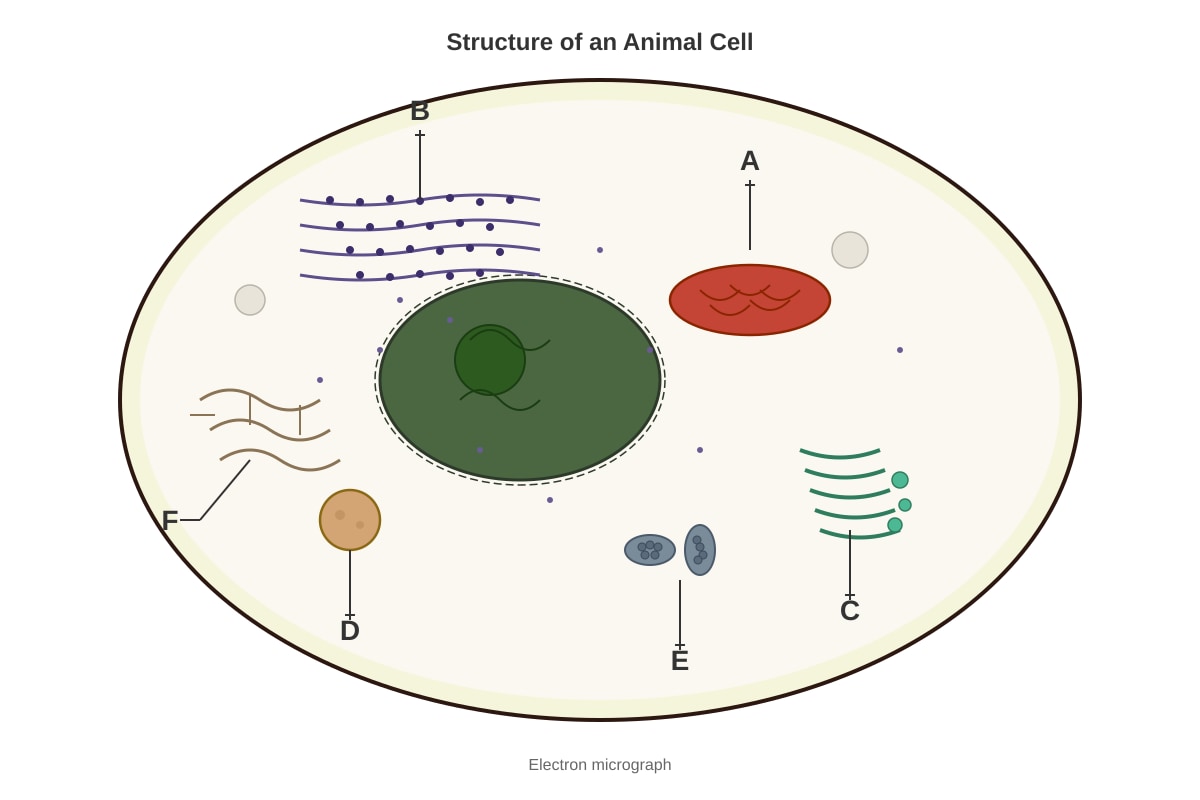
6. The diagram shows the structure of an animal cell as seen under an electron microscope.
[Diagram shows cell with labeled organelles A-F]
(a) Name the organelles labeled A, B, and C. [3 marks]
A: _________________________
B: _________________________
C: _________________________
(b) State the function of organelle B. [1 mark]
(c) Explain why this cell would have many mitochondria if it were a muscle cell. [2 marks]
7. A student investigated the effect of temperature on the activity of amylase enzyme using the following method:
- Starch solution and amylase enzyme were mixed at different temperatures
- Samples were tested with iodine solution every 30 seconds
- The time taken for the starch to be completely digested was recorded
The results are shown in the table below:
| Temperature (°C) | Time for complete digestion (seconds) |
|---|---|
| 20 | 240 |
| 30 | 180 |
| 40 | 120 |
| 50 | 90 |
| 60 | 150 |
| 70 | 300 |
| 80 | No digestion |
(a) How would the student know that starch digestion was complete? [1 mark]
(b) What is the optimum temperature for amylase activity? [1 mark]
(c) Explain why no digestion occurred at 80°C. [2 marks]
(d) Describe and explain what happens to enzyme activity between 50°C and 70°C. [3 marks]
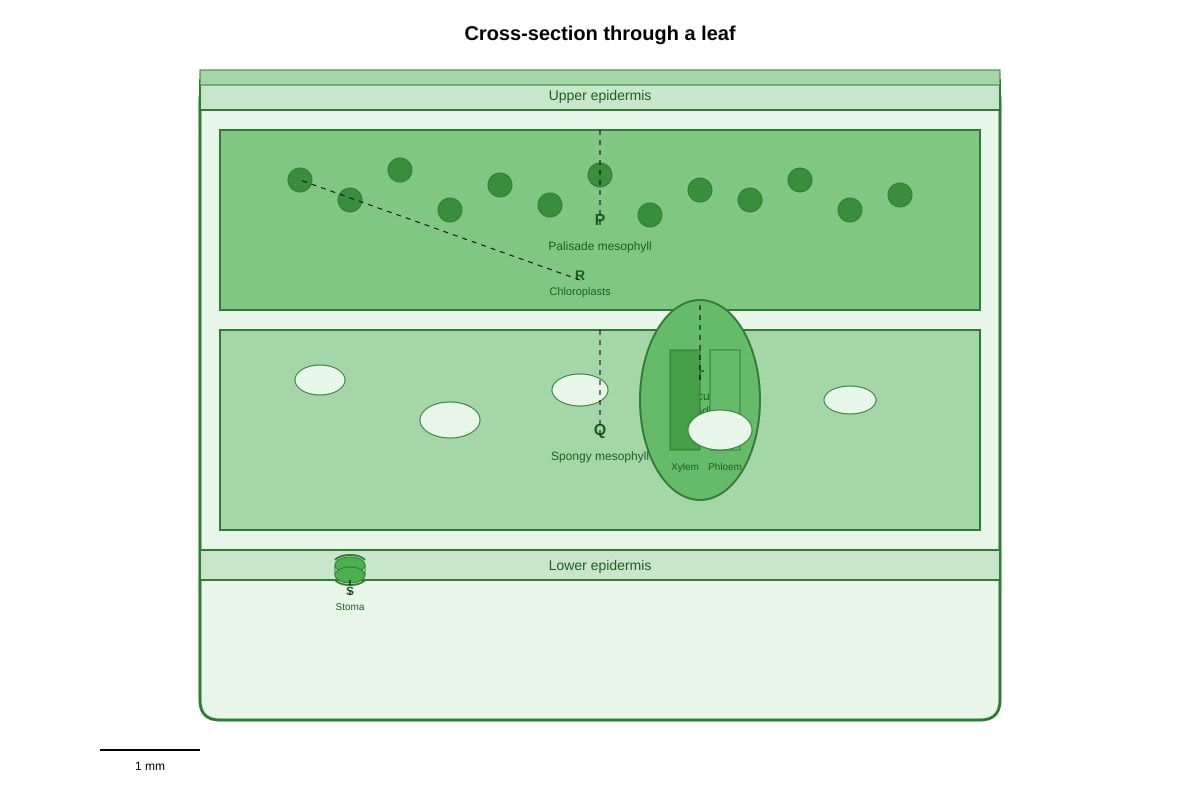
8. The diagram shows a cross-section through a leaf.
[Diagram shows leaf cross-section with structures labeled P, Q, R, S, T]
(a) Identify the structures labeled P and Q. [2 marks]
P: _________________________
Q: _________________________
(b) Explain how structure R is adapted for photosynthesis. [3 marks]
Adaptation 1: ____________________________________________
Explanation: _____________________________________________
Adaptation 2: ____________________________________________
Explanation: _____________________________________________
(c) A student placed this leaf in bright sunlight and covered part of it with black paper. After 6 hours, the leaf was tested for starch.
Predict and explain the results of the starch test for:
(i) The uncovered part of the leaf [2 marks]
Result: _________________________________________________
Explanation: _____________________________________________
(ii) The covered part of the leaf [2 marks]
Result: _________________________________________________
Explanation: _____________________________________________
9. The pedigree chart shows the inheritance of cystic fibrosis in a family. Cystic fibrosis is caused by a recessive allele.
[Pedigree showing: Generation 1: Male (unaffected) × Female (unaffected) → Generation 2: 3 unaffected children, 1 affected child]
(a) Using the symbols C for the normal allele and c for the cystic fibrosis allele, state the genotypes of:
(i) The affected child [1 mark]
(ii) Both parents [2 marks]
Father: _________ Mother: _________
(b) Complete the genetic diagram to show this cross. [3 marks]
Parents' genotypes: _______ × _______
Gametes: _______ _______ _______ _______
Offspring genotypes: _________________________________
(c) What is the probability that their next child will have cystic fibrosis? [1 mark]
10. Compare and contrast the structure and function of red blood cells and root hair cells. [6 marks]
Red Blood Cell:
Structure: _______________________________________________
Function: _______________________________________________
Root Hair Cell:
Structure: _______________________________________________
Function: _______________________________________________
Similarities: __________________________________________
Differences: __________________________________________
11. Describe the process of photosynthesis, including the two main stages and their locations within the chloroplast. [8 marks]
12. A student set up an experiment to investigate transpiration in a leafy shoot using a potometer.
(a) Explain why the air bubble moved up the capillary tube. [3 marks]
(b) Suggest two environmental factors that would increase the rate of transpiration and explain how each factor has this effect. [4 marks]
Factor 1: _______________________________________________
Explanation: _____________________________________________
Factor 2: _______________________________________________
Explanation: _____________________________________________
END OF PAPER
Answers
TuitionGoWhere Practice Paper - Biology Secondary 3 (Answer Key)
Total Marks: 65
Section A: Multiple Choice Questions [15 marks - 3 marks each]
1. B - Nucleus → Rough ER → Golgi apparatus → Secretory vesicles Correct pathway for protein synthesis and export
2. B - 2 (Cell membrane) Cell membrane is selectively permeable and controls entry/exit of substances
3. B - Iodine test - yellow to blue-black Iodine test for starch: yellow/brown iodine turns blue-black in presence of starch
4. C - 5% salt solution Hypertonic solution causes water to leave cells by osmosis, making them shrivel
5. C - Oxygen concentration Oxygen is a product of photosynthesis, not a limiting factor
Section B: Structured Questions [50 marks]
6. (a) [3 marks - 1 mark each]
- A: Nucleus
- B: Mitochondrion/Mitochondria
- C: Rough endoplasmic reticulum/Rough ER
6. (b) [1 mark]
- Produces energy/ATP for cellular processes OR Site of aerobic respiration
6. (c) [2 marks]
- Muscle cells require a lot of energy for contraction (1 mark)
- Many mitochondria produce more ATP/energy (1 mark)
7. (a) [1 mark]
- Iodine solution remains yellow/brown OR No blue-black color with iodine
7. (b) [1 mark]
- 50°C
7. (c) [2 marks]
- High temperature denatures the enzyme (1 mark)
- Active site changes shape, cannot bind to substrate (1 mark)
7. (d) [3 marks]
- Enzyme activity decreases (1 mark)
- Temperature is above optimum, enzyme begins to denature (1 mark)
- Higher temperature causes more enzyme molecules to lose their shape (1 mark)
8. (a) [2 marks - 1 mark each]
- P: Upper epidermis
- Q: Palisade mesophyll (tissue/cells)
8. (b) [3 marks]
- Adaptation 1: Contains many chloroplasts (1 mark)
- Explanation: More chlorophyll to absorb light energy (½ mark)
- Adaptation 2: Cells arranged in columns/tightly packed (½ mark)
- Explanation: Maximizes light interception (1 mark)
8. (c) (i) [2 marks]
- Result: Blue-black color with iodine test/Starch present (1 mark)
- Explanation: Light available for photosynthesis, glucose converted to starch (1 mark)
8. (c) (ii) [2 marks]
- Result: Yellow/brown color with iodine test/No starch present (1 mark)
- Explanation: No light available, no photosynthesis, no starch produced (1 mark)
9. (a) (i) [1 mark]
- cc
9. (a) (ii) [2 marks - 1 mark each]
- Father: Cc
- Mother: Cc
9. (b) [3 marks]
- Parents' genotypes: Cc × Cc (1 mark)
- Gametes: C c C c (1 mark)
- Offspring genotypes: CC, Cc, Cc, cc OR 1CC : 2Cc : 1cc (1 mark)
9. (c) [1 mark]
- 1/4 OR 25% OR 1 in 4
10. [6 marks] Red Blood Cell: (2 marks)
- Structure: Biconcave shape, no nucleus, contains haemoglobin (1 mark)
- Function: Transport oxygen from lungs to tissues (1 mark)
Root Hair Cell: (2 marks)
- Structure: Long projection/hair-like extension, thin cell wall (1 mark)
- Function: Absorb water and minerals from soil (1 mark)
Similarities: (1 mark)
- Both are specialized cells adapted to their function
Differences: (1 mark)
- RBC has no nucleus, root hair cell has nucleus OR RBC transports, root hair cell absorbs
11. [8 marks] Award marks for the following points:
- Photosynthesis converts light energy to chemical energy (1 mark)
- Occurs in two stages: light-dependent and light-independent reactions (1 mark)
- Light-dependent reactions occur in thylakoid membranes (1 mark)
- Light energy absorbed by chlorophyll, water split, oxygen released (1 mark)
- ATP and NADPH produced (1 mark)
- Light-independent reactions occur in stroma (1 mark)
- CO₂ fixed using ATP and NADPH from first stage (1 mark)
- Glucose synthesized (1 mark)
12. (a) [3 marks]
- Water evaporates from leaves during transpiration (1 mark)
- This creates a water potential gradient/tension (1 mark)
- Water is pulled up the xylem, carrying the bubble upward (1 mark)
12. (b) [4 marks - 2 marks per factor] Factor 1: Higher temperature (1 mark) Explanation: Increases rate of evaporation from leaf surfaces (1 mark)
Factor 2: Lower humidity/Dry air (1 mark) Explanation: Greater water potential gradient between leaf and air (1 mark)
Alternative acceptable factors: Wind/air movement, increased light intensity