AI Generated Quiz

Secondary 2 Science Scientific Inquiry Quiz

Free AI-Generated NVIDIA Nemotron 3 Ultra 550B A55B Free Secondary 2 Science Scientific Inquiry quiz with questions and answers for Singapore students. This page is rendered as a direct URL so the questions and answers can be discovered without pressing in-page buttons.

These static practice materials are generated from the site's syllabus and paper-generation workflow, with source and model context shown so students and parents can evaluate the material before use.

Secondary 2 Science AI Generated Generated by NVIDIA Nemotron 3 Ultra 550B A55B Free Updated 2026-06-07

Questions

<!-- TuitionGoWhere generation metadata: stage=5-1; model=nvidia/nemotron-3-ultra-550b-a55b:free; model_label=NVIDIA Nemotron 3 Ultra 550B A55B Free; generated=2026-06-06; Sources: Stage 4-0 LLM templates, syllabus context, and Stage 2 evidence where available. -->

Secondary 2 Science Quiz - Scientific Inquiry

Name: ___________________________
Class: ___________________________
Date: ___________________________
Score: ________ / 40

Duration: 45 minutes
Total Marks: 40

Instructions:

  • Answer all questions in the spaces provided.
  • Show all working for calculation questions.
  • Use appropriate units and significant figures.
  • Diagrams are not drawn to scale unless stated.

Section A: Multiple Choice Questions (10 marks)

Questions 1 to 10 carry 1 mark each. Choose the correct answer and write the letter (A, B, C, or D) in the box provided.

1. Which of the following best describes a hypothesis in scientific inquiry?

A. A proven fact that explains a natural phenomenon
B. A testable prediction based on observations and prior knowledge
C. A detailed procedure for conducting an experiment
D. A conclusion drawn after analysing experimental data

Answer:

2. In an experiment to investigate the effect of temperature on the rate of dissolving sugar in water, the independent variable is:

A. The mass of sugar dissolved
B. The temperature of the water
C. The volume of water used
D. The time taken for sugar to dissolve

Answer:

3. A student measures the length of a metal rod three times and obtains the readings: 15.2 cm, 15.3 cm, and 15.2 cm. The true length is 15.0 cm. Which statement best describes the measurements?

A. Accurate but not precise
B. Precise but not accurate
C. Both accurate and precise
D. Neither accurate nor precise

Answer:

4. When using a measuring cylinder to measure the volume of a liquid, the reading should be taken at:

A. The top of the meniscus
B. The bottom of the meniscus
C. The middle of the meniscus
D. Any point on the meniscus

Answer:

5. Which of the following is a controlled variable in an experiment investigating how the surface area of a parachute affects its falling time?

A. The height from which the parachute is dropped
B. The time taken for the parachute to reach the ground
C. The surface area of the parachute
D. The material used to make the parachute

Answer:

6. A student records the temperature of water every minute as it is heated. The data is best represented using:

A. A pie chart
B. A bar chart
C. A line graph
D. A histogram

Answer:

7. The precision of a measuring instrument refers to:

A. How close the measured value is to the true value
B. The smallest division on the instrument's scale
C. The range of values the instrument can measure
D. The consistency of repeated measurements

Answer:

8. In a fair test, only one variable is changed at a time. This variable is called the:

A. Dependent variable
B. Controlled variable
C. Independent variable
D. Responding variable

Answer:

9. A student measures the mass of a beaker as 50.0 g. After adding a liquid, the mass is 75.5 g. The mass of the liquid, expressed to the correct number of significant figures, is:

A. 25.5 g
B. 25.50 g
C. 26 g
D. 25 g

Answer:

10. Which of the following is not a step in the scientific method?

A. Making observations
B. Forming a hypothesis
C. Publishing results in a newspaper
D. Analysing data and drawing conclusions

Answer:


Section B: Structured Questions (18 marks)

Answer all questions in the spaces provided.

11. A group of students wants to investigate how the concentration of salt solution affects the growth of bean seedlings.

(a) State a suitable hypothesis for this investigation.
[1]


(b) Identify the independent variable and the dependent variable in this investigation.
Independent variable: ________________________________________________________ [1]
Dependent variable: _________________________________________________________ [1]

(c) State two variables that should be kept constant to ensure a fair test.

  1. ________________________________________________________________________ [1]
  2. ________________________________________________________________________ [1]

(d) The students measure the height of the seedlings using a ruler with 1 mm divisions. What is the smallest measurement they can reliably read from this ruler?
______________________________________________________________________________ [1]


12. In an experiment to determine the density of a small irregular stone, a student uses a measuring cylinder and an electronic balance.

(a) The student pours water into the measuring cylinder and records the initial volume as 45.0 cm³. After lowering the stone into the water, the volume reading is 53.5 cm³.
Calculate the volume of the stone.
[1]


(b) The mass of the stone is measured as 24.3 g. Calculate the density of the stone in g/cm³. Give your answer to three significant figures.
[2]


(c) The student notices that the water surface in the measuring cylinder is curved (meniscus). Explain how the student should position their eyes to avoid parallax error when taking the volume reading.
[1]


13. A student investigates the relationship between the length of a pendulum and its period (time for one complete swing). The table below shows the results.

Length of pendulum / cmPeriod / s
200.90
301.10
401.27
501.42
601.55

(a) Plot the data on the grid below. Draw a smooth curve of best fit.
[3]

<image_placeholder> id: Q13-fig1 type: graph linked_question: Q13 description: Blank graph grid for plotting period vs length of pendulum. X-axis: Length of pendulum / cm (0 to 70 cm, major gridlines every 10 cm). Y-axis: Period / s (0 to 1.8 s, major gridlines every 0.2 s). Grid size: 8 cm x 6 cm. No data points or lines pre-drawn. labels: X-axis: "Length of pendulum / cm", Y-axis: "Period / s" values: Data points: (20, 0.90), (30, 1.10), (40, 1.27), (50, 1.42), (60, 1.55) must_show: Clearly labelled axes with units and appropriate scales, gridlines, space for plotting 5 points and drawing a smooth curve </image_placeholder>

(b) Use your graph to estimate the period of a pendulum of length 35 cm. Show clearly on the graph how you obtained your answer.
[1]


(c) State the relationship between the length of the pendulum and its period based on the graph.
[1]


14. The diagram below shows a vernier caliper with its jaws closed.

<image_placeholder> id: Q14-fig1 type: diagram linked_question: Q14 description: Vernier caliper with jaws closed. Main scale reading shows 0 cm mark aligned with vernier 0 mark. Vernier scale has 10 divisions (0-10). The 4th vernier division aligns exactly with a main scale division. Main scale smallest division = 0.1 cm. Vernier scale least count = 0.01 cm. labels: Main scale, Vernier scale, Jaws, Zero marks, Aligned division (4th vernier division) values: Main scale: 0.0 cm at zero; Vernier: 4th division aligned; Least count = 0.01 cm must_show: Clear depiction of main scale and vernier scale alignment, zero error visible (positive zero error of +0.04 cm) </image_placeholder>

(a) State the zero error of the vernier caliper.
[1]


(b) When the jaws are used to measure the diameter of a metal sphere, the main scale reading is 2.3 cm and the 7th vernier division aligns with a main scale division. Calculate the corrected diameter of the sphere.
[2]


15. A student conducts an experiment to find the boiling point of pure water. She records the temperature every 30 seconds as the water is heated. The graph below shows her results.

<image_placeholder> id: Q15-fig1 type: graph linked_question: Q15 description: Temperature-time graph for heating water. X-axis: Time / min (0 to 10 min). Y-axis: Temperature / °C (0 to 110 °C). Graph shows temperature rising steadily from 25°C at 0 min to 100°C at 5 min, then remaining constant at 100°C from 5 min to 10 min. labels: X-axis: "Time / min", Y-axis: "Temperature / °C" values: Rising section: (0, 25) to (5, 100); Plateau section: (5, 100) to (10, 100) must_show: Clear temperature plateau at 100°C, labelled axes with units, smooth curve </image_placeholder>

(a) State the boiling point of pure water based on the graph.
[1]


(b) Explain why the temperature remains constant during the plateau region even though heating continues.
[2]


(c) The student's thermometer has a zero error of +0.5°C. If the thermometer reads 100.0°C at the plateau, what is the true boiling point of the water?
[1]


Section C: Data Analysis and Experimental Design (12 marks)

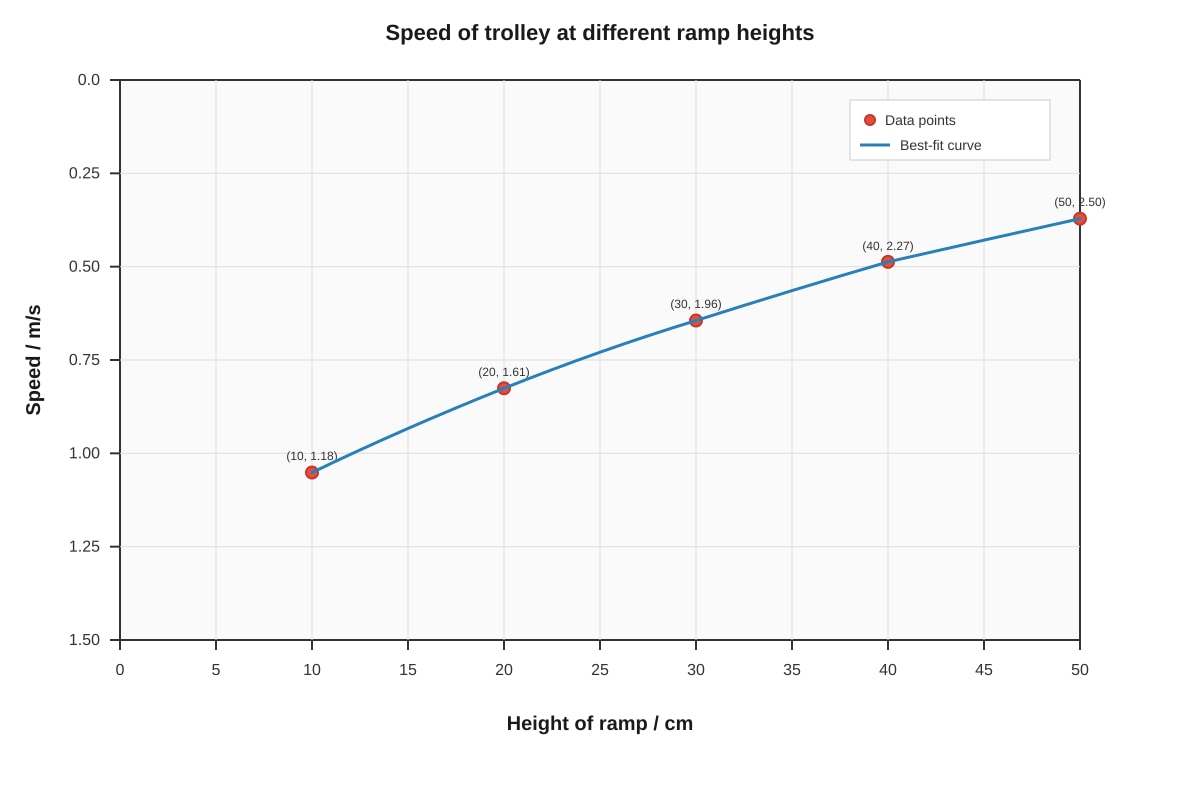
16. A student wants to investigate how the angle of a ramp affects the speed of a toy car rolling down it. She sets up a ramp of fixed length 1.5 m and varies the angle by changing the height of the raised end. She measures the time taken for the car to travel the length of the ramp.

(a) State the independent variable and the dependent variable in this investigation.
Independent variable: ________________________________________________________ [1]
Dependent variable: _________________________________________________________ [1]

(b) State two controlled variables that must be kept constant.

  1. ________________________________________________________________________ [1]
  2. ________________________________________________________________________ [1]

(c) The student repeats the timing three times for each angle and calculates the average time. Explain why repeating measurements and calculating an average improves the reliability of the results.
[2]


(d) The student plots a graph of average speed against angle of ramp. She draws a smooth curve of best fit. State one precaution she should take when drawing the curve of best fit.
[1]


17. In an experiment to investigate the effect of light intensity on the rate of photosynthesis, a student places a water plant in a test tube of water and shines a lamp on it at different distances. She counts the number of bubbles produced per minute.

The table below shows her results.

Distance of lamp from plant / cmNumber of bubbles per minute
1048
2032
3021
4014
509

(a) Plot the data on the grid below. Draw a smooth curve of best fit.
[3]

<image_placeholder> id: Q17-fig1 type: graph linked_question: Q17 description: Blank graph grid for plotting number of bubbles per minute vs distance of lamp. X-axis: Distance of lamp from plant / cm (0 to 60 cm, major gridlines every 10 cm). Y-axis: Number of bubbles per minute (0 to 55, major gridlines every 5). Grid size: 8 cm x 6 cm. No data points or lines pre-drawn. labels: X-axis: "Distance of lamp from plant / cm", Y-axis: "Number of bubbles per minute" values: Data points: (10, 48), (20, 32), (30, 21), (40, 14), (50, 9) must_show: Clearly labelled axes with units and appropriate scales, gridlines, space for plotting 5 points and drawing a smooth curve </image_placeholder>

(b) Describe the relationship between the distance of the lamp and the rate of photosynthesis.
[1]


(c) The student concludes: "Light intensity is directly proportional to the rate of photosynthesis."
Explain why this conclusion is not fully supported by the data.
[2]


(d) Suggest one way to improve the accuracy of measuring the rate of photosynthesis in this experiment.
[1]


18. A student measures the diameter of a wire using a micrometer screw gauge. The diagram shows the reading when the wire is placed between the anvil and spindle.

<image_placeholder> id: Q18-fig1 type: diagram linked_question: Q18 description: Micrometer screw gauge reading. Sleeve scale shows 5.5 mm (5 mm mark visible, half-way mark visible). Thimble scale shows 28th division aligned with reference line. Sleeve smallest division = 0.5 mm. Thimble has 50 divisions, least count = 0.01 mm. No zero error. labels: Sleeve scale, Thimble scale, Reference line, Anvil, Spindle values: Sleeve reading: 5.5 mm; Thimble reading: 28 × 0.01 mm = 0.28 mm; Zero error: 0.00 mm must_show: Clear micrometer diagram with sleeve and thimble scales readable, wire between anvil and spindle </image_placeholder>

(a) Read the diameter of the wire from the micrometer screw gauge.
[1]


(b) The student measures the diameter at three different positions along the wire and obtains: 5.78 mm, 5.76 mm, and 5.80 mm. Calculate the average diameter.
[1]


(c) Explain why measuring the diameter at several positions along the wire and taking an average gives a more accurate result.
[1]


19. The table below shows the results of an experiment to investigate the extension of a spring when different loads are hung from it.

Load / NExtension / cm
00.0
12.5
25.0
37.5
410.0
512.5

(a) Plot the data on the grid below. Draw the best-fit straight line.
[3]

<image_placeholder> id: Q19-fig1 type: graph linked_question: Q19 description: Blank graph grid for plotting extension vs load. X-axis: Load / N (0 to 6 N, major gridlines every 1 N). Y-axis: Extension / cm (0 to 14 cm, major gridlines every 2 cm). Grid size: 8 cm x 6 cm. No data points or lines pre-drawn. labels: X-axis: "Load / N", Y-axis: "Extension / cm" values: Data points: (0, 0.0), (1, 2.5), (2, 5.0), (3, 7.5), (4, 10.0), (5, 12.5) must_show: Clearly labelled axes with units and appropriate scales, gridlines, space for plotting 6 points and drawing a straight best-fit line through origin </image_placeholder>

(b) Determine the spring constant (force per unit extension) from your graph. State the unit.
[2]


(c) The student hangs a load of 6.0 N from the spring. Use your graph to predict the extension. State one assumption you made in your prediction.
[2]


20. A student is given an unknown clear liquid and is asked to determine whether it is pure water or a salt solution. She has access to the following apparatus: electronic balance, measuring cylinder, Bunsen burner, tripod, gauze, beaker, thermometer, and evaporating dish.

Design an experiment to distinguish between pure water and a salt solution. Your answer should include:

  • The measurements you would take
  • The procedure you would follow
  • How you would use the results to draw a conclusion
    [4]


End of Quiz

Answers

<!-- TuitionGoWhere generation metadata: stage=5-1; model=nvidia/nemotron-3-ultra-550b-a55b:free; model_label=NVIDIA Nemotron 3 Ultra 550B A55B Free; generated=2026-06-06; Sources: Stage 4-0 LLM templates, syllabus context, and Stage 2 evidence where available. -->

Secondary 2 Science Quiz - Scientific Inquiry (Answer Key)

Total Marks: 40


Section A: Multiple Choice Questions (10 marks)

1. Answer: B [1]

Explanation: A hypothesis is a testable prediction based on observations and prior knowledge. It is not a proven fact (A), a procedure (C), or a conclusion (D). A good hypothesis can be tested through experimentation.

2. Answer: B [1]

Explanation: The independent variable is the variable that is deliberately changed by the experimenter. In this investigation, the temperature of the water is being changed to observe its effect on the rate of dissolving. The mass of sugar dissolved (A) and time taken (D) are dependent variables. Volume of water (C) should be a controlled variable.

3. Answer: B [1]

Explanation: The readings (15.2, 15.3, 15.2 cm) are close to each other, showing precision (consistency). However, they are not close to the true value of 15.0 cm, so they are not accurate. Precision refers to repeatability; accuracy refers to closeness to the true value.

4. Answer: B [1]

Explanation: For most liquids (e.g., water), the meniscus is concave. The correct reading is taken at the bottom of the meniscus at eye level to avoid parallax error. (For mercury, which has a convex meniscus, the top is read.)

5. Answer: A [1]

Explanation: Controlled variables are kept constant to ensure a fair test. The height from which the parachute is dropped must be the same for all trials. The time taken (B) is the dependent variable. Surface area (C) is the independent variable. Material (D) could be a controlled variable, but height (A) is more fundamental and directly affects falling time.

6. Answer: C [1]

Explanation: A line graph is used to show how a continuous variable (temperature) changes over time (continuous). Pie charts show proportions, bar charts compare discrete categories, and histograms show frequency distributions of continuous data.

7. Answer: B [1]

Explanation: Precision of an instrument refers to the smallest division on its scale (least count), which indicates the finest measurement it can make. Option A describes accuracy. Option D describes precision of measurements (repeatability), not the instrument itself.

8. Answer: C [1]

Explanation: In a fair test, the independent variable is the one deliberately changed. The dependent variable is measured/observed. Controlled variables are kept constant. "Responding variable" is another term for dependent variable.

9. Answer: A [1]

Explanation: Mass of liquid = 75.5 g – 50.0 g = 25.5 g. Both measurements are given to 1 decimal place (tenths of a gram), so the result should also be expressed to 1 decimal place (25.5 g). Significant figures: 75.5 (3 s.f.) – 50.0 (3 s.f.) = 25.5 (3 s.f., 1 d.p.).

10. Answer: C [1]

Explanation: The scientific method involves: observation → hypothesis → experiment → data analysis → conclusion → communication (typically through scientific reports/journals, not newspapers). Publishing in a newspaper is not a standard step.


Section B: Structured Questions (18 marks)

11. Investigation: Salt concentration and bean seedling growth

(a) Hypothesis: As the concentration of salt solution increases, the growth (height) of bean seedlings decreases. [1]
Acceptable alternatives: "Higher salt concentration reduces seedling growth" or "Seedlings grown in pure water will grow taller than those in salt solution."

(b) Independent variable: Concentration of salt solution (e.g., 0%, 1%, 2%, 3%) [1]
Dependent variable: Growth of bean seedlings (measured as height / mass / number of leaves) [1]

(c) Any two of: [1 each, max 2]

  • Volume of solution given to each seedling
  • Type and size of container
  • Type of bean seed / source of seeds
  • Amount of light / temperature / humidity
  • Initial size/age of seedlings
  • Volume of soil / type of growing medium

(d) 0.1 cm (or 1 mm) [1]
Explanation: The smallest division is 1 mm = 0.1 cm. The reading can be estimated to half the smallest division (0.05 cm), but the reliable reading is to the smallest division (0.1 cm).


12. Density of an irregular stone

(a) Volume of stone = Final volume – Initial volume = 53.5 cm³ – 45.0 cm³ = 8.5 cm³ [1]

(b) Density = Mass / Volume = 24.3 g / 8.5 cm³ = 2.8588... g/cm³
= 2.86 g/cm³ (to 3 significant figures) [2]
Mark breakdown: 1 mark for correct substitution/formula, 1 mark for correct answer with 3 s.f. and unit.

(c) The student's eyes should be level with the bottom of the meniscus (perpendicular to the scale) to avoid parallax error. [1]
Key points: Eye level with meniscus, perpendicular to scale, read at bottom of meniscus.


13. Pendulum length vs period

(a) Graph plotting [3]
Mark breakdown:

  • 1 mark: Axes labelled with quantities and units (Length/cm, Period/s), correct orientation
  • 1 mark: Appropriate scales (using >50% of grid, regular intervals), all points plotted correctly (± half a small square)
  • 1 mark: Smooth curve of best fit passing through or near all points, not forced through origin if data doesn't support it

(b) From graph: At 35 cm, period ≈ 1.00 s (accept 0.98–1.02 s) [1]
Student should show construction lines on graph (vertical from 35 cm to curve, horizontal to y-axis).

(c) As the length of the pendulum increases, the period increases. The relationship is non-linear (period increases at a decreasing rate / period is proportional to the square root of length). [1]
Accept: "Period increases with length but not directly proportional" or "Period ∝ √length".


14. Vernier caliper zero error and measurement

(a) Zero error = +0.04 cm (or +0.4 mm) [1]
Explanation: The 4th vernier division aligns. Zero error = 4 × 0.01 cm = +0.04 cm. Positive because the vernier zero is to the right of the main scale zero.

(b) Main scale reading = 2.3 cm
Vernier reading = 7 × 0.01 cm = 0.07 cm
Observed reading = 2.3 + 0.07 = 2.37 cm
Corrected reading = Observed reading – Zero error = 2.37 – 0.04 = 2.33 cm [2]
Mark breakdown: 1 mark for correct observed reading (2.37 cm), 1 mark for correct subtraction of zero error and final answer with unit.


15. Boiling point of water

(a) 100°C [1]

(b) During boiling, the heat energy supplied is used to overcome intermolecular forces between water molecules to change state from liquid to gas (latent heat of vaporisation), not to increase kinetic energy of molecules. Therefore, temperature remains constant. [2]
Mark breakdown: 1 mark for mentioning change of state / latent heat, 1 mark for explaining energy used to overcome forces / separate molecules rather than raise temperature.

(c) True reading = Observed reading – Zero error = 100.0°C – 0.5°C = 99.5°C [1]
Positive zero error means thermometer reads higher than actual.


Section C: Data Analysis and Experimental Design (12 marks)

16. Ramp angle and toy car speed

(a) Independent variable: Angle of ramp (or height of raised end) [1]
Dependent variable: Speed of toy car (or time taken to travel 1.5 m) [1]

(b) Any two of: [1 each, max 2]

  • Mass of toy car
  • Surface of ramp (material, texture)
  • Length of ramp (1.5 m)
  • Starting position / release method (no push)
  • Same toy car used throughout
  • Surface of wheels / axle friction

(c) Repeating measurements and calculating an average reduces the effect of random errors (e.g., reaction time in starting/stopping stopwatch, slight variations in release). It gives a more reliable estimate of the true value. [2]
Mark breakdown: 1 mark for identifying random errors / inconsistencies, 1 mark for explaining averaging reduces their effect / improves reliability.

(d) The curve of best fit should have an even distribution of points on either side (or "pass as close to as many points as possible" / "be smooth without sharp corners"). [1]
Do not accept "pass through all points" or "pass through origin" unless data supports it.


17. Light intensity and photosynthesis

(a) Graph plotting [3]
Mark breakdown:

  • 1 mark: Axes labelled with quantities and units, correct orientation
  • 1 mark: Appropriate scales, all 5 points plotted correctly (± half a small square)
  • 1 mark: Smooth curve of best fit (decreasing curve, not straight line)

(b) As the distance of the lamp from the plant increases, the number of bubbles per minute (rate of photosynthesis) decreases. The rate of decrease is greater at shorter distances (non-linear relationship). [1]

(c) The conclusion is not fully supported because: [2]

  • The graph shows a curved (non-linear) relationship, not a straight line through the origin. Direct proportionality would require a straight line passing through the origin.
  • Light intensity is inversely proportional to the square of the distance (inverse square law), so the relationship between distance and rate is not direct proportionality. Mark breakdown: 1 mark for identifying graph is not a straight line through origin, 1 mark for explaining inverse square law or non-linear nature.

(d) Any one of: [1]

  • Measure volume of oxygen gas collected in a gas syringe / inverted measuring cylinder (more accurate than counting bubbles)
  • Use a photosynthometer / capillary tube to measure gas volume
  • Control temperature with a water bath / heat shield (temperature affects enzyme activity)
  • Allow time for plant to acclimatise at each distance before counting
  • Repeat at each distance and calculate average

18. Micrometer screw gauge reading

(a) Sleeve reading = 5.5 mm
Thimble reading = 28 × 0.01 mm = 0.28 mm
Diameter = 5.5 + 0.28 = 5.78 mm [1]
Zero error = 0.00 mm, so no correction needed.

(b) Average diameter = (5.78 + 5.76 + 5.80) / 3 = 17.34 / 3 = 5.78 mm [1]

(c) The wire may not be perfectly uniform in diameter (thicker/thinner at different points). Measuring at several positions and averaging reduces the effect of random variations in the wire's thickness, giving a more representative value. [1]


19. Spring extension vs load

(a) Graph plotting [3]
Mark breakdown:

  • 1 mark: Axes labelled with quantities and units (Load/N, Extension/cm), correct orientation
  • 1 mark: Appropriate scales, all 6 points plotted correctly (± half a small square)
  • 1 mark: Straight best-fit line passing through origin (0,0) and close to all points

(b) Spring constant k = Force / Extension = Gradient of graph
Gradient = (12.5 cm – 0 cm) / (5 N – 0 N) = 12.5 / 5 = 2.5 cm/N
k = 2.5 cm/N (or 0.25 m/N, or 250 N/m if converted) [2]
Mark breakdown: 1 mark for correct method (gradient = Δy/Δx or F/x), 1 mark for correct value with unit. Accept 2.5 cm/N, 0.25 m/N, or 250 N/m.

(c) From graph, at 6.0 N, extension ≈ 15.0 cm (by extrapolation) [1]
Assumption: The spring obeys Hooke's Law (limit of proportionality not exceeded) up to 6.0 N / The linear relationship continues beyond the tested range. [1]
Mark breakdown: 1 mark for correct extrapolation reading, 1 mark for valid assumption about Hooke's Law / elastic limit.


20. Distinguishing pure water from salt solution [4]

Marking descriptors (4 marks total):

MarkDescriptor
1Measurements: Identifies at least two relevant measurements (e.g., mass of liquid, volume of liquid, boiling point, mass of residue after evaporation).
1Procedure: Describes a clear, logical sequence: measure volume → measure mass → calculate density OR heat to boiling → record boiling point OR evaporate to dryness → measure mass of residue.
1Control/Accuracy: Mentions at least one precaution for accuracy (e.g., eye level reading, repeat measurements, use same apparatus, cool before weighing residue).
1Conclusion: Correctly interprets results: pure water has density 1.00 g/cm³, boils at 100°C, leaves no residue; salt solution has density >1.00 g/cm³, boils >100°C, leaves solid residue.

Sample Answer (full marks):

  1. Measurements: Measure the mass of a known volume of the liquid (to find density), and/or measure the boiling point, and/or measure the mass of solid residue after evaporation.

  2. Procedure:

    • Use the measuring cylinder to measure 50.0 cm³ of the liquid (read at eye level, bottom of meniscus).
    • Weigh an empty dry beaker/evaporating dish on the electronic balance (tare/zero).
    • Pour the 50.0 cm³ liquid into the beaker and reweigh to find mass of liquid.
    • Calculate density = mass/volume.
    • Alternative/Additional: Heat the liquid in the beaker on a tripod/gauze with Bunsen burner. Use thermometer to record boiling point (eye level, avoid parallax).
    • Alternative/Additional: Heat gently to evaporate all liquid. Cool the evaporating dish and weigh to find mass of residue.
  3. Conclusion:

    • If density = 1.00 g/cm³ (or 1.0 g/cm³), boiling point = 100°C, and no residue remains → pure water.
    • If density > 1.00 g/cm³, boiling point > 100°C, and white solid residue remains → salt solution.

Common mistakes to avoid:

  • Not specifying volume measured (just "measure mass")
  • Forgetting to tare/zero balance or weigh container first
  • Not mentioning eye-level reading for volume/temperature
  • Confusing boiling point elevation with freezing point depression
  • Not linking results to conclusion clearly

End of Answer Key