AI Generated Quiz
Secondary 2 Science Physical Sciences Quiz
Free Sec 2 Science Physical Sciences quiz, HY3 AI version, with questions, answers, and syllabus-aligned practice for Singapore students.
These static practice materials are generated from the site's syllabus and paper-generation workflow, with source and model context shown so students and parents can evaluate the material before use.
Questions
Free quiz and exam paper access
Enter your details to view this paper
Your access is remembered on this device.
Answers
Secondary 2 Science Quiz - Physical Sciences (Answer Key)
Total Marks: 40
Level: Secondary 2
Note: Answers are teaching notes based on syllabus-first templates; not derived from specific past-year papers.
Section A: Forces and Energy
1. [2 marks]
Gain in GPE =
, ,
GPE =
Teaching note: Gravitational potential energy depends on mass, height, and gravitational field strength. Unit is joules (J).
Common mistake: Forgetting to use or wrong unit.
2. [2 marks]
Energy cannot be created or destroyed. [1]
It can be converted from one form to another (or total energy is constant). [1]
Teaching note: This is the law of conservation of energy. Both ideas needed for full marks.
3. [1 mark]
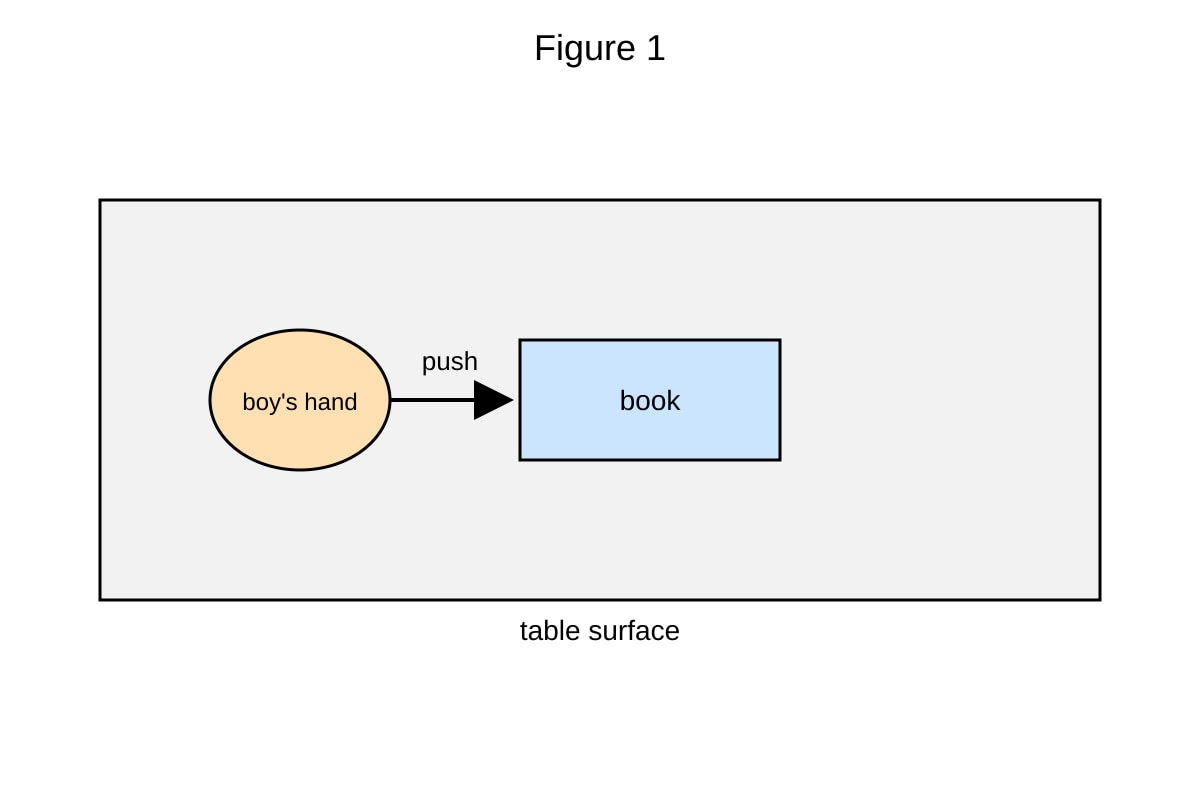
Arrow drawn on Figure 1 pointing left from the book, labelled "friction".
Teaching note: Friction opposes the push, so it acts opposite to motion direction.
4. [2 marks]
Example: a crowbar used to lift a load. [1]
It reduces the effort needed by increasing the distance over which force is applied (or changes direction of force). [1]
Teaching note: A lever is a simple machine; it makes work easier by giving mechanical advantage.
5. [2 marks]
Weight →
Teaching note: Weight is gravitational force; mass = weight ÷ gravitational field strength.
6. [2 marks]
Any two: change shape/size, change speed, change direction, start/stop motion. [1+1]
Teaching note: Forces can deform objects or change their motion.
7. [1 mark]
Opposite to motion (backward / opposite to forward direction).
Teaching note: Friction always opposes motion.
Section B: Electricity and Heat
8. [1 mark]
Ohm ().
Teaching note: Resistance unit is ohm, symbol .
9. [1 mark]
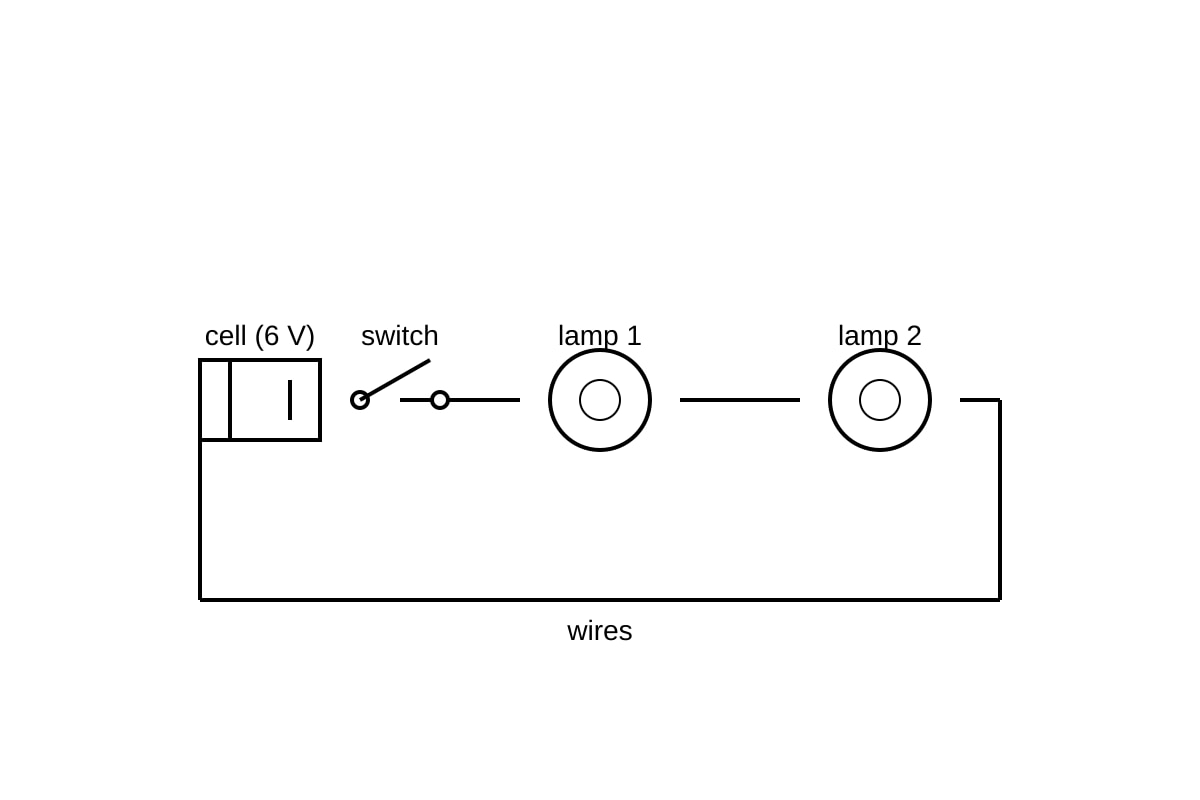
Lamp 2 goes out (or does not light).
Teaching note: In series, removing one component breaks the circuit.
10. [2 marks]
Teaching note: Use Ohm's law . Unit ampere (A).
11. [2 marks]
Renewable: sun / wind / biomass / hydropower. [1]
Non-renewable: coal / crude oil / natural gas. [1]
Teaching note: Renewable sources replenish naturally; fossil fuels do not.
12. [1 mark]
From 80 °C end to 20 °C end (hot to cold).
Teaching note: Heat flows from higher to lower temperature.
13. [2 marks]
Melts / breaks circuit when current too high. [1]
Protects wires from overheating / fire. [1]
Teaching note: Fuse is a safety device.
14. [1 mark]
To maintain temperature (or switch off at set temperature).
Teaching note: Thermostat controls temperature automatically.
Section C: Matter and Applications
15. [2 marks]
Density = mass / volume =
Teaching note: Density = mass ÷ volume. Unit .
16. [2 marks]
Floats. [1]
Density of wood < density of water, so upthrust > weight. [1]
Teaching note: Object floats if its density is less than the fluid.
17. [2 marks]
Neutral. [1]
pH ≈ 7. [1]
Teaching note: Green on universal indicator = neutral, pH 7.
18. [1 mark]
Solution is not alkaline (it is acidic or neutral).
Teaching note: Red litmus stays red in acid/neutral; turns blue in alkali.
19. [2 marks]
Any two: damaged insulation, damp conditions, overloaded circuits, wrong voltage. [1+1]
Teaching note: These can cause shock or fire.
20. [2 marks]
10 J. [1]
At B, all GPE converted to KE (no loss). [1]
Teaching note: Conservation of energy: GPE at A = KE at B.