AI Generated Quiz
Secondary 2 Science Physical Sciences Quiz
Free Sec 2 Science Physical Sciences quiz, Claude AI version, with questions, answers, and syllabus-aligned practice for Singapore students.
These static practice materials are generated from the site's syllabus and paper-generation workflow, with source and model context shown so students and parents can evaluate the material before use.
Questions
Free quiz and exam paper access
Enter your details to view this paper
Your access is remembered on this device.
Answers
Secondary 2 Science Quiz - Physical Sciences (Answer Key)
Section A: Energy and Work (Questions 1-5)
1. A student of mass 50 kg climbs from the ground floor to the 3rd floor of a school building. Each floor is 4 m high.
(a) State the principle of conservation of energy. [2] Answer: Energy cannot be created or destroyed [1], only converted from one form to another [1]. Alternative: The total amount of energy in a closed system remains constant [2].
(b) Calculate the gain in gravitational potential energy of the student. [2] Answer: Height climbed = 3 × 4 = 12 m [1] GPE = mgh = 50 × 10 × 12 = 6000 J [1]
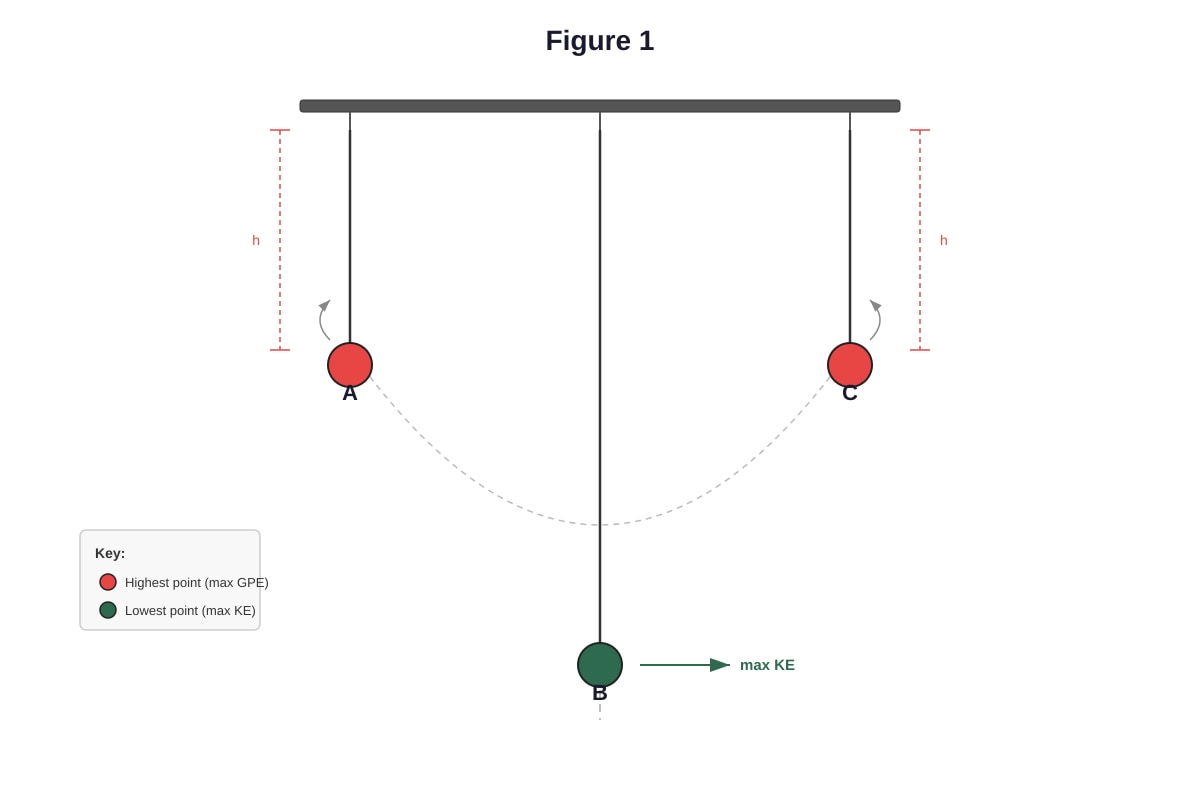
2. Figure 1 shows a pendulum at different positions during its swing.
(a) At which position does the pendulum have maximum kinetic energy? [1] Answer: B [1]
(b) Explain your answer in part (a). [2] Answer: At position B, the pendulum is moving fastest [1] as all gravitational potential energy has been converted to kinetic energy [1].
3. A box is pushed across a rough floor with a constant force of 20 N for a distance of 5 m.
Calculate the work done on the box. [2] Answer: Work done = Force × Distance [1] Work done = 20 × 5 = 100 J [1]
4. State two forms of energy that a moving car possesses. [2] Answer:
- Kinetic energy [1]
- Gravitational potential energy (if above ground level) OR Chemical potential energy (in fuel) [1]
5. A ball is dropped from a height of 2 m. Just before it hits the ground, its kinetic energy is 10 J.
(a) What was the gravitational potential energy of the ball at 2 m height? [1] Answer: 10 J [1]
(b) Explain your answer using the principle of conservation of energy. [1] Answer: All gravitational potential energy is converted to kinetic energy during the fall [1].
Section B: Forces and Motion (Questions 6-10)
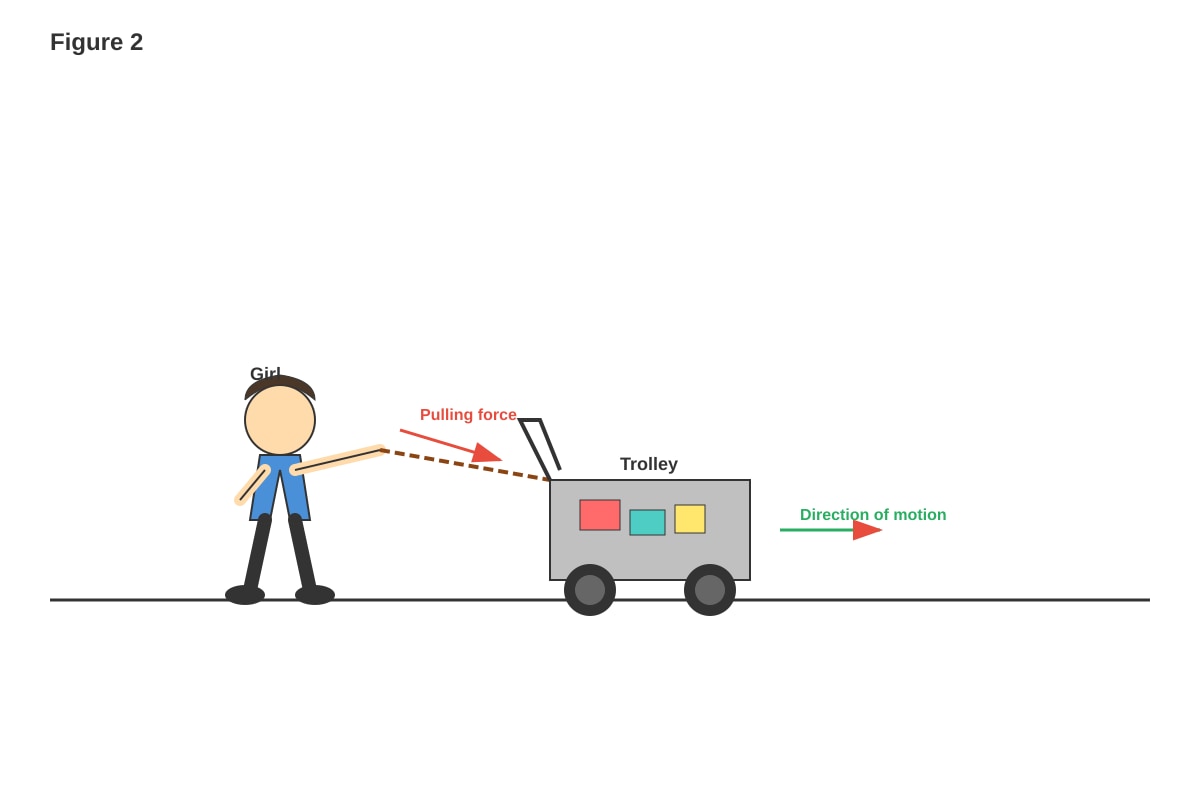
6. Figure 2 shows a girl pulling a trolley at constant speed.
(a) Draw and label the friction force acting on the trolley. [1] Answer: Arrow pointing opposite to direction of motion, labeled "friction" [1]
(b) State the size of the friction force if the pulling force is 15 N. [1] Answer: 15 N [1]
(c) Explain your answer in part (b). [1] Answer: At constant speed, forces are balanced/no resultant force [1].
7. A book rests on a table. The book has a weight of 8 N.
(a) What is the size of the normal force from the table on the book? [1] Answer: 8 N [1]
(b) State Newton's third law. [2] Answer: For every action, there is an equal and opposite reaction [2]. Alternative: When object A exerts a force on object B, object B exerts an equal and opposite force on object A [2].
8. List three effects that forces can have on objects. [3] Answer:
- Change speed/accelerate [1]
- Change direction [1]
- Change shape/deform [1]
9. A car travels at a constant speed of 20 m/s for 10 seconds.
Calculate the distance travelled by the car. [2] Answer: Distance = speed × time [1] Distance = 20 × 10 = 200 m [1]
10. Explain why it is more difficult to stop a heavy truck than a light car when both are travelling at the same speed. [2] Answer: The truck has greater mass [1], so it has greater momentum/kinetic energy and requires more force to stop [1].
Section C: Light and Optics (Questions 11-15)
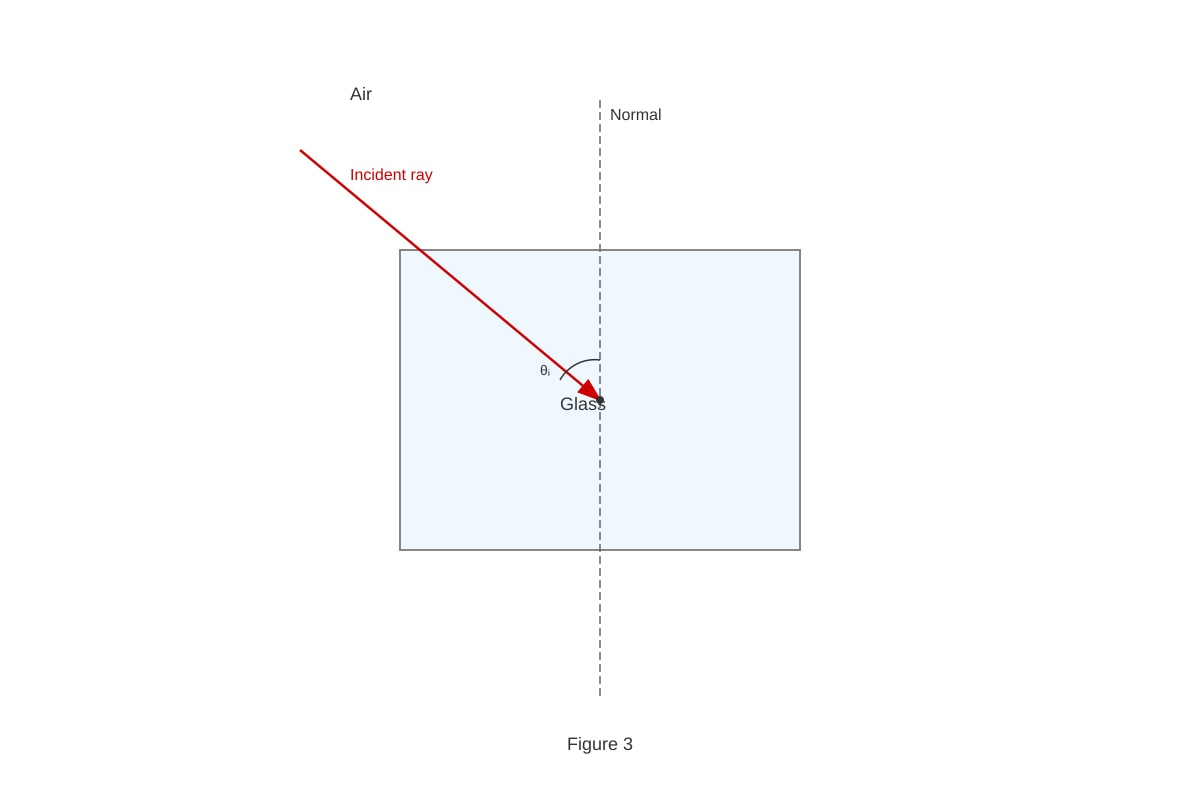
11. Figure 3 shows a light ray entering a glass block from air.
(a) Complete the ray diagram to show the path of light through and out of the glass block. [2] Answer: Ray bends toward normal on entry [1], travels straight through glass, bends away from normal on exit [1].
(b) Name the phenomenon that occurs when light enters the glass block. [1] Answer: Refraction [1]
12. A student uses a plane mirror to reflect sunlight.
(a) State the law of reflection. [2] Answer: The angle of incidence equals the angle of reflection [1], and the incident ray, reflected ray, and normal all lie in the same plane [1].
(b) If the angle of incidence is 30°, what is the angle of reflection? [1] Answer: 30° [1]
13. White light is passed through a triangular prism.
(a) What happens to the white light? [1] Answer: It splits into different colors/spectrum [1]
(b) Name this phenomenon. [1] Answer: Dispersion [1]
(c) Give one practical application of this phenomenon. [1] Answer: Rainbow formation/spectroscopy/prism in optical instruments [1]
14. Explain why a swimming pool appears shallower than it actually is. [2] Answer: Light from the bottom of the pool refracts when it leaves the water [1], making the bottom appear closer to the surface [1].
15. State two properties of the image formed by a plane mirror. [2] Answer:
- Same size as object/virtual [1]
- Laterally inverted/upright/same distance behind mirror [1]
Section D: Electricity (Questions 16-20)
16. A circuit contains a 6V battery connected to a 3Ω resistor.
(a) Calculate the current in the circuit. [2] Answer: I = V/R [1] I = 6/3 = 2 A [1]
(b) Calculate the power dissipated by the resistor. [2] Answer: P = VI or P = I²R [1] P = 6 × 2 = 12 W or P = 2² × 3 = 12 W [1]
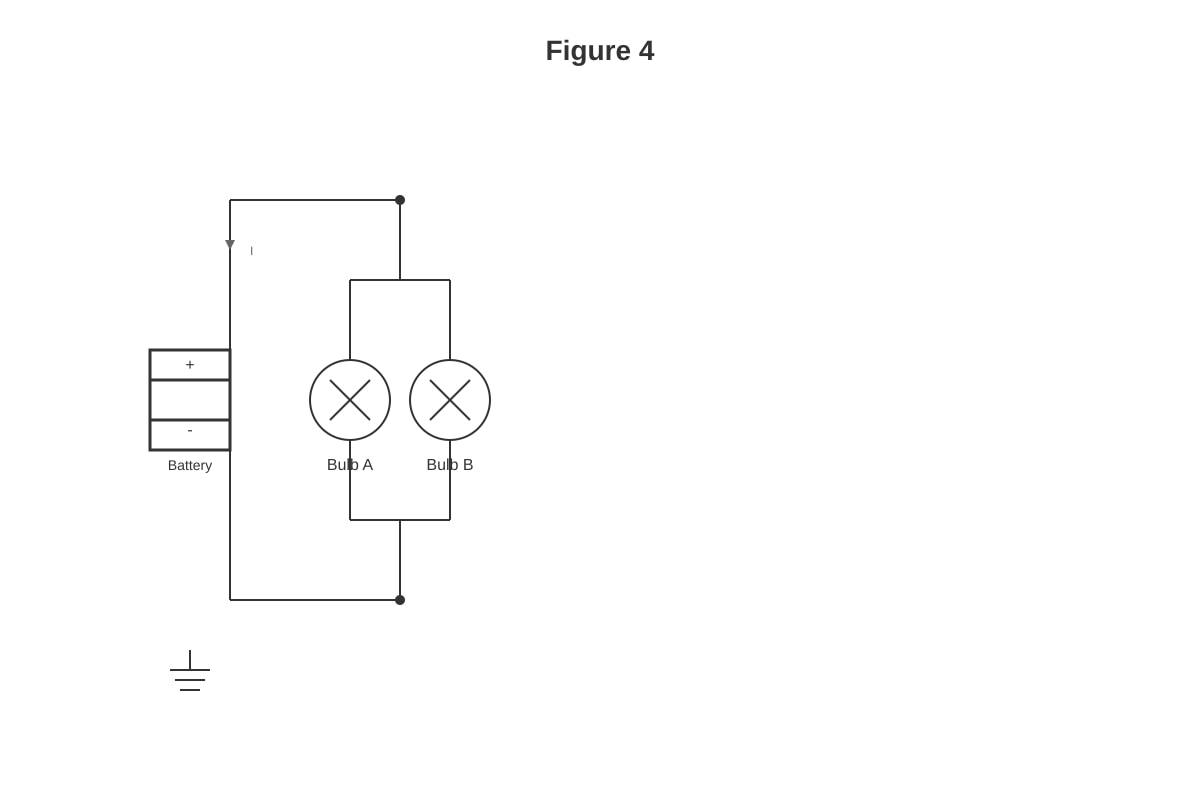
17. Figure 4 shows two identical bulbs connected to a battery.
(a) Are the bulbs connected in series or parallel? [1] Answer: Parallel [1]
(b) If one bulb is removed, what happens to the brightness of the other bulb? [1] Answer: Stays the same/no change [1]
(c) Explain your answer in part (b). [1] Answer: Each bulb has its own complete circuit/same voltage across remaining bulb [1].
18. An electric kettle has a power rating of 2000 W and is used for 0.5 hours.
Calculate the energy consumed by the kettle. [2] Answer: E = P × t [1] E = 2000 × 0.5 = 1000 Wh or 3,600,000 J [1]
19. State two safety features found in household electrical systems and explain how each works. [4] Answer:
-
Feature: Fuse/Circuit breaker [1] How it works: Breaks the circuit when current exceeds safe limit/melts when overheated [1]
-
Feature: Earth wire/Residual current device [1] How it works: Provides alternative path for current/detects current leakage and cuts power [1]
20. A student connects three 1.5V cells in series.
(a) Calculate the total voltage provided by the cells. [1] Answer: 1.5 + 1.5 + 1.5 = 4.5 V [1]
(b) Draw a simple circuit diagram showing these cells connected to a bulb. [2] Answer: Three cells drawn in series (+ to -) [1] connected to a bulb symbol in a complete circuit [1]
Marking Notes:
- Accept alternative correct units (e.g., kJ for energy questions)
- Award method marks for correct formula even if calculation error
- Diagrams must show clear arrows and labels for full marks
- Accept scientifically accurate alternative wordings