AI Generated Quiz
Secondary 2 Science Life Sciences Quiz
Free Sec 2 Science Life Sciences quiz, Nemo3 AI version, with questions, answers, and syllabus-aligned practice for Singapore students.
These static practice materials are generated from the site's syllabus and paper-generation workflow, with source and model context shown so students and parents can evaluate the material before use.
Questions


Free quiz and exam paper access
Enter your details to view this paper
Your access is remembered on this device.
Answers
Secondary 2 Science Quiz - Life Sciences (Answer Key)
Total Marks: 50
Section A: Multiple Choice Questions (10 marks)
1. C – Ability to respond to stimuli [1]
Explanation: All living organisms (including plants, bacteria, fungi) respond to stimuli such as light, temperature, touch, or chemicals. Movement from place to place (A) is not shown by plants. Photosynthesis (B) is only done by plants and some bacteria. Sexual reproduction (D) is not universal (many organisms reproduce asexually).
2. B – Cell membrane [1]
Explanation: The cell membrane (plasma membrane) is a partially permeable membrane that controls the movement of substances in and out of the cell. The cell wall (A) is fully permeable and provides structural support. The nucleus (C) controls cell activities. The vacuole (D) stores substances.
3. C – Plant [1]
Explanation: Plant cells have a cell wall (made of cellulose), chloroplasts (for photosynthesis), and a large central vacuole. Animal cells lack all three. Bacterial cells have a cell wall (not cellulose) but no chloroplasts or large vacuole. Fungal cells have a cell wall (chitin) but no chloroplasts.
4. C – Active transport [1]
Explanation: Active transport requires energy (from respiration) to move substances against their concentration gradient (from low to high concentration). Diffusion (A) and osmosis (B) are passive processes (no energy required, down concentration gradient). Transpiration (D) is the loss of water vapour from leaves.
5. B – Palisade mesophyll [1]
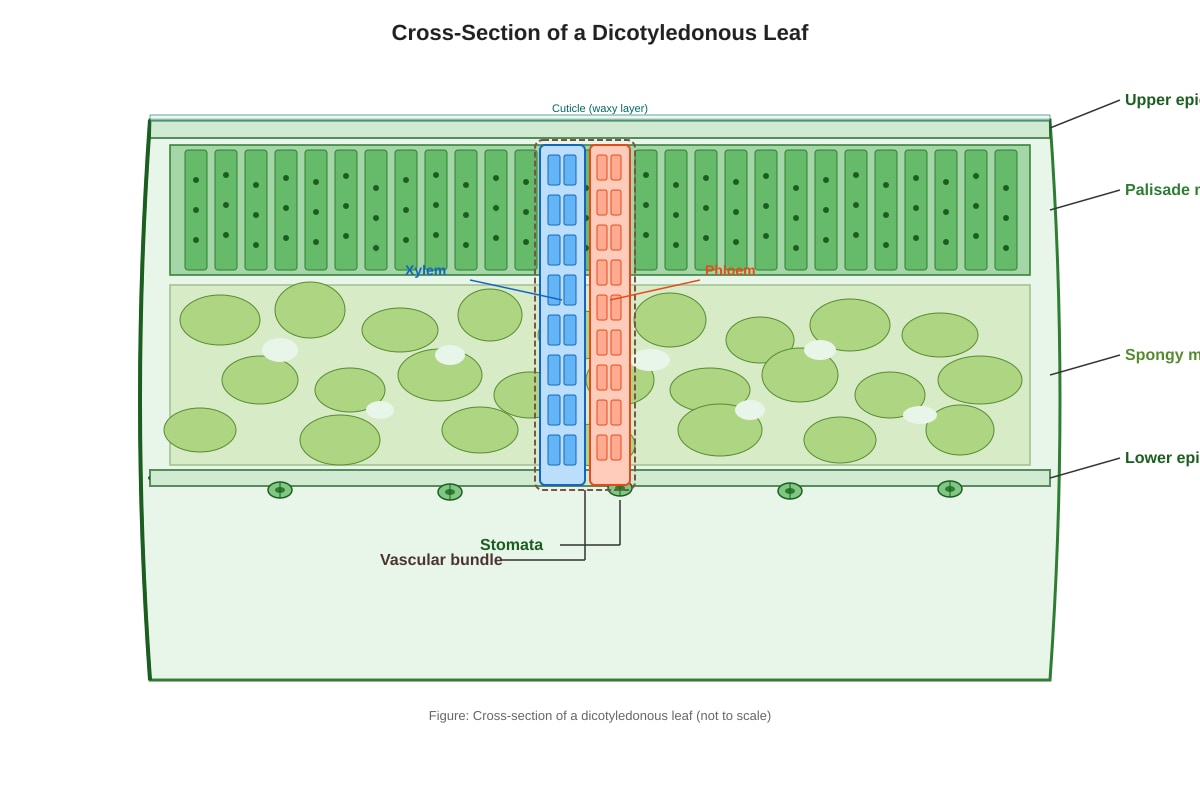
Explanation: The palisade mesophyll contains tightly packed, columnar cells with many chloroplasts, making it the main site of photosynthesis. The upper epidermis (A) is transparent and lacks chloroplasts. The spongy mesophyll (C) has fewer chloroplasts and is mainly for gas exchange. The lower epidermis (D) has stomata for gas exchange.
6. A – Glucose + Oxygen → Carbon dioxide + Water + Energy [1]
Explanation: Aerobic respiration is the complete breakdown of glucose in the presence of oxygen to release energy. Equation B is photosynthesis. Equation C is anaerobic respiration in animal muscles. Equation D is anaerobic respiration in yeast (fermentation).
7. A – Increases [1]
Explanation: Frogs are predators of grasshoppers. If the frog population decreases, there is less predation pressure on grasshoppers, so their population is likely to increase (at least initially).
8. A – Cell → Tissue → Organ → Organ system → Organism [1]
Explanation: This is the correct hierarchical organisation: cells of the same type form tissues, tissues work together to form organs, organs work together to form organ systems, and organ systems make up an organism.
9. B – Small intestine [1]
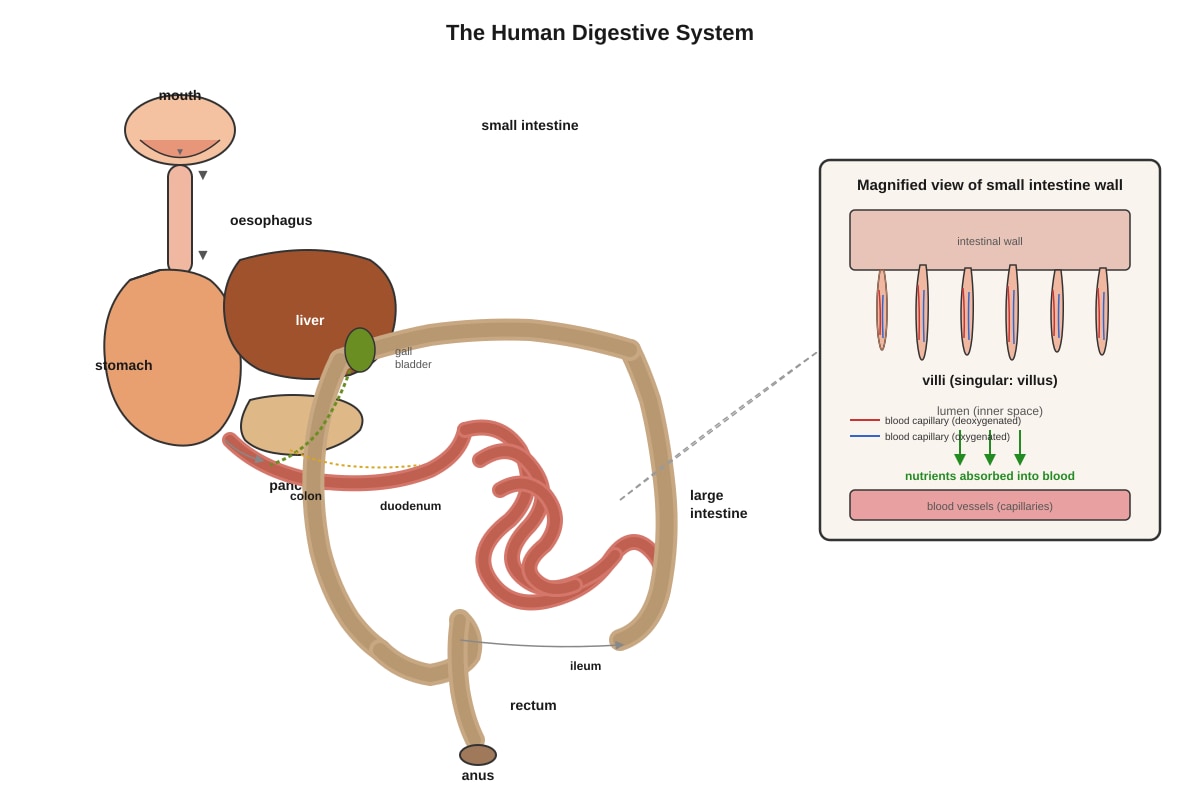
Explanation: The small intestine (especially the ileum) has villi and microvilli that provide a huge surface area for absorption of digested nutrients (glucose, amino acids, fatty acids, glycerol, vitamins, minerals). The stomach (A) mainly digests proteins. The large intestine (C) absorbs water and salts. The liver (D) processes absorbed nutrients.
10. B – Transport of water and mineral salts from roots to leaves [1]
Explanation: Xylem transports water and dissolved mineral salts from roots upwards to the rest of the plant. Phloem (A) transports sugars (translocation). Oxygen (C) and carbon dioxide (D) diffuse through stomata and air spaces, not transported by xylem.
Section B: Structured Questions (24 marks)
11. (a) Any two of: Cell wall, Chloroplasts, Large central vacuole [2]
Marking: 1 mark each for any two correct structures. Explanation: These three structures are unique to plant cells (and some algae/fungi have cell walls but not cellulose/chloroplasts/large vacuole in the same way). Animal cells lack all three.
(b) Mitochondria are the site of aerobic respiration, where glucose is broken down with oxygen to release energy (ATP) for cellular activities. [1] Explanation: Mitochondria are known as the "powerhouse of the cell" because they carry out aerobic respiration to produce ATP, the energy currency of the cell.
(c) The large central vacuole in plant cells maintains turgor pressure (rigidity) to support the plant structure, while animal cells do not need this structural support and have small vacuoles for temporary storage. [1] Explanation: Plant cells rely on turgor pressure against the rigid cell wall for support (since they lack a skeleton). The large vacuole fills with water, pushing the cell membrane against the cell wall. Animal cells use a cytoskeleton and extracellular matrix for support.
12. (a) Oxygen [1]
Explanation: During photosynthesis, water is split (photolysis) releasing oxygen gas as a by-product, which collects in the test tube.
(b) Any two of: Temperature of the water, Carbon dioxide concentration (e.g., amount of sodium hydrogen carbonate), Type/size of plant, Volume of water, Time allowed for equilibration [2] Marking: 1 mark each for any two valid controlled variables. Explanation: These variables could affect the rate of photosynthesis independently of light intensity. Temperature affects enzyme activity. CO₂ is a raw material. Plant size affects surface area for light absorption.
(c)(i) As the distance of the lamp from the beaker increases, the number of bubbles per minute (rate of photosynthesis) decreases. [1] Explanation: The relationship is inverse: greater distance → lower light intensity → lower rate of photosynthesis.
(c)(ii) Light intensity decreases with distance from the lamp. Light provides the energy for photosynthesis, so lower light intensity reduces the rate of the light-dependent reactions, producing less oxygen. [1] Explanation: Light intensity follows an inverse square law with distance. Light energy drives the photolysis of water and ATP/NADPH production in the light-dependent stage of photosynthesis.
13. (a) Chamber X: Right ventricle [1]
Blood vessel Y: Pulmonary artery [1] Explanation: The right ventricle pumps deoxygenated blood to the lungs via the pulmonary artery. (Note: Pulmonary artery carries deoxygenated blood – an exception to "arteries carry oxygenated blood".)
(b) The wall of the left ventricle is thicker / more muscular than the wall of the right ventricle. [1] Explanation: The left ventricle pumps blood at high pressure to the whole body (systemic circulation), while the right ventricle pumps blood at lower pressure to the nearby lungs (pulmonary circulation).
(c) The left ventricle needs to generate higher pressure to pump blood throughout the entire body (systemic circulation), while the right ventricle only pumps blood to the nearby lungs (pulmonary circulation) which requires lower pressure. [1] Explanation: Systemic circulation has much higher resistance (longer distance, smaller capillaries throughout body) than pulmonary circulation. Thicker muscle = stronger contraction = higher pressure.
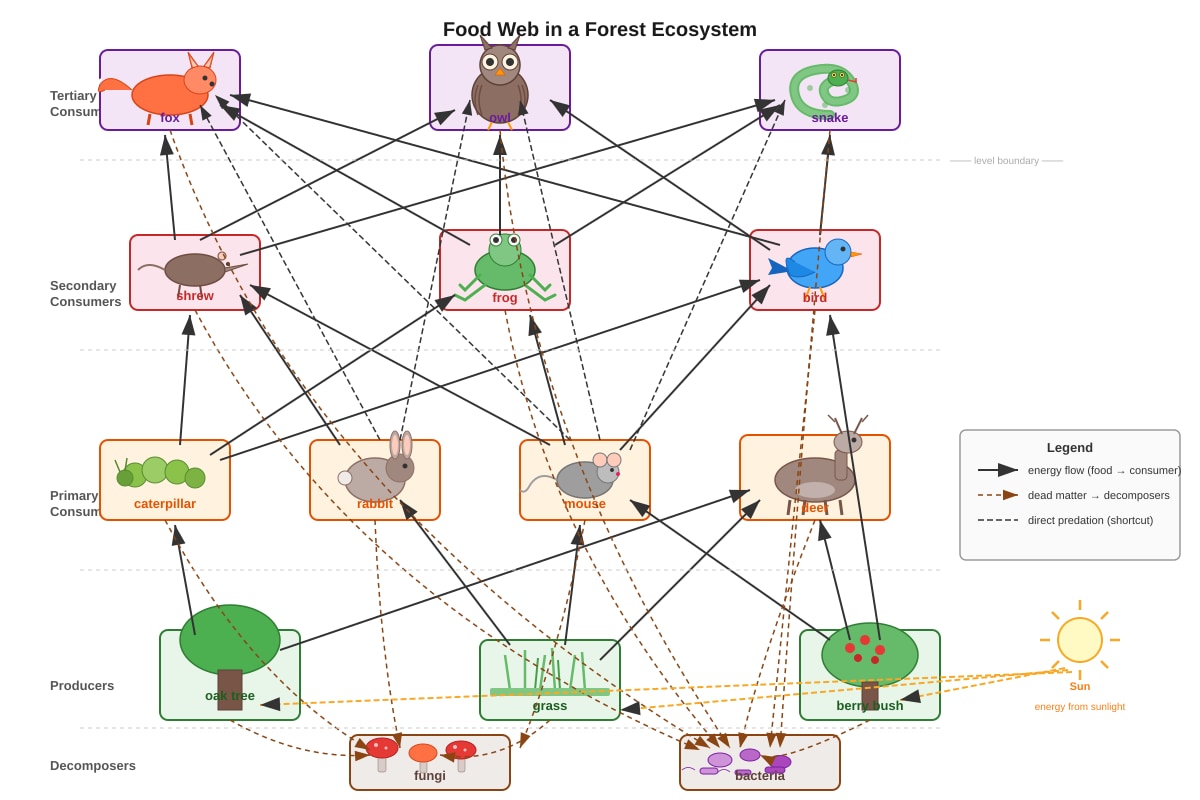
14. (a) Producer: Oak tree / Grass / Berry bush (any one) [1]
Tertiary consumer: Fox / Owl / Snake (any one) [1] Explanation: Producers (autotrophs) make their own food via photosynthesis. Tertiary consumers are top predators that feed on secondary consumers.
(b) Example: Grass → Rabbit → Fox → (nothing eats fox, so 3 trophic levels only) — need 4 levels.
Correct 4-level chain: Oak tree → Caterpillar → Bird → Owl (or Grass → Mouse → Snake → Owl, or Berry bush → Mouse → Fox → (nothing), etc.) [1]
Marking: 1 mark for a valid 4-level chain with correct energy flow direction (producer → primary → secondary → tertiary).
Explanation: Trophic levels: 1 = Producer, 2 = Primary consumer (herbivore), 3 = Secondary consumer (carnivore eating herbivore), 4 = Tertiary consumer (carnivore eating carnivore).
(c) The fox population would decrease because rabbits are a food source for foxes. With fewer rabbits, there is less food available for foxes, leading to starvation, lower reproduction, or migration. [1] Explanation: This demonstrates predator-prey dynamics. Removing a prey species reduces the carrying capacity for its predators.
(d) Decomposers break down dead organisms and waste materials, recycling nutrients (e.g., nitrogen, phosphorus) back into the environment for producers to reuse. [1] Explanation: Without decomposers, nutrients would remain locked in dead matter, and the ecosystem would run out of essential elements for new growth.
15. (a) 37°C [1]
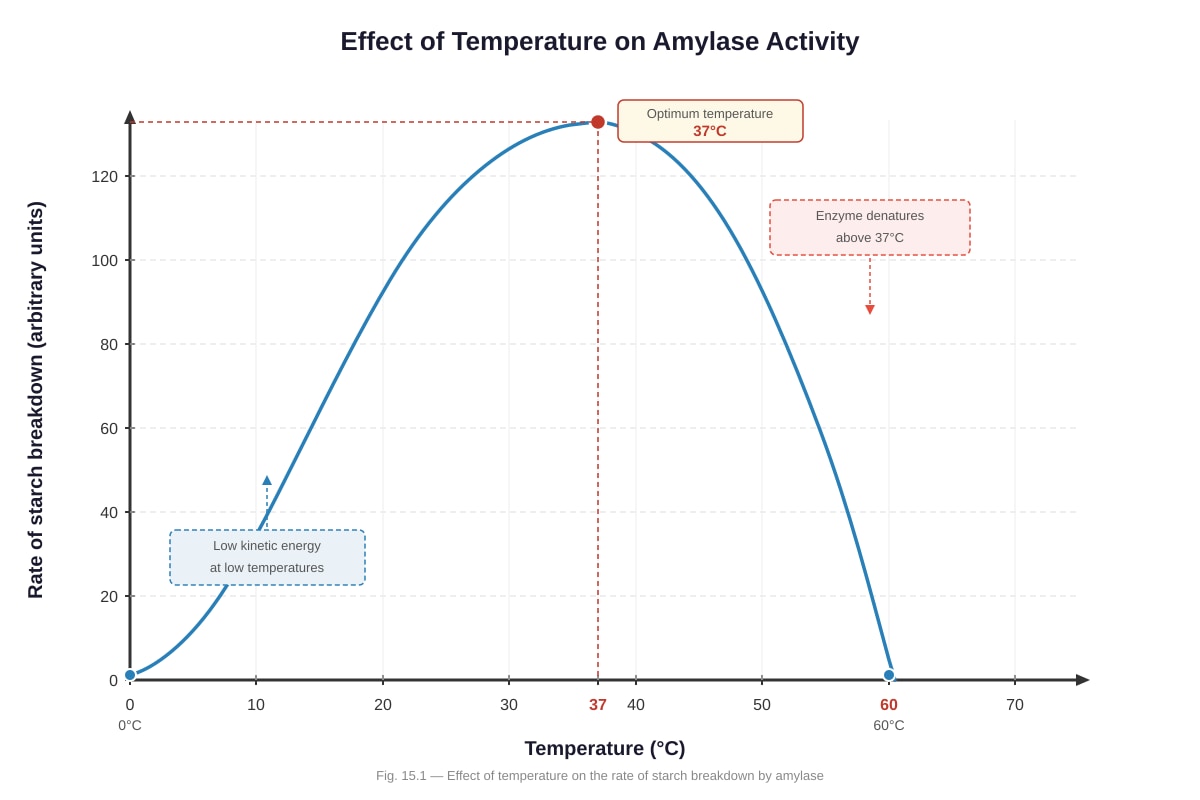
Explanation: The peak of the curve on the graph shows the maximum rate of reaction at 37°C, which is the optimum temperature for this enzyme (human body temperature).
(b) At 10°C, the kinetic energy of enzyme and substrate molecules is low. They move slowly, resulting in fewer collisions per unit time and fewer successful collisions with sufficient energy (activation energy). The enzyme is not denatured, just inactive. [2] Marking: 1 mark for low kinetic energy / slow movement; 1 mark for fewer collisions / low reaction rate. Explanation: Enzyme activity is temperature-dependent. At low temperatures, molecular motion is reduced, so the frequency of effective collisions between enzyme active sites and substrate molecules decreases. The enzyme structure is intact.
(c) Above 45°C, the high temperature causes the enzyme's protein structure to vibrate violently, breaking the weak bonds (hydrogen bonds, ionic bonds) that maintain its specific 3D shape. The active site changes shape (denaturation), so the substrate can no longer bind. This is usually irreversible. [2] Marking: 1 mark for denaturation / loss of 3D shape / active site changed; 1 mark for substrate cannot bind / reaction stops. Explanation: Enzymes are proteins. High temperatures disrupt the weak interactions maintaining their tertiary structure. Once denatured, the active site no longer fits the substrate (lock-and-key or induced fit fails).
(d) The rate of reaction will decrease. Amylase has an optimum pH (around neutral to slightly alkaline). Adding acid lowers the pH, causing denaturation of the enzyme (change in active site shape), reducing its activity. [1] Explanation: Enzymes are also sensitive to pH. Extreme pH changes alter the charges on amino acid side chains, disrupting ionic bonds and hydrogen bonds in the protein structure, leading to denaturation.
Section C: Free Response / Data-Based Questions (16 marks)
16. (a) Glucose is a useful substance that is completely reabsorbed from the filtrate back into the blood at the proximal convoluted tubule (selective reabsorption). In a healthy person, all filtered glucose is reabsorbed, so none appears in urine and blood concentration remains unchanged. [2]
Marking: 1 mark for "glucose is reabsorbed / selectively reabsorbed"; 1 mark for "at the proximal convoluted tubule" or "all filtered glucose is reabsorbed in a healthy person". Explanation: The kidney filters blood at the glomerulus. Useful substances (glucose, amino acids, water, some salts) are reabsorbed. Glucose reabsorption is active and complete up to a transport maximum. In health, blood glucose is below this threshold, so 100% reabsorption occurs.
(b) Urea is a waste product. It is filtered from the blood at the glomerulus and is not reabsorbed (or only partially reabsorbed passively). Most urea remains in the tubule and is excreted in urine, so its concentration in the blood leaving the kidney is lower. [2] Marking: 1 mark for "urea is a waste product / filtered at glomerulus"; 1 mark for "not reabsorbed / excreted in urine". Explanation: Urea is produced in the liver from deamination of excess amino acids. It is toxic in high concentrations. The kidney's function is to remove it. Unlike glucose, urea is not actively reabsorbed; some diffuses back passively, but net movement is into urine.
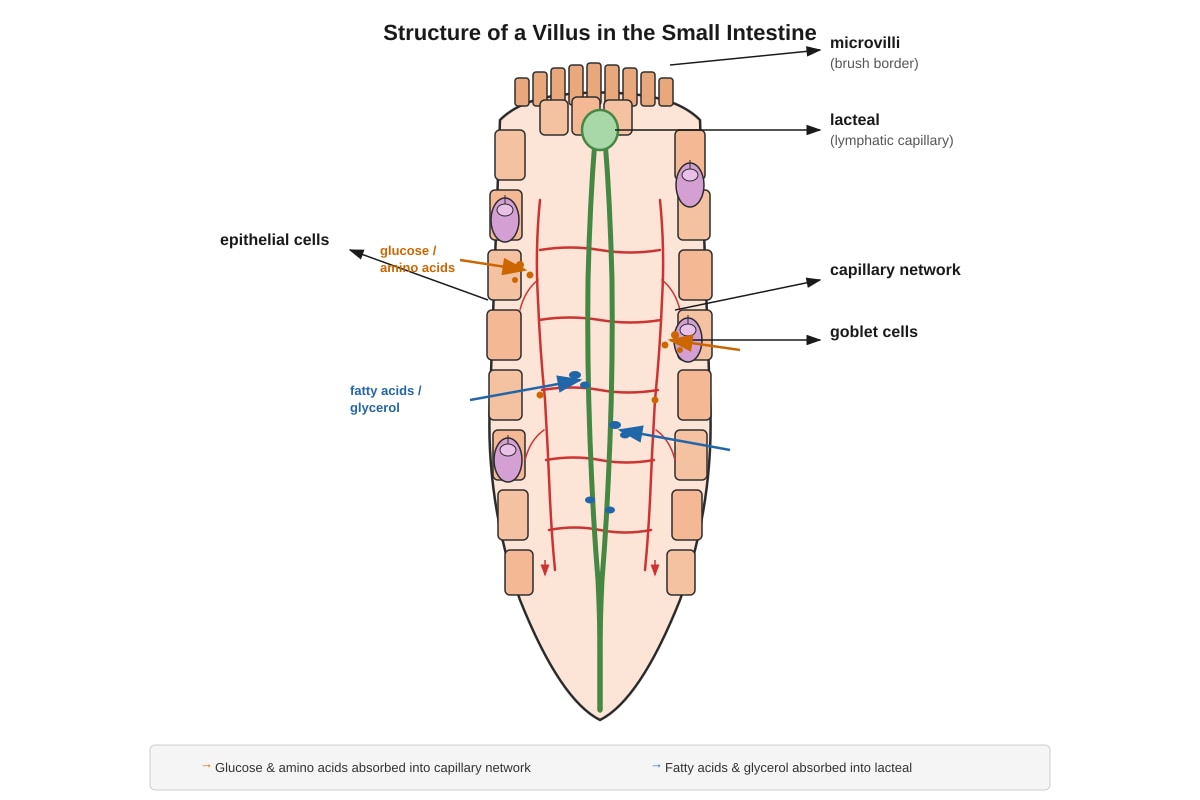
17. (a) The villus is adapted for efficient absorption by:
- Having a large surface area due to its finger-like projection and the microvilli (brush border) on epithelial cells.
- Having a thin epithelium (one cell thick) providing a short diffusion distance for nutrients to enter the blood/lacteal.
- Having a dense capillary network and a lacteal to maintain a steep concentration gradient by rapidly carrying away absorbed nutrients. [3] Marking: 1 mark each for any three valid adaptations with explanation (surface area, thin wall, good blood supply/lacteal, mitochondria for active transport, etc.). Explanation: These are the classic adaptations: Surface area (villi + microvilli = huge SA), Diffusion distance (single layer of epithelial cells), Concentration gradient maintenance (blood flow in capillaries/lacteal removes absorbed products quickly).
(b) Blood capillary / Capillary network [1] Explanation: Glucose and amino acids are water-soluble and are absorbed into the blood capillaries (then to hepatic portal vein → liver).
(c) Lacteal [1] Explanation: Fatty acids and glycerol are reassembled into triglycerides in the epithelial cells, packaged into chylomicrons, and enter the lacteal (lymphatic capillary) because they are too large for blood capillaries. They enter blood via the thoracic duct.
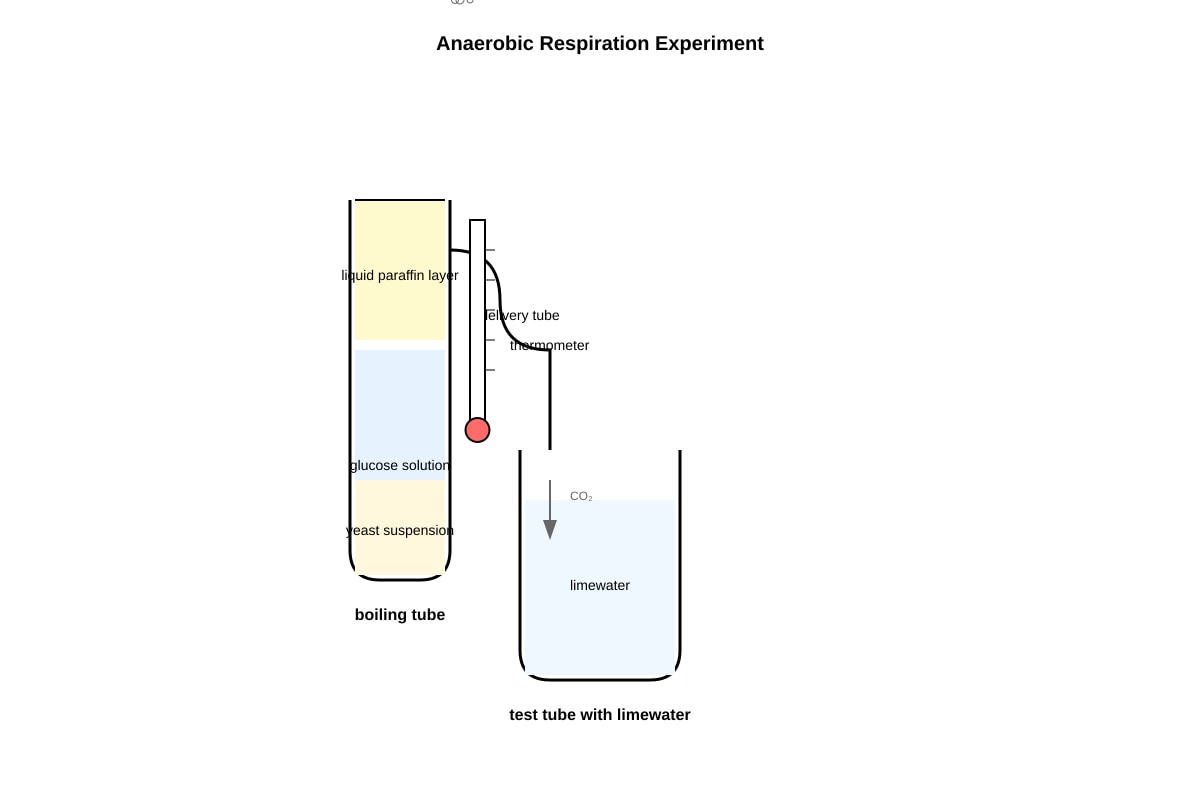
18. (a) To exclude air (oxygen) from the yeast-glucose mixture, creating anaerobic conditions. [1]
Explanation: Yeast carries out aerobic respiration when oxygen is present. The liquid paraffin forms an airtight seal, preventing oxygen from dissolving in the solution, forcing yeast to respire anaerobically.
(b) Glucose → Ethanol + Carbon dioxide + Energy (small amount) [1] Explanation: This is the word equation for alcoholic fermentation (anaerobic respiration in yeast). Note: Energy yield is much lower than aerobic respiration (2 ATP vs ~36-38 ATP per glucose).
(c) Observation: The limewater turns cloudy / milky / chalky. [1]
Explanation: Carbon dioxide is produced during anaerobic respiration in yeast. CO₂ reacts with calcium hydroxide (limewater) to form insoluble calcium carbonate (white precipitate), causing cloudiness. [1]
Marking: 1 mark for correct observation; 1 mark for linking CO₂ production to the reaction with limewater.
Explanation: Limewater test for CO₂: Ca(OH)₂(aq) + CO₂(g) → CaCO₃(s) + H₂O(l). The white precipitate of CaCO₃ makes the solution cloudy.
19. (a) The populations of hare and lynx show cyclic fluctuations. The lynx population peaks after the hare population peaks (time lag). When hare numbers are high, lynx numbers increase later; when hare numbers fall, lynx numbers fall later. [1]
Explanation: This is the classic predator-prey cycle (Lotka-Volterra dynamics). The predator population lags behind the prey population.
(b) When the hare population is high, there is abundant food for lynxes have more food for lynxes, so lynxes survive better and reproduce more, causing the lynx population to increase. However, this takes time (gestation, maturation), so the lynx peak follows the hare peak. As lynx numbers rise, they eat more hares, causing the hare population to crash. Then lynxes starve and their population crashes. [2] Marking: 1 mark for "abundant food leads to increased lynx survival/reproduction"; 1 mark for "time lag due to reproduction time" or "lynx overpredation causes hare crash then lynx crash". Explanation: The time lag is due to the reproductive cycle of the predator. More food → better condition → more offspring → population grows after a delay. This delayed density dependence creates the cycles.
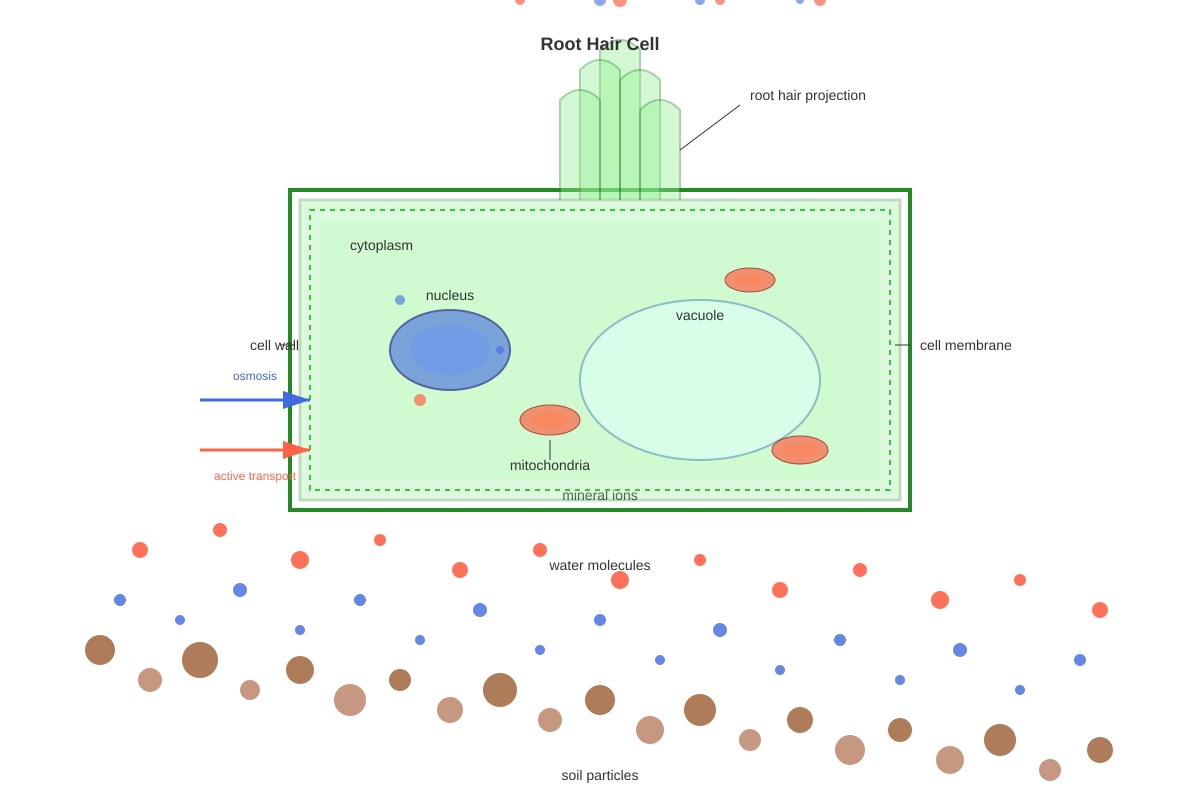
20. (a) The root hair cell has a long, narrow projection (root hair) that greatly increases the surface area for water absorption. Water enters by osmosis down a water potential gradient (from higher water potential in soil to lower water potential in cell vacuole) across the partially permeable cell membrane. [2]
Marking: 1 mark for "increased surface area / root hair extension"; 1 mark for "osmosis down water potential gradient" or "partially permeable membrane". Explanation: Root hairs are extensions of epidermal cells. They massively increase the root's surface area (hundreds of times). Water moves passively by osmosis from soil (high Ψ) to cell (low Ψ due to solutes in vacuole).
(b) Mineral ions in the soil are usually at a lower concentration than inside the root cell. Diffusion would move ions out of the cell (down the concentration gradient). Active transport uses energy (from respiration in mitochondria) to move ions against their concentration gradient (from low concentration in soil to high concentration in cell). [2] Marking: 1 mark for "soil concentration lower than cell concentration / against concentration gradient"; 1 mark for "requires energy from respiration / mitochondria" or "diffusion would move ions in wrong direction". Explanation: Soil is dilute; cell sap is concentrated. Diffusion goes high → low concentration, which would lose ions from the cell. Active transport uses ATP (from mitochondria – note the many mitochondria in the diagram) to pump ions in via protein carriers against the gradient.
End of Answer Key