AI Generated Quiz
Secondary 2 Science Chemistry Materials Quiz
Free AI-Generated NVIDIA Nemotron 3 Ultra 550B A55B Free Secondary 2 Science Chemistry Materials quiz with questions and answers for Singapore students. This page is rendered as a direct URL so the questions and answers can be discovered without pressing in-page buttons.
These static practice materials are generated from the site's syllabus and paper-generation workflow, with source and model context shown so students and parents can evaluate the material before use.
Questions
Secondary 2 Science Quiz - Chemistry Materials
Name: ___________________________
Class: ___________________________
Date: ___________________________
Score: _____ / 40
Duration: 45 minutes
Total Marks: 40
Instructions:
- Answer all questions in the spaces provided.
- Show all working for calculation questions.
- Write chemical equations with correct state symbols where appropriate.
- The number of marks is given in brackets [ ] at the end of each question or part question.
Section A: Multiple Choice Questions (10 marks)
Questions 1 to 10 carry 1 mark each. Choose the correct answer and write its letter (A, B, C, or D) in the box provided.
1. Which of the following is a pure substance? [1]
- A. Air
- B. Brass
- C. Distilled water
- D. Seawater
Answer: □
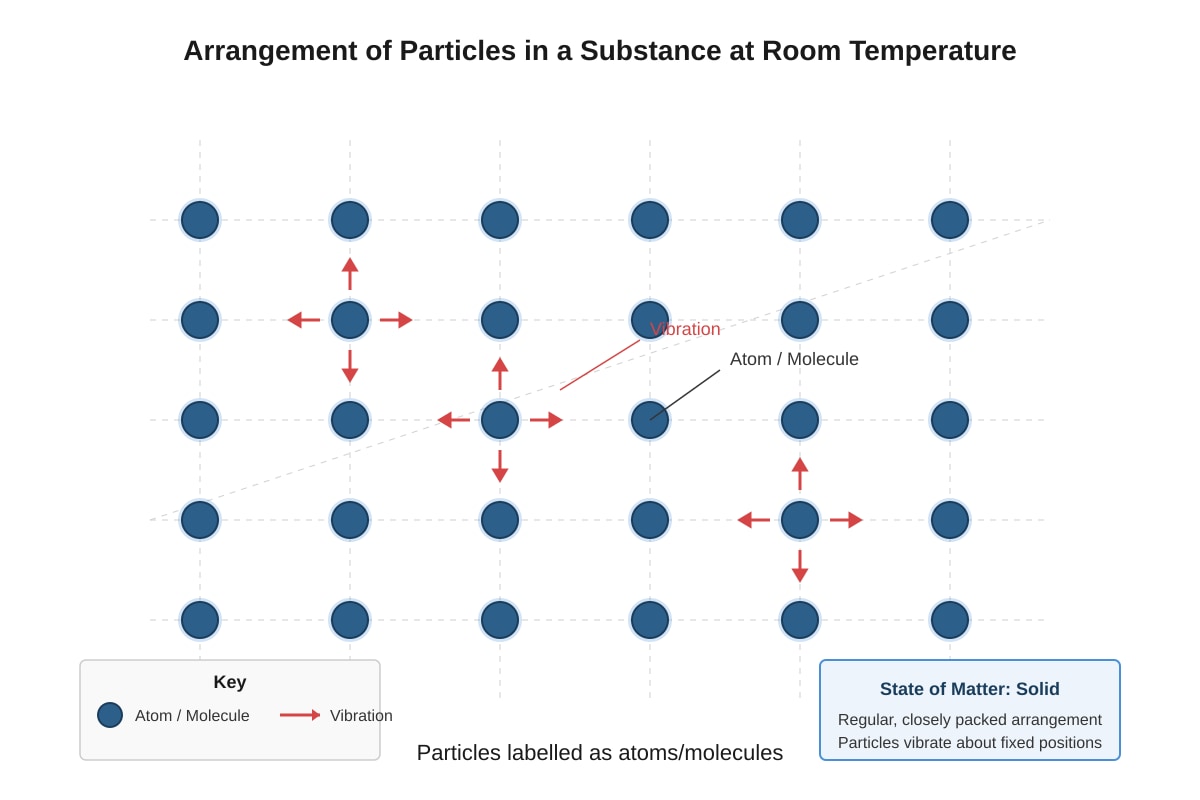
2. The diagram below shows the arrangement of particles in a substance at room temperature.
<image_placeholder> id: Q2-fig1 type: diagram linked_question: Q2 description: Particle diagram showing a regular, closely packed arrangement of identical spheres in a fixed lattice structure. Particles are touching each other with minimal gaps. labels: Particles represented as identical circles in a regular repeating pattern values: Not applicable must_show: Regular repeating lattice arrangement, particles touching, fixed positions, all particles identical </image_placeholder>
Which of the following best describes this substance? [1]
- A. A gas
- B. A liquid
- C. A solid element
- D. A solid compound
Answer: □
3. A student adds dilute hydrochloric acid to four different substances and observes the results shown in the table.
| Substance | Observation |
|---|---|
| W | Bubbles of gas produced, substance disappears |
| X | No visible change |
| Y | Bubbles of gas produced, substance remains |
| Z | Substance dissolves with no gas produced |
Which substance is most likely a metal carbonate? [1]
- A. W
- B. X
- C. Y
- D. Z
Answer: □
4. The chemical formula of aluminium sulfate is Al₂(SO₄)₃. How many atoms are present in one formula unit of aluminium sulfate? [1]
- A. 5
- B. 12
- C. 15
- D. 17
Answer: □
5. Which of the following separation techniques is most suitable for obtaining pure water from seawater? [1]
- A. Filtration
- B. Simple distillation
- C. Fractional distillation
- D. Paper chromatography
Answer: □
6. An element X has the electronic configuration 2,8,6. Which group and period of the Periodic Table does it belong to? [1]
- A. Group 6, Period 3
- B. Group 16, Period 3
- C. Group 6, Period 2
- D. Group 16, Period 2
Answer: □
7. The diagram shows the heating curve of a pure substance.
<image_placeholder> id: Q7-fig1 type: graph linked_question: Q7 description: Heating curve graph with temperature on y-axis and time on x-axis. Shows two horizontal plateaus: first at 0°C (melting), second at 100°C (boiling). Initial solid heating from -20°C to 0°C, liquid heating from 0°C to 100°C, gas heating from 100°C upwards. labels: Temperature (°C) on y-axis, Time (min) on x-axis, plateau at 0°C labelled 'melting', plateau at 100°C labelled 'boiling' values: Melting point = 0°C, Boiling point = 100°C must_show: Two distinct horizontal plateaus, sloping sections for solid/liquid/gas heating, labelled axes with units </image_placeholder>
At which temperature does the substance exist as both liquid and gas? [1]
- A. 0°C
- B. 50°C
- C. 100°C
- D. 120°C
Answer: □
8. Which of the following reactions is a decomposition reaction? [1]
- A. 2Mg + O₂ → 2MgO
- B. CaCO₃ → CaO + CO₂
- C. HCl + NaOH → NaCl + H₂O
- D. Zn + CuSO₄ → ZnSO₄ + Cu
Answer: □
9. A student tests the pH of four solutions using universal indicator. The results are shown below.
| Solution | Colour with Universal Indicator |
|---|---|
| P | Red |
| Q | Green |
| R | Blue |
| S | Yellow |
Which solution is neutral? [1]
- A. P
- B. Q
- C. R
- D. S
Answer: □
10. The diagram shows an experimental setup for separating a mixture of sand and salt.
<image_placeholder> id: Q10-fig1 type: experimental_setup linked_question: Q10 description: Diagram showing a beaker containing mixture of sand and salt in water being stirred, with a filter funnel and filter paper placed over a conical flask. Filtrate collects in conical flask. Residue remains on filter paper. labels: Beaker, mixture (sand + salt + water), stirrer, filter funnel, filter paper, conical flask, filtrate, residue values: Not applicable must_show: Complete filtration setup with labels, mixture in beaker, filtrate in flask, residue on paper </image_placeholder>
What is the residue in this experiment? [1]
- A. Salt solution
- B. Pure water
- C. Sand
- D. Salt
Answer: □
Section B: Structured Questions (20 marks)
Answer all questions in the spaces provided.
11. The table below shows the properties of four substances A, B, C, and D.
| Substance | Melting Point (°C) | Boiling Point (°C) | Electrical Conductivity (Solid) | Electrical Conductivity (Molten/Aqueous) | Solubility in Water |
|---|---|---|---|---|---|
| A | 801 | 1413 | Does not conduct | Conducts | Soluble |
| B | -114 | 78 | Does not conduct | Does not conduct | Miscible |
| C | 3550 | 4827 | Does not conduct | Does not conduct | Insoluble |
| D | 1085 | 2562 | Conducts | Conducts | Insoluble |
(a) Which substance is most likely a covalent compound? Explain your answer. [2]
(b) Which substance is most likely a metal? Explain your answer. [2]
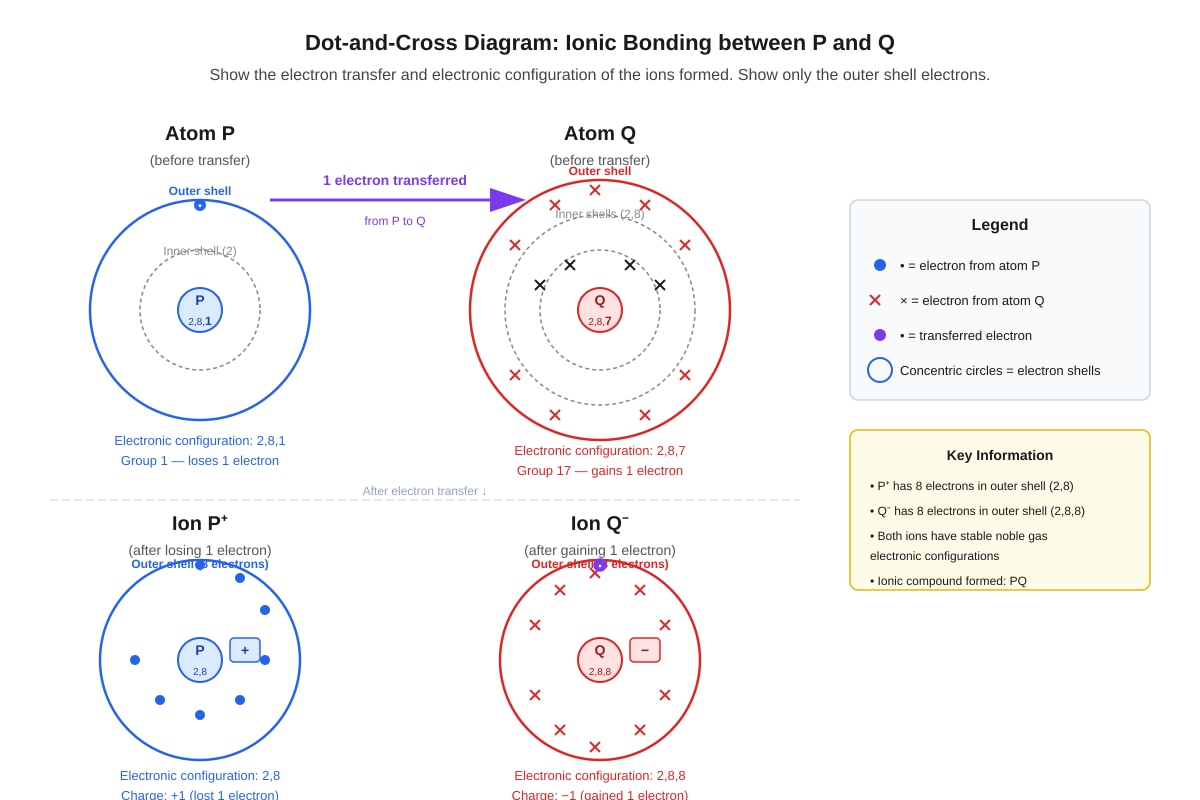
(c) Substance A is sodium chloride. Draw a dot-and-cross diagram to show the bonding in sodium chloride. Show only the outer shell electrons. [2]
<image_placeholder> id: Q11c-fig1 type: diagram linked_question: Q11c description: Blank template for dot-and-cross diagram of NaCl ionic bonding. Shows Na atom (2,8,1) and Cl atom (2,8,7) with space for electron transfer and resulting ions with charges. labels: Na atom, Cl atom, outer shell electrons as dots and crosses, Na⁺ ion, Cl⁻ ion, electron transfer arrow values: Na: 2,8,1; Cl: 2,8,7 must_show: Electron transfer from Na to Cl, resulting ions with correct charges (Na⁺ and Cl⁻), outer shell electrons shown as dots (Cl) and crosses (Na), full outer shells on both ions </image_placeholder>
12. A student investigates the reaction between marble chips (calcium carbonate) and dilute hydrochloric acid. The equation for the reaction is:
CaCO₃(s) + 2HCl(aq) → CaCl₂(aq) + H₂O(l) + CO₂(g)
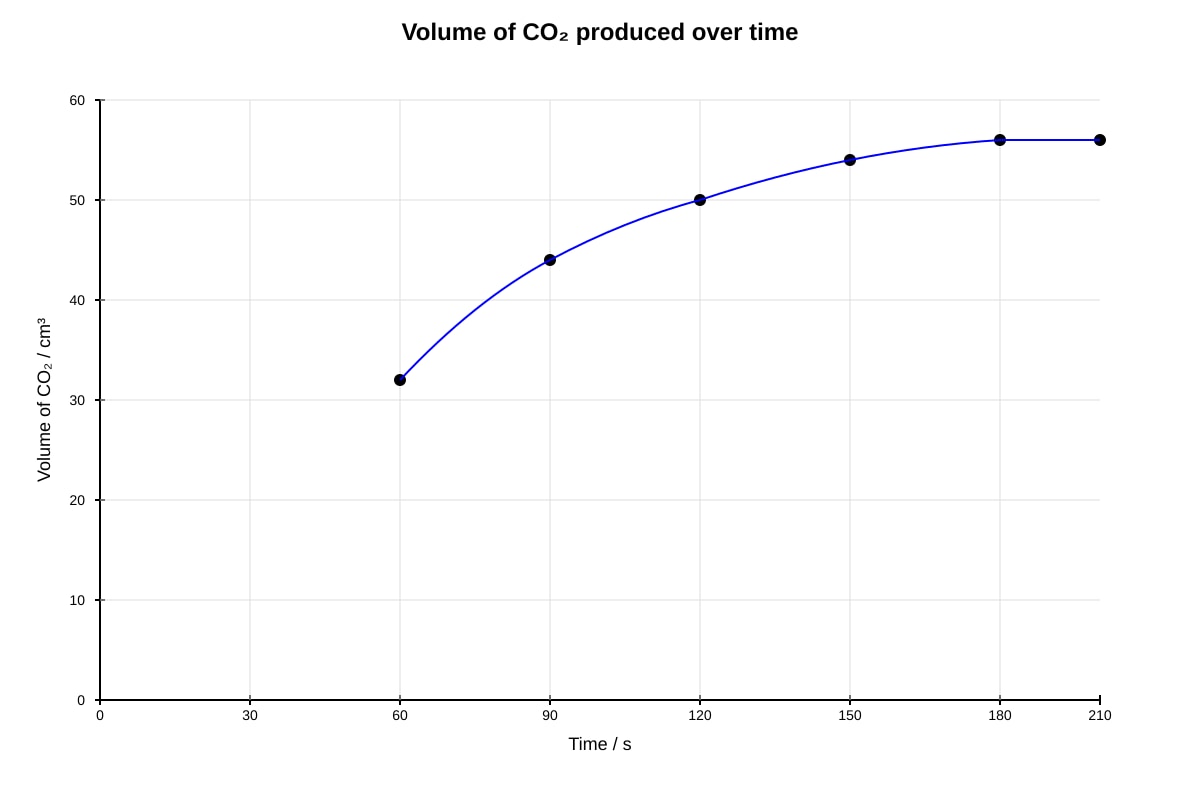
The student measures the volume of carbon dioxide gas produced every 30 seconds. The results are shown below.
| Time (s) | Volume of CO₂ (cm³) |
|---|---|
| 0 | 0 |
| 30 | 24 |
| 60 | 42 |
| 90 | 54 |
| 120 | 60 |
| 150 | 62 |
| 180 | 62 |
(a) Plot the results on the grid below and draw a smooth curve of best fit. [3]
<image_placeholder> id: Q12a-fig1 type: graph linked_question: Q12a description: Blank graph grid for plotting volume of CO₂ vs time. x-axis: Time (s) from 0 to 180, y-axis: Volume of CO₂ (cm³) from 0 to 70. Grid lines at 30s intervals on x-axis, 10 cm³ intervals on y-axis. labels: x-axis: Time (s), y-axis: Volume of CO₂ (cm³) values: Data points: (0,0), (30,24), (60,42), (90,54), (120,60), (150,62), (180,62) must_show: Labelled axes with units, appropriate scales, plotted points, smooth curve of best fit </image_placeholder>
(b) Using your graph, determine the rate of reaction at 60 seconds. Show your working on the graph. [2]
Rate of reaction = _______________ cm³/s
(c) Explain why the reaction eventually stops. [1]
(d) The student repeats the experiment using powdered calcium carbonate instead of marble chips, keeping all other conditions the same. Sketch the expected curve on the same grid and label it "Powdered CaCO₃". [1]
13. The diagram shows the structure of an atom of element X.
<image_placeholder> id: Q13-fig1 type: diagram linked_question: Q13 description: Atomic structure diagram showing a nucleus labelled 'Nucleus: 12 protons, 12 neutrons' with three electron shells: first shell with 2 electrons, second shell with 8 electrons, third shell with 2 electrons. labels: Nucleus (12 protons, 12 neutrons), electron shells labelled K, L, M with 2, 8, 2 electrons respectively values: Proton number = 12, Nucleon number = 24, Electron configuration = 2,8,2 must_show: Nucleus with proton/neutron count, three electron shells with correct electron numbers, shell labels </image_placeholder>
(a) Write the electronic configuration of element X. [1]
(b) State the group number and period number of element X in the Periodic Table. [1]
Group: ________ Period: ________
(c) Element X reacts with chlorine to form a compound. Predict the chemical formula of this compound. [1]
(d) State two physical properties of the compound formed in (c). [2]
14. A student is given a mixture containing iron filings, sand, and sodium chloride. All three substances are in solid form.
(a) Describe a sequence of steps to separate the three components and obtain each as a pure substance. [4]
Step 1: ___________________________________________________________________________
Step 2: ___________________________________________________________________________
Step 3: ___________________________________________________________________________
Step 4: ___________________________________________________________________________
(b) Name the separation technique used in Step 1. [1]
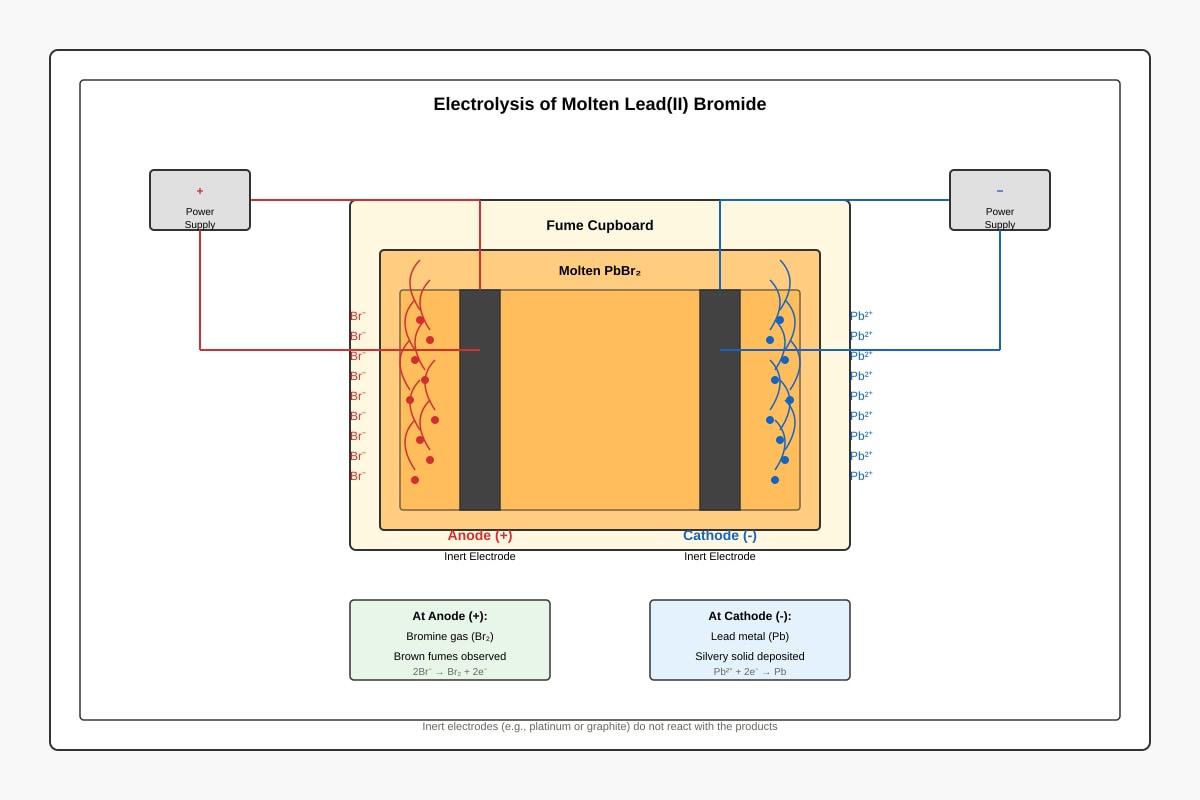
15. The diagram shows the electrolysis of molten lead(II) bromide using inert electrodes.
<image_placeholder> id: Q15-fig1 type: experimental_setup linked_question: Q15 description: Electrolysis setup for molten PbBr₂. Shows a crucible containing molten lead(II) bromide (orange liquid), two graphite electrodes (anode and cathode) connected to a DC power supply. Anode connected to positive terminal, cathode to negative. Fumes at anode, shiny deposit at cathode. labels: Crucible, molten PbBr₂, graphite anode (+), graphite cathode (-), DC power supply, connecting wires, fumes at anode (bromine), shiny deposit at cathode (lead) values: Not applicable must_show: Complete labelled electrolysis setup, molten electrolyte, inert electrodes, power supply with polarity, products at each electrode </image_placeholder>
(a) State what is meant by the term electrolysis. [1]
(b) Write half-equations for the reactions at: (i) the anode (positive electrode) [1]
(ii) the cathode (negative electrode) [1]
(c) Explain why solid lead(II) bromide cannot be electrolysed. [1]
(d) If aqueous lead(II) bromide is used instead of molten lead(II) bromide, state the product formed at the cathode and explain your answer. [2]
Section C: Free Response / Data-Based Questions (10 marks)
Answer all questions in the spaces provided.
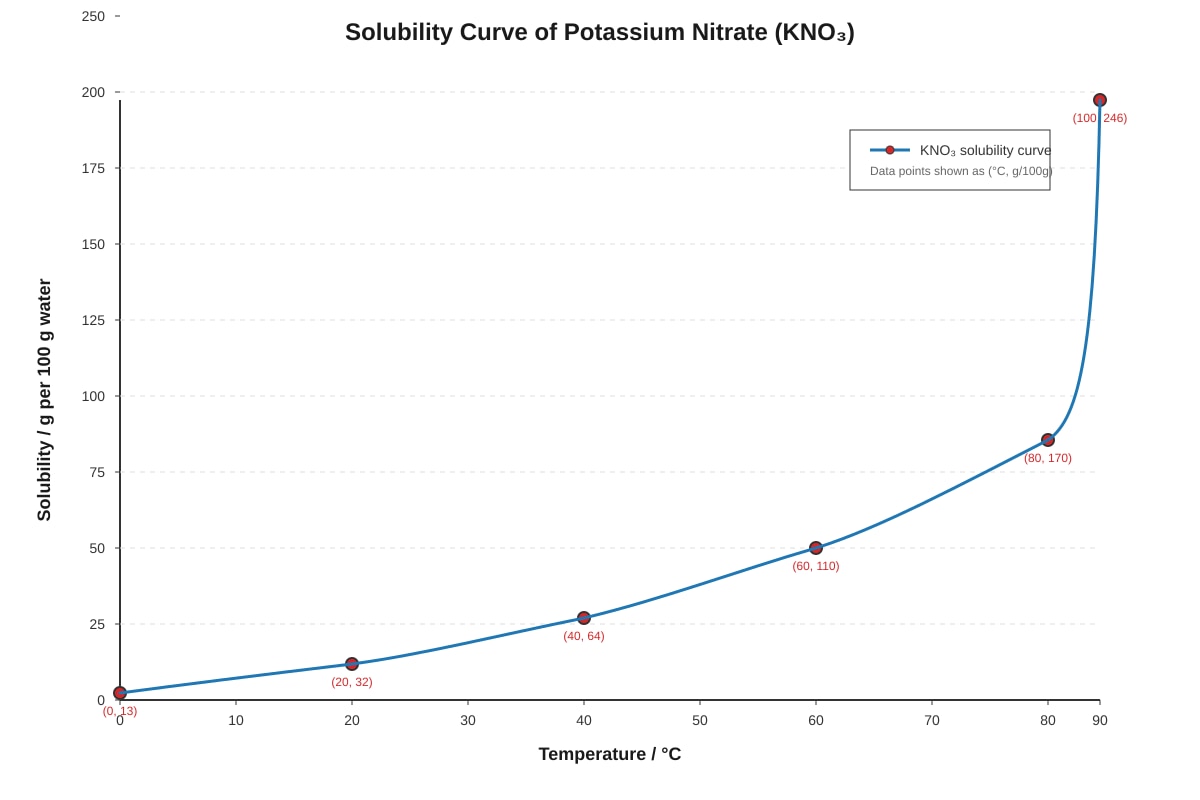
16. The table shows the solubility of three salts in water at different temperatures.
| Salt | Solubility (g per 100 g water) |
|---|---|
| 20°C | |
| Potassium nitrate (KNO₃) | 32 |
| Sodium chloride (NaCl) | 36 |
| Potassium chloride (KCl) | 34 |
(a) Which salt shows the greatest increase in solubility between 20°C and 80°C? [1]
(b) A student prepares a saturated solution of potassium nitrate at 60°C using 50 g of water. Calculate the mass of potassium nitrate that dissolves. [2]
Mass = _______________ g
(c) The hot saturated solution from (b) is cooled to 20°C. Calculate the mass of potassium nitrate that crystallises out. [2]
Mass crystallised = _______________ g
(d) Explain why the solubility of sodium chloride hardly changes with temperature. [1]
17. A student investigates the reactivity of four metals W, X, Y, and Z by adding each to dilute hydrochloric acid and dilute sulfuric acid. The observations are recorded below.
| Metal | Reaction with dilute HCl | Reaction with dilute H₂SO₄ |
|---|---|---|
| W | Vigorous effervescence, metal disappears quickly | Vigorous effervescence, metal disappears quickly |
| X | Slow bubbles, metal takes several minutes to disappear | Slow bubbles, metal takes several minutes to disappear |
| Y | No visible reaction | No visible reaction |
| Z | Steady bubbles, metal disappears in about 1 minute | Steady bubbles, metal disappears in about 1 minute |
(a) Arrange the four metals in order of reactivity, starting with the most reactive. [2]
Most reactive ________ > ________ > ________ > ________ Least reactive
(b) Metal Y does not react with either acid. Suggest the identity of metal Y. [1]
(c) Write a balanced chemical equation for the reaction of metal W with dilute sulfuric acid. [1]
(d) The student adds a piece of metal Z to a solution of metal X sulfate. Predict what will be observed and explain your answer using the reactivity series. [2]
18. The diagram shows a paper chromatography experiment to separate the dyes in three different inks (A, B, and C) and two known dyes (X and Y).
<image_placeholder> id: Q18-fig1 type: diagram linked_question: Q18 description: Paper chromatography chromatogram showing five spots at baseline labelled A, B, C, X, Y. Solvent front near top. Spot A: single spot at Rf 0.3. Spot B: two spots at Rf 0.2 and 0.6. Spot C: single spot at Rf 0.6. Spot X: single spot at Rf 0.2. Spot Y: single spot at Rf 0.6. Baseline and solvent front clearly marked. labels: Baseline, solvent front, spots A, B, C, X, Y with positions as described values: Rf values: A=0.3, B=0.2 and 0.6, C=0.6, X=0.2, Y=0.6 must_show: Chromatogram with baseline, solvent front, five lanes (A,B,C,X,Y), spots at correct Rf positions, distances measurable </image_placeholder>
(a) Which ink contains two different dyes? [1]
(b) Which ink contains a dye that is identical to dye X? [1]
(c) Calculate the Rf value of the dye in ink A if the solvent front moved 12.0 cm and the dye spot moved 3.6 cm from the baseline. [2]
Rf = _______________
(d) Explain why the baseline must be drawn in pencil and not in pen. [1]
19. A student carries out a neutralisation reaction between sodium hydroxide and sulfuric acid. The equation is:
2NaOH(aq) + H₂SO₄(aq) → Na₂SO₄(aq) + 2H₂O(l)
The student uses 25.0 cm³ of 0.100 mol/dm³ sodium hydroxide.
(a) Calculate the number of moles of sodium hydroxide used. [1]
Moles of NaOH = _______________ mol
(b) Determine the number of moles of sulfuric acid required for complete neutralisation. [1]
Moles of H₂SO₄ = _______________ mol
(c) If the concentration of sulfuric acid is 0.0500 mol/dm³, calculate the volume of sulfuric acid needed. [2]
Volume of H₂SO₄ = _______________ cm³
(d) Describe how the student could obtain pure, dry crystals of sodium sulfate from the resulting solution. [2]
20. The diagram shows the fractional distillation of crude oil.
<image_placeholder> id: Q20-fig1 type: diagram linked_question: Q20 description: Fractional distillation column for crude oil. Column with trays/bubble caps, temperature gradient (hot at bottom ~350°C, cool at top ~20°C). Fractions labelled from bottom to top: Bitumen (residue), Fuel oil, Diesel oil, Kerosene, Naphtha, Petrol, Refinery gases. Inlet for crude oil at bottom, fractions drawn off at different heights. labels: Column, trays, temperature gradient, fractions with names and boiling point ranges, crude oil inlet, fraction outlets values: Approximate boiling ranges: Refinery gases <30°C, Petrol 30-100°C, Naphtha 100-180°C, Kerosene 180-260°C, Diesel 260-340°C, Fuel oil 340-450°C, Bitumen >450°C must_show: Tall column with temperature gradient, labelled fractions at correct heights, crude oil feed at bottom, fraction outlets, condenser at top </image_placeholder>
(a) Name the fraction collected at the top of the column with the lowest boiling point. [1]
(b) Explain why the fractions separate at different heights in the column. [2]
(c) State one use of the diesel oil fraction. [1]
(d) The naphtha fraction is often cracked to produce smaller molecules. State two reasons why cracking is carried out. [2]
End of Quiz
Answers
Secondary 2 Science Quiz - Chemistry Materials (Answer Key)
Total Marks: 40
Section A: Multiple Choice Questions (10 marks)
1. C - Distilled water
Explanation: A pure substance contains only one type of particle (element or compound). Distilled water is pure H₂O. Air is a mixture of gases, brass is an alloy (mixture of copper and zinc), and seawater is a mixture of water and dissolved salts.
2. C - A solid element
Explanation: The diagram shows a regular, closely packed arrangement of identical particles in fixed positions. This represents a solid. Since all particles are identical, it is an element (not a compound which would have different types of particles in a fixed ratio).
3. A - W
Explanation: Metal carbonates react with dilute acids to produce carbon dioxide gas (bubbles) and the solid carbonate dissolves/disappears. Substance W shows bubbles and disappears completely, consistent with a metal carbonate reaction: MCO₃ + 2HCl → MCl₂ + H₂O + CO₂↑.
4. D - 17
Explanation: Al₂(SO₄)₃ contains: 2 Al atoms + 3 S atoms + (3 × 4) = 12 O atoms = 2 + 3 + 12 = 17 atoms total.
5. B - Simple distillation
Explanation: Simple distillation separates a solvent (water) from a dissolved solid (salts) based on different boiling points. Water boils at 100°C, leaving salts behind. Fractional distillation separates miscible liquids with close boiling points. Filtration only separates insoluble solids. Chromatography separates dissolved substances.
6. B - Group 16, Period 3
Explanation: Electronic configuration 2,8,6 means 3 electron shells (Period 3) and 6 valence electrons (Group 16 for main group elements, or Group VI in older notation).
7. C - 100°C
Explanation: At the boiling point (100°C on the graph), the substance exists in equilibrium as both liquid and gas. The horizontal plateau represents the phase change where both phases coexist.
8. B - CaCO₃ → CaO + CO₂
Explanation: A decomposition reaction is where a single compound breaks down into two or more simpler substances. Option B shows calcium carbonate decomposing into calcium oxide and carbon dioxide. A is synthesis, C is neutralisation, D is displacement.
9. B - Q
Explanation: Universal indicator shows green at neutral pH (pH 7). Red = acidic, Yellow = weakly acidic, Blue = alkaline.
10. C - Sand
Explanation: Sand is insoluble in water and will be trapped by the filter paper as residue. Salt dissolves in water and passes through as part of the filtrate (salt solution).
Section B: Structured Questions (20 marks)
11. (a) Substance B [2]
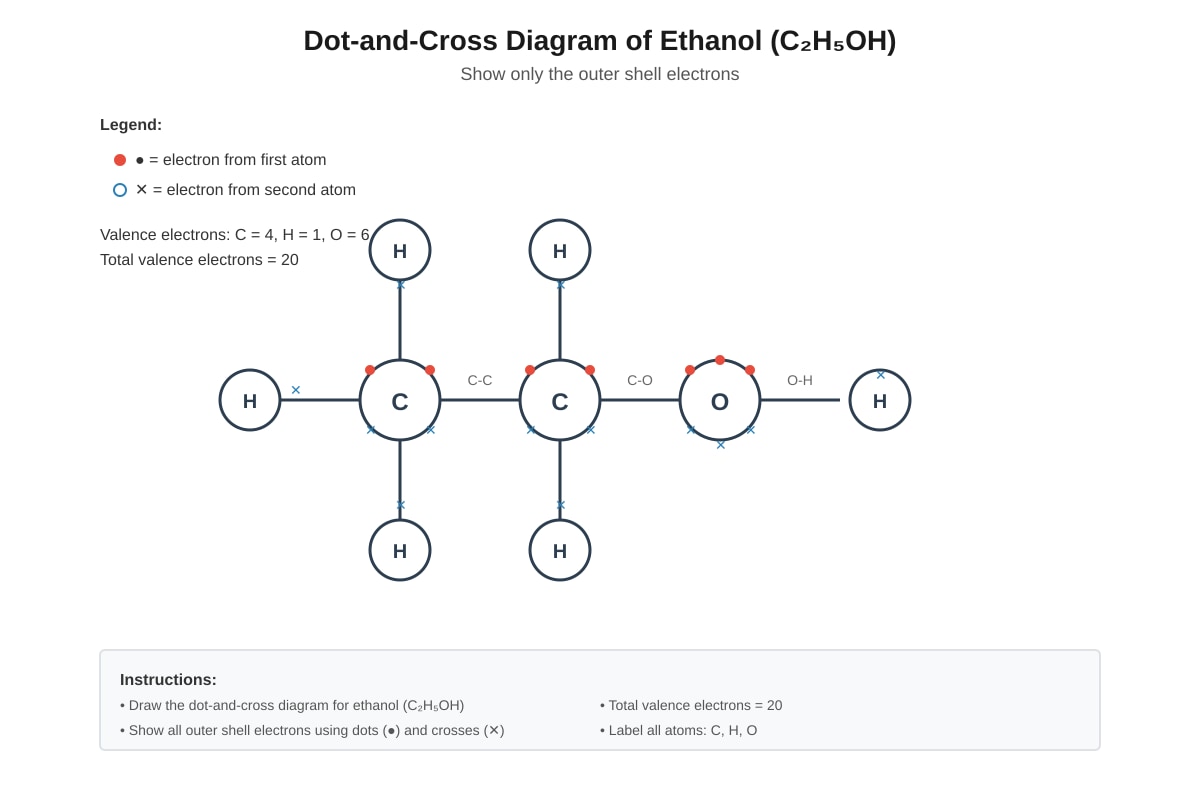
Explanation: Substance B has low melting/boiling points (-114°C, 78°C), does not conduct electricity in any state, and is miscible with water. These are typical properties of a simple covalent molecular compound (e.g., ethanol).
Mark breakdown: 1 mark for identifying B, 1 mark for correct explanation referencing at least two properties (low m.p./b.p., non-conductivity, miscibility).
(b) Substance D [2] Explanation: Substance D has high melting/boiling points, conducts electricity in both solid and molten states, and is insoluble in water. These are typical metallic properties: metallic bonding with delocalised electrons allowing conduction in all states.
Mark breakdown: 1 mark for identifying D, 1 mark for correct explanation referencing conductivity in solid state and high m.p./b.p.
(c) Dot-and-cross diagram for NaCl [2]
<image_placeholder> id: Q11c-ans-fig1 type: diagram linked_question: Q11c description: Completed dot-and-cross diagram showing Na atom (2,8,1) with 1 cross in outer shell, Cl atom (2,8,7) with 7 dots in outer shell. Arrow showing transfer of 1 electron from Na to Cl. Resulting Na⁺ ion (2,8) with empty outer shell shown as crosses, Cl⁻ ion (2,8,8) with full outer shell of 8 electrons (7 dots + 1 cross). Charges shown as + and -. labels: Na atom, Cl atom, electron transfer arrow, Na⁺ ion, Cl⁻ ion, outer shell electrons values: Na: 2,8,1 → Na⁺: 2,8; Cl: 2,8,7 → Cl⁻: 2,8,8 must_show: Electron transfer from Na to Cl, both ions with full outer shells (8 electrons), correct charges Na⁺ and Cl⁻, dots for Cl electrons, crosses for Na electron </image_placeholder>
Mark breakdown: 1 mark for correct electron transfer showing Na losing 1 electron and Cl gaining 1 electron. 1 mark for correct charges on both ions (Na⁺ and Cl⁻) and both having full outer shells (8 electrons).
Common mistake: Forgetting to show charges on ions, or not showing full outer shell on Na⁺ (should have 8 electrons in second shell, not empty).
12. (a) Graph plotting [3]
<image_placeholder> id: Q12a-ans-fig1 type: graph linked_question: Q12a description: Completed graph with labelled axes (Time/s on x-axis, Volume of CO₂/cm³ on y-axis), appropriate linear scales, all 7 data points plotted accurately as crosses or dots, smooth curve of best fit passing through or near all points, curve levelling off at 62 cm³. labels: x-axis: Time (s), y-axis: Volume of CO₂ (cm³) values: Points: (0,0), (30,24), (60,42), (90,54), (120,60), (150,62), (180,62) must_show: Labelled axes with units, correct scales, all points plotted accurately, smooth curve, curve plateaus at 62 cm³ </image_placeholder>
Mark breakdown: 1 mark for correct axes labels with units and appropriate scales. 1 mark for all points plotted accurately (± half a small square). 1 mark for smooth curve of best fit (not dot-to-dot).
(b) Rate at 60 seconds [2] Working: Draw tangent to curve at t = 60 s. Gradient = ΔVolume / ΔTime = (54 - 24) cm³ / (90 - 30) s = 30 / 60 = 0.50 cm³/s (accept 0.48–0.52 cm³/s depending on tangent drawing)
Mark breakdown: 1 mark for correct method (tangent drawn at 60 s). 1 mark for correct calculation with units.
(c) Reaction stops because one of the reactants is used up (limiting reagent). [1] Explanation: The volume of CO₂ becomes constant at 62 cm³, indicating no more gas is produced. The reaction stops when either the calcium carbonate or the hydrochloric acid is completely consumed. Usually, the acid is the limiting reagent in this experiment.
(d) Curve for powdered CaCO₃ [1] Explanation: Powdered calcium carbonate has a larger surface area, so the reaction is faster. The curve should:
- Start at origin (0,0)
- Rise more steeply initially
- Reach the same final volume (62 cm³) since same amounts of reactants used
- Level off earlier (at ~120 s instead of 150 s)
Mark breakdown: 1 mark for curve starting at origin, steeper initial gradient, same final volume, labelled "Powdered CaCO₃".
13. (a) Electronic configuration: 2,8,2 [1]
(b) Group 2, Period 3 [1] Explanation: 3 electron shells = Period 3. 2 valence electrons = Group 2 (alkaline earth metals).
(c) MgCl₂ [1] Explanation: Element X is magnesium (Group 2, forms Mg²⁺). Chlorine is Group 17, forms Cl⁻. Formula balances charges: Mg²⁺ + 2Cl⁻ → MgCl₂.
(d) Two physical properties of MgCl₂: [2]
- High melting and boiling points (ionic compound, strong electrostatic forces)
- Conducts electricity when molten or in aqueous solution (mobile ions)
- Soluble in water
- Solid at room temperature, crystalline structure (Any two correct properties, 1 mark each)
14. (a) Separation sequence [4]
Step 1: Use a magnet to attract and remove the iron filings from the mixture. (Magnetic separation) Step 2: Add water to the remaining mixture (sand + sodium chloride) and stir to dissolve the sodium chloride. Sand is insoluble. Step 3: Filter the mixture. Sand remains as residue on the filter paper; sodium chloride solution passes through as filtrate. Step 4: Evaporate the filtrate to dryness (or heat to crystallisation point then cool) to obtain pure sodium chloride crystals.
Mark breakdown: 1 mark per correct step in logical order. Must include: magnetic separation, dissolving in water, filtration, evaporation/crystallisation.
(b) Magnetic separation (or "using a magnet") [1]
15. (a) Electrolysis is the decomposition of an ionic compound (in molten or aqueous state) into its elements by passing an electric current through it. [1]
(b) Half-equations: [1 each] (i) Anode: 2Br⁻(l) → Br₂(g) + 2e⁻ (ii) Cathode: Pb²⁺(l) + 2e⁻ → Pb(l)
Mark breakdown: 1 mark each for correct species, balancing, state symbols, and electrons on correct side.
(c) Solid lead(II) bromide cannot be electrolysed because the ions (Pb²⁺ and Br⁻) are held in fixed positions in the giant ionic lattice and cannot move to conduct electricity. [1] Explanation: Electrolysis requires mobile ions to carry charge. In solid state, ions are immobile.
(d) Product at cathode with aqueous PbBr₂: Lead (Pb) [2] Explanation: In aqueous solution, both Pb²⁺ and H⁺ are present at the cathode. Pb²⁺ is lower in the reactivity series than hydrogen (Pb is less reactive than H), so Pb²⁺ is preferentially discharged: Pb²⁺ + 2e⁻ → Pb. Hydrogen ions remain in solution.
Mark breakdown: 1 mark for correct product (lead), 1 mark for correct explanation referencing reactivity series / selective discharge.
Section C: Free Response / Data-Based Questions (10 marks)
16. (a) Potassium nitrate (KNO₃) [1]
Explanation: Increase = 170 - 32 = 138 g/100g water. NaCl increases by 3 g, KCl by 21 g. KNO₃ shows the greatest increase.
(b) Mass of KNO₃ at 60°C [2] Working: Solubility at 60°C = 110 g per 100 g water For 50 g water: mass = (110 g / 100 g) × 50 g = 55 g
Mark breakdown: 1 mark for correct reading of solubility (110 g/100g), 1 mark for correct calculation with 50 g water.
(c) Mass crystallised on cooling to 20°C [2] Working: At 60°C: 55 g dissolved (from part b) At 20°C: Solubility = 32 g per 100 g water → for 50 g water = (32/100) × 50 = 16 g remains dissolved Mass crystallised = 55 g - 16 g = 39 g
Mark breakdown: 1 mark for calculating mass remaining dissolved at 20°C (16 g), 1 mark for correct subtraction and final answer.
(d) NaCl solubility hardly changes because the enthalpy change of solution for NaCl is close to zero (slightly endothermic), meaning the energy required to break the ionic lattice is almost balanced by the energy released during hydration of ions. Temperature has minimal effect on the equilibrium. [1] Simpler explanation acceptable: The dissolution of NaCl is neither significantly exothermic nor endothermic, so temperature change does not greatly shift the solubility equilibrium.
17. (a) Reactivity order: W > Z > X > Y [2]
Explanation: W reacts vigorously (most reactive), Z reacts steadily (moderately reactive), X reacts slowly (less reactive), Y does not react (least reactive).
Mark breakdown: 1 mark for correct order, 1 mark for correct reasoning or just correct sequence. All four must be in correct positions.
(b) Copper (Cu) or Silver (Ag) or Gold (Au) or Platinum (Pt) [1] Explanation: These metals are below hydrogen in the reactivity series and do not react with dilute acids.
(c) Balanced equation for W with H₂SO₄: [1] Assuming W is magnesium (typical vigorous reactor): Mg(s) + H₂SO₄(aq) → MgSO₄(aq) + H₂(g) Or if W is zinc: Zn(s) + H₂SO₄(aq) → ZnSO₄(aq) + H₂(g) General form: Metal + H₂SO₄ → Metal sulfate + H₂ Mark breakdown: 1 mark for correct reactants, products, balancing, and state symbols.
(d) Observation and explanation: [2] Observation: Metal Z will displace metal X from its sulfate solution. The solution colour may change (e.g., blue CuSO₄ becomes colourless if X = Cu, Z = Mg/Zn), and a deposit of metal X forms on metal Z. Explanation: Z is more reactive than X (higher in reactivity series). A more reactive metal can displace a less reactive metal from its compound (displacement reaction).
Mark breakdown: 1 mark for correct observation (displacement occurs), 1 mark for correct explanation using reactivity series.
18. (a) Ink B [1]
Explanation: Ink B shows two separate spots on the chromatogram, indicating it contains two different dyes.
(b) Ink C [1] Explanation: Ink C has a spot at the same Rf value (0.6) as dye Y, meaning they are the same substance. (Also dye X at Rf 0.2 matches one spot in Ink B).
(c) Rf value calculation [2] Working: Rf = distance moved by solute / distance moved by solvent Rf = 3.6 cm / 12.0 cm = 0.30 (no units)
Mark breakdown: 1 mark for correct formula/substitution, 1 mark for correct answer (0.30 or 0.3).
(d) Baseline in pencil because pencil marks (graphite) are insoluble in the solvent and will not dissolve or travel up the paper, whereas ink from a pen would dissolve and separate, contaminating the chromatogram. [1]
19. (a) Moles of NaOH [1]
Working: Volume = 25.0 cm³ = 0.0250 dm³ Concentration = 0.100 mol/dm³ Moles = concentration × volume = 0.100 × 0.0250 = 0.00250 mol (or 2.50 × 10⁻³ mol)
(b) Moles of H₂SO₄ required [1] Working: Mole ratio from equation: 2 NaOH : 1 H₂SO₄ Moles H₂SO₄ = 0.00250 / 2 = 0.00125 mol (or 1.25 × 10⁻³ mol)
(c) Volume of H₂SO₄ [2] Working: Concentration H₂SO₄ = 0.0500 mol/dm³
<stage5_quiz_answers_md>
Secondary 2 Science Quiz - Chemistry Materials (Answer Key)
Total Marks: 40
Section A: Multiple Choice Questions (10 marks)
| Question | Answer | Explanation |
|---|---|---|
| 1 | C | Distilled water is a pure substance (H₂O only). Air is a mixture of gases, brass is an alloy (mixture), seawater is a mixture of water and dissolved salts. |
| 2 | C | The diagram shows a regular, closely packed arrangement of identical particles in fixed positions — characteristic of a solid element. A compound would show different types of particles. |
| 3 | W | Metal carbonates react with dilute acids to produce CO₂ gas (bubbles) and the solid carbonate dissolves/disappears. |
| 4 | D | Al₂(SO₄)₃ = 2 Al + 3 S + 12 O = 17 atoms total. |
| 5 | B | Simple distillation separates pure water (lower boiling point) from dissolved salts in seawater. |
| 6 | B | Electronic configuration 2,8,6 → 6 valence electrons = Group 16; 3 shells = Period 3. |
| 7 | C | At the boiling point (100°C), liquid and gas coexist in equilibrium (horizontal plateau on heating curve). |
| 8 | B | Decomposition: one compound breaks down into two or more simpler substances (CaCO₃ → CaO + CO₂). |
| 9 | B | Universal indicator shows green at pH 7 (neutral). Red = acidic, Blue = alkaline, Yellow = weakly acidic. |
| 10 | C | Sand is insoluble and remains on the filter paper as residue. Salt solution passes through as filtrate. |
Section B: Structured Questions (20 marks)
11. Properties of Substances
(a) Substance B [2]
- Low melting/boiling points, does not conduct electricity in any state, miscible with water — typical of a simple covalent molecular compound (e.g., ethanol).
(b) Substance D [2]
- High melting/boiling points, conducts electricity in both solid and molten states, insoluble in water — typical of a metal (metallic bonding with delocalised electrons).
(c) Dot-and-cross diagram for NaCl [2]
- Na atom (2,8,1) loses 1 electron (shown as cross) → Na⁺ ion (2,8) with +1 charge
- Cl atom (2,8,7) gains 1 electron (shown as dot) → Cl⁻ ion (2,8,8) with -1 charge
- Electron transfer arrow from Na to Cl
- Both ions have full outer shells (octet)
12. Reaction of Marble Chips with HCl
(a) Graph [3]
- Axes labelled with units: Time (s) and Volume of CO₂ (cm³)
- Appropriate scales covering all data points
- All 7 points plotted accurately
- Smooth curve of best fit passing through or near all points
(b) Rate at 60 seconds [2]
- Draw tangent to curve at t = 60 s
- Rate = gradient of tangent = ΔVolume / ΔTime
- Expected value: ~0.4 cm³/s (accept 0.35–0.45 cm³/s with correct working shown on graph)
(c) Reaction stops because [1]
- One reactant is used up (limiting reagent). Typically HCl is limiting as marble chips are in excess.
(d) Powdered CaCO₃ curve [1]
- Curve starts steeper (higher initial rate)
- Reaches same final volume (62 cm³) but in less time
- Labelled "Powdered CaCO₃" — increased surface area increases rate
13. Atomic Structure of Element X
(a) Electronic configuration: 2,8,2 [1]
(b) Group: 2, Period: 3 [1]
- 2 valence electrons → Group 2
- 3 electron shells → Period 3
(c) Formula with chlorine: MgCl₂ [1]
- Element X is magnesium (Group 2), forms Mg²⁺; chlorine forms Cl⁻
(d) Two physical properties of MgCl₂: [2]
- High melting/boiling point (ionic compound)
- Conducts electricity when molten or in aqueous solution
- Soluble in water
- Forms crystalline solid at room temperature (Any two correct properties)
14. Separation of Iron Filings, Sand, and NaCl
(a) Sequence of steps: [4]
- Step 1: Use a magnet to attract and remove iron filings (magnetic separation).
- Step 2: Add water to the remaining mixture (sand + NaCl) and stir to dissolve NaCl. Filter — sand remains as residue, NaCl solution as filtrate.
- Step 3: Heat the filtrate (NaCl solution) to evaporate water and obtain solid NaCl crystals (evaporation to dryness / crystallisation).
- Step 4: Dry the sand (residue) and NaCl crystals separately to obtain pure substances.
(b) Technique in Step 1: Magnetic separation [1]
15. Electrolysis of Molten PbBr₂
(a) Electrolysis: [1]
- The decomposition of an ionic compound (in molten or aqueous state) into its elements by passing an electric current through it.
(b) Half-equations: [2]
- (i) Anode: 2Br⁻(l) → Br₂(g) + 2e⁻
- (ii) Cathode: Pb²⁺(l) + 2e⁻ → Pb(l)
(c) Solid PbBr₂ cannot be electrolysed because: [1]
- Ions are fixed in position in the solid lattice and cannot move to carry charge. Mobile ions are required for electrolysis.
(d) Aqueous PbBr₂ at cathode: [2]
- Product: Lead (Pb) — grey/silvery deposit
- Explanation: Pb²⁺ has a lower reduction potential (less negative E°) than H⁺ from water, so Pb²⁺ is preferentially reduced: Pb²⁺ + 2e⁻ → Pb. H⁺ is not discharged.
Section C: Free Response / Data-Based Questions (10 marks)
16. Solubility of Salts
(a) Potassium nitrate (KNO₃) [1]
- Increase = 170 – 32 = 138 g/100g water (largest increase)
(b) Mass of KNO₃ at 60°C in 50 g water: [2]
- Solubility at 60°C = 110 g per 100 g water
- Mass = (110 g / 100 g) × 50 g = 55 g
(c) Mass crystallised on cooling to 20°C: [2]
- Solubility at 20°C = 32 g per 100 g water
- Mass remaining dissolved = (32 g / 100 g) × 50 g = 16 g
- Mass crystallised = 55 g – 16 g = 39 g
(d) NaCl solubility hardly changes because: [1]
- The dissolution of NaCl is only slightly endothermic; the energy change is small, so temperature has little effect on equilibrium position (Le Chatelier's principle). / The hydration energy and lattice energy are closely balanced.
17. Reactivity of Metals
(a) Order of reactivity: [2] W > Z > X > Y
- W: vigorous (most reactive)
- Z: steady, 1 min
- X: slow, several minutes
- Y: no reaction (least reactive)
(b) Identity of metal Y: Copper (Cu) or Silver (Ag) or Gold (Au) [1]
- Metals below hydrogen in reactivity series do not react with dilute acids.
(c) Equation for W + H₂SO₄: [1]
- W(s) + H₂SO₄(aq) → WS₄(aq) + H₂(g) (assuming W forms 2+ ion; if W is Mg: Mg + H₂SO₄ → MgSO₄ + H₂)
- Accept any Group 1 or 2 metal formula with correct balancing and state symbols.
(d) Metal Z + Metal X sulfate: [2]
- Observation: Metal Z displaces metal X — a deposit of metal X forms on Z / solution colour changes.
- Explanation: Z is more reactive than X (higher in reactivity series), so Z can reduce X²⁺ ions: Z + X²⁺ → Z²⁺ + X. A more reactive metal displaces a less reactive metal from its salt solution.
End of Answer Key