From Real Exams Quiz
Secondary 2 Science Scientific Inquiry Quiz
Free Exam-Derived NVIDIA Nemotron 3 Ultra 550B A55B Free Secondary 2 Science Scientific Inquiry quiz with questions and answers for Singapore students. This page is rendered as a direct URL so the questions and answers can be discovered without pressing in-page buttons.
These static practice materials are generated from the site's syllabus and paper-generation workflow, with source and model context shown so students and parents can evaluate the material before use.
Questions
Secondary 2 Science Quiz - Scientific Inquiry
Name: ___________________________
Class: ___________________________
Date: ___________________________
Score: ______ / 50
Duration: 45 minutes
Total Marks: 50
Instructions:
- Answer all questions in the spaces provided.
- Show all working for calculation questions.
- Use appropriate significant figures and units.
- Diagrams are not drawn to scale unless stated otherwise.
Section A: Multiple Choice Questions (10 marks)
Questions 1 to 10 carry 1 mark each. Choose the correct answer and write its letter (A, B, C, or D) in the box provided.
-
Which of the following best describes the difference between accuracy and precision in measurements?
A. Accuracy refers to how close measurements are to each other; precision refers to how close measurements are to the true value.
B. Accuracy refers to how close measurements are to the true value; precision refers to how close measurements are to each other.
C. Accuracy and precision both refer to how close measurements are to the true value.
D. Accuracy and precision both refer to how close measurements are to each other.Answer: □
-
A student measures the length of a metal rod five times using a metre rule. The readings are: 15.2 cm, 15.3 cm, 15.1 cm, 15.2 cm, 15.3 cm. The actual length of the rod is 15.0 cm. Which statement is correct?
A. The measurements are accurate but not precise.
B. The measurements are precise but not accurate.
C. The measurements are both accurate and precise.
D. The measurements are neither accurate nor precise.Answer: □
-
When using a measuring cylinder to measure the volume of a liquid, which of the following is a parallax error?
A. Reading the top of the meniscus instead of the bottom.
B. Reading the volume from an angle instead of at eye level.
C. Not accounting for the zero error of the measuring cylinder.
D. Using a measuring cylinder with a larger capacity than necessary.Answer: □
-
In an experiment to investigate the effect of temperature on the rate of reaction between magnesium and hydrochloric acid, what is the independent variable?
A. Volume of hydrochloric acid used
B. Concentration of hydrochloric acid
C. Temperature of the hydrochloric acid
D. Time taken for magnesium to disappearAnswer: □
-
A student wants to investigate how the length of a pendulum affects its period. Which of the following variables must be kept constant to ensure a fair test?
A. Length of the pendulum and mass of the bob
B. Mass of the bob and angle of release
C. Length of the pendulum and angle of release
D. Period of the pendulum and mass of the bobAnswer: □
-
Which of the following is an example of a systematic error?
A. A student reading the scale slightly differently each time.
B. A balance that reads 0.5 g when nothing is placed on it.
C. Slight variations in room temperature during the experiment.
D. A student accidentally spilling some reactant.Answer: □
-
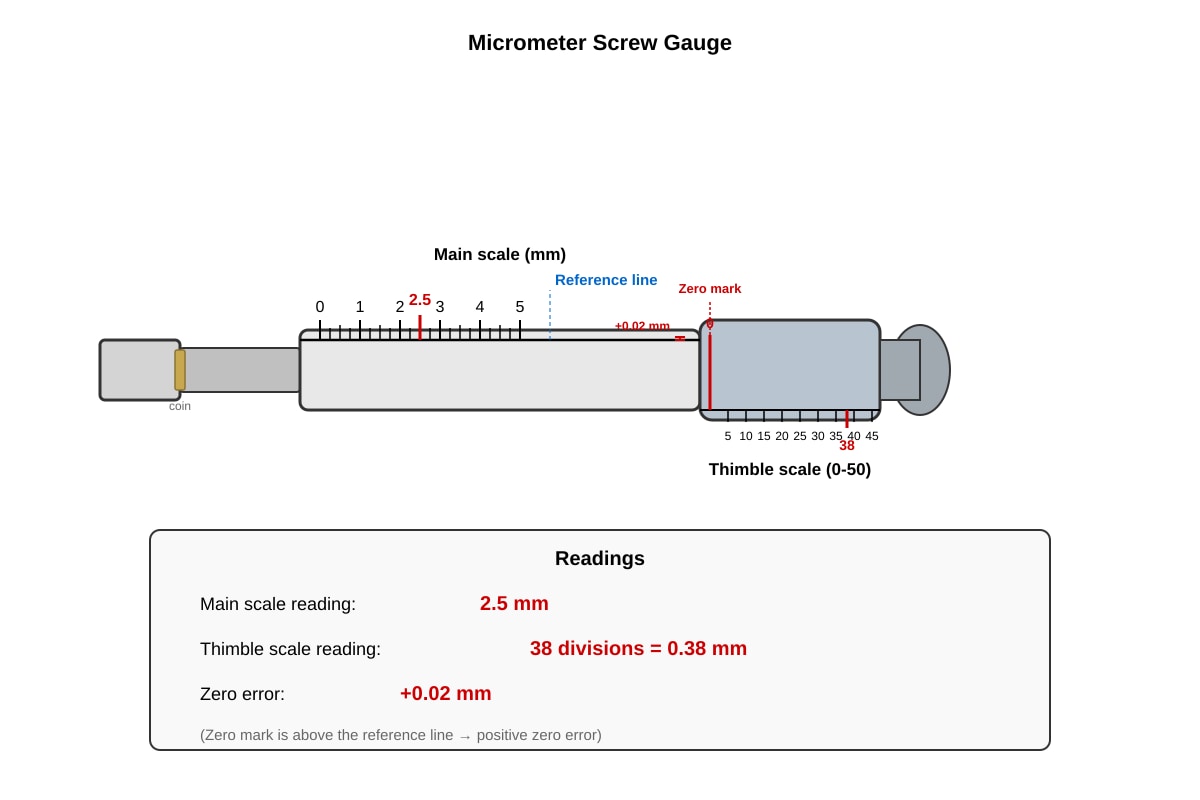
The diameter of a wire is measured as 0.24 mm using a micrometer screw gauge. How many significant figures does this measurement have?
A. 1
B. 2
C. 3
D. 4Answer: □
-
A student calculates the density of a metal block. The mass is measured as 45.6 g (3 significant figures) and the volume is measured as 12.0 cm³ (3 significant figures). The calculated density should be reported to how many significant figures?
A. 1
B. 2
C. 3
D. 4Answer: □
-
In a controlled experiment, what is the purpose of a control set-up?
A. To provide a baseline for comparison with the experimental set-up.
B. To test the independent variable at its maximum value.
C. To ensure the dependent variable changes.
D. To repeat the experiment for reliability.Answer: □
-
Which of the following graphs correctly shows the relationship between the extension of a spring and the force applied, assuming the spring obeys Hooke's Law and the limit of proportionality is not exceeded?
A. A curved line passing through the origin.
B. A straight line passing through the origin.
C. A horizontal straight line.
D. A vertical straight line.Answer: □
Section B: Structured Questions (24 marks)
Answer all questions in the spaces provided.
- A student uses a vernier caliper to measure the external diameter of a cylindrical metal rod. The diagram below shows the vernier caliper reading.
<image_placeholder> id: Q11-fig1 type: diagram linked_question: Q11 description: Vernier caliper showing main scale and vernier scale for measuring external diameter of a metal rod. Main scale reads 1.2 cm (12 mm). Vernier scale shows the 6th division aligned with a main scale division. Least count = 0.01 cm. labels: Main scale (cm), Vernier scale (divisions 0-10), Jaws, Object (metal rod) values: Main scale reading = 1.2 cm, Vernier division aligned = 6, Least count = 0.01 cm must_show: Clear alignment of 6th vernier division with main scale, zero marks on both scales, object between jaws </image_placeholder>
(a) State the main scale reading.
Answer: ___________________________ [1]
(b) State the vernier scale reading.
Answer: ___________________________ [1]
(c) Determine the external diameter of the metal rod.
Answer: ___________________________ [1]
(d) The student measures the diameter at three different positions along the rod and obtains the following readings: 1.26 cm, 1.27 cm, 1.25 cm. Calculate the average diameter.
Answer: ___________________________ [1]
(e) Explain why the student should measure the diameter at several positions along the rod.
Answer: _________________________________________________________________________________ [1]
- An experiment is conducted to investigate how the mass of a toy car affects its speed at the bottom of a ramp. The car is released from rest at the top of the ramp.
(a) Identify the independent variable in this experiment.
Answer: ___________________________ [1]
(b) Identify the dependent variable in this experiment.
Answer: ___________________________ [1]
(c) State two variables that should be kept constant to ensure a fair test.
Answer: ___________________________ [2]
(d) The student repeats the experiment three times for each mass and calculates the average speed. Explain why repeating the experiment improves the reliability of the results.
Answer: _________________________________________________________________________________ [1]
(e) The student plots a graph of speed against mass. The graph shows that as mass increases, speed remains constant. Using the concept of energy conversion, explain why the speed does not depend on the mass of the car.
Answer: _________________________________________________________________________________ [2]
- A student measures the time taken for a pendulum to complete 20 oscillations using a stopwatch. The student repeats this measurement three times and obtains the following readings: 38.4 s, 38.6 s, 38.2 s.
(a) Calculate the average time for 20 oscillations.
Answer: ___________________________ [1]
(b) Calculate the period of the pendulum (time for one oscillation).
Answer: ___________________________ [1]
(c) The student's reaction time introduces a random error of approximately ±0.2 s in starting and stopping the stopwatch. Explain how measuring 20 oscillations instead of 1 oscillation reduces the percentage error in the period.
Answer: _________________________________________________________________________________ [2]
(d) Suggest one way to further reduce the error in measuring the period, other than increasing the number of oscillations.
Answer: _________________________________________________________________________________ [1]
- In an experiment to determine the density of an irregularly shaped stone, a student uses the displacement method. The following measurements are recorded:
- Mass of stone = 48.5 g
- Initial volume of water in measuring cylinder = 50.0 cm³
- Final volume of water with stone submerged = 68.0 cm³
(a) Calculate the volume of the stone.
Answer: ___________________________ [1]
(b) Calculate the density of the stone. Give your answer in g/cm³ to 3 significant figures.
Answer: ___________________________ [2]
(c) The student notices that some water splashes out of the measuring cylinder when the stone is dropped in. Explain how this affects the calculated density.
Answer: _________________________________________________________________________________ [1]
(d) State one precaution the student should take when reading the volume of water in the measuring cylinder to avoid parallax error.
Answer: _________________________________________________________________________________ [1]
- A student investigates the effect of light intensity on the rate of photosynthesis in an aquatic plant. The number of bubbles produced per minute is counted at different distances from a light source.
<image_placeholder> id: Q15-fig1 type: table linked_question: Q15 description: Table showing distance of light source from plant and number of bubbles produced per minute. labels: Distance from light source (cm), Number of bubbles per minute values: Distance: 10, 20, 30, 40, 50 cm; Bubbles/min: 48, 32, 20, 12, 8 must_show: Complete table with headers, units, and all 5 data rows </image_placeholder>
(a) State the independent variable and the dependent variable in this experiment.
Answer: ___________________________ [2]
(b) Plot the data on the grid below and draw a smooth curve of best fit.
<image_placeholder> id: Q15-fig2 type: graph linked_question: Q15 description: Blank graph grid for plotting number of bubbles per minute against distance from light source. labels: x-axis: Distance from light source (cm), y-axis: Number of bubbles per minute values: x-axis range 0-60 cm, y-axis range 0-55 bubbles/min must_show: Labeled axes with units, appropriate scale, grid lines, data points plotted, smooth curve of best fit </image_placeholder>
(c) Describe the relationship between the distance from the light source and the rate of photosynthesis.
Answer: _________________________________________________________________________________ [1]
(d) Explain why the rate of photosynthesis decreases as the distance from the light source increases.
Answer: _________________________________________________________________________________ [2]
(e) State one variable that must be kept constant in this experiment.
Answer: ___________________________ [1]
Section C: Data Analysis and Experimental Design (16 marks)
Answer all questions in the spaces provided.
- A student conducts an experiment to investigate how the concentration of sodium thiosulfate solution affects the rate of reaction with hydrochloric acid. The reaction produces a yellow precipitate of sulfur, which makes the solution cloudy. The student measures the time taken for a cross marked on a paper beneath the reaction flask to become invisible.
The following results are obtained:
| Concentration of Na₂S₂O₃ (mol/dm³) | Time for cross to disappear (s) | Rate of reaction (1/time) (s⁻¹) |
|---|---|---|
| 0.10 | 120 | 0.0083 |
| 0.15 | 80 | 0.0125 |
| 0.20 | 60 | 0.0167 |
| 0.25 | 48 | 0.0208 |
| 0.30 | 40 | 0.0250 |
(a) Complete the table by calculating the rate of reaction for 0.10 mol/dm³ concentration. The rate for 0.15 mol/dm³ has been calculated for you.
Answer: ___________________________ [1]
(b) Plot a graph of rate of reaction (y-axis) against concentration of sodium thiosulfate (x-axis) on the grid below. Draw a line of best fit.
<image_placeholder> id: Q16-fig1 type: graph linked_question: Q16 description: Blank graph grid for plotting rate of reaction against concentration of sodium thiosulfate. labels: x-axis: Concentration of Na₂S₂O₃ (mol/dm³), y-axis: Rate of reaction (s⁻¹) values: x-axis range 0-0.35 mol/dm³, y-axis range 0-0.030 s⁻¹ must_show: Labeled axes with units, appropriate scale, grid lines, data points plotted, straight line of best fit passing through origin </image_placeholder>
(c) Describe the relationship between the concentration of sodium thiosulfate and the rate of reaction.
Answer: _________________________________________________________________________________ [1]
(d) Using collision theory, explain why the rate of reaction increases with concentration.
Answer: _________________________________________________________________________________ [2]
(e) The student wants to investigate the effect of temperature on the same reaction. State two variables that must be kept constant.
Answer: ___________________________ [2]
(f) Suggest how the student can ensure the temperature remains constant during the experiment.
Answer: _________________________________________________________________________________ [1]
- A student is tasked with designing an experiment to investigate the effect of the surface area of a solid reactant on the rate of reaction between calcium carbonate and hydrochloric acid.
(a) State a suitable hypothesis for this investigation.
Answer: _________________________________________________________________________________ [1]
(b) Identify the independent variable, dependent variable, and one controlled variable.
Answer: ___________________________ [3]
(c) List the apparatus and materials needed for this experiment.
Answer: _________________________________________________________________________________ [2]
(d) Describe the procedure for the experiment, including how the student will measure the rate of reaction.
Answer: _________________________________________________________________________________ [3]
(e) State one safety precaution the student should take during this experiment.
Answer: _________________________________________________________________________________ [1]
- The diagram below shows an experimental set-up to investigate the heating curve of a pure substance.
<image_placeholder> id: Q18-fig1 type: experimental_setup linked_question: Q18 description: Experimental set-up for heating curve: Bunsen burner, tripod, wire gauze, beaker with pure substance, thermometer clamped in place, stirrer, stopwatch. Substance starts as solid at room temperature. labels: Bunsen burner, Tripod, Wire gauze, Beaker, Pure substance (solid), Thermometer, Stirrer, Stopwatch, Clamp stand values: Initial temperature = 25°C, Heating rate = constant must_show: All apparatus labeled, thermometer bulb immersed in substance but not touching beaker, stirrer in substance, stopwatch visible </image_placeholder>
The substance is heated at a constant rate and its temperature is recorded every minute. The graph below shows the heating curve obtained.
<image_placeholder> id: Q18-fig2 type: graph linked_question: Q18 description: Heating curve graph showing temperature vs time with two plateaus. labels: x-axis: Time (min), y-axis: Temperature (°C) values: First plateau at 60°C from 3-8 min, second plateau at 120°C from 15-25 min. Initial gradient 15°C/min, final gradient 10°C/min. must_show: Clear plateaus at melting and boiling points, labeled axes with units, sloped sections for solid, liquid, gas heating </image_placeholder>
(a) State the melting point and boiling point of the substance.
Answer: ___________________________ [2]
(b) During which time intervals is the substance present in:
(i) solid state only
(ii) solid and liquid states
(iii) liquid state only
(iv) liquid and gas states
(v) gas state only
Answer: ___________________________ [3]
(c) Explain why the temperature remains constant during the plateaus on the heating curve.
Answer: _________________________________________________________________________________ [2]
(d) The specific latent heat of fusion of the substance is 150 J/g. If 50 g of the substance is melted, calculate the thermal energy required.
Answer: ___________________________ [2]
(e) State one assumption made when using this method to determine the melting and boiling points.
Answer: _________________________________________________________________________________ [1]
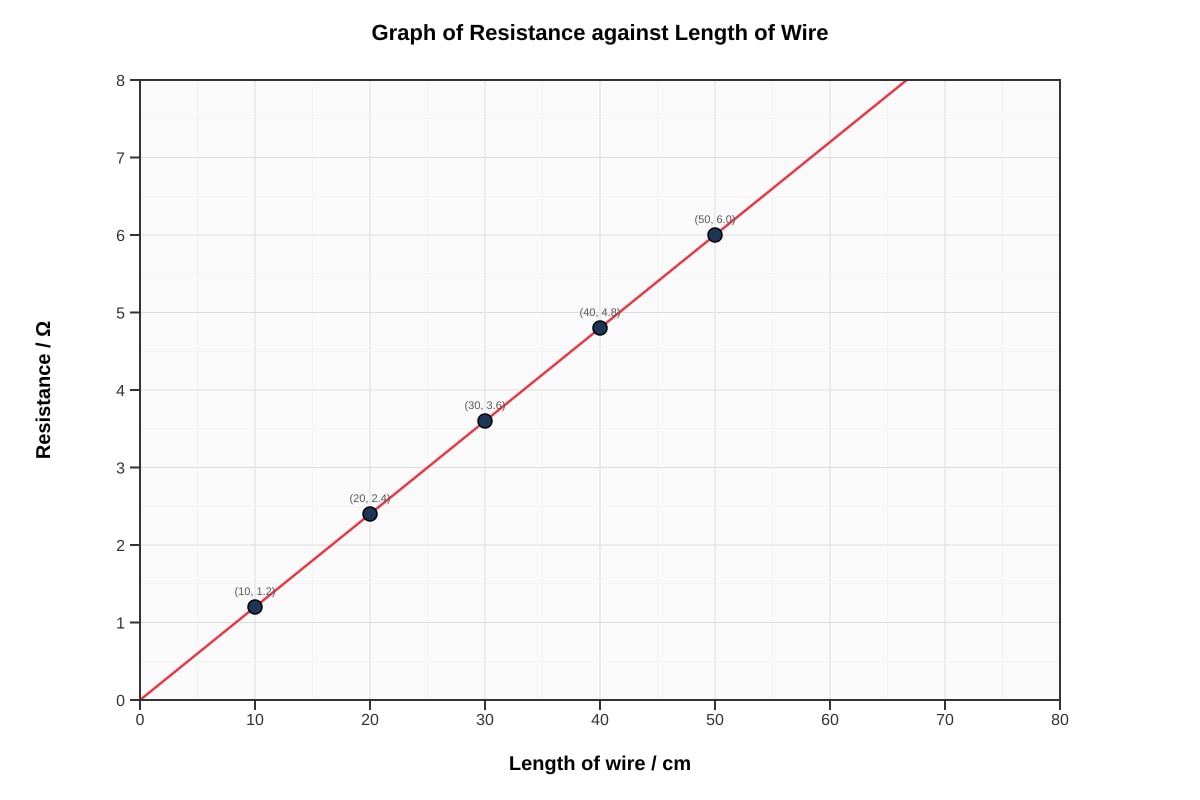
- A student measures the resistance of a wire at different lengths using the circuit shown below.
<image_placeholder> id: Q19-fig1 type: diagram linked_question: Q19 description: Circuit diagram for measuring resistance of wire at different lengths. Battery, ammeter, voltmeter, variable length of wire (with sliding contact), connecting wires, switch. labels: Battery, Ammeter (in series), Voltmeter (in parallel across wire), Wire with sliding contact, Switch, Connecting wires values: Battery voltage = 1.5 V, Wire material = constantan, Wire diameter = constant must_show: Correct series/parallel connections, sliding contact on wire, ammeter in series, voltmeter across test length of wire </image_placeholder>
The student records the following data:
| Length of wire (cm) | Current (A) | Voltage (V) | Resistance (Ω) |
|---|---|---|---|
| 20 | 0.50 | 1.0 | 2.0 |
| 40 | 0.25 | 1.0 | 4.0 |
| 60 | 0.17 | 1.0 | 5.9 |
| 80 | 0.13 | 1.0 | 7.7 |
| 100 | 0.10 | 1.0 | 10.0 |
(a) The resistance for 60 cm is calculated as 5.9 Ω. Verify this calculation using the formula R = V/I.
Answer: ___________________________ [1]
(b) Plot a graph of resistance (y-axis) against length of wire (x-axis) on the grid below. Draw a line of best fit.
<image_placeholder> id: Q19-fig2 type: graph linked_question: Q19 description: Blank graph grid for plotting resistance against length of wire. labels: x-axis: Length of wire (cm), y-axis: Resistance (Ω) values: x-axis range 0-110 cm, y-axis range 0-12 Ω must_show: Labeled axes with units, appropriate scale, grid lines, data points plotted, straight line of best fit passing through origin </image_placeholder>
(c) State the relationship between the resistance of the wire and its length.
Answer: _________________________________________________________________________________ [1]
(d) The student concludes that resistance is directly proportional to length. Using the graph, explain whether this conclusion is supported by the data.
Answer: _________________________________________________________________________________ [2]
(e) Suggest one source of error in this experiment and how it can be minimised.
Answer: _________________________________________________________________________________ [2]
- A group of students plans an investigation to determine which of three different brands of batteries (Brand X, Y, and Z) lasts the longest when used in identical torches.
(a) Identify the independent variable and the dependent variable.
Answer: ___________________________ [2]
(b) State three variables that must be controlled to ensure a fair comparison.
Answer: ___________________________ [3]
(c) The students decide to test each brand only once. Explain why this is not good scientific practice.
Answer: _________________________________________________________________________________ [2]
(d) Describe how the students should present their results to allow a clear comparison between the three brands.
Answer: _________________________________________________________________________________ [2]
(e) The students find that Brand X lasts 8 hours, Brand Y lasts 10 hours, and Brand Z lasts 9 hours. They conclude that Brand Y is the best battery to buy. State one other factor, besides duration, that should be considered when deciding which battery to buy.
Answer: _________________________________________________________________________________ [1]
End of Quiz
Answers
Secondary 2 Science Quiz - Scientific Inquiry (Answer Key)
Total Marks: 50
Section A: Multiple Choice Questions (10 marks)
-
B [1]
Explanation: Accuracy refers to how close a measured value is to the true/accepted value. Precision refers to how close repeated measurements are to each other (reproducibility). This is a fundamental distinction in measurement science. -
B [1]
Explanation: The readings (15.1–15.3 cm) are close to each other (precise) but systematically higher than the true value of 15.0 cm (not accurate). This indicates a systematic error, such as a zero error on the metre rule. -
B [1]
Explanation: Parallax error occurs when the observer's eye is not perpendicular to the scale (not at eye level), causing the meniscus to appear at a different position. Reading the top of the meniscus (A) is a technique error for most liquids (except mercury). Zero error (C) is a systematic error. Using a larger cylinder (D) affects precision but is not parallax error. -
C [1]
Explanation: The independent variable is the one deliberately changed by the experimenter. Here, the investigation is on the effect of temperature, so temperature is the independent variable. Volume and concentration of acid (A, B) should be controlled. Time taken (D) is the dependent variable. -
B [1]
Explanation: To test the effect of length (independent variable) on period (dependent variable), the mass of the bob and angle of release must be kept constant. Length (A, C) is the independent variable and is changed. Period (D) is the dependent variable. -
B [1]
Explanation: A systematic error is a consistent, repeatable error caused by faulty equipment or flawed technique. A balance reading 0.5 g with no load is a zero error (systematic). Random reading variations (A) and temperature fluctuations (C) are random errors. Spilling reactant (D) is a mistake/blunder, not a systematic error. -
B [1]
Explanation: The measurement 0.24 mm has two significant figures (2 and 4). Leading zeros before the first non-zero digit are not significant. Trailing zeros after a decimal point are significant, but here there are no trailing zeros after the 4. -
C [1]
Explanation: For multiplication and division, the result should have the same number of significant figures as the measurement with the fewest significant figures. Both mass (45.6 g) and volume (12.0 cm³) have 3 significant figures, so the density should be reported to 3 significant figures. -
A [1]
Explanation: A control set-up is identical to the experimental set-up except the independent variable is not applied (or is set to a baseline value). It provides a baseline to compare results against, ensuring any change in the dependent variable is due to the independent variable. -
B [1]
Explanation: Hooke's Law states that extension is directly proportional to force (F = kx) within the limit of proportionality. This gives a straight line graph passing through the origin. A curved line (A) would indicate non-linear behaviour. Horizontal (C) or vertical (D) lines would indicate no relationship or infinite stiffness.
Section B: Structured Questions (24 marks)
-
(a) 1.2 cm [1]
Explanation: The main scale reading is the value on the main scale just before the zero of the vernier scale. The diagram shows 1.2 cm (or 12 mm).(b) 0.06 cm [1]
Explanation: The vernier scale reading is the division on the vernier scale that aligns exactly with a main scale division. The 6th division aligns. With a least count of 0.01 cm, the vernier reading = 6 × 0.01 cm = 0.06 cm.(c) 1.26 cm [1]
Explanation: Total reading = Main scale reading + Vernier scale reading = 1.2 cm + 0.06 cm = 1.26 cm.(d) 1.26 cm [1]
Working: Average = (1.26 + 1.27 + 1.25) / 3 = 3.78 / 3 = 1.26 cm.(e) To check for uniformity of the rod / to detect any variation in diameter along the length / to obtain a more reliable average value. [1]
Explanation: The rod may not be perfectly cylindrical; its diameter might vary slightly along its length. Measuring at multiple positions and averaging reduces the effect of random variations and gives a more representative value. -
(a) Mass of the toy car [1]
Explanation: The independent variable is the one deliberately changed to observe its effect. The investigation is on how mass affects speed.(b) Speed of the car at the bottom of the ramp [1]
Explanation: The dependent variable is the one measured/observed in response to changes in the independent variable.(c) Height/length/angle of the ramp; surface of the ramp; release mechanism (starting from rest); same car body (only mass changed). (Any two) [2]
Explanation: Controlled variables must be kept constant to ensure a fair test. Only the independent variable (mass) should change.(d) Repeating allows identification of anomalous results and calculation of an average, which reduces the effect of random errors and increases reliability. [1]
Explanation: Random errors cause readings to scatter. Averaging multiple readings cancels out random fluctuations, giving a value closer to the true value.(e) Gravitational potential energy (GPE) at the top = mgh. Kinetic energy (KE) at the bottom = ½mv². By conservation of energy, mgh = ½mv². Mass (m) cancels out, giving v = √(2gh), which is independent of mass. [2]
Marking points: (1) GPE = mgh, KE = ½mv²; (2) Mass cancels out, showing speed depends only on height (and g).
Explanation: Assuming no energy losses, all GPE converts to KE. Since both GPE and KE are proportional to mass, the mass cancels out. The speed depends only on the vertical height of the ramp and gravitational acceleration. -
(a) 38.4 s [1]
Working: Average = (38.4 + 38.6 + 38.2) / 3 = 115.2 / 3 = 38.4 s.(b) 1.92 s [1]
Working: Period T = Average time for 20 oscillations / 20 = 38.4 s / 20 = 1.92 s.(c) The absolute error (±0.2 s for start + ±0.2 s for stop = ±0.4 s total) is spread over 20 oscillations. The error in the period = ±0.4 s / 20 = ±0.02 s. For 1 oscillation, the error would be ±0.4 s. The percentage error is reduced by a factor of 20. [2]
Marking points: (1) Total reaction time error is fixed regardless of number of oscillations; (2) Dividing by 20 reduces the error per oscillation by factor of 20.
Explanation: Reaction time error is a fixed absolute error per measurement event (start + stop). Measuring multiple oscillations means this fixed error is divided by the number of oscillations to get the error per period.(d) Use a light gate / photogate timer / data logger with a sensor to automatically start and stop timing. [1]
Explanation: Automated timing eliminates human reaction time error entirely. Other acceptable answers: use a fiducial marker at the centre of oscillation to judge the endpoint more precisely; video record and analyse frame by frame. -
(a) 18.0 cm³ [1]
Working: Volume of stone = Final volume – Initial volume = 68.0 cm³ – 50.0 cm³ = 18.0 cm³.(b) 2.69 g/cm³ [2]
Working: Density = Mass / Volume = 48.5 g / 18.0 cm³ = 2.6944... g/cm³ = 2.69 g/cm³ (3 s.f.).
Marking points: (1) Correct formula and substitution; (2) Correct answer to 3 s.f. with units.(c) Water splashing out reduces the final volume reading, making the calculated volume of the stone smaller than actual. Since density = mass/volume, a smaller volume gives a larger calculated density (overestimation). [1]
Explanation: Volume of stone = V_final – V_initial. If water splashes out, V_final is lower than it should be, so calculated volume is too low. Density is inversely proportional to volume, so calculated density is too high.(d) Read the bottom of the meniscus at eye level with the meniscus. [1]
Explanation: Parallax error is avoided by positioning the eye perpendicular to the scale at the same level as the meniscus. For water and most aqueous solutions, the bottom of the concave meniscus is read. -
(a) Independent variable: Distance from light source (cm). Dependent variable: Number of bubbles per minute (rate of photosynthesis). [2]
Explanation: The independent variable is what the experimenter changes (distance). The dependent variable is what is measured in response (bubbles/min, indicating photosynthesis rate).(b) Graph: [No marks in answer key - student draws on quiz paper]
Expected graph features: Axes labeled with units, appropriate linear scales covering data range, all 5 points plotted accurately, smooth curve of best fit showing decreasing trend with decreasing gradient.(c) As the distance from the light source increases, the rate of photosynthesis (bubbles per minute) decreases. [1]
Explanation: The data shows a clear decreasing trend: 48 → 32 → 20 → 12 → 8 bubbles/min as distance increases from 10 to 50 cm.(d) Light intensity decreases with distance (inverse square law). Light provides the energy for photosynthesis. Lower light intensity means less energy available for the light-dependent reactions, so the rate of photosynthesis decreases. [2]
Marking points: (1) Light intensity decreases as distance increases; (2) Light energy drives photosynthesis, so less light = slower rate.
Explanation: Photosynthesis requires light energy to split water and produce ATP/NADPH. At greater distances, light spreads out, intensity drops (∝ 1/d²), reducing the rate of the light-dependent reactions and thus overall photosynthesis.(e) Temperature / concentration of CO₂ (e.g., NaHCO₃ concentration) / type/size of plant / volume of water / wavelength of light. (Any one) [1]
Explanation: These factors also affect photosynthesis rate and must be controlled to isolate the effect of light intensity. -
(a) 0.0083 s⁻¹ [1]
Working: Rate = 1 / time = 1 / 120 = 0.00833... = 0.0083 s⁻¹ (2 s.f. consistent with table).(b) Graph: [No marks in answer key]
Expected graph: Axes labeled with units, appropriate scales, points plotted, straight line of best fit passing through origin (0,0). The relationship is directly proportional.(c) The rate of reaction is directly proportional to the concentration of sodium thiosulfate. [1]
Explanation: The graph is a straight line through the origin. As concentration increases, rate increases proportionally (doubling concentration doubles the rate).(d) Increasing concentration increases the number of reactant particles per unit volume. This increases the frequency of collisions between reactant particles. More frequent collisions lead to more successful collisions per unit time, increasing the rate of reaction. [2]
Marking points: (1) More particles per unit volume; (2) Increased collision frequency → increased rate.
Explanation: Collision theory states reactions occur when particles collide with sufficient energy and correct orientation. Higher concentration → more particles in same volume → more collisions per second → more successful collisions per second → faster rate.(e) Concentration of sodium thiosulfate; concentration of hydrochloric acid; volume of each solution; total volume of reaction mixture; size/shape of flask; cross used. (Any two) [2]
Explanation: When investigating temperature, all other factors affecting rate (concentrations, volumes, surface area, catalyst) must be constant.(f) Conduct the experiment in a water bath / thermostated room / use a temperature-controlled environment. [1]
Explanation: A water bath maintains constant temperature by surrounding the reaction vessel with water at a fixed temperature, minimising temperature fluctuations during the reaction. -
(a) As the surface area of calcium carbonate increases, the rate of reaction with hydrochloric acid increases. [1]
Explanation: A hypothesis is a testable prediction. Larger surface area exposes more particles to the acid, increasing collision frequency.(b) Independent variable: Surface area of calcium carbonate (e.g., powder vs. small chips vs. large chips). Dependent variable: Rate of reaction (measured by volume of CO₂ produced per unit time / time for fixed volume of CO₂ / mass loss per unit time). Controlled variable: Concentration of HCl / volume of HCl / mass of calcium carbonate / temperature / no catalyst. [3]
Marking points: (1) Correct independent variable; (2) Correct dependent variable with measurement method; (3) One valid controlled variable.(c) Calcium carbonate (marble chips/powder of different sizes), hydrochloric acid (same concentration), conical flask, gas syringe / measuring cylinder over water trough / balance, stopwatch, measuring cylinder for acid, cotton wool (if using balance method). [2]
Marking points: (1) Reactants and apparatus for measuring gas/mass loss; (2) Timing and measuring apparatus.
Explanation: Need a way to measure rate: gas syringe (volume of CO₂), displacement of water (volume), or balance (mass loss).(d) 1. Measure a fixed mass of calcium carbonate (e.g., 2 g) in large chips. 2. Add fixed volume and concentration of HCl (e.g., 50 cm³ of 1 mol/dm³) to conical flask. 3. Add calcium carbonate, immediately seal flask (with gas syringe/stopper) and start stopwatch. 4. Record volume of gas produced at regular intervals (e.g., every 10 s) until reaction stops. 5. Repeat with same mass of medium chips, then powder. 6. Plot graphs of volume vs time for each; initial gradient = rate. [3]
Marking points: (1) Fair test: same mass, acid volume/concentration; (2) Measurement of rate (gas volume at intervals); (3) Repeat for different surface areas.
Explanation: The procedure must ensure only surface area changes. Measuring gas volume over time allows calculation of rate (gradient). Repeating for three surface areas allows comparison.(e) Wear safety goggles / gloves. Hydrochloric acid is corrosive. [1]
Explanation: HCl can damage eyes and skin. Goggles are essential. Other acceptable: handle acid carefully, clean spills immediately, do not inhale fumes. -
(a) Melting point = 60°C. Boiling point = 120°C. [2]
Explanation: Plateaus on a heating curve occur at phase changes. The first plateau (constant temperature) is melting (solid→liquid). The second is boiling (liquid→gas).(b) (i) 0–3 min (ii) 3–8 min (iii) 8–15 min (iv) 15–25 min (v) 25 min onwards [3]
Marking points: 1 mark each for correct identification of solid only, solid+liquid, liquid only, liquid+gas, gas only intervals.
Explanation: Temperature rises in single-phase regions. Temperature constant in two-phase regions (phase change).(c) During phase changes, energy supplied is used to overcome intermolecular forces (latent heat), not to increase kinetic energy of particles. Since temperature is proportional to average kinetic energy, it remains constant. [2]
Marking points: (1) Energy used to overcome intermolecular forces / break bonds; (2) Not used to increase kinetic energy, so temperature constant.
Explanation: In melting, energy separates particles from fixed positions to sliding past each other. In boiling, energy separates particles completely to become gas. This potential energy increase doesn't affect kinetic energy (temperature).(d) 7500 J [2]
Working: Q = m × L = 50 g × 150 J/g = 7500 J.
Marking points: (1) Correct formula Q = mL; (2) Correct substitution and answer with unit.(e) **The substance is pure / no impurities present. / Heating rate is constant. / Thermometer reads the bulk temperature of the substance
<stage3_quiz_answers_md>
Secondary 2 Science Quiz - Scientific Inquiry (Answer Key)
Total Marks: 50
Section A: Multiple Choice Questions (10 marks)
- B — Accuracy refers to how close measurements are to the true value; precision refers to how close measurements are to each other.
- B — The measurements are close to each other (precise) but not close to the true value of 15.0 cm (not accurate).
- B — Parallax error occurs when the reading is taken from an angle instead of at eye level.
- C — The temperature of the hydrochloric acid is the variable being changed (independent variable).
- B — Mass of the bob and angle of release must be kept constant; length is the independent variable.
- B — A zero error on a balance is a systematic error (consistent offset).
- B — 0.24 mm has 2 significant figures (leading zeros are not significant).
- C — For multiplication/division, the answer should have the same number of significant figures as the measurement with the fewest significant figures (3 SF).
- A — A control set-up provides a baseline for comparison.
- B — Hooke's Law states , a linear relationship passing through the origin.
Section B: Structured Questions (24 marks)
Question 11 (5 marks)
(a) 1.2 cm (or 12 mm)
(b) 0.06 cm (6 × 0.01 cm)
(c) 1.26 cm (Main scale + Vernier scale = 1.2 + 0.06)
(d) 1.26 cm ()
(e) To check for uniformity/consistency of the rod's diameter and to reduce random errors by averaging.
Question 12 (7 marks)
(a) Mass of the toy car
(b) Speed of the toy car at the bottom of the ramp
(c) Any two: Height/length of the ramp, surface of the ramp, release mechanism (starting from rest), angle of inclination.
(d) Repeating allows identification of anomalies and calculation of an average, reducing the effect of random errors.
(e) Gravitational Potential Energy () converts to Kinetic Energy (). Mass cancels out: . Speed depends only on height (and ), not mass.
Question 13 (5 marks)
(a) 38.4 s ()
(b) 1.92 s ()
(c) Total reaction time error ( s) is spread over 20 oscillations. Percentage error in total time . For 1 oscillation, error would be .
(d) Use a light gate / photogate timer / data logger to remove human reaction time. OR Use a fiducial marker at the centre of oscillation to time the midpoint.
Question 14 (5 marks)
(a) 18.0 cm³ ()
(b) 2.69 g/cm³ ( to 3 SF)
(c) Volume of water displaced appears smaller calculated volume of stone is smaller calculated density () is larger/higher than actual.
(d) Position eye level with the bottom of the meniscus.
Question 15 (8 marks)
(a) Independent: Distance from light source (cm); Dependent: Number of bubbles per minute (rate of photosynthesis)
(b) Graph requirements: Axes labeled with units, suitable scales (>50% grid), points plotted correctly (✗ or ●), smooth curve of best fit passing through/near points.
(c) As distance increases, the rate of photosynthesis (bubbles/min) decreases at a decreasing rate (non-linear, inversely proportional relationship).
(d) Light intensity decreases with distance (inverse square law). Light energy is required for photosynthesis; lower intensity provides less energy for the light-dependent stage, reducing the rate.
(e) Any one: Temperature, concentration of CO₂ (bicarbonate solution), type/size of plant, wavelength of light, time allowed for equilibration.
Section C: Data Analysis and Experimental Design (16 marks)
Question 16 (8 marks)
(a) 0.0083 s⁻¹ ()
(b) Graph requirements: Axes labeled with units (Rate / s⁻¹ vs Conc. / mol dm⁻³), suitable scales, points plotted correctly, straight line of best fit passing through the origin.
(c) Rate of reaction is directly proportional to the concentration of sodium thiosulfate. (Straight line through origin).
(d) Higher concentration more particles per unit volume frequency of effective collisions increases rate of reaction increases.
(e) Any two: Concentration of HCl, volume of reactants, total volume of solution, particle size (if solid used), pressure (if gas involved).
(f) Conduct experiment in a thermostated water bath / use a large water bath as a heat sink / monitor temperature and adjust flame.
Question 17 (10 marks)
(a) As the surface area of calcium carbonate increases, the rate of reaction with hydrochloric acid increases.
(b) Independent: Surface area / particle size of calcium carbonate (e.g., powder vs chips); Dependent: Rate of reaction (measured by volume of CO₂/time or mass loss/time); Controlled: Concentration/volume of HCl, mass of CaCO₃, temperature.
(c) Calcium carbonate (marble chips & powder), dilute hydrochloric acid, conical flask, gas syringe / measuring cylinder over water trough / top-pan balance, stopwatch, cotton wool (if mass loss), safety goggles.
(d) 1. Measure fixed mass of CaCO₃ (large chips). 2. Add fixed volume/conc. HCl to flask. 3. Immediately connect gas syringe/start timer. 4. Record volume of gas every 10/20s until reaction stops. 5. Repeat with same mass of medium chips, then powder. 6. Plot volume vs time graphs; initial gradient = rate. Compare rates.
(e) Wear safety goggles (HCl is corrosive/irritant; gas pressure may build up).
Question 18 (8 marks)
(Note: The question text was truncated in the prompt. Answers below assume standard heating curve questions based on the description provided.)
(a) Melting point = 60°C; Boiling point = 120°C.
(b) Melting (solid liquid) at 60°C (3–8 min); Boiling (liquid gas) at 120°C (15–25 min).
(c) During plateaus, heat energy is used to overcome intermolecular forces (latent heat) rather than increase kinetic energy (temperature).
(d) Temperature remains constant during the change of state.
(e) Stirring ensures uniform temperature throughout the substance so the thermometer reads the true bulk temperature.
(f) The specific latent heat of vaporisation is greater than the specific latent heat of fusion more energy required per kg to boil than to melt longer plateau at boiling point (10 min vs 5 min) for constant heating rate.
(g) Use a temperature sensor / data logger for continuous, precise readings without parallax error; or use a thermometer with smaller graduations (0.1°C).
(h) Energy supplied = Power × Time. Since power (heating rate) is constant, the length of the plateau (time) is proportional to the latent heat. Longer plateau = larger latent heat.