From Real Exams Quiz
Secondary 2 Science Scientific Inquiry Quiz
Free Sec 2 Science Scientific Inquiry quiz, HY3 Exam version, with questions, answers, and syllabus-aligned practice for Singapore students.
These static practice materials are generated from the site's syllabus and paper-generation workflow, with source and model context shown so students and parents can evaluate the material before use.
Questions
Free quiz and exam paper access
Enter your details to view this paper
Your access is remembered on this device.
Answers
Secondary 2 Science Quiz - Scientific Inquiry (Answer Key)
Total Marks: 40
Topic: Scientific Inquiry
Section A: Multiple Choice
-
B [1]
Teaching note: The independent variable is the one changed by the student. Here, type of soil is changed to see its effect.
Common mistake: Choosing A or C, which are dependent variables (they respond to the change). -
C [1]
Teaching note: Corrosive substances can burn skin and destroy materials. Flammable means catches fire easily, not necessarily burns on contact.
Marking note: Accept "corrosive" only. -
B [1]
Teaching note: A fair test keeps other variables constant so the effect seen is only from the independent variable.
Common mistake: Thinking it is to save time or materials. -
C [1]
Teaching note: Laboratory thermometer measures temperature in degrees Celsius (°C). kg = mass, s = time, mL = volume. -
C [1]
Teaching note: Electronic balance measures mass. Measuring cylinder measures volume, ruler measures length, thermometer measures temperature.
Section B: Short Answer
-
To prevent accidents / injuries / exposure to harmful chemicals [1]
Teaching note: Safety guidelines protect students from burns, poison, fires. Any one valid reason accepted. -
Toxic to the environment [1]
Teaching note: This symbol (often a dead tree/fish) warns of harm to aquatic life and environment. -
mL (or cm³) [1]
Teaching note: Volume of liquid is measured in millilitres (mL) or cubic centimetres (cm³). -
Biomass / hydropower / sun / wind [1]
Teaching note: Renewable sources are naturally replenished. Any one from syllabus accepted. -
Time taken for block to slide down [1]
Teaching note: Dependent variable is what is measured; here it is the time affected by surface texture.
Section C: Structured Response
-
(a) Height from which ball is dropped [1]
(b) Same ball / same surface / same measurement method [1]
Teaching note: Independent = changed by investigator; controlled = kept same to ensure fair test. -
Precautions: [2]
- Tie hair back / wear goggles [1]
- Do not leave burner unattended / turn off when not in use [1]
Teaching note: Bunsen burner safety focuses on fire and burn prevention.
-
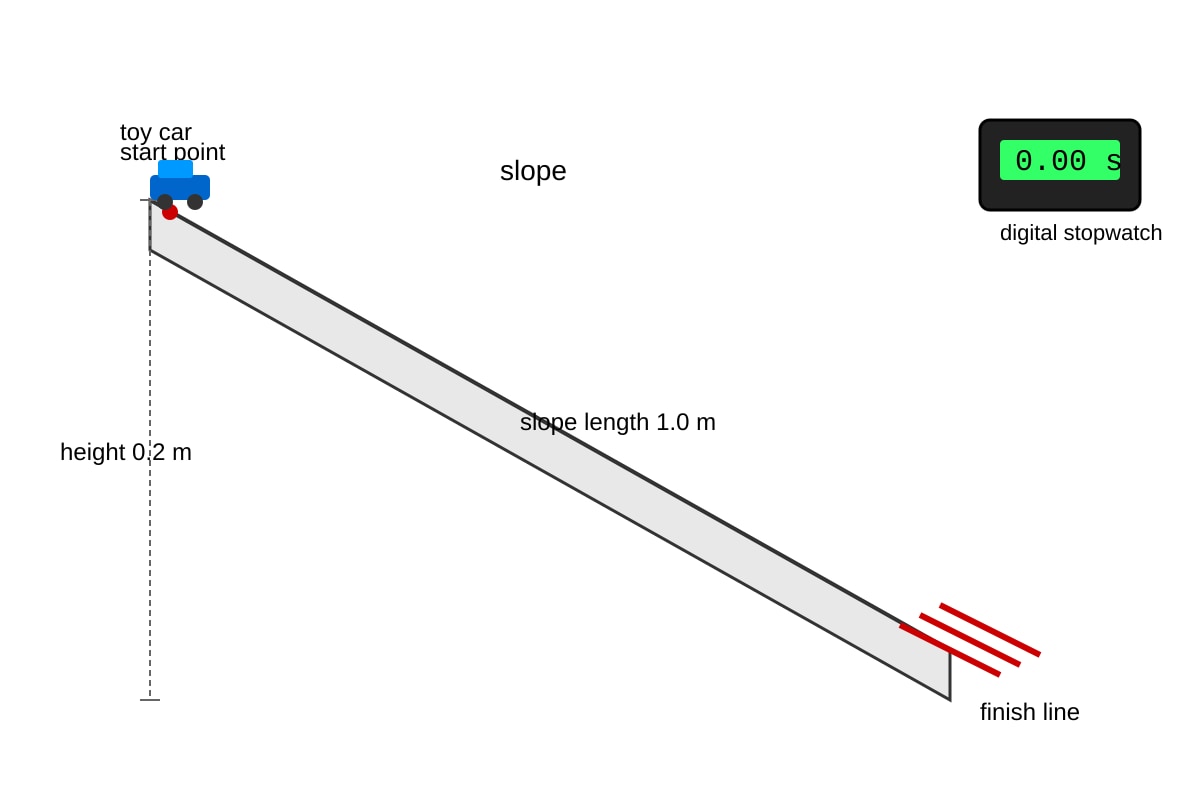
(a) Time interval [1]
(b) Second (s) [1]
Teaching note: Stopwatch measures time interval; unit is second. Image shows car, slope, stopwatch at 0.00 s. -
Average = (12.4 + 12.6 + 12.5) / 3 = 37.5 / 3 = 12.5 g [2]
Working: Sum = 37.5 g; divide by 3 readings. Unit g required.
Common mistake: Omitting unit or wrong division. -
A fair test ensures that any observed change is caused only by the independent variable, not by other factors. This makes results valid and comparable. [2]
Marking: 1 mark for "only independent variable causes change"; 1 mark for "valid/reliable results". -
Hazards: [3]
- Damaged insulation → shock [1]
- Overloaded circuit → fire [1]
Safety feature: Circuit breaker / fuse / earth wire [1]
Teaching note: From syllabus: hazards and safety features of electricity.
-
(a) Light intensity [1]
(b) Same plant type, same water amount, same temperature (any two) [2]
Teaching note: Controlled variables remove other growth influences. -
(a) 40 − 25 = 15 °C [1]
(b) Heat was supplied / exothermic reaction / surrounding warmer [1]
Teaching note: Temperature rise means heat gained. -
Flammable symbol (fire icon); store away from heat sources / in cool cabinet [2]
Marking: 1 for symbol identification, 1 for storage. -
(a) Mass increases linearly with volume [1]
(b) Yes, fair test if only volume changed and same cylinder used (constant other factors). [2]
Marking: 1 for yes/fair, 1 for reason (only independent variable changed).