Secondary 2 Science Quiz - Physical Sciences
Name: ______________________
Class: _________
Date: ___________
Score: _______ / 40
Duration: 60 minutes
Total Marks: 40
Instructions:
- Answer all 20 questions.
- Section A: Multiple Choice (1 mark each)
- Section B: Short Structured Questions (1–3 marks each)
- Section C: Extended Structured Questions (3–4 marks each)
- Show all working clearly and write units where required.
- Use g=10 m/s2 unless stated otherwise.
Section A: Multiple Choice (Questions 1–5)
1. Which of the following is an example of elastic force?
A. A book resting on a table
B. A stretched rubber band pulling back
C. A magnet attracting a pin
D. A person pushing a trolley
______________________________________________________ [1]
2. A lamp is connected to two cells in series. If one cell is removed, what happens to the current in the circuit?
A. Increases
B. Decreases
C. Stays the same
D. Becomes zero only if the second cell is also removed
______________________________________________________ [1]
3. Which energy conversion takes place when a solar panel powers a fan?
A. Light → electrical → kinetic
B. Heat → electrical → sound
C. Chemical → light → kinetic
D. Kinetic → electrical → light
______________________________________________________ [1]
4. An object has a density of 0.8 g/cm3. It is placed in water (1.0 g/cm3). What happens?
A. It sinks
B. It floats
C. It dissolves
D. It stays suspended in the middle
______________________________________________________ [1]
5. Which of the following is a renewable energy source?
A. Natural gas
B. Coal
C. Wind
D. Crude oil
______________________________________________________ [1]
Section B: Short Structured Questions (Questions 6–15)
6. State the principle of conservation of energy. [2]
7. A spring balance measures a force of 5 N acting downward on a mass. Name the type of force being measured and the instrument used. [2]
Force: ____________________
Instrument: ____________________
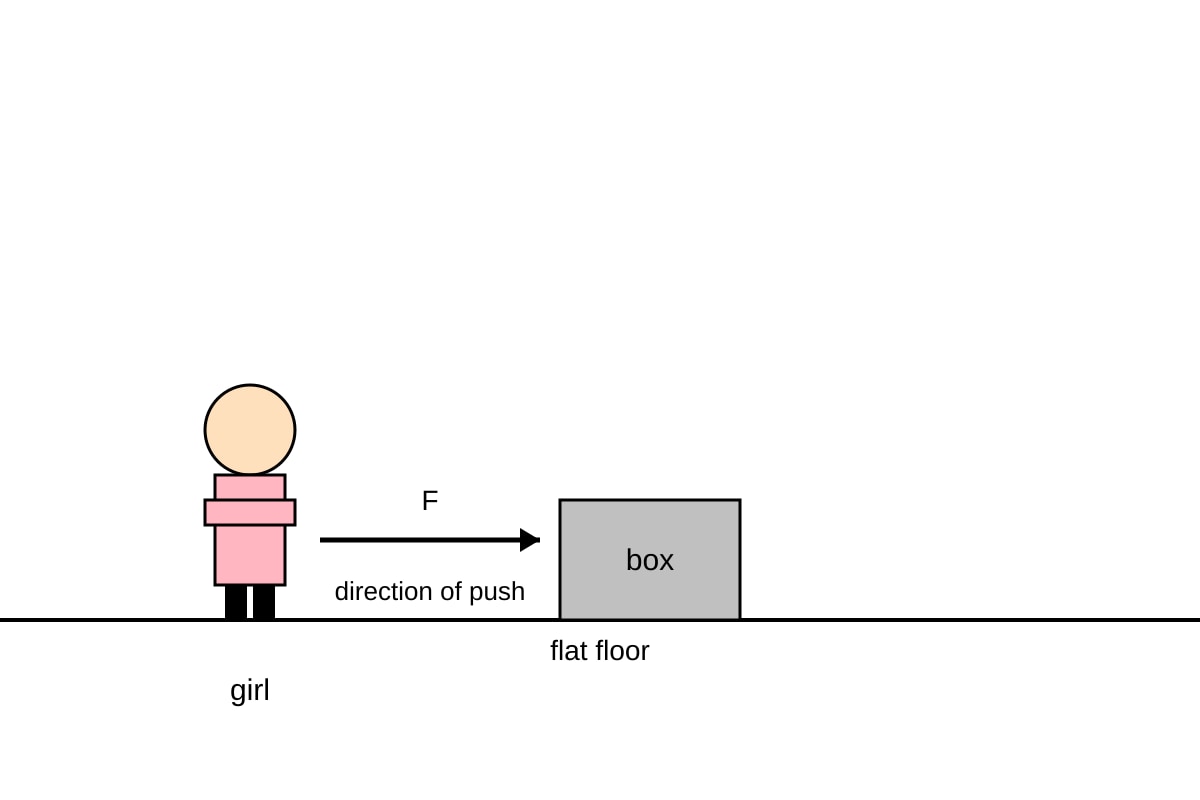
8.
Generated diagram for Q8.
On the diagram above, draw and label the force the girl exerts on the box. [1]
9. Calculate the work done when a 4 kg bag is lifted by 3 m. Use g=10 m/s2. [2]
Working:
Answer: ____________________ J
10. State one advantage and one disadvantage of using fossil fuels. [2]
Advantage: ____________________
Disadvantage: ____________________
11. A circuit has a 230 V supply and a lamp drawing 2 A. Calculate the power of the lamp. [2]
Working:
Answer: ____________________ W
12. A metal rod expands when heated. State one everyday problem this causes and one device that uses expansion to control temperature. [2]
Problem: ____________________
Device: ____________________
13. An object of mass 2 kg is raised from the ground to a height of 5 m. State its gain in gravitational potential energy. [1]
Answer: ____________________ J
14. A solution turns red litmus paper blue. State whether it is acidic, neutral, or alkaline. [1]
Answer: ____________________
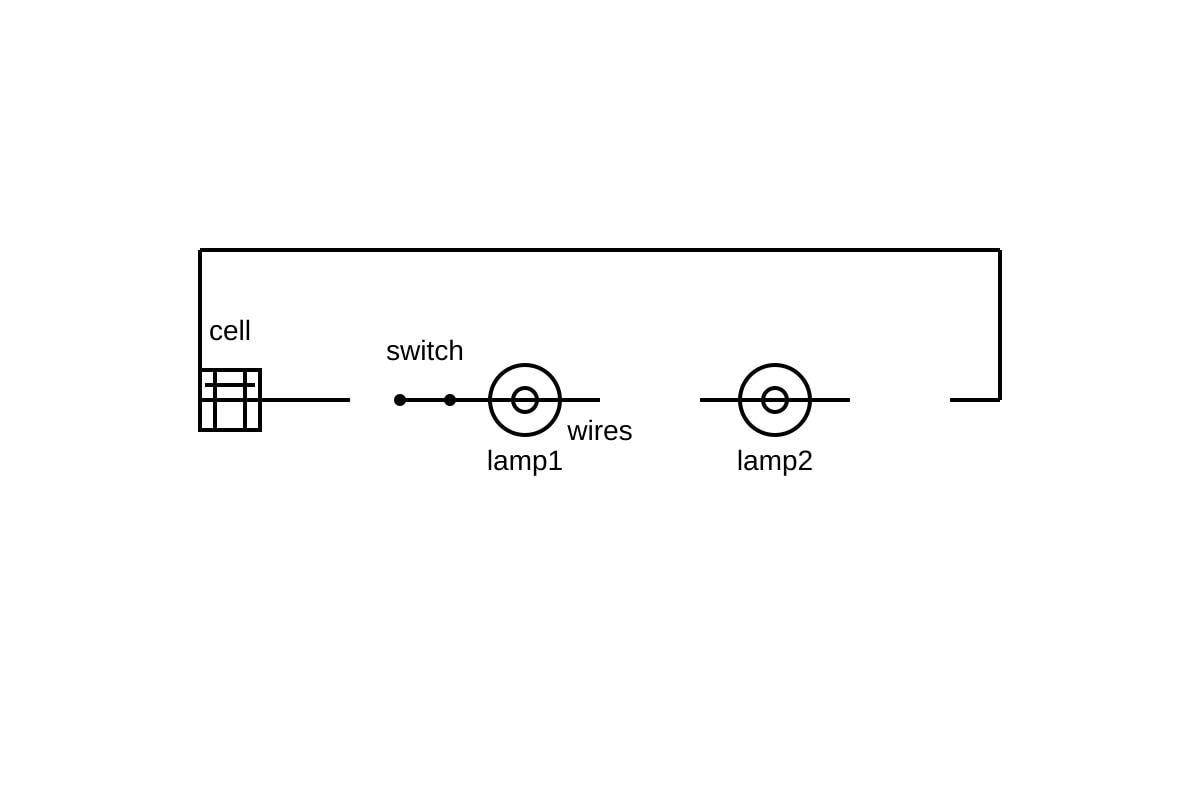
15.
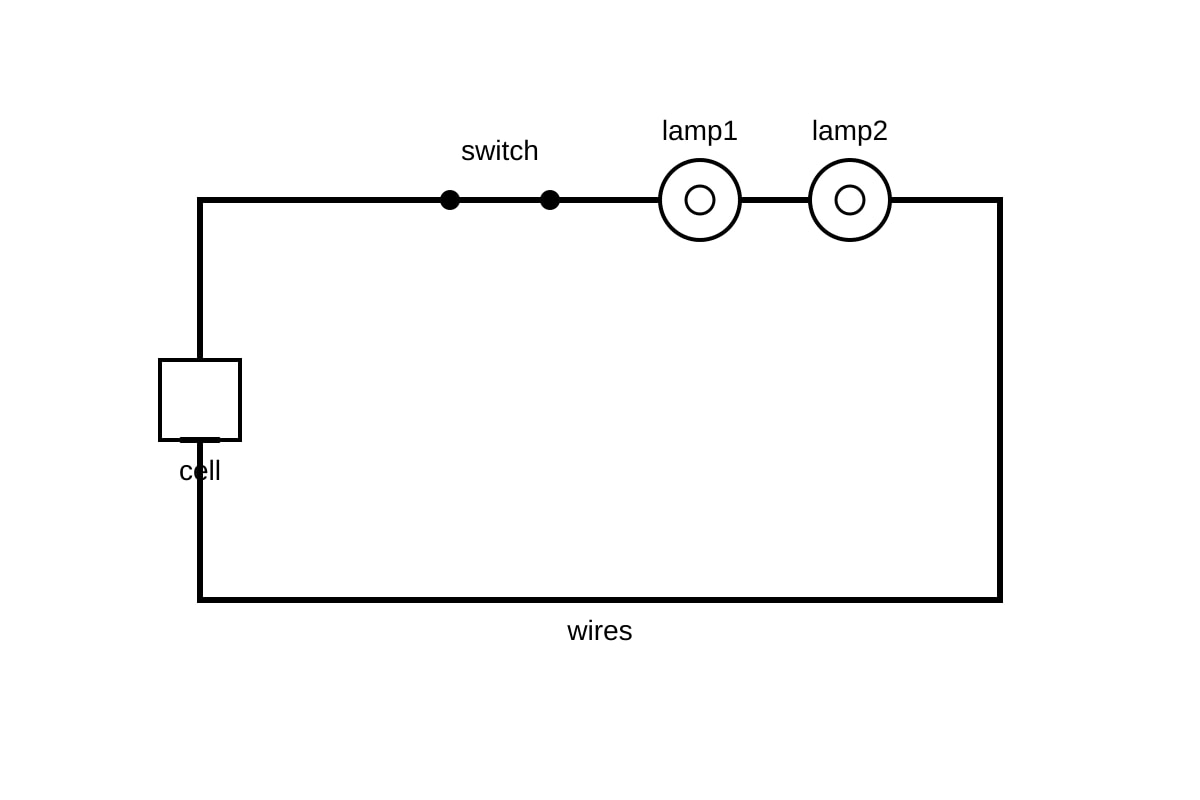
Generated circuit for Q15.
State one difference between this series circuit and a parallel circuit. [1]
Answer: ____________________
Section C: Extended Structured Questions (Questions 16–20)
16. (a) State the principle of conservation of energy. [2]
(b) A pendulum swings from its highest point A to the lowest point B. At A it has 50 J of gravitational potential energy and 0 J kinetic energy. Assuming no energy loss, state the kinetic energy at B and explain. [2]
(a) ______________________________________________________
(b) KE = __________ J
Explanation: ______________________________________________________
17. A boy of mass 30 kg climbs 4 flights of stairs. Each flight is 2.5 m high.
(a) Calculate the total height climbed. [1]
(b) Calculate the work done against gravity. [2]
(c) State the energy conversion that takes place. [1]
(a) Height = __________ m
(b) Working:
Work = __________ J
(c) ______________________________________________________
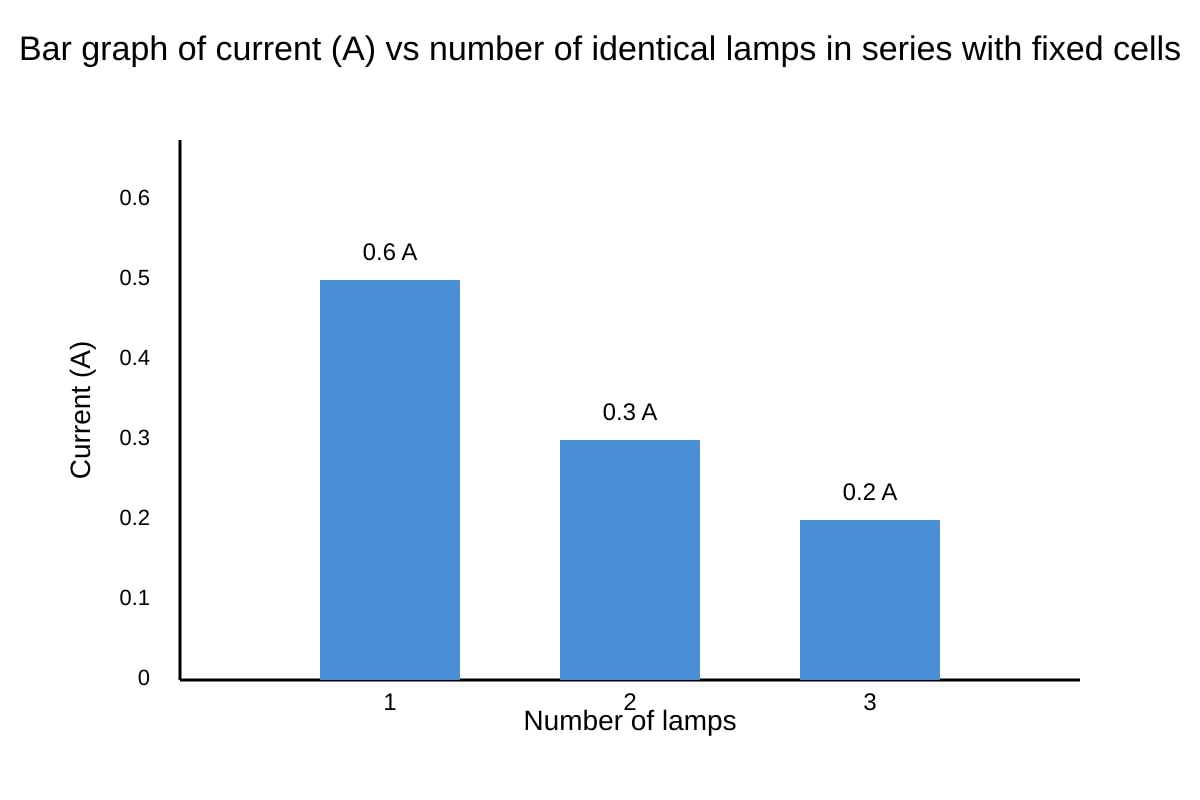
18.
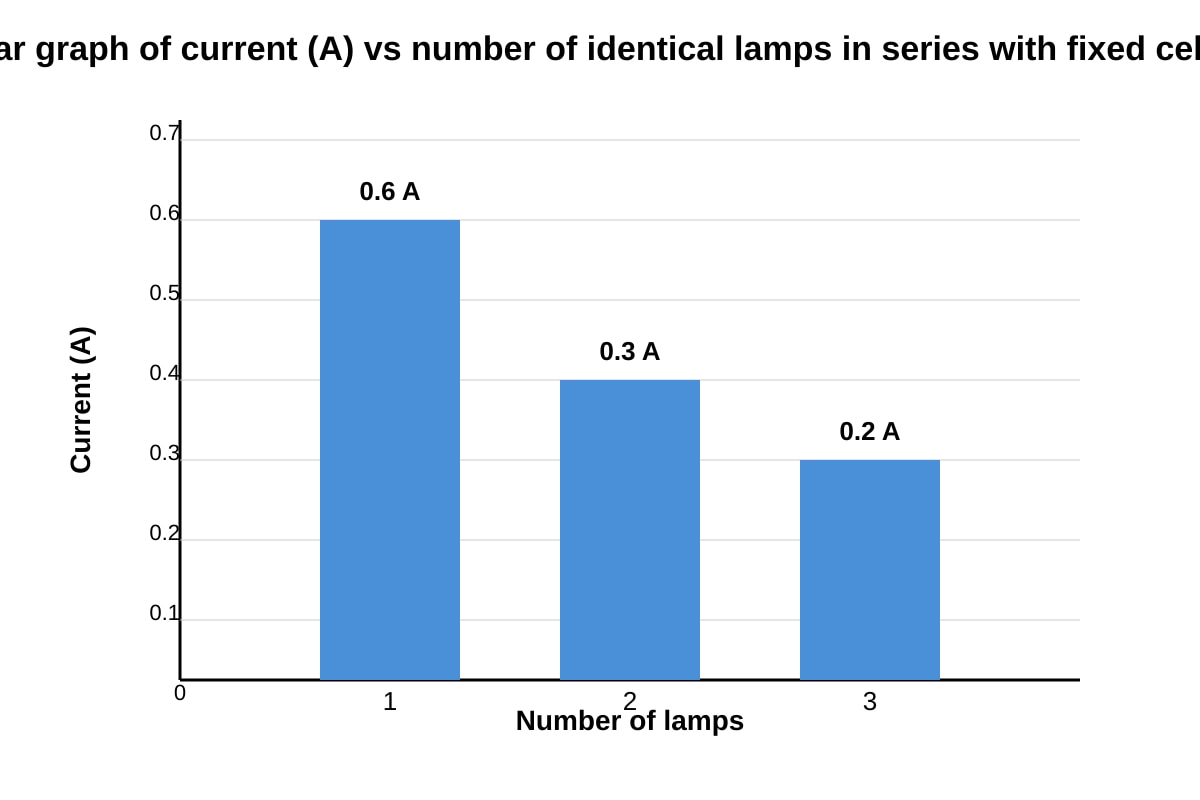
Generated graph for Q18.
(a) From the graph, describe how current changes as more lamps are added in series. [1]
(b) Explain why this happens. [2]
(c) What is the voltage supplied to homes in Singapore? [1]
(a) ______________________________________________________
(b) ______________________________________________________
(c) __________ V
19. A 12 V battery is connected to a resistor of 4 Ω.
(a) Calculate the current using I=V/R. [2]
(b) Calculate the energy used in 10 seconds using E=Pt and P=IV. [2]
(a) Working:
I = __________ A
(b) Working:
E = __________ J
20. (a) Name two types of forces that can change the shape of an object. [2]
(b) A block is pressed with a force that changes its size. State the effect of force shown. [1]
(c) Explain why friction is useful when walking. [1]
(a) ____________________ , ____________________
(b) ____________________
(c) ______________________________________________________
</stage3_quiz_answers_md>
Secondary 2 Science Quiz - Physical Sciences (Answer Key)
Total Marks: 40
Duration: 60 minutes
Section A: Multiple Choice
1. B [1]
Teaching note: Elastic force is the force exerted by a stretched or compressed object returning to shape. A stretched rubber band pulls back — that is elastic force. A is gravitational/normal, C is magnetic, D is applied push (not elastic).
2. B [1]
Teaching note: In series, total voltage = sum of cell voltages. Removing one cell reduces total voltage, so current decreases (I = V/R total). Not zero unless circuit is broken.
3. A [1]
Teaching note: Solar panel converts light (sun) → electrical energy, which powers fan → kinetic (motion). This matches energy conversion chain.
4. B [1]
Teaching note: Object density (0.8) < water density (1.0), so it is less dense and floats. Compare density to surrounding medium.
5. C [1]
Teaching note: Wind is renewable (naturally replenished). Gas, coal, crude oil are fossil fuels (non-renewable).
Section B: Short Structured Questions
6. [2]
- Energy cannot be created or destroyed. [1]
- Energy can be converted from one form to another (or total energy remains constant). [1]
Teaching note: Both points needed. Common mistake: only stating one part.
7. [2]
Force: gravitational force (weight) [1]
Instrument: spring balance [1]
Teaching note: Spring balance measures force in newtons; the downward 5 N is weight = gravitational force.
8. [1]
On the diagram, draw a right-pointing arrow from girl to box, labelled F.
Marking: Arrow in correct direction (right) [1].
Teaching note: Action force by girl on box is horizontal push.
9. [2]
Working: W=mgh=4×10×3=120 J [1 for substitution, 1 for answer]
Answer: 120 J
Teaching note: Lifting = work against gravity = gain in GPE.
10. [2]
Advantage: e.g., high energy output / readily available / established infrastructure [1]
Disadvantage: e.g., non-renewable / produces CO₂ / causes global warming [1]
Teaching note: Any reasonable pair accepted.
11. [2]
Working: P=IV=230×2=460 W [1 sub, 1 ans]
Answer: 460 W
Teaching note: Power = voltage × current.
12. [2]
Problem: e.g., buckling of railway tracks / cracks in bridges [1]
Device: thermostat (bimetallic strip) [1]
Teaching note: Expansion can damage structures; thermostat uses bimetallic strip to regulate temp.
13. [1]
Answer: ΔPE=mgh=2×10×5=100 J
Marking: 100 J [1]
14. [1]
Answer: alkaline [1]
Teaching note: Red litmus turns blue in alkali.
15. [1]
Answer: e.g., in series same current flows through all lamps; in parallel current splits / if one lamp breaks others still work. [1]
Teaching note: Any one correct difference.
Section C: Extended Structured Questions
16. [4]
(a) [2] Energy cannot be created or destroyed [1]; can be converted from one form to another [1].
(b) KE = 50 J [1]. Explanation: At B, all GPE (50 J) converted to KE (no loss) [1].
Teaching note: Conservation means total 50 J constant; at lowest point PE=0 so KE=50.
17. [4]
(a) Height = 4×2.5=10 m [1]
(b) Work = mgh=30×10×10=3000 J [1 sub, 1 ans]
(c) Chemical (food) → gravitational potential energy [1]
Teaching note: Count flights not floors; work = GPE gain.
18. [4]
(a) Current decreases as more lamps added in series. [1]
(b) More lamps in series = higher total resistance, so for same voltage current drops (I=V/R). [2]
(c) 230 V [1]
19. [4]
(a) I=V/R=12/4=3 A [1 sub, 1 ans]
(b) P=IV=3×12=36 W; E=Pt=36×10=360 J [1 sub P, 1 E ans]
Teaching note: Step-by-step required.
20. [4]
(a) e.g., elastic force, compressive/applied force [2]
(b) Change in size/shape [1]
(c) Friction between shoes and ground prevents slipping, allows push-off. [1]
</stage3_quiz_answers_md>
<stage3_quiz_md>
Secondary 2 Science Quiz - Physical Sciences
Name: ______________________
Class: _________
Date: ___________
Score: _______ / 40
Duration: 60 minutes
Total Marks: 40
Instructions:
- Answer all 20 questions.
- Section A: Multiple Choice (1 mark each)
- Section B: Short Structured Questions (1–3 marks each)
- Section C: Extended Structured Questions (3–4 marks each)
- Show all working clearly and write units where required.
- Use g=10 m/s2 unless stated otherwise.
Section A: Multiple Choice (Questions 1–5)
1. Which of the following is an example of elastic force?
A. A book resting on a table
B. A stretched rubber band pulling back
C. A magnet attracting a pin
D. A person pushing a trolley
______________________________________________________ [1]
2. A lamp is connected to two cells in series. If one cell is removed, what happens to the current in the circuit?
A. Increases
B. Decreases
C. Stays the same
D. Becomes zero only if the second cell is also removed
______________________________________________________ [1]
3. Which energy conversion takes place when a solar panel powers a fan?
A. Light → electrical → kinetic
B. Heat → electrical → sound
C. Chemical → light → kinetic
D. Kinetic → electrical → light
______________________________________________________ [1]
4. An object has a density of 0.8 g/cm3. It is placed in water (1.0 g/cm3). What happens?
A. It sinks
B. It floats
C. It dissolves
D. It stays suspended in the middle
______________________________________________________ [1]
5. Which of the following is a renewable energy source?
A. Natural gas
B. Coal
C. Wind
D. Crude oil
______________________________________________________ [1]
Section B: Short Structured Questions (Questions 6–15)
6. State the principle of conservation of energy. [2]
7. A spring balance measures a force of 5 N acting downward on a mass. Name the type of force being measured and the instrument used. [2]
Force: ____________________
Instrument: ____________________
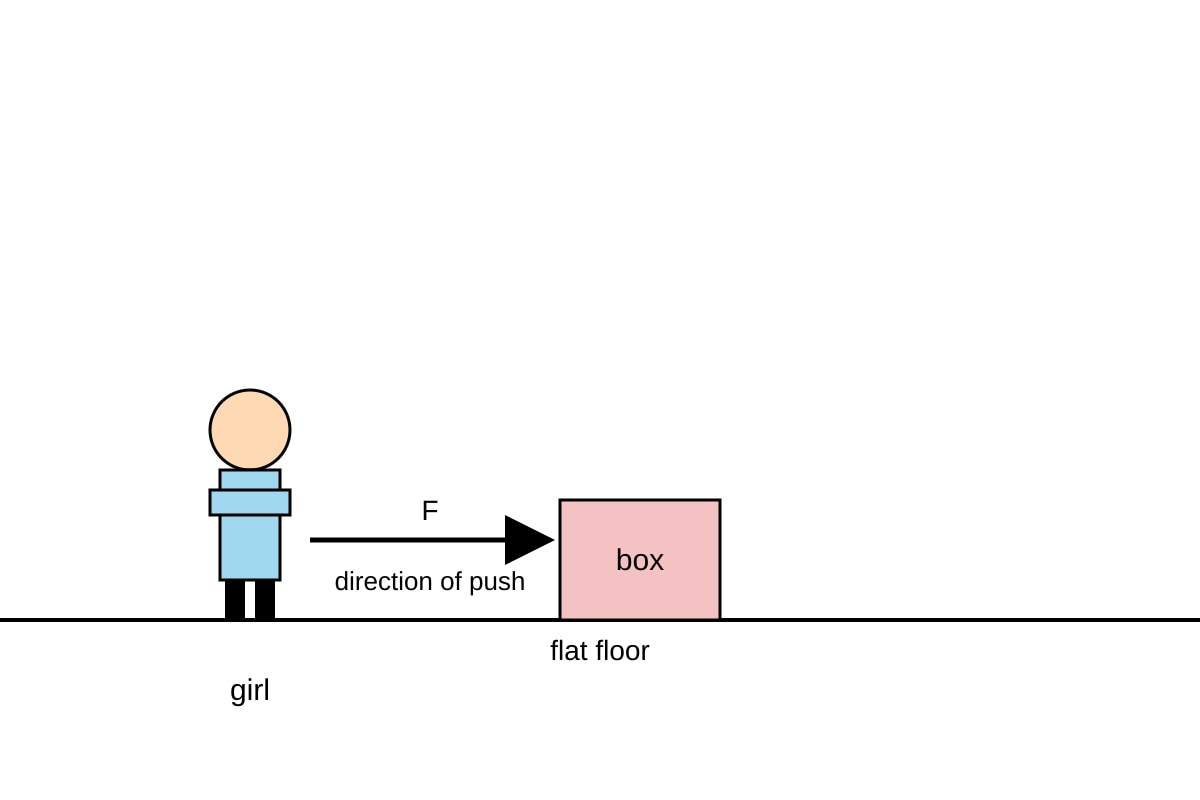
8.
Generated diagram for Q8.
On the diagram above, draw and label the force the girl exerts on the box. [1]
9. Calculate the work done when a 4 kg bag is lifted by 3 m. Use g=10 m/s2. [2]
Working:
Answer: ____________________ J
10. State one advantage and one disadvantage of using fossil fuels. [2]
Advantage: ____________________
Disadvantage: ____________________
11. A circuit has a 230 V supply and a lamp drawing 2 A. Calculate the power of the lamp. [2]
Working:
Answer: ____________________ W
12. A metal rod expands when heated. State one everyday problem this causes and one device that uses expansion to control temperature. [2]
Problem: ____________________
Device: ____________________
13. An object of mass 2 kg is raised from the ground to a height of 5 m. State its gain in gravitational potential energy. [1]
Answer: ____________________ J
14. A solution turns red litmus paper blue. State whether it is acidic, neutral, or alkaline. [1]
Answer: ____________________
15.
Generated circuit for Q15.
State one difference between this series circuit and a parallel circuit. [1]
Answer: ____________________
Section C: Extended Structured Questions (Questions 16–20)
16. (a) State the principle of conservation of energy. [2]
(b) A pendulum swings from its highest point A to the lowest point B. At A it has 50 J of gravitational potential energy and 0 J kinetic energy. Assuming no energy loss, state the kinetic energy at B and explain. [2]
(a) ______________________________________________________
(b) KE = __________ J
Explanation: ______________________________________________________
17. A boy of mass 30 kg climbs 4 flights of stairs. Each flight is 2.5 m high.
(a) Calculate the total height climbed. [1]
(b) Calculate the work done against gravity. [2]
(c) State the energy conversion that takes place. [1]
(a) Height = __________ m
(b) Working:
Work = __________ J
(c) ______________________________________________________
18.
Generated graph for Q18.
(a) From the graph, describe how current changes as more lamps are added in series. [1]
(b) Explain why this happens. [2]
(c) What is the voltage supplied to homes in Singapore? [1]
(a) ______________________________________________________
(b) ______________________________________________________
(c) __________ V
19. A 12 V battery is connected to a resistor of 4 Ω.
(a) Calculate the current using I=V/R. [2]
(b) Calculate the energy used in 10 seconds using E=Pt and P=IV. [2]
(a) Working:
I = __________ A
(b) Working:
E = __________ J
20. (a) Name two types of forces that can change the shape of an object. [2]
(b) A block is pressed with a force that changes its size. State the effect of force shown. [1]
(c) Explain why friction is useful when walking. [1]
(a) ____________________ , ____________________
(b) ____________________
(c) ______________________________________________________