From Real Exams Quiz

Secondary 2 Science Physical Sciences Quiz

Free Exam-Derived Secondary 2 Science Physical Sciences quiz with questions and answers for Singapore students. This page is rendered as a direct URL so the questions and answers can be discovered without pressing in-page buttons.

These static practice materials are generated from the site's syllabus and paper-generation workflow, with source and model context shown so students and parents can evaluate the material before use.

Secondary 2 Science From Real Exams Generated by Claude Sonnet 4 Updated 2026-06-03

Questions

Secondary 2 Science Quiz - Physical Sciences

Name: _________________ Class: _________________ Date: _________________

Score: _____ / 40 Duration: 45 minutes

Instructions

  • Answer all questions in the spaces provided.
  • Show all working for calculations.
  • Include appropriate units in your final answers.
  • Use a pencil for diagrams and drawings.

Section A: Multiple Choice [10 marks]

Choose the best answer for each question. Write the letter in the box provided.

1. Which statement correctly describes the principle of conservation of energy? [2] A. Energy can be created but not destroyed B. Energy cannot be created or destroyed, only converted from one form to another C. Energy is always lost as heat during conversions D. Energy can only exist in kinetic and potential forms

Answer: [ ]

2. A student climbs from the ground floor to the 4th floor of a building. Each floor is 3.5 m high. What is the total vertical distance climbed? [2] A. 3.5 m B. 7.0 m C. 10.5 m D. 14.0 m

Answer: [ ]

3. Which colour does Universal Indicator show at pH 2? [2] A. Green B. Red C. Blue D. Purple

Answer: [ ]

4. In a series circuit with two identical bulbs and a 6V battery, what is the voltage across each bulb? [2] A. 6V B. 3V C. 12V D. 2V

Answer: [ ]

5. Which of the following is evidence of a chemical change? [2] A. Ice melting B. Sugar dissolving in water C. Iron rusting D. Glass breaking

Answer: [ ]


Section B: Energy and Forces [10 marks]

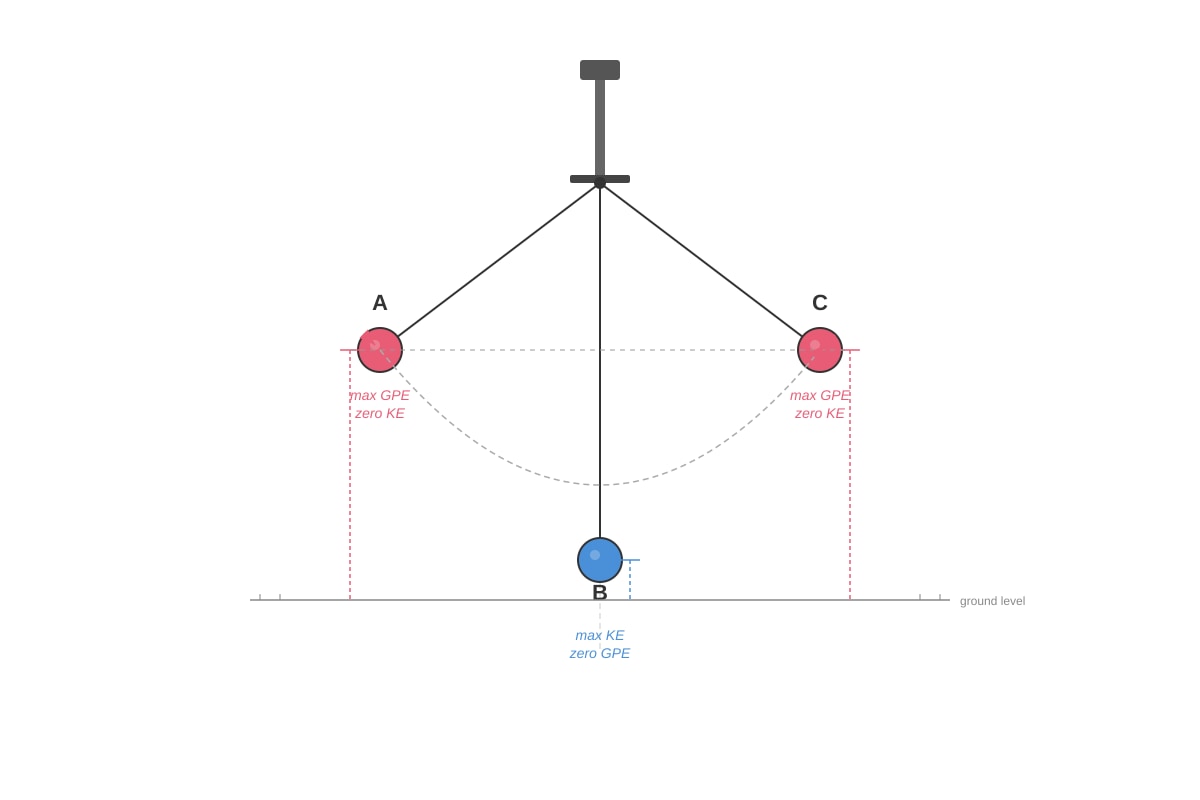
6. A pendulum swings back and forth as shown in the diagram below.

[Diagram shows a pendulum at three positions: highest point A, lowest point B, highest point C]

(a) State the principle of conservation of energy. [2]


(b) At which position (A, B, or C) does the pendulum bob have the greatest kinetic energy? [1]


(c) Explain your answer to part (b). [2]


7. A crane lifts a 500 kg steel beam from ground level to the top of a building 24 m high.

(a) Calculate the work done against gravity. (Take g = 10 m/s²) [3]

Working: _________________________________________________


Answer: _____________ J

(b) The crane takes 2 minutes to lift the beam. Calculate the power developed by the crane. [2]

Working: _________________________________________________

Answer: _____________ W

8. State two forms of energy that a moving car possesses. [2]


9. A ball is dropped from a height of 5 m. Describe the energy changes that occur as it falls. [3]


10. Calculate the gravitational potential energy of a 2 kg book placed on a shelf 1.5 m high. (Take g = 10 m/s²) [2]

Working: _________________________________________________

Answer: _____________ J


Section C: Electricity [10 marks]

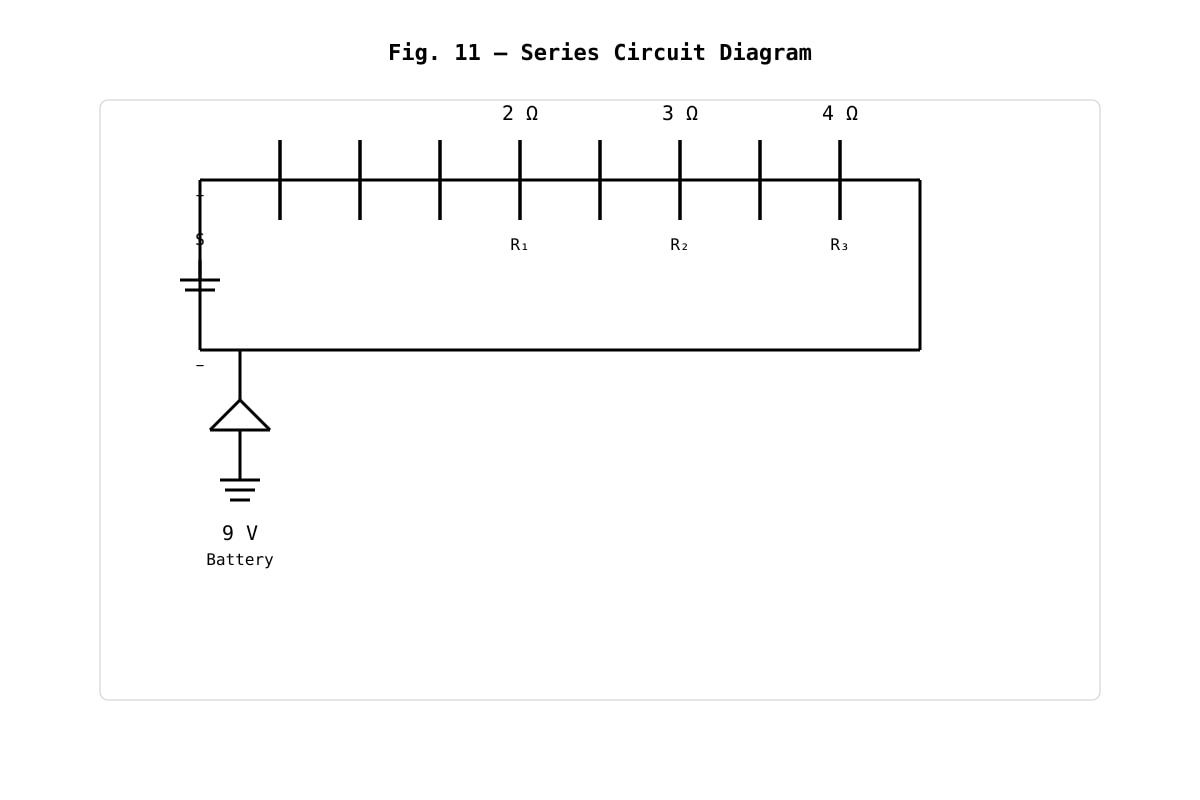
11. The diagram shows an electrical circuit.

[Diagram shows a circuit with a 9V battery, switch, and three resistors: 2Ω, 3Ω, and 4Ω in series]

(a) Calculate the total resistance in the circuit. [2]

Working: _________________________________________________

Answer: _____________ Ω

(b) When the switch is closed, calculate the current flowing through the circuit. [2]

Working: _________________________________________________

Answer: _____________ A

12. State Ohm's Law and write its mathematical formula. [2]

Law: ___________________________________________________

Formula: _______________________________________________

13. A lamp has a resistance of 12 Ω and carries a current of 0.5 A. Calculate the voltage across the lamp. [2]

Working: _________________________________________________

Answer: _____________ V

14. Explain why the current is the same at all points in a series circuit. [2]


15. Name two safety devices used in electrical circuits and explain their purpose. [2]


Section D: Acids and Bases [10 marks]

16. A student investigates the reaction between magnesium and different acids.

(a) Balance the following chemical equation: [1]

Mg + HCl → MgCl₂ + H₂

(b) State whether this is a physical or chemical change. Give one reason for your answer. [2]

Type of change: _________________________________________

Reason: ______________________________________________

17. Universal Indicator is added to solutions with different pH values. Complete the table below. [3]

pH ValueColour of Universal Indicator
1
7
12

18. A student carries out an experiment to identify an unknown acid X. The results are shown below:

  • Acid X has a pH of 1
  • When magnesium is added to Acid X, magnesium sulfate and hydrogen gas are produced
  • Acid X turns Universal Indicator red

(a) Identify Acid X and explain how you arrived at your conclusion. [2]

Acid X: _______________________________________________

Explanation: __________________________________________

(b) Write a word equation for the reaction between magnesium and Acid X. [2]


19. State the pH range for acids, neutral solutions, and bases. [3]

Acids: ________________________________________________

Neutral: ______________________________________________

Bases: ________________________________________________

20. Name one common household acid and one common household base. [2]

Acid: _________________________________________________

Base: _________________________________________________

Answers

Secondary 2 Science Quiz - Physical Sciences (Answer Key)

Section A: Multiple Choice [10 marks]

1. B - Energy cannot be created or destroyed, only converted from one form to another [2]

2. D - 14.0 m [2] Working: 4 floors × 3.5 m = 14.0 m

3. B - Red [2]

4. B - 3V [2] In series circuits, voltage is shared equally between identical components

5. C - Iron rusting [2] Chemical change produces new substances with different properties


Section B: Energy and Forces [10 marks]

6.(a) State the principle of conservation of energy. [2]

  • Energy cannot be created or destroyed [1]
  • Energy can be converted from one form to another / Total energy remains constant [1]

6.(b) Position B [1]

6.(c) Explain your answer to part (b). [2]

  • At position B, the pendulum is at its lowest point / moving fastest [1]
  • All gravitational potential energy has been converted to kinetic energy [1]

7.(a) Calculate work done against gravity. [3] Working: W = mgh [1] W = 500 × 10 × 24 = 120,000 J [1] Answer: 120,000 J (or 1.2 × 10⁵ J) [1]

7.(b) Calculate power: [2] Working: P = W/t = 120,000/(2 × 60) = 120,000/120 = 1000 W [1] Answer: 1000 W (or 1 kW) [1]

8. Two forms of energy: [2]

  1. Kinetic energy [1]
  2. Gravitational potential energy / Chemical potential energy (in fuel) [1]

9. Energy changes as ball falls: [3]

  • Gravitational potential energy decreases [1]
  • Kinetic energy increases [1]
  • Total energy remains constant (conservation of energy) [1]

10. Calculate gravitational potential energy: [2] Working: PE = mgh = 2 × 10 × 1.5 = 30 J [1] Answer: 30 J [1]


Section C: Electricity [10 marks]

11.(a) Calculate the total resistance. [2] Working: R_total = 2 + 3 + 4 = 9 Ω [1] Answer: 9 Ω [1]

11.(b) Calculate the current. [2] Working: I = V/R = 9/9 = 1 A [1] Answer: 1 A [1]

12. Ohm's Law: [2] Law: The current through a conductor is directly proportional to the voltage across it, provided temperature remains constant [1] Formula: V = IR (or I = V/R or R = V/I) [1]

13. Calculate voltage: [2] Working: V = IR = 0.5 × 12 = 6 V [1] Answer: 6 V [1]

14. Current in series circuit: [2]

  • There is only one path for current to flow [1]
  • The same amount of charge flows through each component per second [1]

15. Safety devices: [2]

  1. Fuse - melts when current is too high, breaking the circuit to prevent fire [1]
  2. Circuit breaker - automatically switches off when current is too high, can be reset [1]

Section D: Acids and Bases [10 marks]

16.(a) Balance the equation: [1] Mg + 2HCl → MgCl₂ + H₂ [1]

16.(b) Type and reason: [2] Type of change: Chemical change [1] Reason: New substances are formed (hydrogen gas and magnesium chloride) / Gas is produced / Cannot be easily reversed [1]

17. Universal Indicator colours: [3]

pH ValueColour of Universal Indicator
1Red [1]
7Green [1]
12Purple [1]

18.(a) Identify Acid X: [2] Acid X: Sulfuric acid (H₂SO₄) [1] Explanation: The formation of magnesium sulfate shows the presence of sulfate ions, confirming it is sulfuric acid [1]

18.(b) Word equation: [2] Magnesium + Sulfuric acid → Magnesium sulfate + Hydrogen [2] Award 1 mark for correct reactants, 1 mark for correct products

19. pH ranges: [3] Acids: pH 0-6 (or less than 7) [1] Neutral: pH 7 [1] Bases: pH 8-14 (or greater than 7) [1]

20. Household examples: [2] Acid: Vinegar / Lemon juice / Citric acid [1] Base: Baking soda / Ammonia / Soap [1]


Total: 40 marks

Marking Notes:

  • Accept alternative correct scientific terminology
  • Award marks for correct working even if final answer is incorrect
  • Units must be included for calculation questions
  • Chemical equations must be balanced for full marks
  • Accept H₂SO₄ or "sulfuric acid" for Acid X identification