From Real Exams Quiz
Secondary 2 Science Life Sciences Quiz
Free Sec 2 Science Life Sciences quiz, Nemo3 Exam version, with questions, answers, and syllabus-aligned practice for Singapore students.
These static practice materials are generated from the site's syllabus and paper-generation workflow, with source and model context shown so students and parents can evaluate the material before use.
Questions




Free quiz and exam paper access
Enter your details to view this paper
Your access is remembered on this device.
Answers
Secondary 2 Science Quiz - Life Sciences (Answer Key)
Total Marks: 40
Section A: Multiple Choice Questions (10 marks)
1. C – Ability to respond to stimuli [1]
Explanation: All living organisms share certain characteristics: they respond to stimuli, grow, reproduce, carry out metabolism, maintain homeostasis, and are made of cells. Not all organisms photosynthesise (only plants and some bacteria), not all move from place to place (plants are sessile), and not all reproduce sexually (many reproduce asexually). Responding to stimuli is a universal characteristic of life.
2. C – Chloroplast [1]
Explanation: Chloroplasts are organelles found in plant cells and some protists (like algae) where photosynthesis occurs. Animal cells do not have chloroplasts. Both plant and animal cells have a nucleus, cell membrane, and cytoplasm.
3. B – Photosynthesis [1]
Explanation: Photosynthesis is the process by which green plants, algae, and some bacteria convert carbon dioxide and water into glucose using light energy, with oxygen released as a by-product. Respiration breaks down glucose to release energy. Transpiration is water loss from leaves. Germination is the sprouting of a seed.
4. B – Mitochondria only [1]
Explanation: The equation shown is aerobic respiration: glucose + oxygen → carbon dioxide + water + energy. This process occurs in the mitochondria of both plant and animal cells. Photosynthesis (which occurs in chloroplasts) has the reverse equation: carbon dioxide + water → glucose + oxygen (using light energy).
5. C – Yellow-brown [1]
Explanation: Iodine solution is yellow-brown. It turns blue-black in the presence of starch. A plant kept in darkness for 48 hours will have used up its starch reserves (through respiration) and cannot photosynthesise to make new starch. Therefore, the leaf will test negative for starch, and the iodine will remain its original yellow-brown colour.
6. A – Cell → Tissue → Organ → Organ system → Organism [1]
Explanation: This is the correct hierarchical organisation in multicellular organisms. Cells of the same type form tissues (e.g., muscle tissue). Different tissues work together to form organs (e.g., heart). Organs work together in organ systems (e.g., circulatory system). The organism is the complete living individual.
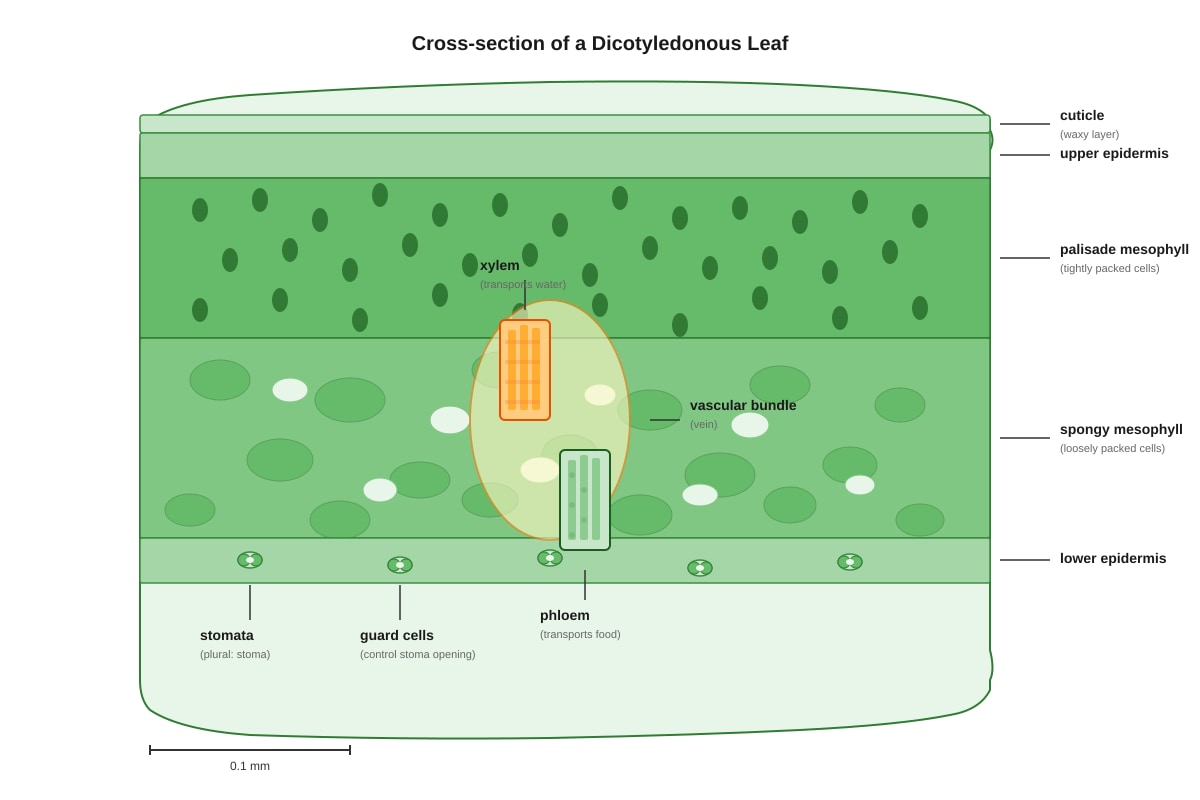
7. B – Palisade mesophyll [1]
Explanation: The palisade mesophyll layer is located just below the upper epidermis and consists of tightly packed, column-shaped cells with many chloroplasts. This arrangement maximises light absorption for photosynthesis. The spongy mesophyll has fewer chloroplasts and more air spaces for gas exchange. The epidermis layers are transparent and lack chloroplasts.
8. B – Oxygen [1]
Explanation: During photosynthesis, plants take in carbon dioxide and water, and using light energy, produce glucose and oxygen. The oxygen is released as a by-product through the stomata. Carbon dioxide is taken in, not released (during photosynthesis). Nitrogen is not directly involved. Water vapour is released during transpiration, not photosynthesis.
9. B – Grasshopper [1]
Explanation: In a food chain, producers (grass) make their own food. Primary consumers eat producers (grasshopper eats grass). Secondary consumers eat primary consumers (frog eats grasshopper). Tertiary consumers eat secondary consumers (snake eats frog). Quaternary consumers eat tertiary consumers (hawk eats snake). The grasshopper is the primary consumer.
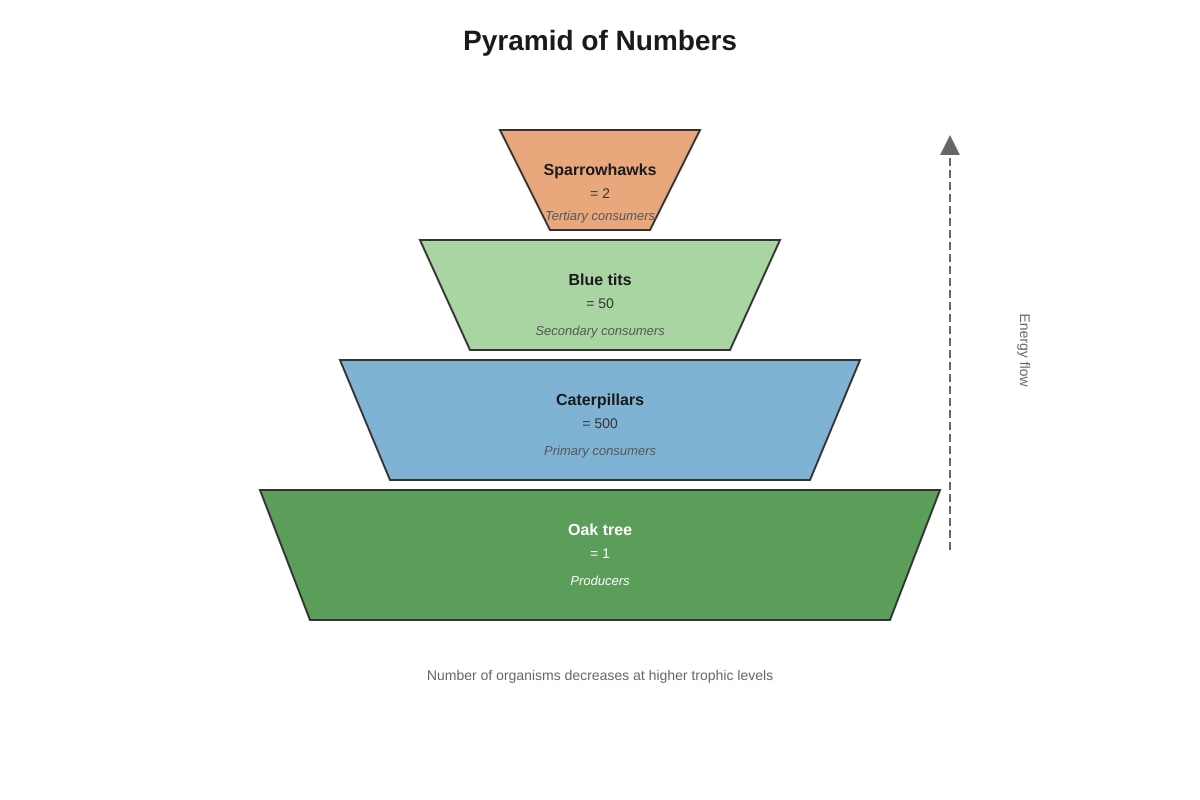
10. A – Energy is lost at each transfer between trophic levels [1]
Explanation: Only about 10% of energy is transferred from one trophic level to the next (10% rule). The rest is lost as heat (from respiration), waste (faeces, urine), and uneaten parts. This energy loss limits the number of trophic levels and causes the pyramid shape. Predator size, species count, and reproduction rate are not the primary reasons for the pyramid shape.
Section B: Structured Questions (30 marks)
11. (a) Any two of: Cell wall, Chloroplast, Large central vacuole [2]
Marking: 1 mark each for any two correct structures. Explanation: Plant cells have a rigid cell wall made of cellulose (absent in animal cells), chloroplasts for photosynthesis (absent in animal cells), and a large central vacuole for storage and turgor pressure (animal cells have only small, temporary vacuoles).
11. (b) Site of aerobic respiration / releases energy from glucose [1]
Explanation: Mitochondria are known as the "powerhouses of the cell." They carry out aerobic respiration, breaking down glucose in the presence of oxygen to release energy in the form of ATP, which the cell uses for various processes.
11. (c) The large central vacuole in plant cells stores water, nutrients, and waste, and maintains turgor pressure to keep the plant rigid and upright. Animal cells do not need this structural support as they have other mechanisms (e.g., cytoskeleton, extracellular matrix) and are not rigid. [2]
Marking: 1 mark for storage/turgor function; 1 mark for contrast with animal cells (no cell wall, no need for turgor). Common mistake: Just saying "for storage" without mentioning turgor pressure or structural support.
12. (a) To kill the cells / stop chemical reactions / denature enzymes / break down cell membranes to allow iodine to enter. [1]
Explanation: Boiling in water kills the leaf tissue, stops all metabolic activity (including photosynthesis and respiration), and breaks down cell membranes, making the leaf permeable to the iodine solution.
12. (b) Ethanol is highly flammable; a water bath provides indirect, controlled heating and prevents the ethanol from catching fire. [1]
Explanation: Ethanol has a low boiling point (~78°C) and is highly flammable. Heating it directly over a Bunsen burner flame is a serious fire hazard. A water bath heats the ethanol gently and evenly without exposing it to an open flame.
12. (c) Yellow-brown to blue-black [1]
Explanation: Iodine solution is yellow-brown. In the presence of starch, it forms a starch-iodine complex that is blue-black in colour. This is the standard test for starch.
12. (d) To destarch the leaves / use up existing starch reserves so that any starch found after the experiment must have been produced during the experiment. [2]
Marking: 1 mark for "destarch" or "use up starch reserves"; 1 mark for explaining that this ensures a fair test / any starch detected was made during the experiment. Explanation: Keeping the plant in darkness for 48 hours ensures that all starch stored in the leaves is translocated or used up in respiration. This provides a "clean slate" so that if the leaf tests positive for starch after an experimental treatment (e.g., exposure to light), we know the starch was produced during that treatment.
13. (a) Grass → Caterpillar → Robin → Hawk (or Grass → Rabbit → Fox → Hawk, or Dandelion → Rabbit → Fox → Hawk, etc.) [1]
Explanation: A food chain with four trophic levels must have: Producer → Primary Consumer → Secondary Consumer → Tertiary Consumer. Any valid chain from the web with four levels is accepted.
13. (b) Rabbit and Caterpillar [1]
Explanation: Primary consumers are herbivores that eat producers. In this food web, rabbits eat grass and dandelions; caterpillars eat grass and dandelions. Both are primary consumers.
13. (c) Fox population: Decreases (less food available). Grass population: Increases (fewer rabbits eating it). [3]
Marking: 1 mark for fox decrease + reason; 1 mark for grass increase + reason; 1 mark for linking both changes to the removal of rabbits. Explanation: Rabbits are prey for foxes and consumers of grass. If rabbits die out, foxes lose a food source, so their population declines due to starvation/reduced reproduction. With fewer rabbits eating grass, the grass population increases due to reduced herbivory.
13. (d) Decomposers break down dead organisms and waste, recycling nutrients back into the environment for producers to use. [1]
Explanation: Decomposers (bacteria and fungi) secrete enzymes onto dead organic matter, breaking it down externally (external digestion), then absorb the simpler substances. This releases inorganic nutrients (like nitrates, phosphates) into the soil, which plants absorb through their roots. Without decomposers, nutrients would be locked in dead bodies.
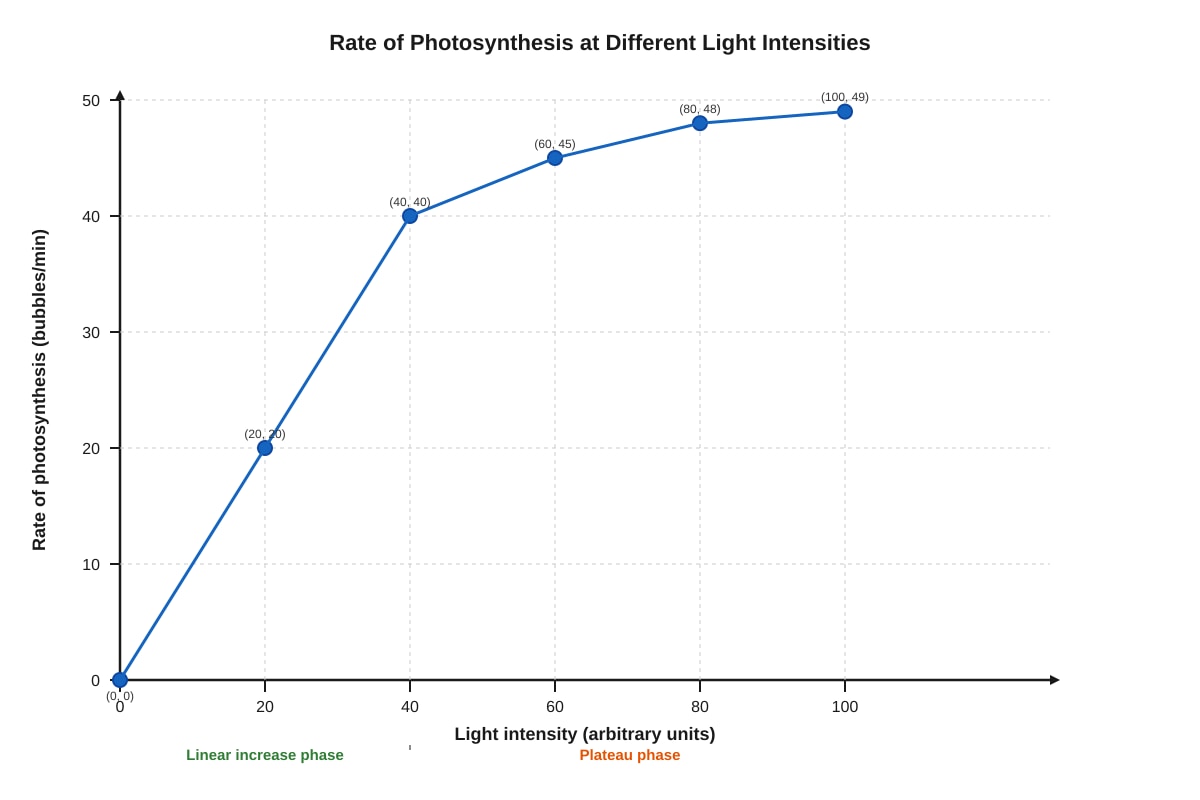
14. (a) As light intensity increases from 0 to 40 units, the rate of photosynthesis increases proportionally / linearly. [1]
Explanation: In this range, light intensity is the limiting factor. More light energy means more photons hitting chlorophyll per unit time, driving more light-dependent reactions, producing more ATP and NADPH for the Calvin cycle, so the rate increases steadily.
14. (b) Another factor (carbon dioxide concentration or temperature) becomes limiting. / The plant is photosynthesising at its maximum rate for the given CO₂ and temperature. [2]
Marking: 1 mark for identifying another limiting factor (CO₂ or temperature); 1 mark for explaining that the rate cannot increase further until that factor is increased. Explanation: At low light, light is the limiting factor. As light increases, the rate increases until another factor (here, CO₂ concentration or temperature) becomes the new limiting factor. The plateau shows the maximum rate possible under those fixed conditions.
14. (c) Increase carbon dioxide concentration / increase temperature (to an optimum). [1]
Explanation: Since light is no longer limiting at 80 units, increasing the other factors (CO₂ or temperature) can raise the plateau level. CO₂ is needed for carbon fixation in the Calvin cycle. Temperature affects enzyme activity in photosynthesis (optimum around 25–35°C for most plants).
15. (a) Small intestine (or Ileum) [1]
Explanation: The small intestine, particularly the ileum, is the primary site for absorption of digested nutrients (glucose, amino acids, fatty acids, glycerol, vitamins, minerals). Its structure (villi, microvilli) provides a huge surface area for absorption.
15. (b) Any two of: Emulsifies fats (breaks large fat globules into smaller droplets), Increases surface area for lipase action, Neutralises acidic chyme from stomach (provides alkaline pH for pancreatic enzymes). [2]
Marking: 1 mark each for any two correct functions. Explanation: Bile is not an enzyme; it acts physically. Emulsification increases the surface area of fats for the enzyme lipase to act efficiently. Bile is also alkaline, neutralising the acidic chyme from the stomach to create the optimal pH (~7.5–8) for pancreatic enzymes (including lipase, amylase, proteases).
15. (c) The small intestine is adapted for absorption by: (1) Being very long (~6 m in adults), providing time and surface area; (2) Having villi (finger-like projections) that increase surface area; (3) Having microvilli on epithelial cells (brush border) that further increase surface area; (4) Having a dense capillary network and lacteal in each villus for rapid transport of absorbed nutrients away, maintaining a steep concentration gradient; (5) Thin epithelium (one cell thick) for short diffusion distance. [3]
Marking: 1 mark each for any three distinct structural adaptations with brief explanation of how each aids absorption. Common mistake: Listing adaptations without explaining how they help absorption.
16. (a) To create anaerobic conditions / prevent oxygen from entering the glucose-yeast mixture / exclude air. [1]
Explanation: Yeast carries out anaerobic respiration (fermentation) only in the absence of oxygen. The liquid paraffin forms a physical barrier on top of the solution, preventing atmospheric oxygen from dissolving into the mixture, ensuring anaerobic conditions.
16. (b) Glucose → Ethanol + Carbon dioxide + Energy (small amount) [1]
Explanation: Anaerobic respiration in yeast (fermentation) converts glucose into ethanol (alcohol) and carbon dioxide, releasing a small amount of energy. This is used in brewing and bread-making.
16. (c) Carbon dioxide [1]
Explanation: CO₂ reacts with limewater (calcium hydroxide solution) to form calcium carbonate, which is insoluble and makes the limewater turn cloudy/milky. This is the standard test for carbon dioxide.
16. (d) 35°C is near the optimum temperature for yeast enzymes. Higher temperatures denature enzymes; lower temperatures slow down enzyme activity. [2]
Marking: 1 mark for stating 35°C is optimum/ideal for yeast enzymes; 1 mark for explaining effect of temperature on enzyme activity (denaturation at high temp, low kinetic energy at low temp). Explanation: Enzymes are proteins that catalyse metabolic reactions. They have an optimum temperature. For yeast, this is around 30–37°C. At 35°C, enzyme activity is high. Above ~45°C, enzymes denature (lose shape). Below 20°C, molecular motion is too slow for effective collisions.
16. (e) Yeast produces ethanol and CO₂; human muscle cells produce lactic acid (lactate). [1]
Explanation: Both are anaerobic respiration (no oxygen), but the pathways differ. Yeast (and some bacteria) undergo alcoholic fermentation: pyruvate → ethanol + CO₂. Human muscle cells undergo lactic acid fermentation: pyruvate → lactate (lactic acid). Both regenerate NAD⁺ so glycolysis can continue.
17. (a) (1,500 ÷ 15,000) × 100% = 10% [2]
Working:
- Energy at producer level = 15,000 kJ/m²/year
- Energy at primary consumer level = 1,500 kJ/m²/year
- Percentage transfer = (Energy at higher level ÷ Energy at lower level) × 100%
- = (1,500 ÷ 15,000) × 100% = 0.1 × 100% = 10% Marking: 1 mark for correct substitution/formula; 1 mark for correct answer with % sign.
17. (b) (150 ÷ 1,500) × 100% = 10% [2]
Working:
- Energy at primary consumer = 1,500 kJ/m²/year
- Energy at secondary consumer = 150 kJ/m²/year
- Percentage transfer = (150 ÷ 1,500) × 100% = 0.1 × 100% = 10% Marking: 1 mark for correct substitution/formula; 1 mark for correct answer with % sign.
17. (c) Any two of: Energy lost as heat during respiration; Energy lost in waste (faeces, urine); Not all of the organism is eaten (bones, fur, roots); Not all eaten food is digested/absorbed; Energy used for movement, maintaining body temperature, etc. [2]
Marking: 1 mark each for any two valid reasons. Explanation: The "10% rule" is a rough average. Energy is lost at each transfer because: (1) Organisms use most energy for respiration (released as heat); (2) Not all biomass is consumed (e.g., roots, bones); (3) Not all consumed food is digested (indigestible fibre); (4) Not all digested food is absorbed (some lost in faeces); (5) Excretion (urine) loses some energy.
18. (a) Pulmonary artery [1]
Explanation: The pulmonary artery carries deoxygenated blood from the right ventricle to the lungs. It is the only artery that carries deoxygenated blood (arteries carry blood away from the heart; veins carry blood to the heart).
18. (b) Bicuspid valve (or Mitral valve) [1]
Explanation: The bicuspid (mitral) valve is between the left atrium and left ventricle. It has two flaps (cusps) and prevents backflow of blood from the left ventricle into the left atrium when the ventricle contracts. The tricuspid valve (three flaps) does the same on the right side.
18. (c) The left ventricle pumps blood to the whole body (systemic circulation) at high pressure, so it needs a thick muscular wall to generate that pressure. The right ventricle pumps blood only to the lungs (pulmonary circulation) at lower pressure, so its wall is thinner. [2]
Marking: 1 mark for left ventricle pumps to whole body / systemic circulation / high pressure; 1 mark for right ventricle pumps to lungs only / pulmonary circulation / lower pressure. Explanation: Systemic circulation requires high pressure to overcome the resistance of the entire body's capillary network. Pulmonary circulation is a short, low-resistance circuit. The left ventricle wall is 2–3 times thicker than the right.
18. (d) Pulmonary artery carries deoxygenated blood (low O₂, high CO₂); pulmonary vein carries oxygenated blood (high O₂, low CO₂). [1]
Explanation: This is a unique feature of the pulmonary circuit. In the systemic circuit, arteries carry oxygenated blood and veins carry deoxygenated blood. In the pulmonary circuit, it is reversed: pulmonary artery = deoxygenated, pulmonary vein = oxygenated.
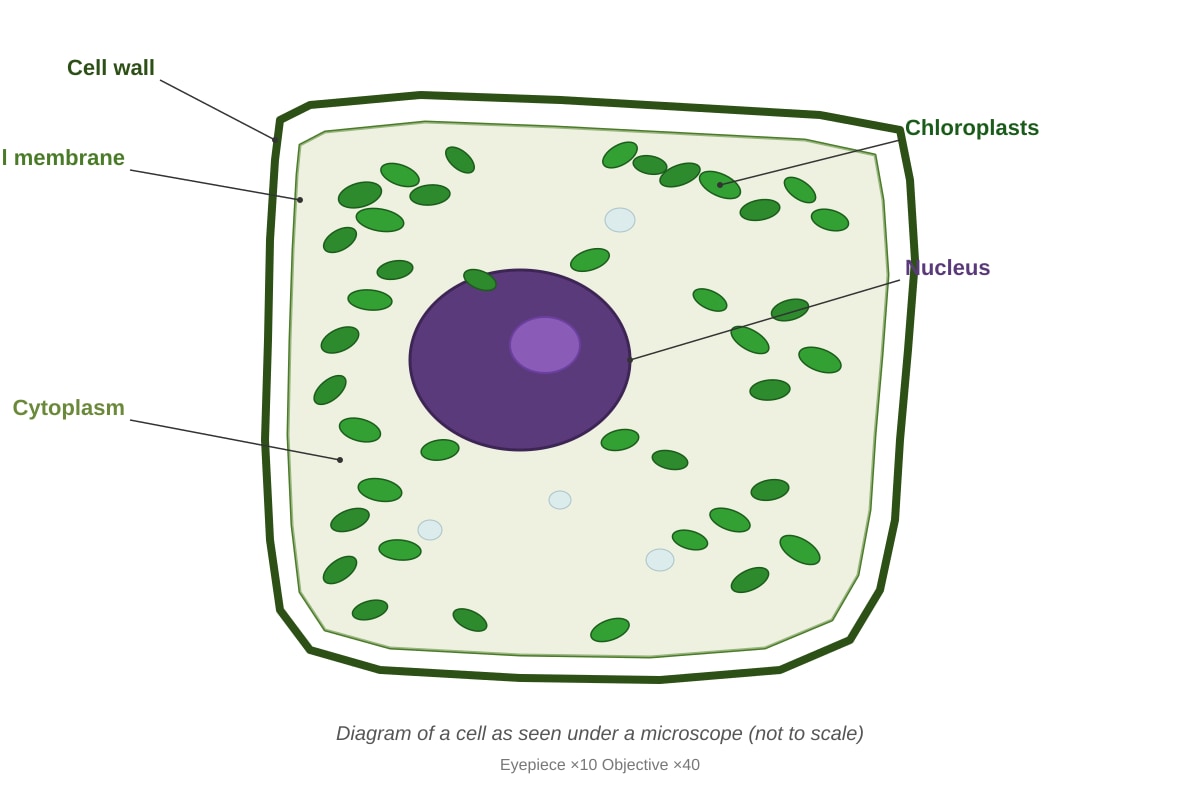
19. (a) Plant cell. Reason: It has a cell wall and chloroplasts. [1]
Marking: 1 mark for correct identification + reason (both needed). Explanation: Animal cells lack a cell wall and chloroplasts. The presence of both confirms it is a plant cell. The cell wall provides rigidity; chloroplasts indicate photosynthetic function.
19. (b) Palisade mesophyll cell (or leaf photosynthetic cell). Reason: It has many chloroplasts for photosynthesis but no large central vacuole (which would push chloroplasts to the edge), and it is elongated/columnar to pack tightly for light absorption. [2]
Marking: 1 mark for correct cell type; 1 mark for reasoning linking structure (many chloroplasts, no large vacuole, shape) to function (photosynthesis, light absorption). Explanation: Palisade mesophyll cells are specialised for photosynthesis. They are tall and thin, packed tightly under the upper epidermis. They contain numerous chloroplasts. The absence of a large central vacuole (typical of mature parenchyma cells) suggests this is a young or highly specialised photosynthetic cell where the cytoplasm fills most of the cell volume.
19. (c) Total magnification = Eyepiece magnification × Objective magnification = ×10 × ×40 = ×400 [1]
Explanation: The total magnification of a compound light microscope is the product of the eyepiece (ocular) lens magnification and the objective lens magnification. Here, 10 × 40 = 400 times magnification.
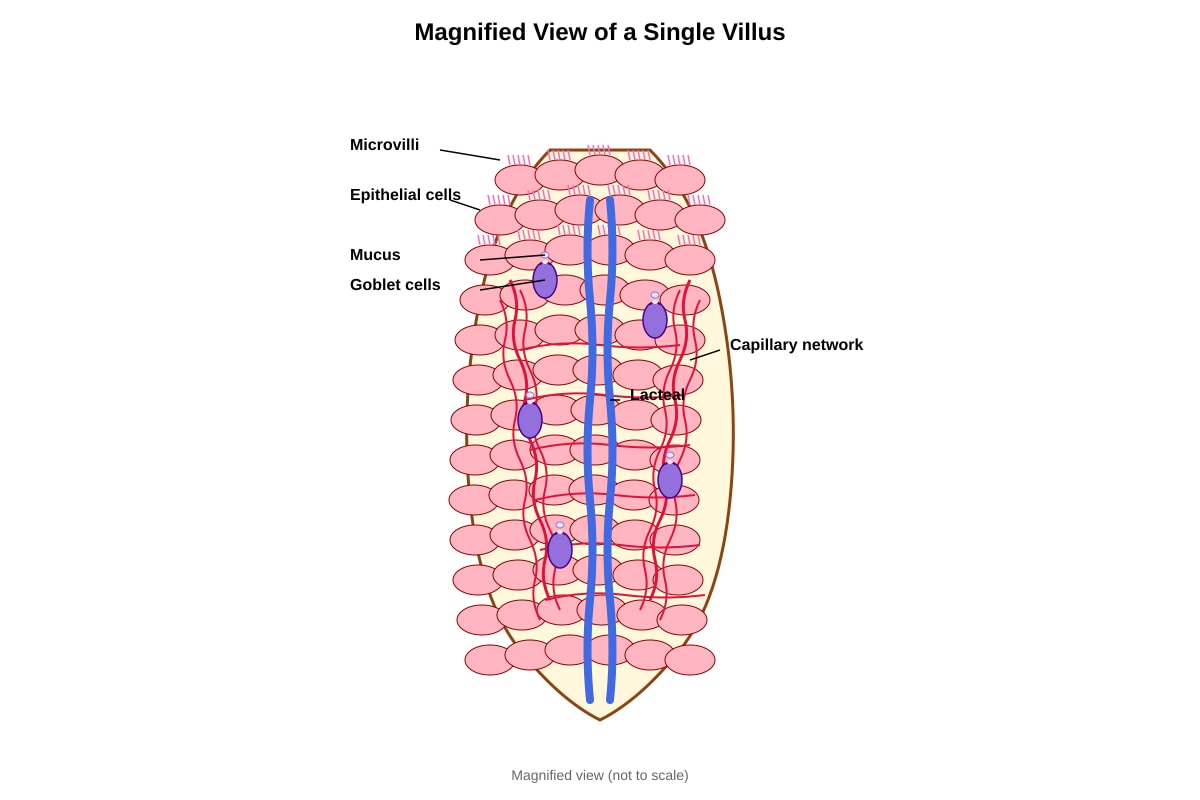
20. (a) Lacteal [1]
Explanation: The lacteal is a blind-ended lymphatic capillary in the centre of each villus. It absorbs the products of fat digestion: fatty acids and glycerol (which are reassembled into triglycerides, packaged into chylomicrons, and enter the lymph). Glucose and amino acids enter the blood capillaries.
20. (b) Microvilli are microscopic projections on the surface of epithelial cells (forming the brush border) that greatly increase the surface area for absorption, allowing more nutrients to be absorbed per unit time. [2]
Marking: 1 mark for "increase surface area"; 1 mark for "faster/more efficient absorption" or "more transport proteins can be embedded". Explanation: Each villus has microvilli on its epithelial cells. This creates a "brush border" that increases the surface area by about 30–40 times compared to a flat surface. More surface area means more carrier proteins and channels for active transport and facilitated diffusion, and more area for simple diffusion.
20. (c) Glucose and amino acids are water-soluble, so they dissolve in the blood plasma and are transported via the bloodstream (capillaries → hepatic portal vein → liver). Fatty acids and glycerol are lipid-soluble; they are reassembled into triglycerides in the epithelial cells, packaged into chylomicrons (lipoproteins), which are too large to enter blood capillaries, so they enter the lacteal (lymphatic system) and eventually reach the bloodstream via the thoracic duct. [2]
Marking: 1 mark for water-soluble vs lipid-soluble / size difference; 1 mark for correct destination vessels (blood capillaries vs lacteal) and brief reason (chylomicrons too large for blood capillaries / enter lymph). Explanation: This is a key concept in digestion. Water-soluble nutrients (monosaccharides, amino acids, minerals, water-soluble vitamins) go directly into blood capillaries. Fat-soluble products (fatty acids, monoglycerides, fat-soluble vitamins) are reassembled into triglycerides, coated with protein to form chylomicrons, which enter the lacteal because they are too large for the fenestrations in blood capillaries. The lymphatic system drains into the subclavian vein, bypassing the liver initially.
End of Answer Key