From Real Exams Quiz
Secondary 2 Science Life Sciences Quiz
Free Sec 2 Science Life Sciences quiz, Exam version, with questions, answers, and syllabus-aligned practice for Singapore students.
These static practice materials are generated from the site's syllabus and paper-generation workflow, with source and model context shown so students and parents can evaluate the material before use.
Questions
Free quiz and exam paper access
Enter your details to view this paper
Your access is remembered on this device.
Answers
Secondary 2 Science Quiz - Life Sciences (Answer Key)
Total Marks: 40
Section A: Multiple Choice [10 marks - 1 mark each]
-
c) Magnetism
- Living organisms show growth, reproduction, and response to stimuli, but not magnetism.
-
c) Cell
- The cell is the basic structural and functional unit of all living organisms.
-
b) Nucleus
- The nucleus contains DNA and controls all cellular activities.
-
c) Chloroplast
- Chloroplasts contain chlorophyll and are the site of photosynthesis.
-
d) Cell wall
- Cell walls are found only in plant cells, providing structural support.
Section B: Cell Structure and Function [5 marks - 1 mark each]
-
b) Reproduction
- Reproduction is the biological process of producing offspring.
-
c) Circulatory system
- The circulatory system transports blood, nutrients, and waste around the body.
-
c) Sperm
- Sperm are the male gametes in human reproduction.
-
b) Proteins
- Proteins are essential for growth, repair, and maintenance of body tissues.
-
b) Osmosis
- Osmosis is the specific movement of water through a partially permeable membrane.
Section C: Structured Questions [15 marks]
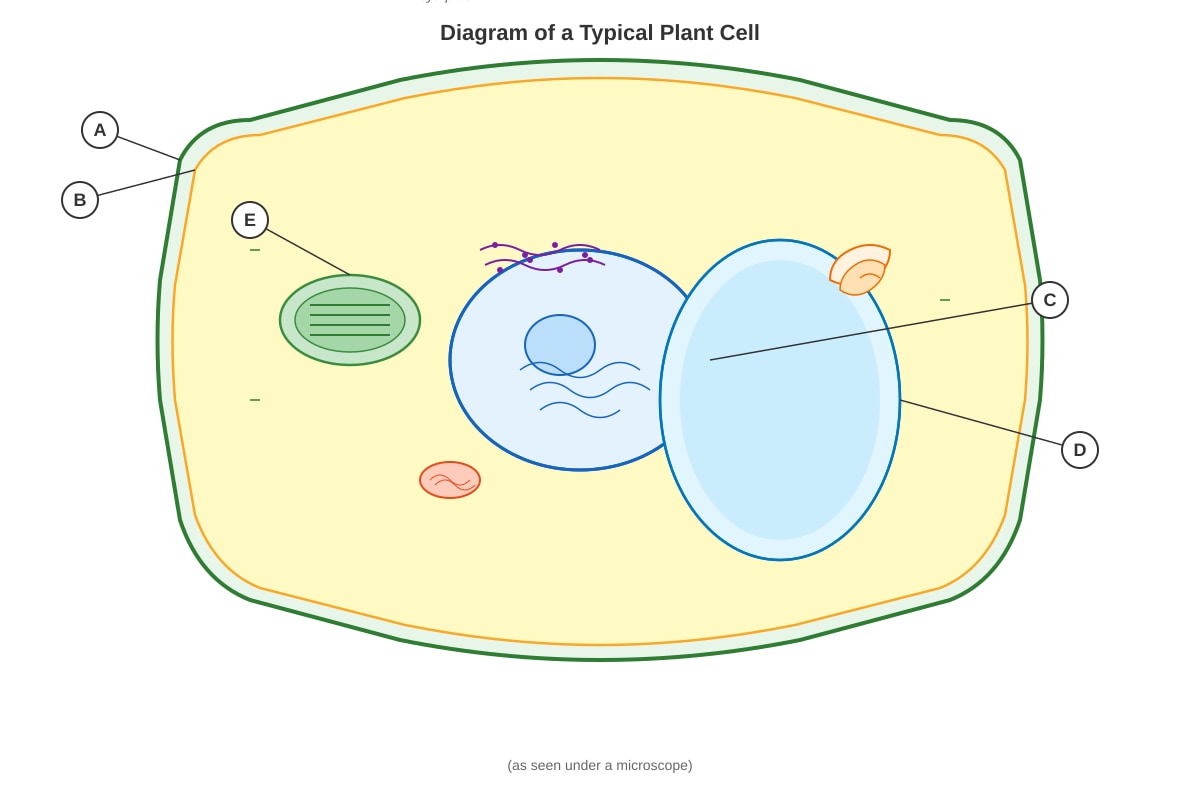
Question 11 [5 marks - 1 mark each]
- A: Cell wall (rigid outer boundary)
- B: Chloroplast (green organelle for photosynthesis)
- C: Nucleus (large central structure)
- D: Vacuole (large central space)
- E: Cell membrane (inner boundary)
Question 12 [2 marks - 1 mark each] Any two from:
- Plant cells have a cell wall; animal cells do not
- Plant cells have chloroplasts; animal cells do not
- Plant cells have a large central vacuole; animal cells have small vacuoles
- Plant cells are generally rectangular; animal cells are more rounded
Question 13 [5 marks]
a) [2 marks] Osmosis is the movement of water molecules [1 mark] from a region of higher water concentration to a region of lower water concentration through a partially permeable membrane [1 mark].
b) [3 marks] Prediction: Potato strips will gain water/become turgid/swell [1 mark] Explanation: Pure water has higher water concentration than potato cells, so water moves into cells by osmosis [2 marks]
Question 14 [3 marks]
a) [1 mark] Digestion
b) [2 marks - 1 mark each] Any two from:
- Produces gastric juice/hydrochloric acid
- Kills bacteria in food
- Provides acidic conditions for pepsin to work
- Churns food to mix it with gastric juice
- Begins protein digestion
Question 15 [2 marks] Large food molecules are too big to be absorbed [1 mark] so they must be broken down into smaller molecules that can pass through the intestinal wall into the bloodstream [1 mark].
Section D: Extended Response [10 marks]
Question 16 [3 marks] Size difference: Sperm cells are much smaller than egg cells [1 mark] Reason: Sperm need to be small and streamlined for efficient movement; eggs are large to store nutrients for early development [2 marks]
Question 17 [3 marks] Numbers difference: Males produce millions of sperm; females produce one egg per menstrual cycle [1 mark] Reason: Many sperm are needed to increase chances of fertilization as most will not reach the egg; eggs require significant energy investment so fewer are produced [2 marks]
Question 18 [3 marks - 1 mark each] Any three from:
- Movement/locomotion
- Growth in size
- Response to stimuli
- Reproduction/cell division
- Feeding/nutrition
- Respiration
- Excretion
Question 19 [1 mark] The organisms are too small to be seen with the naked eye or Microscopes magnify small objects to make them visible
Question 20 [3 marks - 1 mark each] Any three from:
- Growth
- Reproduction
- Respiration
- Nutrition/Feeding
- Excretion
- Response to stimuli
- Movement
Marking Notes:
- Accept alternative correct scientific terminology
- Award marks for correct understanding even if wording differs slightly
- Deduct marks for incorrect scientific terms or concepts
- Partial marks may be awarded for incomplete but correct responses