AI Generated Exam Paper

Secondary 2 Science Practice Paper 5

Free Sec 2 Science Practice Paper 5, Nemo3 AI version, with questions, answers, and syllabus-aligned practice for Singapore students.

These static practice materials are generated from the site's syllabus and paper-generation workflow, with source and model context shown so students and parents can evaluate the material before use.

Secondary 2 Science AI Generated Generated by NVIDIA Nemotron 3 Ultra 550B A55B Free Updated 2026-06-18

Questions

<!-- TuitionGoWhere generation metadata: stage=5-2; model=nvidia/nemotron-3-ultra-550b-a55b:free; model_label=NVIDIA Nemotron 3 Ultra 550B A55B Free; generated=2026-06-16; Sources: Stage 4-0 LLM templates, syllabus context, and Stage 2 evidence where available. -->

TuitionGoWhere Practice Paper - Science Secondary 2

TuitionGoWhere Practice Paper (AI) — Version 5

Subject: Science
Level: Secondary 2 (G3)
Paper: Practice Paper — Physical Sciences Focus
Duration: 1 hour 30 minutes
Total Marks: 60

Name: ________________________
Class: __________
Date: __________


Instructions to Candidates

  1. Write your name, class, and date in the spaces provided above.
  2. Answer all questions.
  3. Write your answers in the spaces provided on the question paper.
  4. The number of marks is given in brackets [ ] at the end of each question or part question.
  5. The total mark for this paper is 60.
  6. You may use a calculator.
  7. Where necessary, take the acceleration due to gravity, g=10 m/s2g = 10 \text{ m/s}^2.
  8. Show all working for calculation questions.

Section A: Multiple Choice Questions [10 marks]

Answer all questions. For each question, choose the one correct answer and write the letter (A, B, C, or D) in the box provided.

1

A 2.0 kg block is lifted vertically from the ground to a shelf 1.5 m high. The work done against gravity is: A. 3.0 J
B. 15 J
C. 30 J
D. 45 J

Answer: \fbox{\phantom{A}}

2

A pendulum bob is released from rest at position X (height 0.4 m above the lowest point). Ignoring air resistance, what is the speed of the bob at the lowest point? A. 2.0 m/s
B. 2.8 m/s
C. 4.0 m/s
D. 8.0 m/s

Answer: \fbox{\phantom{A}}

3

Which of the following energy conversions occurs when a battery-powered torch is switched on? A. Chemical potential energy \to Electrical energy \to Light energy + Heat energy
B. Electrical energy \to Chemical potential energy \to Light energy
C. Kinetic energy \to Electrical energy \to Light energy + Heat energy
D. Chemical potential energy \to Kinetic energy \to Light energy

Answer: \fbox{\phantom{A}}

4

A motor lifts a 50 N load through a vertical height of 4 m in 5 s. The power developed by the motor is: A. 10 W
B. 40 W
C. 200 W
D. 400 W

Answer: \fbox{\phantom{A}}

5

A ball of mass 0.5 kg is thrown vertically upwards with an initial speed of 10 m/s. The maximum height reached by the ball (ignoring air resistance) is: A. 2.5 m
B. 5.0 m
C. 10 m
D. 20 m

Answer: \fbox{\phantom{A}}

6

In a simple series circuit with a 6 V battery and two identical resistors, the potential difference across each resistor is: A. 3 V
B. 6 V
C. 12 V
D. Cannot be determined without the resistance value

Answer: \fbox{\phantom{A}}

7

An electrical appliance rated 240 V, 1200 W is used for 30 minutes. The energy consumed in kWh is: A. 0.6 kWh
B. 1.2 kWh
C. 6.0 kWh
D. 36 kWh

Answer: \fbox{\phantom{A}}

8

Which statement about the resistance of a metallic conductor is correct? A. Resistance decreases as temperature increases.
B. Resistance is independent of the length of the conductor.
C. Resistance increases as cross-sectional area increases.
D. Resistance increases as temperature increases.

Answer: \fbox{\phantom{A}}

9

Three identical resistors are connected in parallel across a 12 V battery. The total current drawn from the battery is 3.0 A. The resistance of each resistor is: A. 4.0 Ω\Omega
B. 12 Ω\Omega
C. 36 Ω\Omega
D. 108 Ω\Omega

Answer: \fbox{\phantom{A}}

10

A student measures the current through a resistor at different voltages and plots a graph of VV against II. The graph is a straight line passing through the origin. This shows that: A. The resistor is non-ohmic.
B. The resistance increases with voltage.
C. The resistor obeys Ohm's Law.
D. The power dissipated is constant.

Answer: \fbox{\phantom{A}}


Section B: Structured Questions [30 marks]

Answer all questions in the spaces provided.

11

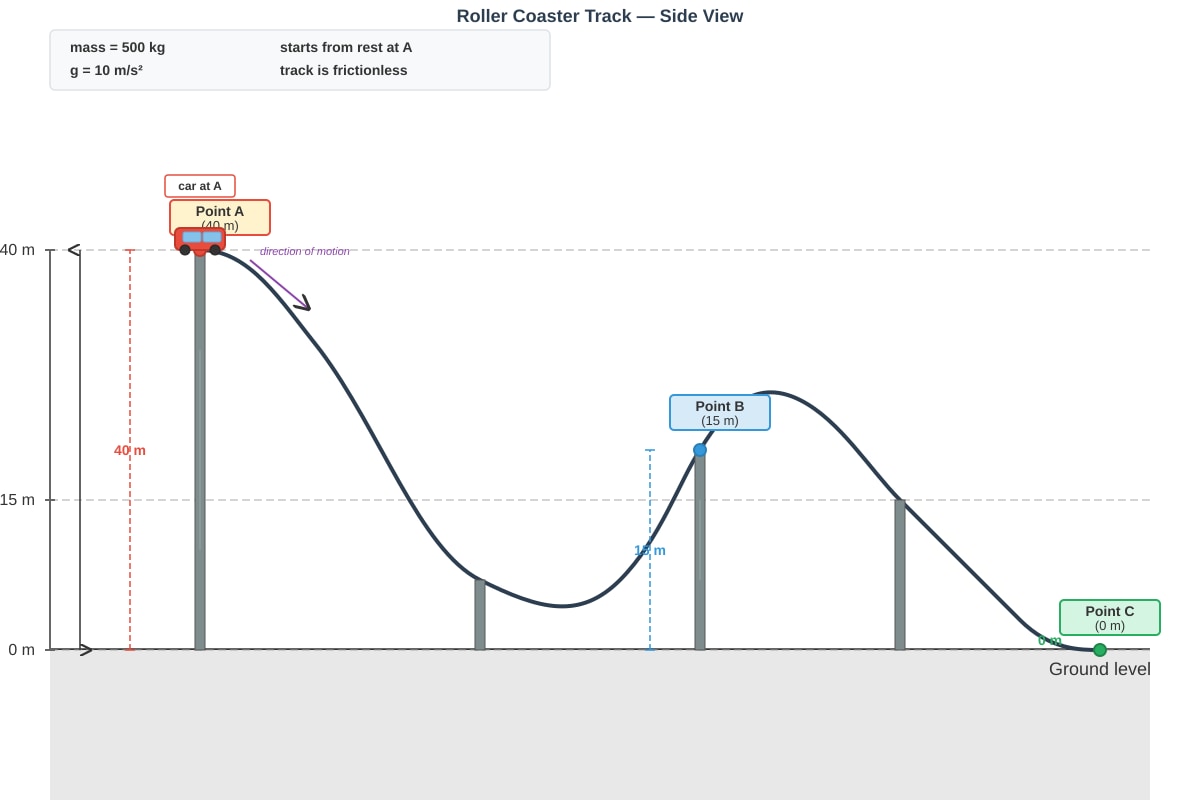
A roller coaster car of mass 500 kg starts from rest at point A, which is 40 m above ground level. The track is frictionless.

<image_placeholder> id: Q11-fig1 type: diagram linked_question: Q11 description: Side-view diagram of a roller coaster track showing point A at 40 m height, point B at 15 m height, and point C at ground level (0 m). The car is shown at point A. Label points A, B, C with heights. labels: Point A (40 m), Point B (15 m), Point C (0 m), car at A values: Heights: A=40 m, B=15 m, C=0 m; mass=500 kg; g=10 m/s² must_show: Three distinct points at different heights, car at starting position, height labels </image_placeholder>

(a) State the principle of conservation of energy. [2]


(b) Calculate the gravitational potential energy of the car at point A. [2]


(c) Determine the speed of the car at point B. [3]


(d) At point C, the car enters a horizontal braking zone and comes to rest over a distance of 25 m. Calculate the average braking force acting on the car. [3]


12

A student sets up a circuit to investigate how the current through a filament lamp varies with the potential difference across it.

<image_placeholder> id: Q12-fig1 type: diagram linked_question: Q12 description: Circuit diagram showing a battery, variable resistor (rheostat), filament lamp, ammeter in series, and voltmeter in parallel across the lamp. Standard circuit symbols. labels: Battery, variable resistor, filament lamp, ammeter (A), voltmeter (V), connecting wires values: Battery voltage not specified (variable via rheostat) must_show: Complete series circuit with ammeter, voltmeter across lamp only, variable resistor symbol </image_placeholder>

(a) Name the component used to vary the potential difference across the lamp. [1]


(b) The student records the following data:

VV / V0.01.02.03.04.05.0
II / A0.000.150.250.320.370.40

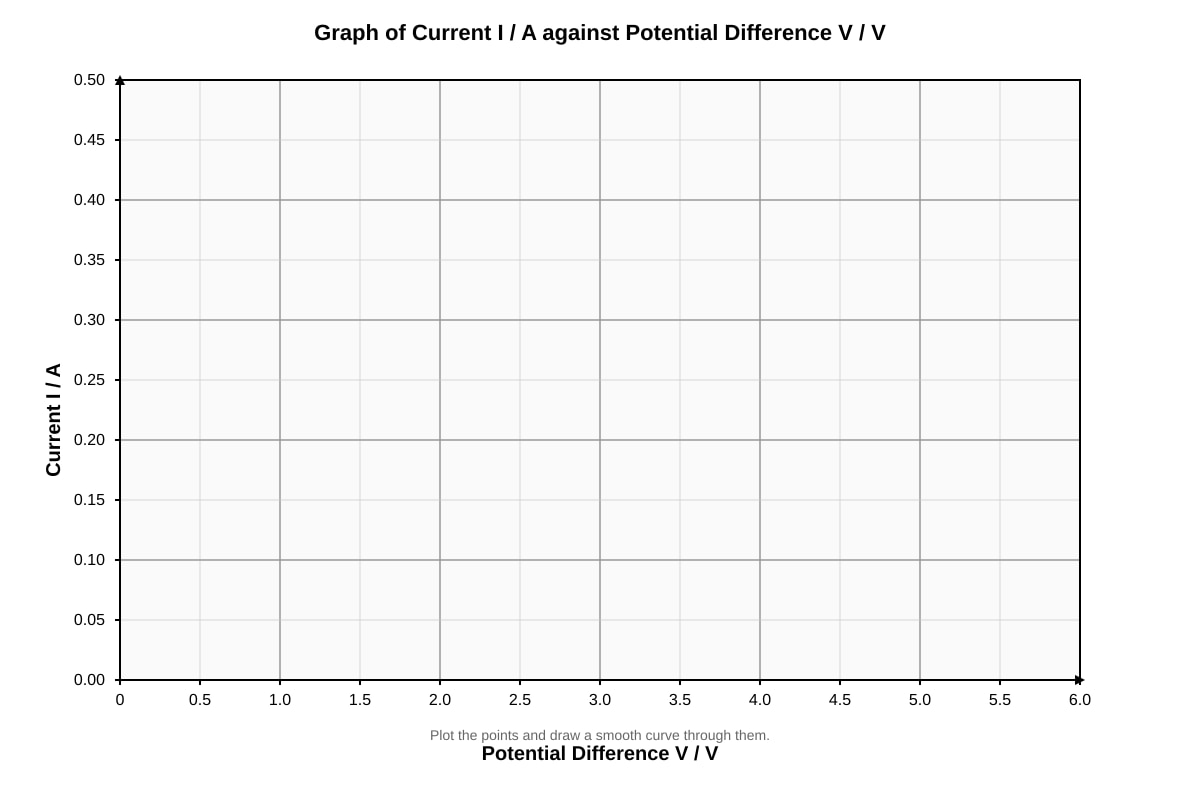
(i) Plot the graph of II (y-axis) against VV (x-axis) on the grid below. [2]

<image_placeholder> id: Q12-fig2 type: graph linked_question: Q12 description: Blank graph grid with axes labelled. x-axis: Potential Difference V / V (0 to 6 V). y-axis: Current I / A (0 to 0.5 A). Grid lines at 0.5 V and 0.05 A intervals. labels: x-axis: V / V, y-axis: I / A values: x-range 0-6 V, y-range 0-0.5 A must_show: Labelled axes with units, appropriate scale, grid lines </image_placeholder>

(ii) Use your graph to determine the resistance of the lamp when V=3.0V = 3.0 V. [2]


(iii) Explain why the resistance of the filament lamp changes as the potential difference increases. [2]


13

An electric kettle rated 240 V, 2.2 kW is used to heat 1.5 kg of water from 25°C to 100°C. The specific heat capacity of water is 4200 J/(kg·°C).

(a) Calculate the energy required to heat the water. [2]


(b) Calculate the time taken for the kettle to heat the water, assuming no heat losses. [2]


(c) In practice, the actual time taken is longer than calculated in (b). State one reason for this difference. [1]


(d) The kettle is used once per day. Calculate the cost of electricity for 30 days if 1 kWh costs $0.28. [2]


14

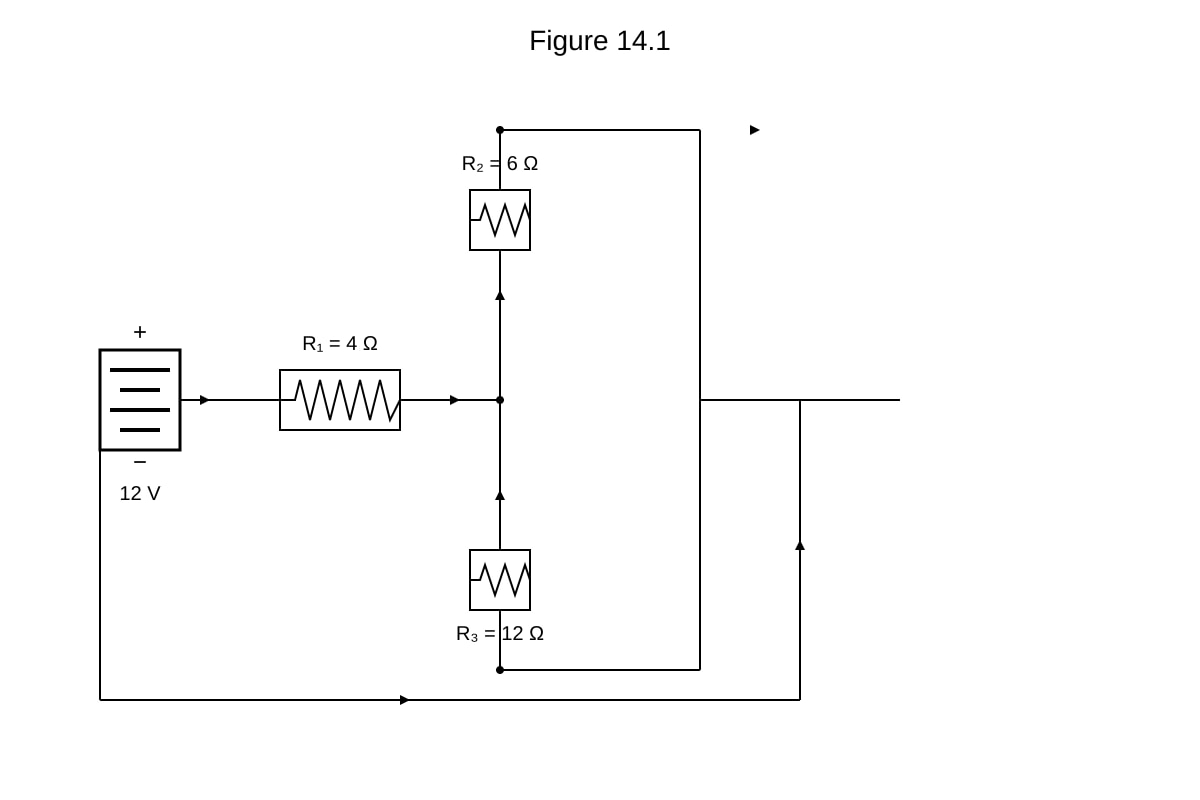
A 12 V battery of negligible internal resistance is connected to a network of three resistors as shown.

<image_placeholder> id: Q14-fig1 type: diagram linked_question: Q14 description: Circuit diagram: 12 V battery connected to a 4 Ω resistor in series with a parallel combination of 6 Ω and 12 Ω resistors. labels: Battery 12 V, R1 = 4 Ω (series), R2 = 6 Ω (parallel branch), R3 = 12 Ω (parallel branch) values: V = 12 V, R1 = 4 Ω, R2 = 6 Ω, R3 = 12 Ω must_show: Clear series-parallel arrangement, all resistor values labelled, battery polarity </image_placeholder>

(a) Calculate the combined resistance of the parallel combination (6 Ω and 12 Ω). [2]


(b) Calculate the total resistance of the circuit. [1]


(c) Calculate the current supplied by the battery. [2]


(d) Calculate the potential difference across the 6 Ω resistor. [2]


(e) Calculate the power dissipated in the 12 Ω resistor. [2]


15

A crane lifts a concrete block of mass 800 kg vertically at a constant speed of 0.5 m/s through a height of 12 m.

(a) State the net force acting on the block while it moves at constant speed. Explain your answer. [2]


(b) Calculate the tension in the lifting cable. [2]


(c) Calculate the work done by the tension force. [2]


(d) Calculate the power output of the crane motor during the lift. [2]


Section C: Longer Structured and Data-Based Questions [20 marks]

Answer all questions in the spaces provided.

16

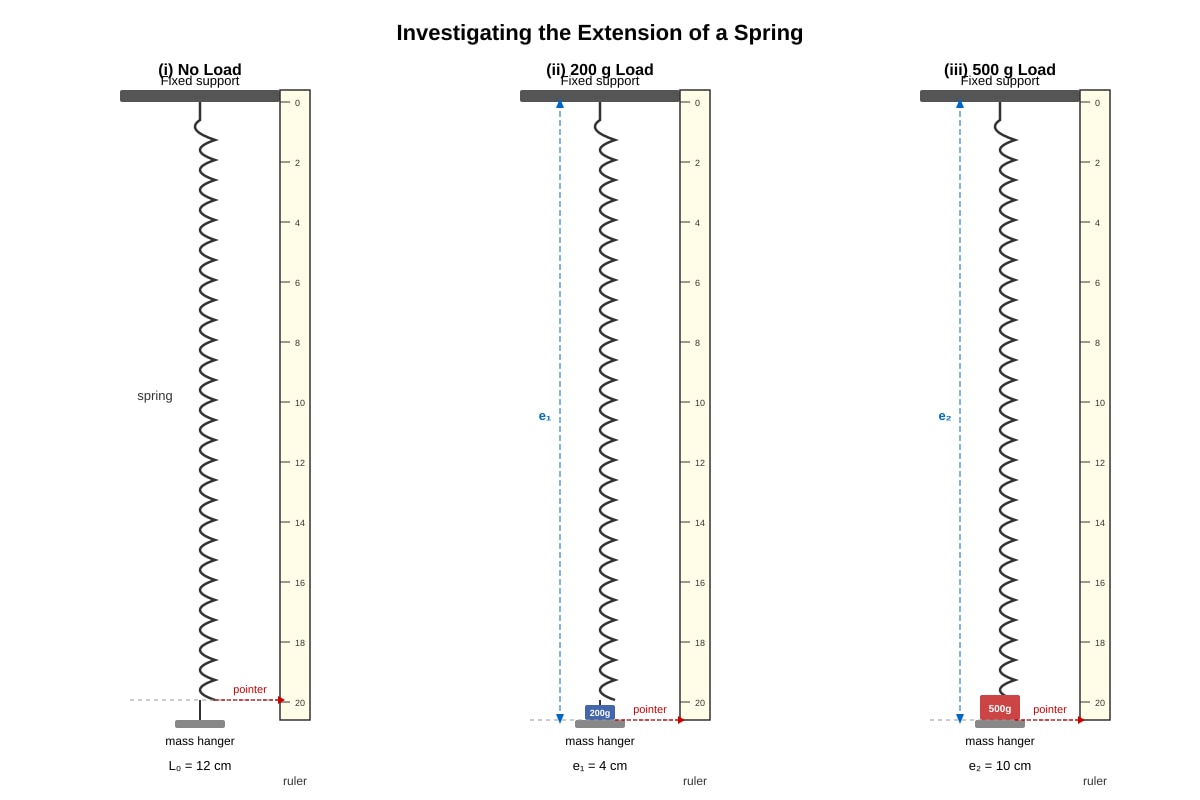
A student investigates the relationship between the extension of a spring and the force applied to it. The spring obeys Hooke's Law up to its limit of proportionality.

<image_placeholder> id: Q16-fig1 type: diagram linked_question: Q16 description: Diagram of a spring hanging vertically from a fixed support. A mass hanger is attached to the bottom. A ruler is placed alongside the spring. Three positions shown: (i) spring with no load, (ii) spring with 200 g load, (iii) spring with 500 g load. Extension indicated with double-headed arrows. labels: Fixed support, spring, mass hanger, ruler, pointer, extensions e1, e2 values: Original length L0, extension with 200 g = 4 cm, extension with 500 g = 10 cm must_show: Vertical spring with ruler, three load states, extension arrows clearly labelled </image_placeholder>

(a) State Hooke's Law. [1]


(b) The spring has an original length of 12 cm. With a 200 g mass, the length is 16 cm. With a 500 g mass, the length is 22 cm. Calculate the spring constant kk in N/m. [3]


(c) Calculate the elastic potential energy stored in the spring when the 500 g mass is attached. [2]


(d) The student adds a 1000 g mass and the spring extends to 35 cm. Does the spring still obey Hooke's Law? Explain using the data. [2]


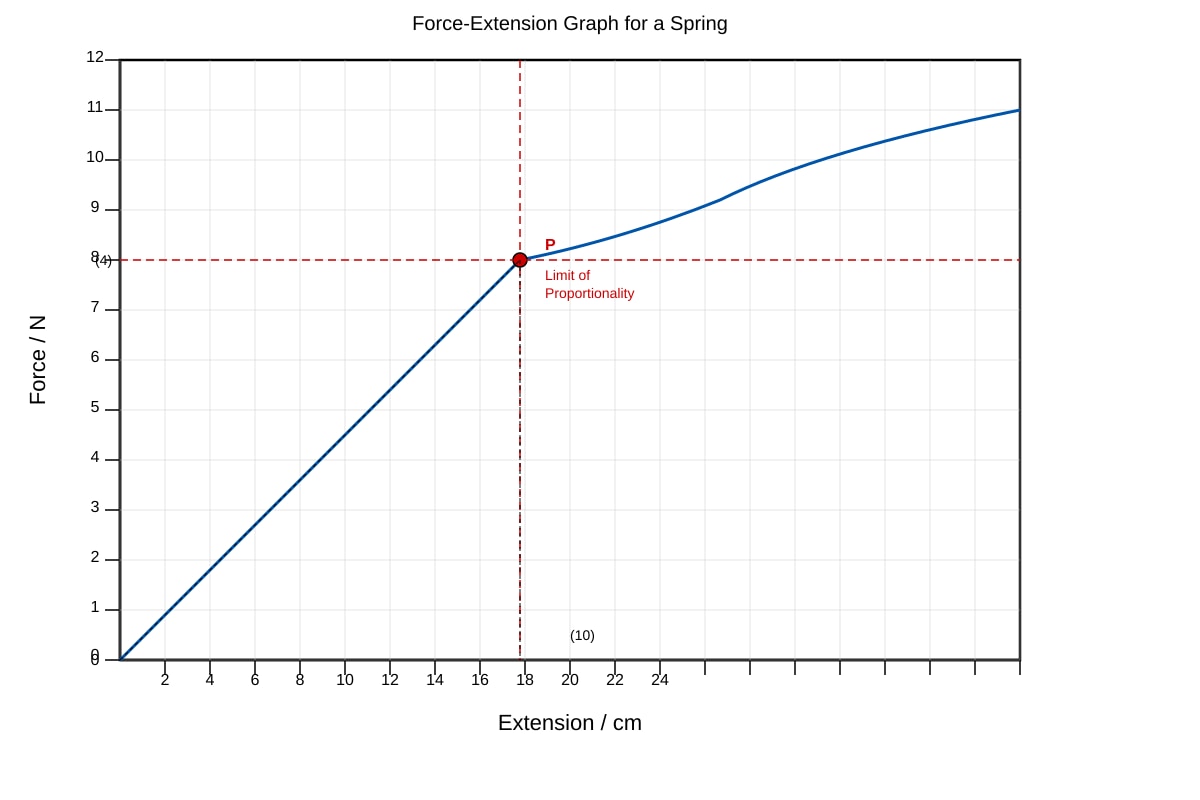
(e) Sketch the force-extension graph for the spring from 0 to 1000 g on the axes below. Label the limit of proportionality. [2]

<image_placeholder> id: Q16-fig2 type: graph linked_question: Q16 description: Blank axes for force-extension graph. x-axis: Extension / cm (0 to 25 cm). y-axis: Force / N (0 to 12 N). Grid lines at 2 cm and 1 N intervals. labels: x-axis: Extension / cm, y-axis: Force / N values: x-range 0-25 cm, y-range 0-12 N must_show: Labelled axes with units, linear region then curve, limit of proportionality marked </image_placeholder>

17

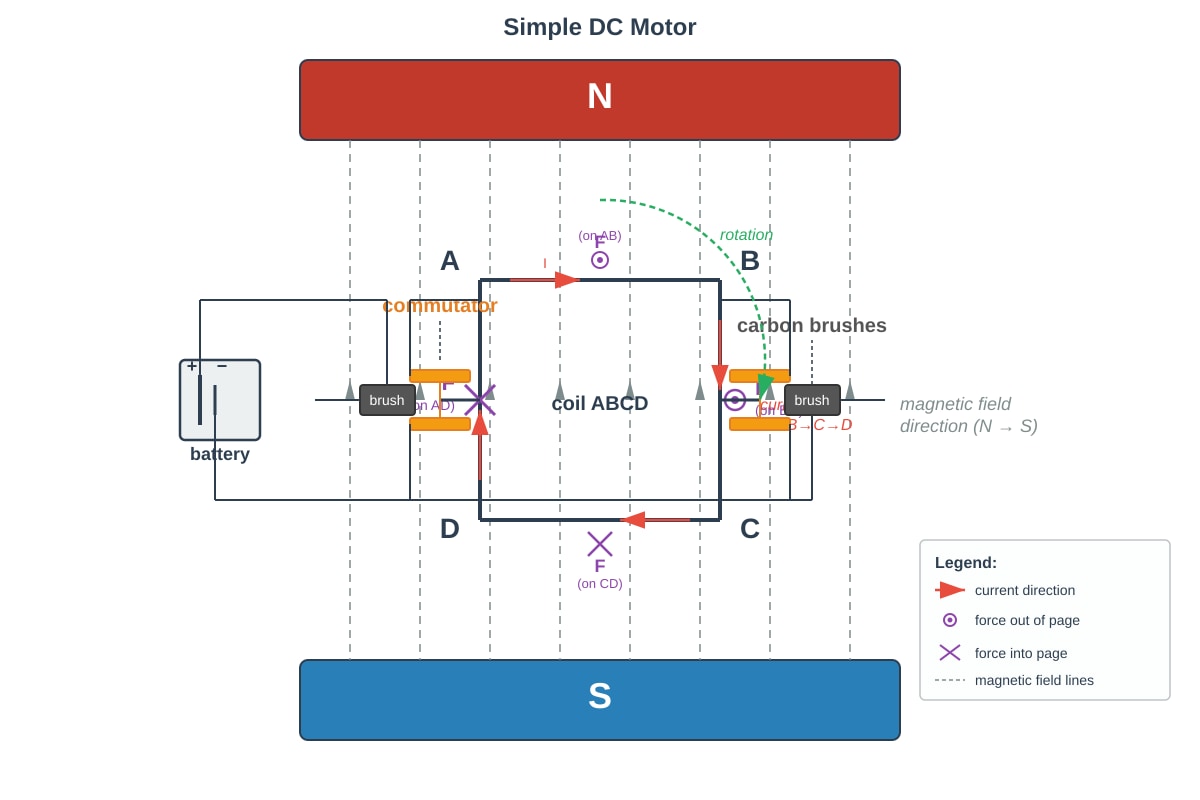
The diagram shows a simple DC motor.

<image_placeholder> id: Q17-fig1 type: diagram linked_question: Q17 description: Diagram of a simple DC motor: rectangular coil ABCD in a uniform magnetic field between N-S field (N to S), commutator (split-ring), carbon brushes, battery. Current direction shown in coil. Forces on sides AB and CD indicated. labels: N pole, S pole, coil ABCD, commutator, brushes, battery, current direction arrows, force arrows on AB and CD values: Magnetic field direction N→S, current direction A→B→C→D must_show: Rectangular coil in magnetic field, split-ring commutator, brushes, current and force directions </image_placeholder>

(a) On the diagram, label the commutator and carbon brushes. [1]

(b) Explain why the coil experiences a turning effect (torque) when current passes through it. [3]


(c) State two ways to increase the turning effect of the motor. [2]


(d) The motor is connected to a 6 V supply and draws a current of 0.8 A. The motor lifts a 0.5 kg load through 2 m in 4 s. Calculate the efficiency of the motor. [3]


18

A solar panel installation on a roof generates electrical energy from sunlight. On a particular day, the solar panel receives solar power of 800 W/m². The total area of the panels is 12 m². The electrical power output is 1.8 kW.

(a) Calculate the total solar power incident on the panels. [2]


(b) Calculate the efficiency of the solar panel system. [2]


(c) The system operates at this efficiency for 6 hours on a sunny day. Calculate the electrical energy generated in kWh. [2]


(d) Suggest two factors that affect the efficiency of solar panels in real-world conditions. [2]


(e) The household uses 15 kWh of electricity per day. The solar system costs 12,000toinstallandelectricitycosts12,000 to install and electricity costs 0.28/kWh. Estimate the payback period in years, assuming the system generates the same energy every day. [3]


19

The table shows the voltage and current ratings of four electrical appliances used in a home.

ApplianceVoltage / VPower / WCurrent / A
Hair dryer2401800
Refrigerator240150
Microwave oven2401200
LED lamp24012

(a) Complete the table by calculating the current drawn by each appliance. [3]


(b) The appliances are connected in parallel to the 240 V mains supply. Explain why parallel connection is used for household wiring. [2]


(c) The mains circuit is protected by a 30 A circuit breaker. Determine whether the circuit breaker will trip if all four appliances are switched on simultaneously. [2]


(d) The hair dryer has a metal casing and is fitted with a 3-pin plug. Explain the function of the earth wire in the plug. [2]


20

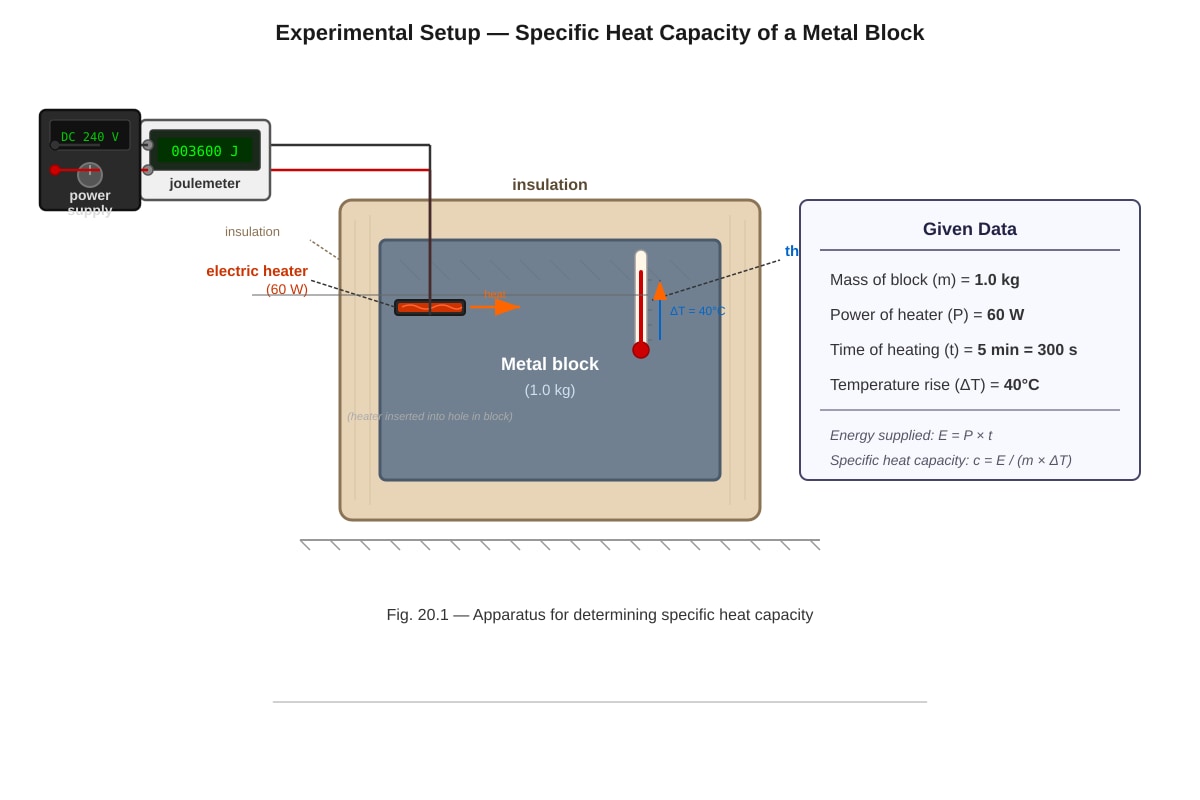
A student conducts an experiment to determine the specific heat capacity of a metal block. The block has a mass of 1.0 kg. An electric heater rated 60 W is inserted into the block for 5 minutes. The temperature rise is measured as 40°C.

<image_placeholder> id: Q20-fig1 type: experimental_setup linked_question: Q20 description: Diagram of metal block with embedded electric heater and thermometer. Insulation around the block. Power supply connected to heater, joulemeter or ammeter/voltmeter shown. labels: Metal block (1.0 kg), electric heater (60 W), thermometer, insulation, power supply, joulemeter values: Mass = 1.0 kg, Power = 60 W, Time = 5 min, ΔT = 40°C must_show: Block with heater and thermometer holes, insulation layer, electrical connections </image_placeholder>

(a) Calculate the energy supplied by the heater. [2]


(b) Calculate the experimental value of the specific heat capacity of the metal. [2]


(c) The accepted value for the specific heat capacity of this metal is 450 J/(kg·°C). Calculate the percentage difference between the experimental and accepted values. [2]


(d) Suggest two reasons why the experimental value differs from the accepted value, and state how each could be minimised. [4]


End of Paper

Answers

<!-- TuitionGoWhere generation metadata: stage=5-2; model=nvidia/nemotron-3-ultra-550b-a55b:free; model_label=NVIDIA Nemotron 3 Ultra 550B A55B Free; generated=2026-06-16; Sources: Stage 4-0 LLM templates, syllabus context, and Stage 2 evidence where available. -->

TuitionGoWhere Practice Paper - Science Secondary 2 (Answer Key)

Subject: Science
Level: Secondary 2 (G3)
Paper: Practice Paper — Physical Sciences Focus (Version 5)
Total Marks: 60


Section A: Multiple Choice Questions [10 marks]

1

Answer: C
Working:
Work done against gravity = Gain in gravitational potential energy = mghmgh
=2.0×10×1.5=30 J= 2.0 \times 10 \times 1.5 = 30 \text{ J}

Marking: 1 mark for correct formula/substitution, 1 mark for correct answer with unit.


2

Answer: B
Working:
By conservation of energy: Loss in GPE = Gain in KE
mgh=12mv2mgh = \frac{1}{2}mv^2
v=2gh=2×10×0.4=82.83 m/s2.8 m/sv = \sqrt{2gh} = \sqrt{2 \times 10 \times 0.4} = \sqrt{8} \approx 2.83 \text{ m/s} \approx 2.8 \text{ m/s}

Marking: 1 mark for correct energy equation, 1 mark for correct calculation.


3

Answer: A
Explanation:
A battery stores chemical potential energy. When the torch is switched on, chemical energy is converted to electrical energy in the circuit, which is then converted to light energy (useful) and heat energy (wasted) in the filament.

Marking: 1 mark for correct sequence.


4

Answer: B
Working:
Work done = Force ×\times distance = 50×4=200 J50 \times 4 = 200 \text{ J}
Power = Work doneTime=2005=40 W\frac{\text{Work done}}{\text{Time}} = \frac{200}{5} = 40 \text{ W}

Marking: 1 mark for work done, 1 mark for power calculation.


5

Answer: B
Working:
At maximum height, KE = 0. Initial KE = Final GPE
12mv2=mgh\frac{1}{2}mv^2 = mgh
h=v22g=1022×10=10020=5.0 mh = \frac{v^2}{2g} = \frac{10^2}{2 \times 10} = \frac{100}{20} = 5.0 \text{ m}

Marking: 1 mark for energy conservation equation, 1 mark for correct answer.


6

Answer: A
Explanation:
In a series circuit with identical resistors, the total voltage divides equally across each resistor. 6 V/2=3 V6 \text{ V} / 2 = 3 \text{ V} per resistor.

Marking: 1 mark.


7

Answer: A
Working:
Energy = Power ×\times Time = 1.2 kW×0.5 h=0.6 kWh1.2 \text{ kW} \times 0.5 \text{ h} = 0.6 \text{ kWh}

Marking: 1 mark for unit conversion (1200 W = 1.2 kW, 30 min = 0.5 h), 1 mark for correct answer.


8

Answer: D
Explanation:
For metallic conductors, resistance increases with temperature due to increased lattice vibrations impeding electron flow.

Marking: 1 mark.


9

Answer: B
Working:
For parallel identical resistors: 1Rtotal=3R\frac{1}{R_{\text{total}}} = \frac{3}{R} so Rtotal=R3R_{\text{total}} = \frac{R}{3}
V=IRtotal12=3.0×R3R=12 ΩV = I R_{\text{total}} \Rightarrow 12 = 3.0 \times \frac{R}{3} \Rightarrow R = 12 \ \Omega

Marking: 1 mark for parallel resistance formula, 1 mark for correct answer.


10

Answer: C
Explanation:
A straight-line VV-II graph through the origin indicates constant resistance (VIV \propto I), which is Ohm's Law.

Marking: 1 mark.


Section B: Structured Questions [30 marks]

11

(a) [2 marks]
Answer:

  • Energy cannot be created or destroyed. [1]
  • Energy can be converted from one form to another / The total energy in a closed system remains constant. [1]

Marking notes: Both points required for full marks. "Energy is conserved" alone is insufficient.

(b) [2 marks]
Working:
GPE = mgh=500×10×40=200,000 J=200 kJmgh = 500 \times 10 \times 40 = 200,000 \text{ J} = 200 \text{ kJ}

Marking: 1 mark for correct substitution, 1 mark for correct answer with unit.

(c) [3 marks]
Working:
At point B: GPE = 500×10×15=75,000 J500 \times 10 \times 15 = 75,000 \text{ J}
Loss in GPE from A to B = 200,00075,000=125,000 J200,000 - 75,000 = 125,000 \text{ J}
This equals gain in KE: 12mv2=125,000\frac{1}{2}mv^2 = 125,000
v2=2×125,000500=500v^2 = \frac{2 \times 125,000}{500} = 500
v=50022.4 m/sv = \sqrt{500} \approx 22.4 \text{ m/s}

Marking: 1 mark for GPE at B, 1 mark for energy conservation equation, 1 mark for correct speed.

(d) [3 marks]
Working:
At point C, all initial GPE (200,000 J) is converted to KE, then dissipated by braking force.
Work done by braking force = Force ×\times distance = Initial GPE
F×25=200,000F \times 25 = 200,000
F=200,00025=8,000 NF = \frac{200,000}{25} = 8,000 \text{ N}

Marking: 1 mark for work-energy principle, 1 mark for correct substitution, 1 mark for answer with unit.


12

(a) [1 mark]
Answer: Variable resistor (or rheostat).

(b)(i) [2 marks]
Graph requirements:

  • Axes labelled with units (V / V, I / A) [1]
  • Points plotted correctly, smooth curve through origin [1]
  • Curve should show decreasing gradient (increasing resistance)

Marking notes: Deduct 1 mark if axes not labelled or scale inappropriate.

(b)(ii) [2 marks]
Working:
At V=3.0 VV = 3.0 \text{ V}, from table/graph I=0.32 AI = 0.32 \text{ A}
R=VI=3.00.32=9.375 Ω9.4 ΩR = \frac{V}{I} = \frac{3.0}{0.32} = 9.375 \ \Omega \approx 9.4 \ \Omega

Marking: 1 mark for reading correct current, 1 mark for calculation with unit.

(b)(iii) [2 marks]
Answer:
As potential difference increases, the filament temperature increases. The increased lattice vibrations impede electron flow, causing resistance to increase.

Marking: 1 mark for temperature increase, 1 mark for lattice vibration/electron collision explanation.


13

(a) [2 marks]
Working:
Q=mcΔθ=1.5×4200×(10025)=1.5×4200×75=472,500 J=472.5 kJQ = mc\Delta\theta = 1.5 \times 4200 \times (100 - 25) = 1.5 \times 4200 \times 75 = 472,500 \text{ J} = 472.5 \text{ kJ}

Marking: 1 mark for correct substitution, 1 mark for answer with unit.

(b) [2 marks]
Working:
P=2.2 kW=2200 WP = 2.2 \text{ kW} = 2200 \text{ W}
t=QP=472,5002200=214.77 s215 s (3 min 35 s)t = \frac{Q}{P} = \frac{472,500}{2200} = 214.77 \text{ s} \approx 215 \text{ s} \ (3 \text{ min } 35 \text{ s})

Marking: 1 mark for power in watts, 1 mark for correct time with unit.

(c) [1 mark]
Answer: Heat losses to surroundings / Heat absorbed by the kettle itself / Not all electrical energy converted to heat in water.

Marking: 1 mark for any valid reason.

(d) [2 marks]
Working:
Energy per use = 2.2 kW×2153600 h=0.1314 kWh2.2 \text{ kW} \times \frac{215}{3600} \text{ h} = 0.1314 \text{ kWh}
Energy for 30 days = 0.1314×30=3.942 kWh0.1314 \times 30 = 3.942 \text{ kWh}
Cost = 3.942 \times 0.28 = \1.10 (or \1.104)

Alternative using time in hours directly:
Time per use = 215/3600=0.0597 h215/3600 = 0.0597 \text{ h}
Daily energy = 2.2×0.0597=0.131 kWh2.2 \times 0.0597 = 0.131 \text{ kWh}
Monthly energy = 3.93 kWh3.93 \text{ kWh}
Cost = 3.93 \times 0.28 = \1.10$

Marking: 1 mark for energy calculation, 1 mark for cost calculation.


14

(a) [2 marks]
Working:
1Rparallel=16+112=212+112=312=14\frac{1}{R_{\text{parallel}}} = \frac{1}{6} + \frac{1}{12} = \frac{2}{12} + \frac{1}{12} = \frac{3}{12} = \frac{1}{4}
Rparallel=4 ΩR_{\text{parallel}} = 4 \ \Omega

Marking: 1 mark for correct formula/substitution, 1 mark for answer.

(b) [1 mark]
Answer: Rtotal=4+4=8 ΩR_{\text{total}} = 4 + 4 = 8 \ \Omega

(c) [2 marks]
Working:
I=VRtotal=128=1.5 AI = \frac{V}{R_{\text{total}}} = \frac{12}{8} = 1.5 \text{ A}

Marking: 1 mark for formula, 1 mark for answer with unit.

(d) [2 marks]
Working:
Voltage across parallel combination = I×Rparallel=1.5×4=6 VI \times R_{\text{parallel}} = 1.5 \times 4 = 6 \text{ V}
In parallel, p.d. is same across both resistors.
V6Ω=6 VV_{6\Omega} = 6 \text{ V}

Marking: 1 mark for p.d. across parallel combination, 1 mark for answer.

(e) [2 marks]
Working:
V12Ω=6 VV_{12\Omega} = 6 \text{ V} (same as parallel combination)
P=V2R=6212=3612=3 WP = \frac{V^2}{R} = \frac{6^2}{12} = \frac{36}{12} = 3 \text{ W}
Alternatively: I12Ω=612=0.5 AI_{12\Omega} = \frac{6}{12} = 0.5 \text{ A}, P=I2R=0.52×12=3 WP = I^2R = 0.5^2 \times 12 = 3 \text{ W}

Marking: 1 mark for correct voltage/current, 1 mark for power calculation with unit.


15

(a) [2 marks]
Answer:
Net force = 0 N. [1]
Since the block moves at constant speed, acceleration is zero. By Newton's First Law, the net force is zero. [1]

Marking: 1 mark for zero, 1 mark for explanation linking constant speed to zero acceleration.

(b) [2 marks]
Working:
Tension = Weight (since net force = 0)
T=mg=800×10=8000 NT = mg = 800 \times 10 = 8000 \text{ N}

Marking: 1 mark for equating tension to weight, 1 mark for answer with unit.

(c) [2 marks]
Working:
Work done = Force ×\times distance = 8000×12=96,000 J=96 kJ8000 \times 12 = 96,000 \text{ J} = 96 \text{ kJ}

Marking: 1 mark for formula/substitution, 1 mark for answer with unit.

(d) [2 marks]
Working:
Power = Work doneTime\frac{\text{Work done}}{\text{Time}}
Time = distancespeed=120.5=24 s\frac{\text{distance}}{\text{speed}} = \frac{12}{0.5} = 24 \text{ s}
Power = 96,00024=4,000 W=4 kW\frac{96,000}{24} = 4,000 \text{ W} = 4 \text{ kW}

Marking: 1 mark for time calculation, 1 mark for power with unit.


Section C: Longer Structured and Data-Based Questions [20 marks]

16

(a) [1 mark]
Answer: The extension of a spring is directly proportional to the force applied, provided the limit of proportionality is not exceeded.

Marking: 1 mark for both "directly proportional" and "limit of proportionality" mentioned.

(b) [3 marks]
Working:
For 200 g mass: Force = 0.2×10=2 N0.2 \times 10 = 2 \text{ N}, Extension = 1612=4 cm=0.04 m16 - 12 = 4 \text{ cm} = 0.04 \text{ m}
k=Fe=20.04=50 N/mk = \frac{F}{e} = \frac{2}{0.04} = 50 \text{ N/m}

Check with 500 g: Force = 0.5×10=5 N0.5 \times 10 = 5 \text{ N}, Extension = 2212=10 cm=0.1 m22 - 12 = 10 \text{ cm} = 0.1 \text{ m}
k=50.1=50 N/mk = \frac{5}{0.1} = 50 \text{ N/m} (consistent)

Marking: 1 mark for correct force calculation, 1 mark for extension in metres, 1 mark for spring constant with unit.

(c) [2 marks]
Working:
Elastic potential energy = 12ke2=12×50×(0.1)2=0.25 J\frac{1}{2} k e^2 = \frac{1}{2} \times 50 \times (0.1)^2 = 0.25 \text{ J}
Alternatively: 12Fe=12×5×0.1=0.25 J\frac{1}{2} F e = \frac{1}{2} \times 5 \times 0.1 = 0.25 \text{ J}

Marking: 1 mark for correct formula/substitution, 1 mark for answer with unit.

(d) [2 marks]
Working:
For 1000 g: Force = 1.0×10=10 N1.0 \times 10 = 10 \text{ N}, Extension = 3512=23 cm=0.23 m35 - 12 = 23 \text{ cm} = 0.23 \text{ m}
If Hooke's Law obeyed: e=Fk=1050=0.20 m=20 cme = \frac{F}{k} = \frac{10}{50} = 0.20 \text{ m} = 20 \text{ cm}
Actual extension (23 cm) > expected (20 cm), so spring does not obey Hooke's Law. Limit of proportionality exceeded.

Marking: 1 mark for calculation of expected extension, 1 mark for conclusion with reasoning.

(e) [2 marks]
Graph requirements:

  • Straight line from origin to limit of proportionality (at ~10 cm, 5 N) [1]
  • Curve with increasing gradient beyond limit of proportionality [1]
  • Limit of proportionality labelled

Marking notes: Axes must be labelled.


17

(a) [1 mark]
Answer: Commutator and carbon brushes correctly labelled on diagram.

Marking: 1 mark for both correct.

(b) [3 marks]
Answer:

  • Current-carrying conductors AB and CD experience forces in a

<stage5_exam_answers_md>

TuitionGoWhere Practice Paper - Science Secondary 2 (Answer Key)

TuitionGoWhere Practice Paper (AI) — Version 5

Subject: Science
Level: Secondary 2 (G3)
Paper: Practice Paper — Physical Sciences Focus
Duration: 1 hour 30 minutes
Total Marks: 60


Section A: Multiple Choice Questions [10 marks]

QuestionAnswerExplanation
1CWork done against gravity = mgh=2.0×10×1.5=30 Jmgh = 2.0 \times 10 \times 1.5 = 30 \text{ J}
2Bmgh=12mv2v=2gh=2×10×0.4=82.8 m/smgh = \frac{1}{2}mv^2 \Rightarrow v = \sqrt{2gh} = \sqrt{2 \times 10 \times 0.4} = \sqrt{8} \approx 2.8 \text{ m/s}
3ABattery: Chemical → Electrical → Light + Heat
4BPower = Work/Time = (50×4)/5=200/5=40 W(50 \times 4)/5 = 200/5 = 40 \text{ W}
5Bv2=u22gh0=1022(10)hh=5.0 mv^2 = u^2 - 2gh \Rightarrow 0 = 10^2 - 2(10)h \Rightarrow h = 5.0 \text{ m}
6AIdentical resistors in series share voltage equally: 6/2=3 V6/2 = 3 \text{ V}
7AEnergy = P×t=1.2 kW×0.5 h=0.6 kWhP \times t = 1.2 \text{ kW} \times 0.5 \text{ h} = 0.6 \text{ kWh}
8DFor metallic conductors, resistance increases with temperature
9BParallel: V=12 VV = 12 \text{ V}, Itotal=3 ARtotal=4ΩI_{\text{total}} = 3 \text{ A} \Rightarrow R_{\text{total}} = 4 \Omega. Each R=3×4=12ΩR = 3 \times 4 = 12 \Omega
10CStraight line through origin \Rightarrow constant V/IV/I \Rightarrow Ohm's Law obeyed

Section B: Structured Questions [30 marks]

11

(a) Energy cannot be created or destroyed; it can only be converted from one form to another. The total energy in an isolated system remains constant. [2]

(b) GPE=mgh=500×10×40=200,000 JGPE = mgh = 500 \times 10 \times 40 = 200,000 \text{ J} (or 200 kJ200 \text{ kJ}) [2]

(c) At point B: GPEB=500×10×15=75,000 JGPE_B = 500 \times 10 \times 15 = 75,000 \text{ J}
KEB=GPEAGPEB=200,00075,000=125,000 JKE_B = GPE_A - GPE_B = 200,000 - 75,000 = 125,000 \text{ J}
12mv2=125,000v2=250,000500=500v=50022.4 m/s\frac{1}{2}mv^2 = 125,000 \Rightarrow v^2 = \frac{250,000}{500} = 500 \Rightarrow v = \sqrt{500} \approx 22.4 \text{ m/s} [3]

(d) At point C: KEC=GPEA=200,000 JKE_C = GPE_A = 200,000 \text{ J}
Work done by braking force = KEC=F×dKE_C = F \times d
F=200,00025=8,000 NF = \frac{200,000}{25} = 8,000 \text{ N} [3]

12

(a) Variable resistor (rheostat) [1]

(b)(i) Graph: Points plotted at (0,0), (1,0.15), (2,0.25), (3,0.32), (4,0.37), (5,0.40). Smooth curve through points, curving downward (decreasing gradient). [2]

(ii) At V=3.0 VV = 3.0 \text{ V}, I=0.32 AI = 0.32 \text{ A}
R=V/I=3.0/0.32=9.375Ω9.4ΩR = V/I = 3.0 / 0.32 = 9.375 \Omega \approx 9.4 \Omega [2]

(iii) As VV increases, current increases, causing the filament temperature to rise. Higher temperature increases the vibration of metal ions, increasing collision frequency with electrons, thus increasing resistance. [2]

13

(a) Q=mcΔθ=1.5×4200×(10025)=1.5×4200×75=472,500 JQ = mc\Delta\theta = 1.5 \times 4200 \times (100 - 25) = 1.5 \times 4200 \times 75 = 472,500 \text{ J} [2]

(b) P=2.2 kW=2200 WP = 2.2 \text{ kW} = 2200 \text{ W}
t=Q/P=472,500/2200=214.77 s215 st = Q/P = 472,500 / 2200 = 214.77 \text{ s} \approx 215 \text{ s} (or 3 min 35 s3 \text{ min } 35 \text{ s}) [2]

(c) Heat losses to surroundings / kettle body / incomplete energy transfer. [1]

(d) Energy per use = 2.2 kW×(215/3600) h=0.1314 kWh2.2 \text{ kW} \times (215/3600) \text{ h} = 0.1314 \text{ kWh}
30 days = 0.1314×30=3.942 kWh0.1314 \times 30 = 3.942 \text{ kWh}
Cost = 3.942 \times \0.28 = $1.10(orusingexact:(or using exact:2.2 \times \frac{472500}{2200 \times 3600} \times 30 \times 0.28 = $1.10$) [2]

14

(a) 1Rparallel=16+112=212+112=312=14\frac{1}{R_{\text{parallel}}} = \frac{1}{6} + \frac{1}{12} = \frac{2}{12} + \frac{1}{12} = \frac{3}{12} = \frac{1}{4}
Rparallel=4ΩR_{\text{parallel}} = 4 \Omega [2]

(b) Rtotal=4+4=8ΩR_{\text{total}} = 4 + 4 = 8 \Omega [1]

(c) I=V/R=12/8=1.5 AI = V/R = 12/8 = 1.5 \text{ A} [2]

(d) Vparallel=I×Rparallel=1.5×4=6 VV_{\text{parallel}} = I \times R_{\text{parallel}} = 1.5 \times 4 = 6 \text{ V} (same across both parallel resistors) [2]

(e) P=V2/R=62/12=36/12=3 WP = V^2/R = 6^2/12 = 36/12 = 3 \text{ W} [2]

15

(a) Net force = 0 N. Constant speed means zero acceleration (a=0a=0), so by Newton's Second Law Fnet=ma=0F_{\text{net}} = ma = 0. [2]

(b) T=mg=800×10=8,000 NT = mg = 800 \times 10 = 8,000 \text{ N} [2]

(c) W=F×d=8,000×12=96,000 JW = F \times d = 8,000 \times 12 = 96,000 \text{ J} [2]

(d) P=W/t=F×v=8,000×0.5=4,000 W=4 kWP = W/t = F \times v = 8,000 \times 0.5 = 4,000 \text{ W} = 4 \text{ kW} [2]


Section C: Longer Structured and Data-Based Questions [20 marks]

16

(a) The extension of a spring is directly proportional to the force applied, provided the limit of proportionality is not exceeded. [1]

(b) For 200 g: F=0.2×10=2 NF = 0.2 \times 10 = 2 \text{ N}, e=1612=4 cm=0.04 me = 16 - 12 = 4 \text{ cm} = 0.04 \text{ m}
k=F/e=2/0.04=50 N/mk = F/e = 2 / 0.04 = 50 \text{ N/m}
Check with 500 g: F=5 NF = 5 \text{ N}, e=10 cm=0.1 me = 10 \text{ cm} = 0.1 \text{ m}, k=5/0.1=50 N/mk = 5/0.1 = 50 \text{ N/m} [3]

(c) EPE=12ke2=12×50×(0.1)2=0.25 JEPE = \frac{1}{2}ke^2 = \frac{1}{2} \times 50 \times (0.1)^2 = 0.25 \text{ J} [2]

(d) For 1000 g: F=10 NF = 10 \text{ N}, e=3512=23 cm=0.23 me = 35 - 12 = 23 \text{ cm} = 0.23 \text{ m}
Expected ee if Hooke's Law obeyed: e=F/k=10/50=0.20 m=20 cme = F/k = 10/50 = 0.20 \text{ m} = 20 \text{ cm}
Actual extension (23 cm) > expected (20 cm), so spring does not obey Hooke's Law (limit of proportionality exceeded). [2]

(e) Graph: Straight line from origin to limit of proportionality (at ~20 cm, 10 N), then curves upward (increasing extension for same force increment). Label "Limit of proportionality" at the end of linear region. [2]

17

(a) Labels on diagram: Commutator (split-ring), Carbon brushes (contacting commutator). [1]

(b) Current-carrying conductors AB and CD experience forces in a magnetic field (Fleming's Left-Hand Rule). Forces on AB and CD are equal in magnitude, opposite in direction, and not along the same line, forming a couple that produces a turning effect (torque). [3]

(c) Any two: Increase current; Increase magnetic field strength; Increase number of turns on coil; Increase area of coil; Use soft iron core. [2]

(d) Electrical input power = VI=6×0.8=4.8 WVI = 6 \times 0.8 = 4.8 \text{ W}
Useful output power = Work/time = mgh/t=0.5×10×2/4=10/4=2.5 Wmgh/t = 0.5 \times 10 \times 2 / 4 = 10/4 = 2.5 \text{ W}
Efficiency = OutputInput×100%=2.54.8×100%=52.1%\frac{\text{Output}}{\text{Input}} \times 100\% = \frac{2.5}{4.8} \times 100\% = 52.1\% [3]


End of Answer Key