AI Generated Exam Paper
Secondary 2 Science Practice Paper 5
Free Sec 2 Science Practice Paper 5, HY3 AI version, with questions, answers, and syllabus-aligned practice for Singapore students.
These static practice materials are generated from the site's syllabus and paper-generation workflow, with source and model context shown so students and parents can evaluate the material before use.
Questions
TuitionGoWhere Practice Paper - Science Secondary 2
TuitionGoWhere Practice Paper (AI) — Version 5
Subject: Science
Level: Secondary 2
Paper: Practice Paper (Physical Sciences)
Duration: 60 minutes
Total Marks: 60
Name: ___________________________
Class: ____________
Date: ____________
Instructions:
- This practice paper covers the Physical Sciences topic for Secondary 2.
- Answer all questions in the spaces provided.
- Show your working clearly for calculation questions.
- Use appropriate units in your answers.
- Section A: 10 short questions (2 marks each = 20 marks)
- Section B: 6 structured questions (5 marks each = 30 marks)
- Section C: 2 extended questions (5 marks each = 10 marks)
Section A (20 marks)
Answer all questions. Each question carries 2 marks.
1. A box of mass 2 kg is lifted vertically by 3 m. Calculate the gain in gravitational potential energy. (Take g=10 m/s2) [2]
2. State the principle of conservation of energy. [2]
3. The voltage supplied to homes in Singapore is ______ V. [2]
4. A spring balance measures a force of 5 N acting on a book. Name the instrument used and the unit of force. [2]
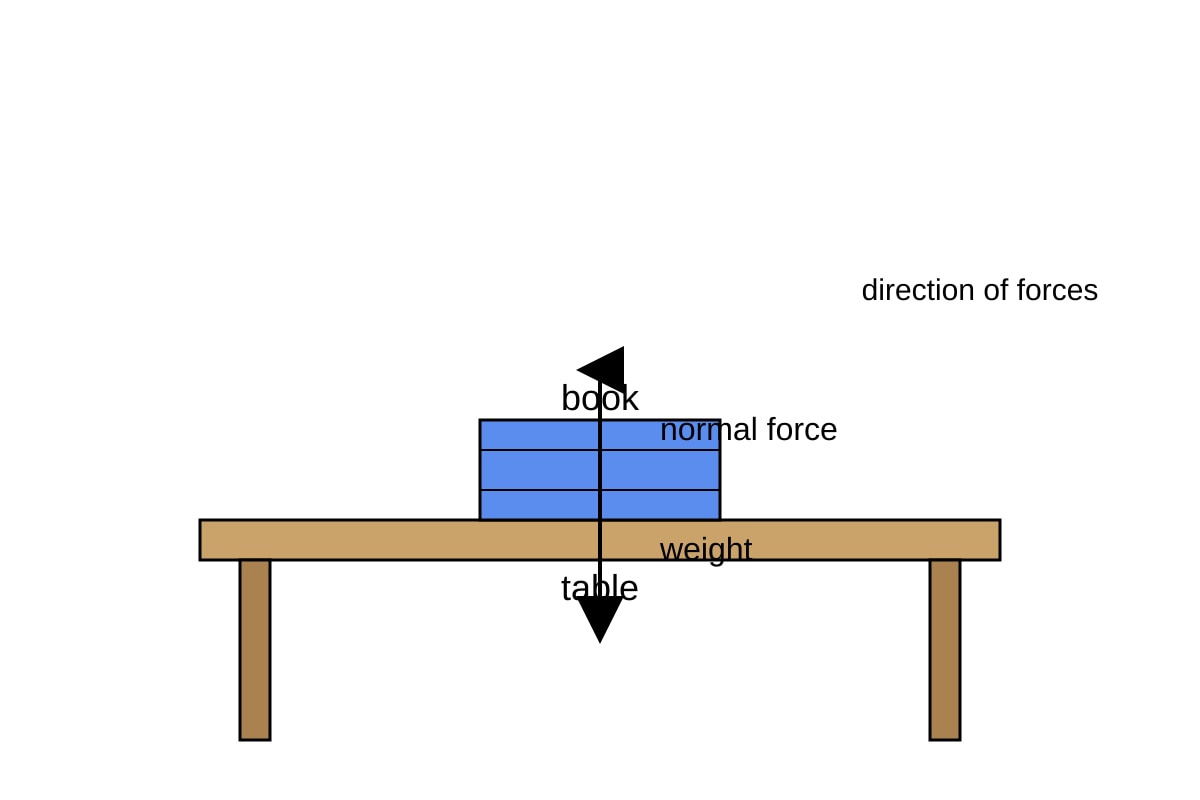
5.
Image pending generation: diagram for Q5.
On the diagram, draw and label the weight acting on the book. [2]
6. Name two renewable sources of energy. [2]
7. A circuit has two lamps connected one after another in a single loop. What type of circuit is this? [2]
8. Heat flows from a region of ______ temperature to a region of ______ temperature. [2]
9. A metal rod expands when heated. State one everyday application of expansion and contraction. [2]
10. An object has a density greater than water. Will it float or sink? [2]
Section B (30 marks)
Answer all questions. Each question carries 5 marks.
11. A student of mass 40 kg climbs from the ground floor to the 5th floor. Each floor is 3 m high. (a) State the principle of conservation of energy. [2] (b) Calculate the gain in gravitational potential energy. [3]
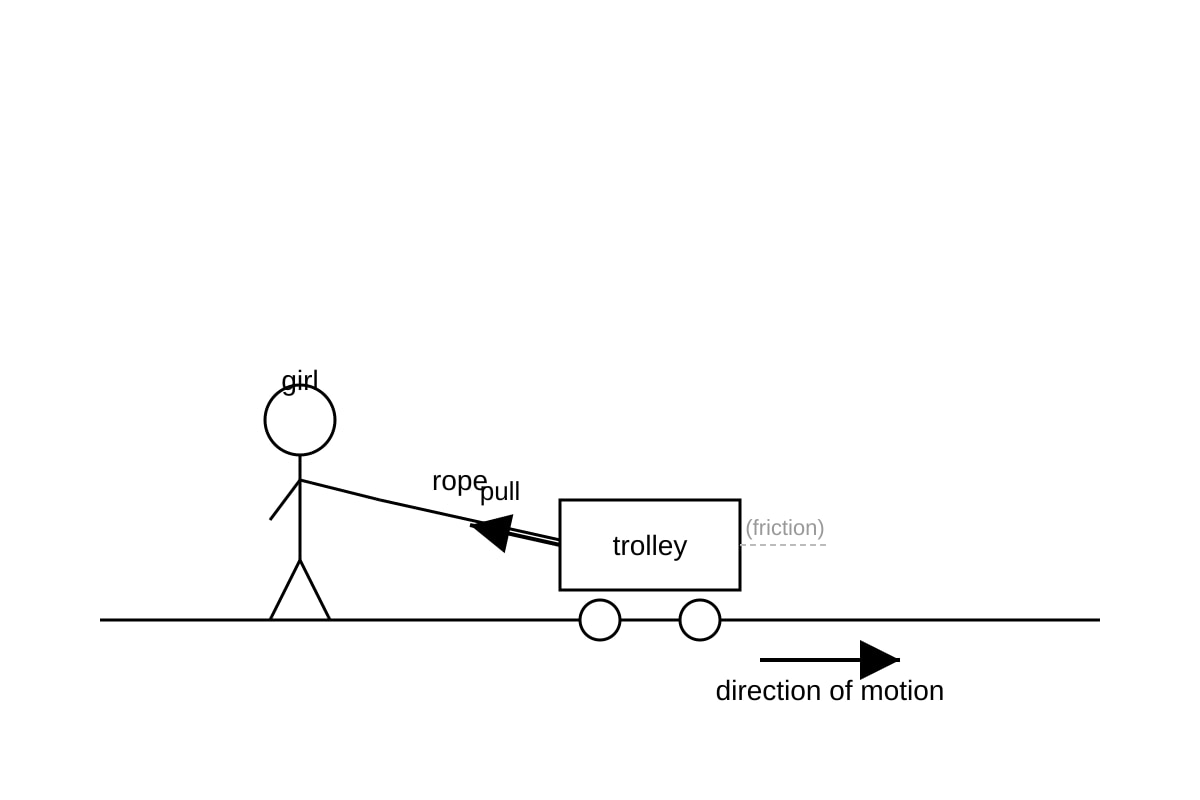
12.
Image pending generation: diagram for Q12.
Figure shows a girl pulling a trolley at constant speed. (a) Draw and label the friction force on the trolley. [1] (b) State the size of the friction force if the pull is 10 N. [1] (c) Explain your answer. [1] (d) Name one other force acting on the trolley and its direction. [2]
13. A lamp is connected to a 230 V supply and draws a current of 0.5 A. (a) Calculate the power of the lamp. [2] (b) If it is used for 4 hours, calculate the electrical energy consumed in kWh. [3]
14. A block of mass 1 kg is dropped from a height of 5 m. (a) Calculate its gravitational potential energy at the top. [2] (b) State the form of energy it has just before hitting the ground (ignoring air resistance). [1] (c) Calculate the speed just before impact using KE=21mv2. [2]
15. A learner connects three cells in series with a lamp. (a) State how the brightness changes compared to one cell. [1] (b) Draw a circuit diagram with a battery, switch, and lamp in series. [2] (c) State the function of a fuse. [2]
16. A substance is heated from 20∘C to 80∘C and gains 600 J of heat. (a) What does temperature measure? [1] (b) Calculate the heat capacity of the substance. [2] (c) Explain why heat and temperature are different. [2]
Section C (10 marks)
Answer all questions. Each question carries 5 marks.
17. A pendulum swings from its highest point A to the lowest point B. (a) State the energy conversion from A to B. [2] (b) Explain why the pendulum eventually stops, using the principle of conservation of energy. [3]
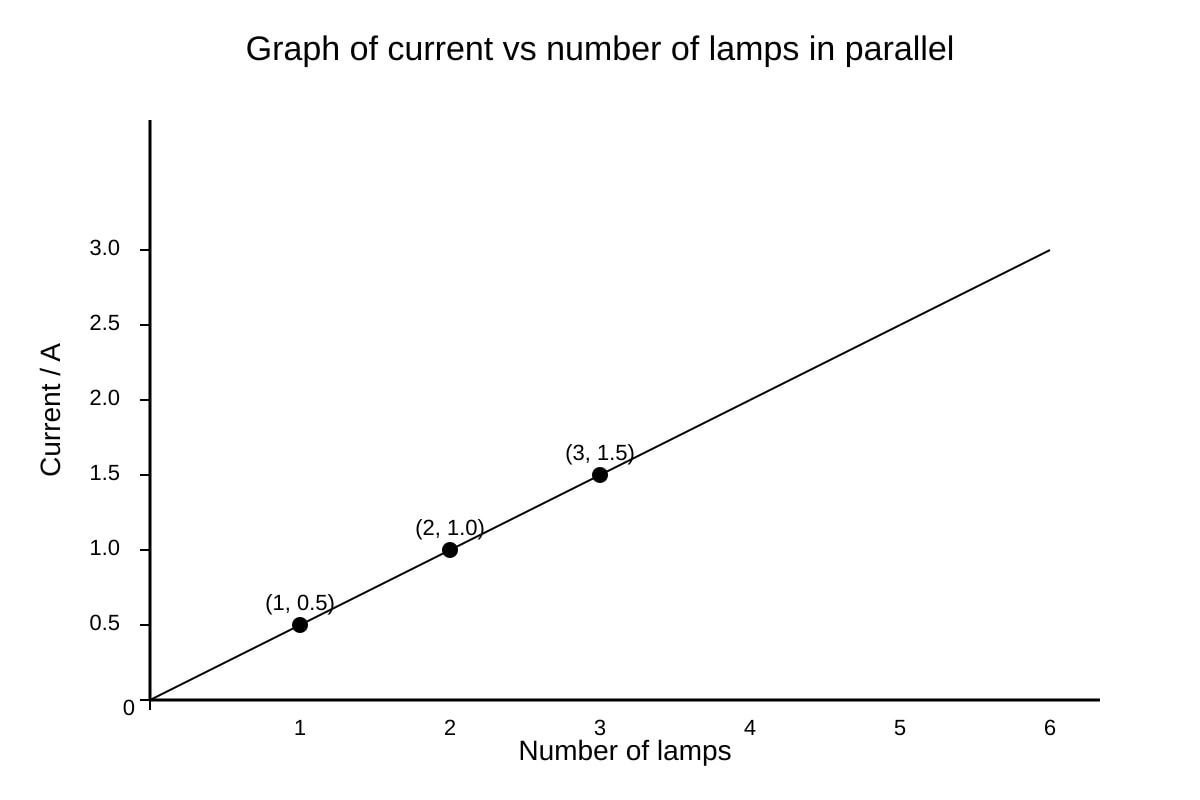
18.
Image pending generation: graph for Q18.
The graph shows current in a parallel circuit as lamps are added. (a) Describe the trend. [2] (b) Explain the trend using concepts of current and resistance. [3]
Answers
TuitionGoWhere Practice Paper - Science Secondary 2 (Version 5) Answer Key
Total Marks: 60
Section A (20 marks)
1. [2]
Gain in GPE = mgh=2×10×3=60 J.
Teaching note: GPE increases with height lifted. Use g=10 m/s2 as given. Common mistake: omitting unit J.
2. [2]
Energy cannot be created or destroyed; it can only be converted from one form to another (or total energy remains constant).
Marking: 1 mark for non-creation/destruction, 1 mark for conversion/constancy.
3. [2]
230 V. (2 marks for correct value; 1 mark if unit missing but value correct not applicable as blank fill – full 2 for "230")
4. [2]
Instrument: spring balance; Unit: newton (N). (1 mark each)
5. [2]
Arrow downward from book centre labelled "weight" (or "W").
Must match placeholder: downward arrow from book, labelled.
6. [2]
Any two: biomass, hydropower, sun, wind. (1 mark each)
7. [2]
Series circuit. (2 marks)
8. [2]
Higher; lower. (1 mark each)
9. [2]
Bimetallic strip in thermostat / buckling of railway tracks. (2 marks for one clear application)
10. [2]
Sink. (2 marks; because density > surrounding medium)
Section B (30 marks)
11. [5]
(a) [2] Energy cannot be created or destroyed, only converted (1+1).
(b) [3] Floors climbed = 5 (ground to 5th = 5 floors); height = 5×3=15 m; GPE = 40×10×15=6000 J (1 for height, 2 for calc with unit).
12. [5]
(a) [1] Arrow left from trolley labelled "friction".
(b) [1] 10 N.
(c) [1] Constant speed → balanced forces, friction = pull.
(d) [2] Weight (downward), normal/upward from ground (2 marks: name + direction).
13. [5]
(a) [2] P=IV=230×0.5=115 W.
(b) [3] E=Pt=0.115 kW×4 h=0.46 kWh (1 convert W→kW, 2 calc).
14. [5]
(a) [2] GPE=1×10×5=50 J.
(b) [1] Kinetic energy.
(c) [2] KE=50=21×1×v2⇒v2=100⇒v=10 m/s.
15. [5]
(a) [1] Brighter.
(b) [2] Correct series diagram: cells+battery symbol, switch, lamp in loop.
(c) [2] Melts/breaks circuit if current too high, protects wiring.
16. [5]
(a) [1] Degree of hotness.
(b) [2] C=Q/ΔT=600/(80−20)=10 J/∘C.
(c) [2] Heat is energy transferred; temperature is intensity of hotness.
Section C (10 marks)
17. [5]
(a) [2] Potential → kinetic.
(b) [3] Energy converted to sound/heat by air resistance/friction; total conserved but less mechanical (1 convert, 2 explain loss to surroundings).
18. [5]
(a) [2] Current increases linearly with lamps.
(b) [3] Each lamp adds path, total resistance drops, current rises (1 resistance, 2 current relation).
Free quiz and exam paper access
Enter your details to view this paper
Your access is remembered on this device.