AI Generated Exam Paper
Secondary 2 Science Practice Paper 3
Free AI-Generated NVIDIA Nemotron 3 Ultra 550B A55B Free Secondary 2 Science Practice Paper 3 practice paper with questions and answers for Singapore students. This page is rendered as a direct URL so the questions and answers can be discovered without pressing in-page buttons.
These static practice materials are generated from the site's syllabus and paper-generation workflow, with source and model context shown so students and parents can evaluate the material before use.
Questions
TuitionGoWhere Practice Paper - Science Secondary 2
TuitionGoWhere Practice Paper (AI) — Version 3
Subject: Science
Level: Secondary 2 (G3)
Paper: Practice Paper — Physical Sciences
Duration: 1 hour 30 minutes
Total Marks: 60
Name: ________________________
Class: ________________________
Date: ________________________
Instructions to Candidates
- Write your name, class, and date in the spaces provided above.
- Answer all questions.
- Write your answers in the spaces provided on the question paper.
- The number of marks is given in brackets [ ] at the end of each question or part question.
- The total mark for this paper is 60.
- You may use a calculator.
- Where appropriate, take the acceleration due to gravity, g, as 10 N/kg.
- Show all working for calculation questions.
Section A: Multiple Choice Questions [10 marks]
Answer all questions. For each question, choose the correct option (A, B, C, or D) and write the letter in the box provided.
1 A 2.0 kg ball is dropped from a height of 10 m above the ground. Ignoring air resistance, what is the kinetic energy of the ball just before it hits the ground?
[Take g = 10 N/kg]
☐ A 20 J
☐ B 100 J
☐ C 200 J
☐ D 400 J
[1]
2 Which of the following energy conversions takes place when a battery-powered torch is switched on?
☐ A Chemical energy → Electrical energy → Light energy + Heat energy
☐ B Electrical energy → Chemical energy → Light energy + Heat energy
☐ C Light energy → Electrical energy → Chemical energy + Heat energy
☐ D Heat energy → Electrical energy → Chemical energy + Light energy
[1]
3 A force of 25 N is used to push a box horizontally across a floor for a distance of 4.0 m. The work done by the force is:
☐ A 6.25 J
☐ B 29 J
☐ C 100 J
☐ D 400 J
[1]
4 A student runs up a flight of stairs of vertical height 3.0 m in 4.0 s. The student has a mass of 50 kg. What is the average power developed by the student against gravity?
[Take g = 10 N/kg]
☐ A 37.5 W
☐ B 150 W
☐ C 375 W
☐ D 1500 W
[1]
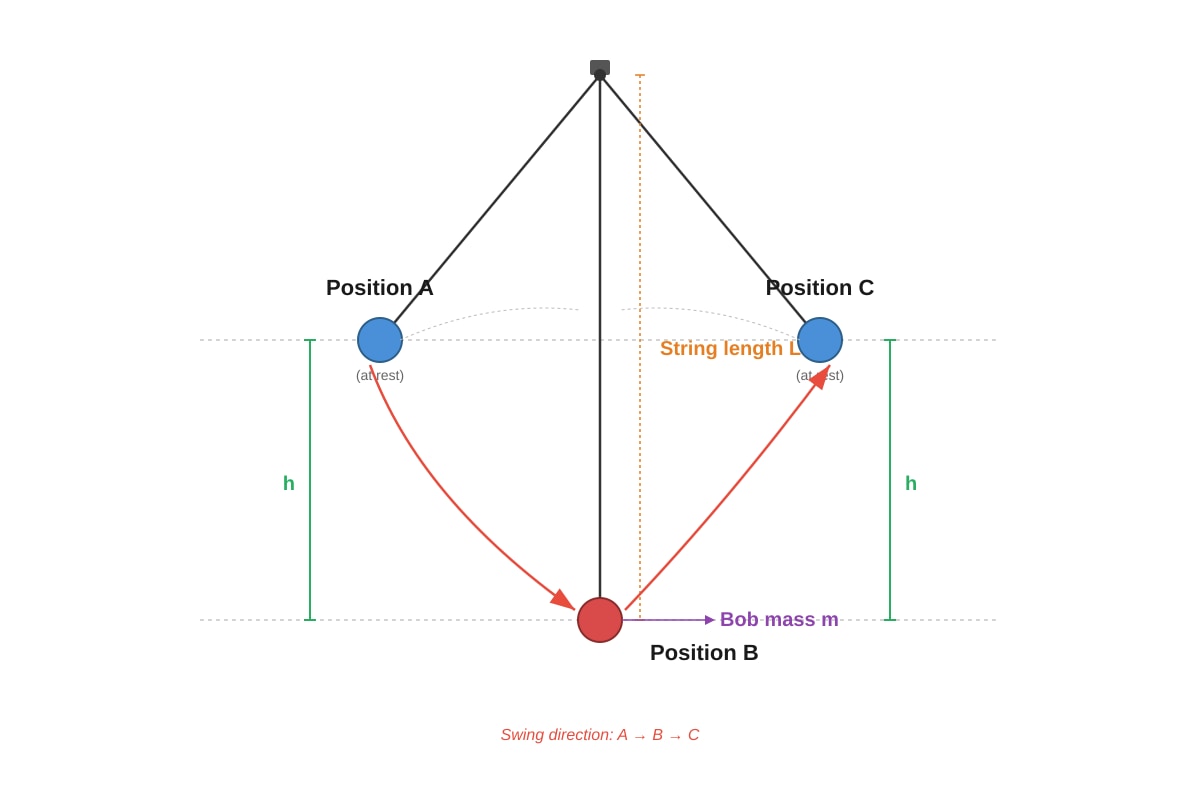
5 The diagram below shows a simple pendulum swinging from position P to Q to R.
<image_placeholder>
id: Q5-fig1
type: diagram
linked_question: Q5
description: Simple pendulum at three positions: P (highest left), Q (lowest centre), R (highest right). Label P, Q, R. Show vertical height h from Q to P/R. Indicate velocity direction at Q.
labels: P, Q, R, h, velocity arrow at Q
values: h = 0.20 m, length of string = 1.0 m
must_show: Three distinct positions, height difference labelled, velocity direction at lowest point
</image_placeholder>
At which position does the pendulum bob have the maximum kinetic energy?
☐ A P only
☐ B Q only
☐ C R only
☐ D P and R
[1]
6 A 0.5 kg toy car moves at a constant speed of 2.0 m/s on a horizontal track. The kinetic energy of the toy car is:
☐ A 0.5 J
☐ B 1.0 J
☐ C 2.0 J
☐ D 4.0 J
[1]
7 Which of the following statements about power is correct?
☐ A Power is the total amount of energy transferred.
☐ B Power is the rate of doing work.
☐ C Power is measured in joules.
☐ D Power increases when the time taken to do work increases.
[1]
8 A crane lifts a load of 800 N through a vertical height of 15 m in 20 s. The useful power output of the crane is:
☐ A 600 W
☐ B 1200 W
☐ C 6000 W
☐ D 12000 W
[1]
9 A block of mass 3.0 kg slides down a smooth inclined plane of length 5.0 m and vertical height 2.0 m. The gravitational potential energy lost by the block is:
[Take g = 10 N/kg]
☐ A 30 J
☐ B 60 J
☐ C 150 J
☐ D 300 J
[1]
10 In a hydroelectric power station, water stored in a high reservoir flows down to turn turbines. The main energy conversion is:
☐ A Kinetic energy → Electrical energy
☐ B Gravitational potential energy → Kinetic energy → Electrical energy
☐ C Chemical energy → Electrical energy
☐ D Heat energy → Kinetic energy → Electrical energy
[1]
Section B: Structured Questions [30 marks]
Answer all questions in the spaces provided.
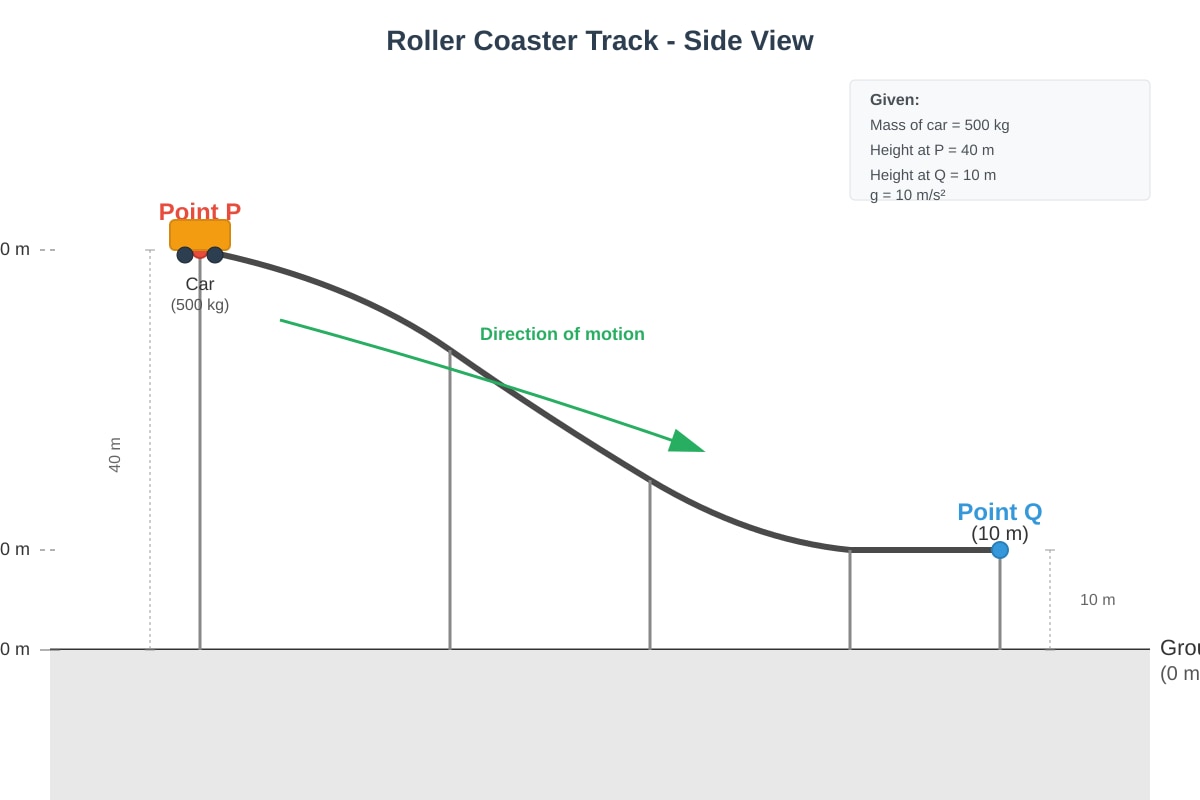
11 A roller coaster car of mass 500 kg is at rest at the top of a hill (Point A) which is 40 m above the ground. The car then rolls down the track to Point B, which is 10 m above the ground. Assume negligible friction and air resistance.
[Take g = 10 N/kg]
<image_placeholder> id: Q11-fig1 type: diagram linked_question: Q11 description: Roller coaster track side view showing Point A at height 40 m, Point B at height 10 m, and ground level. Car shown at Point A. labels: Point A, Point B, ground, height 40 m, height 10 m values: h_A = 40 m, h_B = 10 m, mass = 500 kg must_show: Two distinct heights labelled, car at starting position, ground reference </image_placeholder>
(a) State the principle of conservation of energy.
[2]
(b) Calculate the gravitational potential energy of the car at Point A.
[2]
(c) Calculate the kinetic energy of the car at Point B.
[2]
(d) Determine the speed of the car at Point B.
[2]
12 A student pulls a sled of mass 15 kg across horizontal snow using a constant horizontal force of 60 N. The sled moves a distance of 12 m. The frictional force between the sled and snow is 20 N.
(a) Calculate the work done by the student on the sled.
[2]
(b) Calculate the work done against friction.
[2]
(c) Calculate the net work done on the sled.
[2]
(d) Using the work-energy principle, determine the increase in kinetic energy of the sled.
[1]
(e) If the sled started from rest, calculate its final speed.
[2]
13 An electric kettle rated at 2.2 kW is used to heat 1.5 kg of water from 25°C to 100°C. The specific heat capacity of water is 4200 J/(kg·°C).
(a) Calculate the thermal energy required to heat the water.
[2]
(b) Calculate the minimum time required for the kettle to heat the water, assuming all electrical energy is converted to thermal energy in the water.
[2]
(c) In practice, the kettle takes longer than the calculated time. State two reasons for this.
[2]
14 A 0.2 kg stone is thrown vertically upwards with an initial speed of 20 m/s. Ignore air resistance.
[Take g = 10 N/kg]
(a) Calculate the initial kinetic energy of the stone.
[2]
(b) State the maximum gravitational potential energy gained by the stone.
[1]
(c) Calculate the maximum height reached by the stone.
[2]
(d) On the axes below, sketch a graph of kinetic energy against height for the stone from launch to maximum height. Label the axes with appropriate quantities and units.
[2]
<image_placeholder> id: Q14-fig1 type: graph linked_question: Q14 description: Blank axes for sketching kinetic energy vs height graph. x-axis: height (m), y-axis: kinetic energy (J). Origin at (0,0). labels: Height (m) on x-axis, Kinetic Energy (J) on y-axis values: Max height = 20 m, Max KE = 40 J must_show: Linear decrease from (0, 40) to (20, 0), axes labelled with units </image_placeholder>
15 A weightlifter lifts a 120 kg barbell from the floor to a height of 2.0 m above his head in 1.5 s. He holds it there for 3.0 s, then lowers it back to the floor in 1.5 s.
[Take g = 10 N/kg]
(a) Calculate the work done by the weightlifter in lifting the barbell.
[2]
(b) Calculate the average power developed during the lifting phase.
[2]
(c) State the work done by the weightlifter while holding the barbell stationary. Explain your answer.
[2]
(d) When lowering the barbell, the weightlifter exerts an upward force. Is the work done by the weightlifter positive, negative, or zero? Explain.
[2]
Section C: Longer Structured and Data-Based Questions [20 marks]
Answer all questions in the spaces provided.
16 A group of students investigates the energy conversion of a bouncing ball. They drop a tennis ball of mass 0.06 kg from a height of 1.5 m onto a hard floor. The ball rebounds to a height of 0.9 m.
[Take g = 10 N/kg]
<image_placeholder> id: Q16-fig1 type: diagram linked_question: Q16 description: Tennis ball dropped from 1.5 m, rebounding to 0.9 m. Show initial drop height, rebound height, and floor. labels: Initial height 1.5 m, Rebound height 0.9 m, Floor values: h_initial = 1.5 m, h_rebound = 0.9 m, mass = 0.06 kg must_show: Two distinct heights, ball at top and rebound positions, floor line </image_placeholder>
(a) Calculate the gravitational potential energy of the ball at the initial drop height.
[2]
(b) Calculate the speed of the ball just before it hits the floor.
[2]
(c) Calculate the gravitational potential energy of the ball at the maximum rebound height.
[2]
(d) Calculate the percentage of the initial gravitational potential energy that is not recovered after the bounce.
[2]
(e) Explain what happens to the energy that is not recovered.
[2]
17 The table below shows the power ratings and typical daily usage times for several electrical appliances in a household.
| Appliance | Power Rating (W) | Daily Usage Time (hours) |
|---|---|---|
| Refrigerator | 150 | 24 |
| Air Conditioner | 1500 | 6 |
| Washing Machine | 500 | 1 |
| LED Television | 80 | 4 |
| Electric Kettle | 2000 | 0.25 |
(a) Calculate the energy consumed by the air conditioner in one day, in kWh.
[2]
(b) Calculate the total energy consumed by all five appliances in one day, in kWh.
[2]
(c) If electricity costs $0.28 per kWh, calculate the cost of running these appliances for 30 days.
[2]
(d) The household wants to reduce their electricity bill. Suggest two practical changes they could make, based on the data in the table.
[2]
18 A hydroelectric dam stores water in a reservoir at an average height of 80 m above the turbines. Water flows through the turbines at a rate of 500 kg/s. The overall efficiency of the energy conversion (gravitational potential energy → electrical energy) is 85%.
[Take g = 10 N/kg]
(a) Calculate the gravitational potential energy lost by the water per second.
[2]
(b) Calculate the electrical power output of the hydroelectric station.
[2]
(c) State two forms in which the remaining 15% of the energy is dissipated.
[2]
(d) During a dry season, the water level in the reservoir drops by 20 m. Explain how this affects the power output, assuming the flow rate remains constant.
[2]
19 A 400 kg roller coaster car starts from rest at the top of a hill (Point X) and travels along a frictionless track. It goes through a vertical circular loop of radius 10 m. The top of the loop (Point Y) is 20 m above the ground. Point X is 50 m above the ground.
[Take g = 10 N/kg]
<image_placeholder> id: Q19-fig1 type: diagram linked_question: Q19 description: Roller coaster track with starting hill at 50 m (Point X), vertical loop of radius 10 m, top of loop at 20 m (Point Y). Car shown at Point X. labels: Point X, Point Y, Ground, Radius 10 m values: h_X = 50 m, h_Y = 20 m, radius = 10 m, mass = 400 kg must_show: Starting hill, vertical loop with radius labelled, heights of X and Y above ground </image_placeholder>
(a) Calculate the speed of the car at Point Y (top of the loop).
[3]
(b) Calculate the centripetal force required to keep the car moving in a circle at Point Y.
[2]
(c) The normal reaction force from the track on the car at Point Y is 8000 N. Determine whether the car maintains contact with the track at Point Y. Explain your reasoning.
[3]
20 A student sets up an experiment to investigate the relationship between the height of a ramp and the speed of a trolley at the bottom. The trolley of mass 0.5 kg is released from rest at various heights. The student measures the time taken for the trolley to travel 1.0 m along the horizontal bench after leaving the ramp.
The results are shown below.
| Height of ramp h (cm) | Time for 1.0 m on bench t (s) | Speed on bench v (m/s) |
|---|---|---|
| 10 | 1.25 | 0.80 |
| 20 | 0.88 | 1.14 |
| 30 | 0.72 | 1.39 |
| 40 | 0.62 | 1.61 |
| 50 | 0.56 | 1.79 |
(a) Complete the table by calculating the speed v for h = 30 cm. (The values for other heights have been calculated for you.)
[1]
(b) On the grid below, plot a graph of speed v (y-axis) against height h (x-axis). Draw a smooth curve of best fit.
[3]
<image_placeholder> id: Q20-fig1 type: graph linked_question: Q20 description: Graph paper grid for plotting speed vs height. x-axis: Height h (cm), range 0-50. y-axis: Speed v (m/s), range 0-2.0. Points at (10,0.80), (20,1.14), (30,1.39), (40,1.61), (50,1.79). labels: Height h (cm) on x-axis, Speed v (m/s) on y-axis values: Points as per table must_show: Grid with labelled axes, 5 data points plotted, smooth curve through points </image_placeholder>
(c) Use your graph to estimate the speed of the trolley when the ramp height is 25 cm.
[1]
(d) The student suggests that the speed v is directly proportional to the height h. Use your graph to explain whether this suggestion is correct.
[2]
(e) Assuming no energy losses, calculate the theoretical speed of the trolley at the bottom of the ramp for h = 40 cm. Compare this with the experimental value and suggest a reason for any difference.
[3]
End of Paper
Answers
TuitionGoWhere Practice Paper - Science Secondary 2 (Answer Key)
Subject: Science
Level: Secondary 2 (G3)
Paper: Practice Paper — Physical Sciences (Version 3)
Total Marks: 60
Section A: Multiple Choice Questions [10 marks]
1 C — 200 J
Working:
GPE at top = mgh = 2.0 × 10 × 10 = 200 J
By conservation of energy, KE at bottom = GPE lost = 200 J
2 A — Chemical energy → Electrical energy → Light energy + Heat energy
Reasoning: A battery stores chemical energy, which is converted to electrical energy in the circuit. The electrical energy is then converted to light and heat in the bulb filament.
3 C — 100 J
Working:
Work done = Force × Distance = 25 N × 4.0 m = 100 J
4 C — 375 W
Working:
Work done against gravity = mgh = 50 × 10 × 3.0 = 1500 J
Power = Work / Time = 1500 J / 4.0 s = 375 W
5 B — Q only
Reasoning: At the lowest point (Q), gravitational potential energy is minimum, so kinetic energy is maximum (by conservation of energy). At P and R, the bob is momentarily at rest (KE = 0).
6 B — 1.0 J
Working:
KE = ½mv² = ½ × 0.5 × (2.0)² = 0.25 × 4.0 = 1.0 J
7 B — Power is the rate of doing work.
Reasoning: Power = Work / Time. Unit is watt (W) = J/s. Not total energy (A), not joules (C), and power decreases when time increases for same work (D).
8 A — 600 W
Working:
Work done = Force × Distance = 800 N × 15 m = 12 000 J
Power = Work / Time = 12 000 J / 20 s = 600 W
9 B — 60 J
Working:
GPE lost = mgh = 3.0 × 10 × 2.0 = 60 J
(Note: length of incline 5.0 m is not needed; only vertical height matters for GPE.)
10 B — Gravitational potential energy → Kinetic energy → Electrical energy
Reasoning: Water at height has GPE. As it falls, GPE → KE. Turbines convert KE of water → electrical energy via generators.
Section B: Structured Questions [30 marks]
Question 11 [8 marks]
(a) [2 marks]
Answer:
- Energy cannot be created or destroyed. [1]
- It can only be converted from one form to another / The total amount of energy in a closed system remains constant. [1]
Marking note: Both points required for full marks. "Energy is conserved" alone is insufficient.
(b) [2 marks]
Working:
GPE = mgh = 500 × 10 × 40 = 200 000 J (or 200 kJ) [2]
- 1 mark for correct formula/substitution
- 1 mark for correct answer with unit
(c) [2 marks]
Working:
GPE at B = mgh = 500 × 10 × 10 = 50 000 J
Loss in GPE = 200 000 − 50 000 = 150 000 J
By conservation of energy, KE at B = Loss in GPE = 150 000 J [2]
- 1 mark for correct GPE at B or loss in GPE
- 1 mark for correct KE with unit
(d) [2 marks]
Working:
KE = ½mv²
150 000 = ½ × 500 × v²
v² = 300 000 / 500 = 600
v = √600 = 24.5 m/s (or 10√6 m/s) [2]
- 1 mark for correct rearrangement/substitution
- 1 mark for correct answer with unit
Question 12 [9 marks]
(a) [2 marks]
Working:
Work done by student = Force × Distance = 60 × 12 = 720 J [2]
(b) [2 marks]
Working:
Work done against friction = Frictional force × Distance = 20 × 12 = 240 J [2]
(c) [2 marks]
Working:
Net work = Work by student − Work against friction = 720 − 240 = 480 J [2]
Alternative: Net force = 60 − 20 = 40 N; Net work = 40 × 12 = 480 J
(d) [1 mark]
Answer: Increase in KE = Net work done = 480 J [1]
Reasoning: Work-energy principle states net work done on an object = change in its kinetic energy.
(e) [2 marks]
Working:
KE = ½mv²
480 = ½ × 15 × v²
v² = 960 / 15 = 64
v = 8.0 m/s [2]
- 1 mark for correct substitution
- 1 mark for correct answer with unit
Question 13 [6 marks]
(a) [2 marks]
Working:
Q = mcΔθ = 1.5 × 4200 × (100 − 25) = 1.5 × 4200 × 75 = 472 500 J [2]
- 1 mark for correct substitution
- 1 mark for correct answer with unit
(b) [2 marks]
Working:
Power = 2.2 kW = 2200 W
Time = Energy / Power = 472 500 / 2200 = 214.8 s (or 3 min 35 s) [2]
- 1 mark for correct formula/substitution
- 1 mark for correct answer with unit
(c) [2 marks]
Any two valid reasons, e.g.:
- Some thermal energy is lost to the surroundings / kettle body / air. [1]
- Some energy is used to heat the kettle itself (not just the water). [1]
- The kettle may not operate at exactly its rated power. [1]
- Evaporation of water carries away latent heat. [1]
Question 14 [7 marks]
(a) [2 marks]
Working:
KE = ½mv² = ½ × 0.2 × (20)² = 0.1 × 400 = 40 J [2]
(b) [1 mark]
Answer: 40 J [1]
Reasoning: By conservation of energy, maximum GPE gained = initial KE (ignoring air resistance).
(c) [2 marks]
Working:
GPE = mgh
40 = 0.2 × 10 × h
h = 40 / 2 = 20 m [2]
(d) [2 marks]
Graph description for marking:
- Axes labelled: x-axis "Height (m)", y-axis "Kinetic Energy (J)" [1]
- Straight line from (0, 40) to (20, 0) with negative gradient [1]
- Note: KE decreases linearly with height because GPE = mgh increases linearly, and KE + GPE = constant.
Question 15 [8 marks]
(a) [2 marks]
Working:
Work done = Force × Distance = mg × h = 120 × 10 × 2.0 = 2400 J [2]
(b) [2 marks]
Working:
Power = Work / Time = 2400 / 1.5 = 1600 W [2]
(c) [2 marks]
Answer: 0 J [1]
Explanation: Work done = Force × Distance moved in direction of force. While holding, the displacement is zero, so no work is done. [1]
Common mistake: Students may calculate mg × h again. Emphasise: no movement = no work.
(d) [2 marks]
Answer: Negative [1]
Explanation: The weightlifter exerts an upward force, but the displacement is downward. Force and displacement are in opposite directions, so work done is negative. [1]
Alternative: The weightlifter is removing energy from the barbell (lowering it), doing negative work.
Section C: Longer Structured and Data-Based Questions [20 marks]
Question 16 [10 marks]
(a) [2 marks]
Working:
GPE = mgh = 0.06 × 10 × 1.5 = 0.9 J [2]
(b) [2 marks]
Working:
KE just before impact = Initial GPE = 0.9 J
½mv² = 0.9
½ × 0.06 × v² = 0.9
v² = 1.8 / 0.06 = 30
v = √30 ≈ 5.48 m/s [2]
(c) [2 marks]
Working:
GPE at rebound = mgh = 0.06 × 10 × 0.9 = 0.54 J [2]
(d) [2 marks]
Working:
Energy not recovered = 0.9 − 0.54 = 0.36 J
Percentage = (0.36 / 0.9) × 100% = 40% [2]
(e) [2 marks]
Answer: The energy is dissipated as:
- Heat (due to inelastic deformation of ball and floor, and air resistance) [1]
- Sound (the "bounce" noise) [1]
Accept: Thermal energy, sound energy. Not "lost" — energy is conserved but transferred to non-useful forms.
Question 17 [8 marks]
(a) [2 marks]
Working:
Energy = Power × Time = 1500 W × 6 h = 9000 Wh = 9.0 kWh [2]
- 1 mark for correct calculation in Wh
- 1 mark for conversion to kWh
(b) [2 marks]
Working:
Refrigerator: 150 × 24 = 3600 Wh = 3.6 kWh
Air Conditioner: 1500 × 6 = 9000 Wh = 9.0 kWh
Washing Machine: 500 × 1 = 500 Wh = 0.5 kWh
LED TV: 80 × 4 = 320 Wh = 0.32 kWh
Electric Kettle: 2000 × 0.25 = 500 Wh = 0.5 kWh
Total = 3.6 + 9.0 + 0.5 + 0.32 + 0.5 = 13.92 kWh [2]
- 1 mark for correct individual calculations
- 1 mark for correct total
(c) [2 marks]
Working:
Daily cost = 13.92 × 3.8976
30-day cost = 116.93** (or $116.93) [2]
- 1 mark for daily cost
- 1 mark for 30-day total
(d) [2 marks]
Any two practical suggestions, e.g.:
- Reduce air conditioner usage time (highest energy consumer) / set temperature higher / use fans instead. [1]
- Use the refrigerator more efficiently (e.g., don't leave door open, ensure good seals) since it runs 24 h. [1]
- Boil only the water needed in the kettle (high power, though short time). [1]
- Replace older appliances with more energy-efficient models. [1]
Question 18 [8 marks]
(a) [2 marks]
Working:
Mass per second = 500 kg
GPE lost per second = mgh = 500 × 10 × 80 = 400 000 J/s (or 400 kW) [2]
(b) [2 marks]
Working:
Electrical power output = Efficiency × Input power = 0.85 × 400 000 = 340 000 W (or 340 kW) [2]
(c) [2 marks]
Any two valid forms, e.g.:
- Heat (due to friction in turbines, generators, and water turbulence) [1]
- Sound (noise from flowing water and machinery) [1]
- Kinetic energy of water leaving the turbines (not fully converted) [1]
(d) [2 marks]
Answer: The power output decreases. [1]
Explanation: GPE lost per second = mgΔh. If the water level drops by 20 m, the effective height Δh decreases from 80 m to 60 m. Since flow rate (mass per second) is constant, the input power is proportional to height. New input power = 500 × 10 × 60 = 300 kW. Output power = 0.85 × 300 = 255 kW (lower than 340 kW). [1]
Question 19 [8 marks]
(a) [3 marks]
Working:
Loss in GPE from X to Y = mg(h_X − h_Y) = 400 × 10 × (50 − 20) = 400 × 10 × 30 = 120 000 J
This equals KE at Y (conservation of energy, frictionless track).
KE = ½mv² = 120 000
½ × 400 × v² = 120 000
v² = 240 000 / 400 = 600
v = √600 ≈ 24.5 m/s [3]
- 1 mark for correct GPE loss
- 1 mark for equating to KE
- 1 mark for correct v with unit
(b) [2 marks]
Working:
Centripetal force F_c = mv² / r = 400 × 600 / 10 = 24 000 N [2]
- 1 mark for correct formula/substitution
- 1 mark for correct answer with unit
(c) [3 marks]
Working:
At top of loop, forces on car: Weight (mg = 4000 N) downward + Normal reaction (N = 8000 N) downward.
Net downward force = mg + N = 4000 + 8000 = 12 000 N
Required centripetal force = 24 000 N (from part b)
Since 12 000 N < 24 000 N, the net force is insufficient to provide the required centripetal force.
Conclusion: The car loses contact with the track. [3]
- 1 mark for identifying forces and net force
- 1 mark for comparison with required centripetal force
- 1 mark for correct conclusion with reasoning
Alternative reasoning: Minimum centripetal force needed at top is mg = 4000 N for contact. Here required is 24 000 N > 4000 N, so normal force would need to be 20 000 N, but it's only 8000 N → loses contact.
Question 20 [10 marks]
(a) [1 mark]
Answer: 1.39 m/s (already given in table)
Working check: v = distance / time = 1.0 / 0.72 = 1.388... ≈ 1.39 m/s
(b) [3 marks]
Graph marking points:
- Axes correctly labelled with units: x-axis "Height h (cm)", y-axis "Speed v (m/s)" [1]
- Appropriate scales covering data range (0–50 cm, 0–2.0 m/s) [1]
- All 5 points plotted accurately [1]
- Smooth curve of best fit (curved, not straight line) [1]
Note: Total 3 marks — typically 1 for axes/scales, 1 for points, 1 for curve. Adjust as per school marking scheme.
(c) [1 mark]
Answer: From graph, at h = 25 cm, v ≈ 1.27 m/s (accept 1.25–1.30 m/s) [1]
(d) [2 marks]
Answer: The suggestion is incorrect. [1]
Explanation: The graph is a curve, not a straight line through the origin. Speed increases with height but at a decreasing rate (gradient decreases). For direct proportion, the graph would be a straight line through the origin. [1]
Theory: v = √(2gh) → v ∝ √h, not v ∝ h.
(e) [3 marks]
Working:
Theoretical speed (no losses): v = √(2gh)
h = 40 cm = 0.40 m
v = √(2 × 10 × 0.40) = √8 = 2.83 m/s [2]
Comparison: Experimental value = 1.61 m/s (from table). Theoretical (2.83 m/s) > Experimental (1.61 m/s). [1]
Reason for difference: Energy losses due to friction between trolley and ramp/bench, and air resistance. Some GPE is converted to heat and sound, not just KE. [1]
End of Answer Key