AI Generated Exam Paper
Secondary 2 Science Practice Paper 3
Free AI-Generated Secondary 2 Science Practice Paper 3 practice paper with questions and answers for Singapore students. This page is rendered as a direct URL so the questions and answers can be discovered without pressing in-page buttons.
These static practice materials are generated from the site's syllabus and paper-generation workflow, with source and model context shown so students and parents can evaluate the material before use.
Questions
TuitionGoWhere Practice Paper - Science Secondary 2
TuitionGoWhere Practice Paper (AI)
Subject: Science
Level: Secondary 2
Paper: Physical Sciences Practice Paper (Version 3)
Duration: 1 hour 30 minutes
Total Marks: 80
Name: ________________________
Class: ________________________
Date: ________________________
Instructions
- This paper consists of Section A (Multiple Choice), Section B (Structured Questions), and Section C (Extended Response).
- Answer all questions.
- Write your answers in the spaces provided.
- Show all working for calculations.
- The number of marks for each question or part question is given in brackets [ ].
Section A: Multiple Choice Questions [20 marks]
Instructions: For each question, choose the best answer and write the letter in the box provided.
1. Which statement best describes the principle of conservation of energy? A. Energy can be created but not destroyed B. Energy cannot be created or destroyed, only converted from one form to another C. Energy is always lost during conversions D. Energy can only exist as kinetic or potential energy
Answer: [ ]
2. A book of mass 2 kg is lifted from the ground to a shelf 1.5 m high. The gain in gravitational potential energy is: A. 3 J B. 15 J C. 30 J D. 300 J
Answer: [ ]
3. When copper metal is heated strongly in air, it turns black. This is an example of: A. A physical change because the copper changes color B. A chemical change because a new substance is formed C. A physical change because no new substance is formed D. A chemical change because heat is involved
Answer: [ ]
4. Universal Indicator turns red in a solution with pH 2. This indicates the solution is: A. Strongly alkaline B. Weakly alkaline C. Neutral D. Strongly acidic
Answer: [ ]
5. Which separation technique would be most suitable for separating salt from sand? A. Filtration only B. Evaporation only C. Dissolving in water, then filtration, then evaporation D. Magnetic separation
Answer: [ ]
Section B: Structured Questions [45 marks]
6. A student climbs from the ground floor to the 3rd floor of a building. Each floor is 4 m high.
(a) Calculate the total height climbed by the student. [1]
Height = _________________ m
(b) If the student has a mass of 50 kg, calculate the gain in gravitational potential energy. [2]
GPE = mgh = _________________ J
(c) State the principle of conservation of energy. [2]
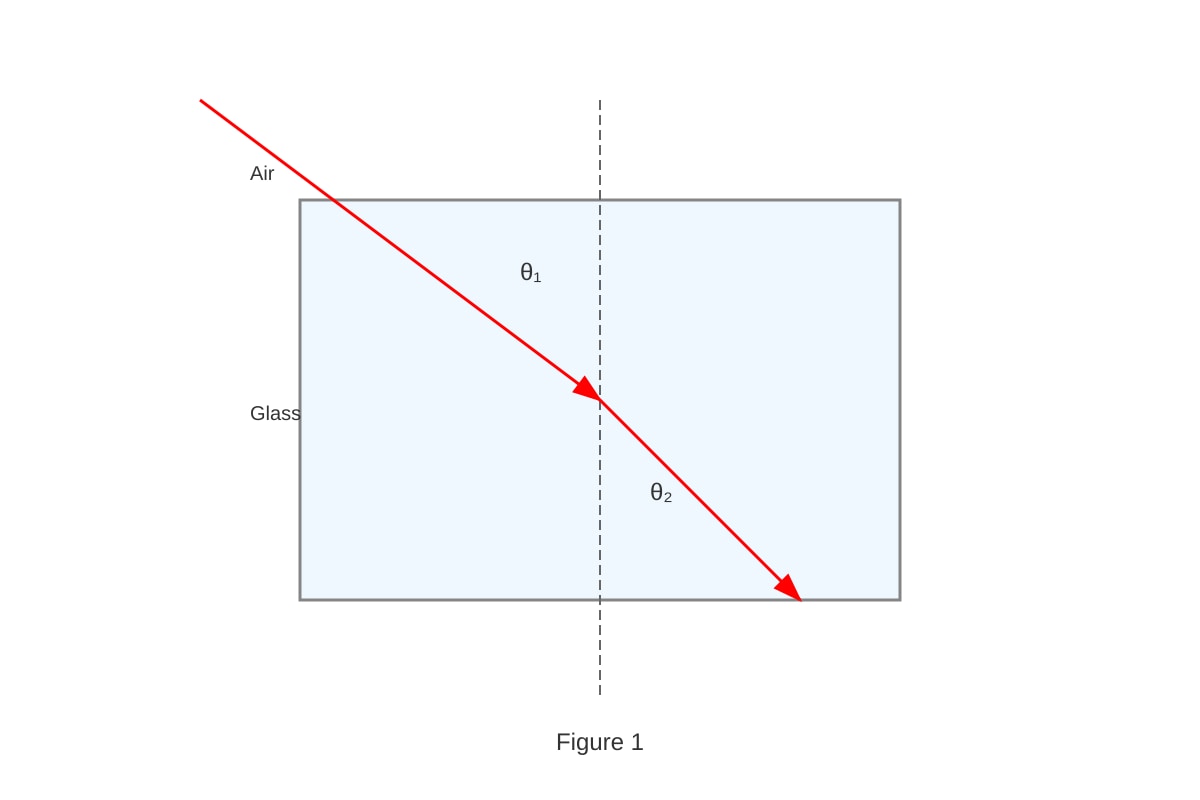
7. Figure 1 shows a light ray entering a glass block.
[Diagram shows a light ray hitting the surface of a rectangular glass block at an angle]
(a) Complete the ray diagram to show the path of light through and out of the glass block. [3]
(b) Name the phenomenon that occurs when light enters the glass block. [1]
(c) Explain why the light ray bends when it enters the glass. [2]
8. A student investigates the reaction between magnesium and different acids. The results are shown in the table below.
| Acid | Product formed | Time for reaction |
|---|---|---|
| P | Magnesium chloride | 30 seconds |
| Q | Magnesium sulfate | 45 seconds |
| R | Magnesium ethanoate | 5 minutes |
(a) Identify acid P and justify your answer. [2]
Acid P: _________________________________________________________________
Justification: _________________________________________________________________
(b) Which acid reacts fastest with magnesium? Give a reason for your answer. [2]
Fastest acid: _________________________________________________________________
Reason: _________________________________________________________________
(c) Write a balanced chemical equation for the reaction between magnesium and acid P. [2]
9. Figure 2 shows an electrical circuit.
[Diagram shows a circuit with a 12V battery, a 6Ω resistor, and an ammeter]
(a) Calculate the current flowing through the circuit. [2]
Current = _________________ A
(b) Calculate the power dissipated by the resistor. [2]
Power = _________________ W
(c) If the circuit operates for 3 hours, calculate the energy consumed. [2]
Energy = _________________ J
10. A mixture contains iron filings, salt, and sand.
(a) Describe a method to separate this mixture into its three pure components. Include the order of separation techniques and justify each choice. [6]
Step 1: _________________________________________________________________
Justification: _________________________________________________________________
Step 2: _________________________________________________________________
Justification: _________________________________________________________________
Step 3: _________________________________________________________________
Justification: _________________________________________________________________
(b) State one safety precaution that should be taken during this separation. [1]
Section C: Extended Response [15 marks]
11. A student wants to investigate how the temperature of water affects the rate at which sugar dissolves.
(a) Design an experiment to investigate this. Your answer should include:
- The independent variable [1]
- The dependent variable [1]
- Two controlled variables [2]
- A method to measure the dependent variable [2]
Independent variable: _________________________________________________________________
Dependent variable: _________________________________________________________________
Controlled variables:
Method to measure dependent variable: _________________________________________________________________
(b) Predict the relationship between temperature and dissolving rate. Explain your prediction using the particle model. [4]
Prediction: _________________________________________________________________
Explanation: _________________________________________________________________
(c) Suggest two ways to make the results of this investigation more reliable. [2]
(d) State one limitation of this investigation and suggest how it could be improved. [3]
Limitation: _________________________________________________________________
Improvement: _________________________________________________________________
END OF PAPER
Answers
TuitionGoWhere Practice Paper - Science Secondary 2 (Answer Key)
TuitionGoWhere Practice Paper (AI) - Version 3
Subject: Science
Level: Secondary 2
Paper: Physical Sciences Practice Paper
Total Marks: 80
Section A: Multiple Choice Questions [20 marks]
1. B - Energy cannot be created or destroyed, only converted from one form to another This is the correct statement of the conservation of energy principle.
2. C - 30 J GPE = mgh = 2 × 10 × 1.5 = 30 J
3. B - A chemical change because a new substance is formed The black color indicates copper oxide formation, which is a new substance.
4. D - Strongly acidic pH 2 is well below 7, indicating a strongly acidic solution. Universal Indicator is red at this pH.
5. C - Dissolving in water, then filtration, then evaporation Salt dissolves in water while sand doesn't. Filter to separate sand, then evaporate to recover salt.
Section B: Structured Questions [45 marks]
6. Student climbing building
(a) Height = 12 m [1] 3 floors × 4 m per floor = 12 m
(b) GPE = mgh = 6000 J [2] GPE = 50 × 10 × 12 = 6000 J Award 1 mark for correct formula, 1 mark for correct answer with units
(c) Energy cannot be created or destroyed [1], only converted from one form to another [1] Both components needed for full marks
7. Light ray and glass block
(a) Ray diagram [3]
- Ray bends toward normal when entering glass [1]
- Ray travels straight through glass [1]
- Ray bends away from normal when exiting glass [1]
(b) Refraction [1]
(c) Light slows down when entering the denser medium (glass) [1], causing the ray to bend toward the normal [1] Accept: change in speed causes bending
8. Acid reactions with magnesium
(a) Acid P: Hydrochloric acid [1] Justification: Magnesium chloride contains chloride ions, which come from hydrochloric acid [1]
(b) Fastest acid: P (hydrochloric acid) [1] Reason: It has the shortest reaction time (30 seconds) [1]
(c) Mg + 2HCl → MgCl₂ + H₂ [2] Award 1 mark for correct reactants and products, 1 mark for balancing
9. Electrical circuit calculations
(a) Current = 2 A [2] I = V/R = 12/6 = 2 A Award 1 mark for correct formula, 1 mark for correct answer
(b) Power = 24 W [2] P = VI = 12 × 2 = 24 W or P = V²/R = 144/6 = 24 W Award 1 mark for correct formula, 1 mark for correct answer
(c) Energy = 259,200 J [2] E = Pt = 24 × 3 × 3600 = 259,200 J Award 1 mark for converting hours to seconds, 1 mark for correct calculation
10. Mixture separation
(a) [6 marks total] Step 1: Use a magnet to remove iron filings [1] Justification: Iron is magnetic while salt and sand are not [1]
Step 2: Add water and stir to dissolve the salt [1] Justification: Salt is soluble in water while sand is not [1]
Step 3: Filter to separate sand, then evaporate water to obtain salt [1] Justification: Filtration separates insoluble sand; evaporation recovers dissolved salt [1]
(b) Wear safety goggles when heating / Use tongs when handling hot equipment / Ensure good ventilation [1] Accept any reasonable safety precaution
Section C: Extended Response [15 marks]
11. Sugar dissolving investigation
(a) [6 marks] Independent variable: Temperature of water [1] Dependent variable: Time taken for sugar to dissolve / Rate of dissolving [1]
Controlled variables: [2 marks]
- Amount/mass of sugar [1]
- Volume of water / Amount of stirring / Size of sugar crystals [1]
Method to measure dependent variable: Use a stopwatch to time how long it takes for all sugar to dissolve / Record time at regular intervals and calculate rate [2]
(b) [4 marks] Prediction: As temperature increases, dissolving rate increases / Higher temperature means faster dissolving [1]
Explanation: At higher temperatures, water particles move faster [1], so they collide with sugar particles more frequently and with more energy [1], breaking down the sugar crystals more quickly [1] Award marks for correct use of particle model to explain increased kinetic energy and collision frequency
(c) [2 marks]
- Repeat the experiment multiple times and calculate an average [1]
- Use the same person to time all trials / Use more precise measuring equipment / Control room temperature [1]
(d) [3 marks] Limitation: Difficult to determine exact moment when all sugar has dissolved / Human reaction time affects timing accuracy / Room temperature may vary [1]
Improvement: Use a more precise method to detect when dissolving is complete / Use electronic timing equipment / Control environmental conditions more carefully [2] Award 1 mark for identifying limitation, 2 marks for appropriate improvement
Marking Notes
Total: 80 marks
Grade Boundaries (Suggested):
- A: 72-80 marks (90-100%)
- B: 64-71 marks (80-89%)
- C: 56-63 marks (70-79%)
- D: 48-55 marks (60-69%)
- E: 40-47 marks (50-59%)
Common Student Errors to Watch For:
- Forgetting units in calculations
- Incomplete statements of energy conservation principle
- Confusing physical and chemical changes
- Incorrect ray diagram directions
- Missing justifications in separation techniques
- Confusing independent and dependent variables
Assessment Objectives Coverage:
- AO1 (Knowledge): Questions 1-5, parts of 6-11
- AO2 (Application): Questions 6-10, calculation parts
- AO3 (Investigation): Question 11, experimental design elements