AI Generated Exam Paper
Secondary 2 Science Practice Paper 2
Free AI-Generated NVIDIA Nemotron 3 Ultra 550B A55B Free Secondary 2 Science Practice Paper 2 practice paper with questions and answers for Singapore students. This page is rendered as a direct URL so the questions and answers can be discovered without pressing in-page buttons.
These static practice materials are generated from the site's syllabus and paper-generation workflow, with source and model context shown so students and parents can evaluate the material before use.
Questions
TuitionGoWhere Practice Paper - Science Secondary 2
TuitionGoWhere Practice Paper (AI)
Subject: Science
Level: Secondary 2 (G3)
Paper: Practice Paper 2 (Version 2 of 5)
Duration: 1 hour 30 minutes
Total Marks: 60
Name: ________________________
Class: ________________________
Date: ________________________
Instructions to Candidates
- Write your name, class, and date in the spaces provided above.
- Answer all questions.
- Write your answers in the spaces provided on the question paper.
- The number of marks is given in brackets [ ] at the end of each question or part question.
- The total marks for this paper is 60.
- You may use a calculator.
- Where appropriate, take gravitational field strength .
- Show all working for calculation questions.
Section A: Multiple Choice Questions [10 marks]
Answer all questions. For each question, choose the correct answer and write the letter (A, B, C, or D) in the box provided.
1
A ball of mass 0.2 kg is dropped from a height of 5 m above the ground. Ignoring air resistance, what is the kinetic energy of the ball just before it hits the ground? (Take )
A. 1 J
B. 5 J
C. 10 J
D. 20 J
Answer: [1]
2
Which of the following energy conversions takes place when a battery-powered torch is switched on?
A. Chemical energy Electrical energy Light energy + Heat energy
B. Electrical energy Chemical energy Light energy + Heat energy
C. Light energy Electrical energy Chemical energy + Heat energy
D. Heat energy Electrical energy Chemical energy + Light energy
Answer: [1]
3
A force of 15 N is used to push a box horizontally across a floor for a distance of 4 m. The work done by the force is:
A. 3.75 J
B. 19 J
C. 60 J
D. 240 J
Answer: [1]
4
The diagram below shows a simple electrical circuit.
<image_placeholder> id: Q4-fig1 type: diagram linked_question: Q4 description: A simple series circuit with a battery labelled 6 V, a switch, an ammeter, and a resistor labelled R. The ammeter reads 0.5 A. labels: Battery (6 V), Switch (closed), Ammeter (0.5 A), Resistor (R) values: Voltage = 6 V, Current = 0.5 A must_show: Series connection, correct symbols for components, ammeter reading visible </image_placeholder>
What is the resistance of resistor R?
A. 3
B. 12
C. 30
D. 0.083
Answer: [1]
5
A student measures the time taken for a pendulum to complete 20 oscillations as 30.0 s using a stopwatch. The reaction time of the student is approximately 0.2 s. What is the percentage uncertainty in the measurement of the period of one oscillation?
A. 0.67%
B. 1.33%
C. 6.67%
D. 13.3%
Answer: [1]
6
Which of the following statements about the principle of conservation of energy is correct?
A. Energy can be created but not destroyed.
B. Energy can be destroyed but not created.
C. The total energy of an isolated system remains constant.
D. The total energy of any system always increases.
Answer: [1]
7
A 60 W light bulb is switched on for 2 hours. How much electrical energy is consumed?
A. 0.12 kWh
B. 120 kWh
C. 7200 J
D. 432 000 J
Answer: [1]
8
In a series circuit with two resistors, which of the following statements is correct?
A. The current through each resistor is different.
B. The potential difference across each resistor is the same.
C. The total resistance is less than the smallest individual resistance.
D. The current through each resistor is the same.
Answer: [1]
9
A car of mass 1000 kg accelerates uniformly from rest to 20 m/s in 10 s. The average power developed by the car engine is:
A. 2000 W
B. 20 000 W
C. 200 000 W
D. 2 000 000 W
Answer: [1]
10
The diagram shows a ray of light travelling from air into a glass block.
<image_placeholder> id: Q10-fig1 type: diagram linked_question: Q10 description: A ray of light incident on a rectangular glass block at an angle of 40° to the normal. The refracted ray inside the glass block bends towards the normal at an angle of 25°. labels: Normal line, Incident ray (40°), Refracted ray (25°), Air, Glass block values: Angle of incidence = 40°, Angle of refraction = 25° must_show: Rectangular glass block, normal line, incident and refracted rays with angles marked, arrows showing direction </image_placeholder>
What is the refractive index of the glass?
A. 0.64
B. 1.00
C. 1.56
D. 2.50
Answer: [1]
Section B: Structured Questions [30 marks]
Answer all questions in the spaces provided.
11
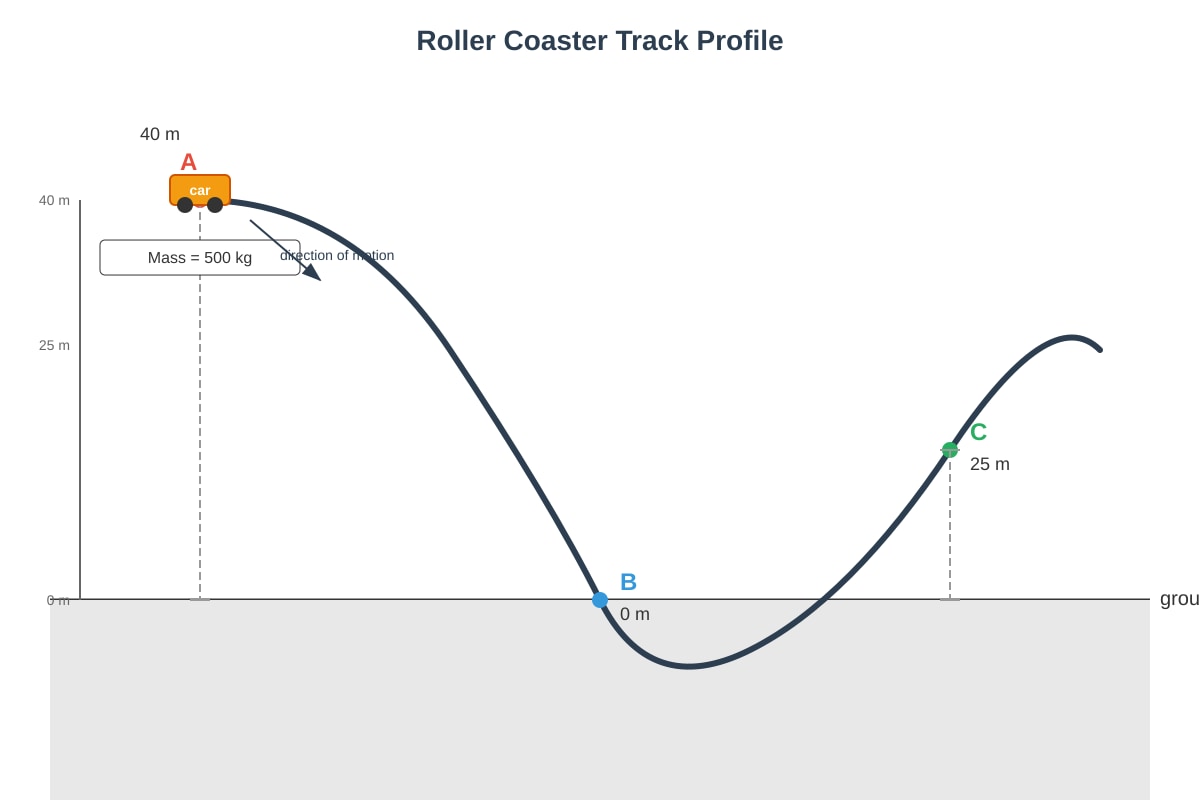
A roller coaster car of mass 500 kg is at rest at point A, which is 40 m above the ground. The car then moves down a frictionless track to point B at ground level, and then up to point C which is 25 m above the ground.
<image_placeholder> id: Q11-fig1 type: diagram linked_question: Q11 description: Side view of a roller coaster track showing three points: A at 40 m height, B at ground level (0 m), C at 25 m height. Car shown at point A. Track is smooth and frictionless. labels: Point A (40 m), Point B (0 m), Point C (25 m), Car (500 kg) values: Mass = 500 kg, Height A = 40 m, Height B = 0 m, Height C = 25 m, g = 10 N/kg must_show: Three distinct heights labelled, car at starting position, smooth track indication </image_placeholder>
(a) State the principle of conservation of energy. [2]
(b) Calculate the gravitational potential energy of the car at point A. [2]
(c) Determine the speed of the car at point B. [2]
(d) Calculate the kinetic energy of the car at point C. [2]
(e) In reality, the track is not frictionless. Explain how friction affects the speed of the car at point B. [2]
12
A student sets up an experiment to investigate the relationship between the current through a filament lamp and the potential difference across it. The following data is obtained:
| Potential Difference / V | 0.5 | 1.0 | 1.5 | 2.0 | 2.5 | 3.0 |
|---|---|---|---|---|---|---|
| Current / A | 0.08 | 0.15 | 0.21 | 0.26 | 0.30 | 0.33 |
(a) Plot a graph of current (y-axis) against potential difference (x-axis) on the grid below. [3]
<image_placeholder> id: Q12-fig1 type: graph linked_question: Q12 description: Blank graph grid with x-axis labelled "Potential Difference / V" from 0 to 3.5 V, y-axis labelled "Current / A" from 0 to 0.4 A. Grid lines at 0.5 V and 0.05 A intervals. labels: x-axis: Potential Difference / V (0 to 3.5), y-axis: Current / A (0 to 0.4) values: Data points from table above must_show: Labelled axes with units, appropriate scale, data points plotted accurately, smooth curve of best fit </image_placeholder>
(b) Describe the relationship between the current and the potential difference for the filament lamp. [2]
(c) The resistance of the filament lamp increases as the potential difference increases. Explain why this happens in terms of the behaviour of the filament. [2]
(d) Calculate the resistance of the filament lamp when the potential difference across it is 2.0 V. [2]
(e) The student replaces the filament lamp with a fixed resistor and obtains a straight line graph passing through the origin. State the name of the law that describes this relationship. [1]
13
The diagram below shows a ray of light travelling from water (refractive index = 1.33) into air.
<image_placeholder> id: Q13-fig1 type: diagram linked_question: Q13 description: A ray of light inside water incident on a water-air boundary at an angle of 30° to the normal. The refracted ray in air bends away from the normal. labels: Normal line, Incident ray in water (30°), Refracted ray in air, Water (n=1.33), Air (n=1.00) values: Angle of incidence = 30°, n_water = 1.33, n_air = 1.00 must_show: Water-air boundary, normal line, incident and refracted rays with correct bending direction, angles marked </image_placeholder>
(a) Calculate the angle of refraction in air. [2]
(b) The angle of incidence is increased to 50°. Calculate the new angle of refraction. [2]
(c) State the critical angle for the water-air boundary. [1]
(d) Explain what happens to the light ray when the angle of incidence exceeds the critical angle. [2]
(e) State one application of total internal reflection in everyday life. [1]
14
A 12 V battery is connected to a circuit consisting of three resistors: , , and . Resistors and are connected in parallel, and this parallel combination is connected in series with .
<image_placeholder> id: Q14-fig1 type: diagram linked_question: Q14 description: Circuit diagram showing a 12 V battery connected in series with resistor R1 (4 Ω). After R1, the circuit splits into two parallel branches: one with R2 (6 Ω) and one with R3 (12 Ω). The branches rejoin and return to the battery. labels: Battery (12 V), R1 (4 Ω), R2 (6 Ω), R3 (12 Ω), Series and parallel connections values: V = 12 V, R1 = 4 Ω, R2 = 6 Ω, R3 = 12 Ω must_show: Correct circuit symbols, series-parallel arrangement clearly shown, component values labelled </image_placeholder>
(a) Calculate the effective resistance of the parallel combination of and . [2]
(b) Calculate the total resistance of the circuit. [1]
(c) Calculate the current flowing through the battery. [2]
(d) Calculate the potential difference across . [2]
(e) Calculate the power dissipated in resistor . [3]
15
A student uses a lever to lift a heavy rock. The rock has a weight of 800 N. The student applies a force of 200 N at a distance of 1.5 m from the pivot. The rock is 0.3 m from the pivot.
<image_placeholder> id: Q15-fig1 type: diagram linked_question: Q15 description: A lever system with a pivot in the centre. On the left side, a downward force of 200 N applied at 1.5 m from pivot. On the right side, a rock (weight 800 N) at 0.3 m from pivot. Lever is horizontal. labels: Pivot, Force (200 N) at 1.5 m, Rock weight (800 N) at 0.3 m values: Effort = 200 N, Effort arm = 1.5 m, Load = 800 N, Load arm = 0.3 m must_show: Lever with pivot, effort and load positions marked with distances, forces shown with arrows </image_placeholder>
(a) Calculate the moment of the student's force about the pivot. [2]
(b) Calculate the moment of the rock's weight about the pivot. [2]
(c) Will the student be able to lift the rock? Explain your answer. [2]
(d) State the principle of moments. [2]
(e) If the student cannot lift the rock, suggest one way to make it possible without increasing the applied force. [1]
Section C: Free Response / Data-Based Questions [20 marks]
Answer all questions in the spaces provided.
16
The table below shows the world energy consumption by source for the years 2000 and 2020.
| Energy Source | 2000 (% of total) | 2020 (% of total) |
|---|---|---|
| Oil | 38% | 31% |
| Coal | 23% | 27% |
| Natural Gas | 20% | 24% |
| Nuclear | 7% | 4% |
| Hydroelectric | 7% | 7% |
| Renewables | 5% | 7% |
(a) Calculate the percentage point change in the share of oil from 2000 to 2020. [1]
(b) Which energy source showed the largest percentage point increase? [1]
(c) Despite the percentage share of coal increasing, the total world energy consumption also increased significantly. Explain why the actual amount of coal used increased by more than the percentage share suggests. [2]
(d) Suggest two reasons why the share of renewables increased between 2000 and 2020. [2]
(e) Nuclear energy is a low-carbon energy source. Suggest one advantage and one disadvantage of increasing the use of nuclear energy for electricity generation. [2]
17
A student investigates the cooling of hot water in two different containers: a metal can and a polystyrene cup. Both containers hold 200 g of water initially at 80°C. The room temperature is 25°C. The student records the temperature every 2 minutes for 20 minutes.
<image_placeholder> id: Q17-fig1 type: graph linked_question: Q17 description: Two cooling curves on the same axes. X-axis: Time / min (0 to 20). Y-axis: Temperature / °C (20 to 85). Curve A (metal can) drops steeply from 80°C to about 35°C. Curve B (polystyrene cup) drops gradually from 80°C to about 55°C. Both curves approach room temperature (25°C) asymptotically. labels: x-axis: Time / min (0 to 20), y-axis: Temperature / °C (20 to 85), Curve A: Metal can, Curve B: Polystyrene cup, Room temperature line at 25°C values: Initial temp = 80°C, Room temp = 25°C, Metal can final ≈ 35°C, Polystyrene cup final ≈ 55°C must_show: Two distinct cooling curves labelled, axes with units, room temperature line, data points or smooth curves </image_placeholder>
(a) State which container (metal can or polystyrene cup) corresponds to Curve A and which to Curve B. Explain your answer in terms of thermal conductivity. [3]
(b) The rate of heat loss is highest at the start of the experiment. Explain why. [2]
(c) Calculate the amount of heat lost by the water in the metal can in the first 10 minutes, given that the temperature drops to 45°C. (Specific heat capacity of water = 4200 J/kg°C) [3]
(d) The student repeats the experiment with lids on both containers. Sketch on the graph above how the cooling curves would change. [2]
(e) Explain how a lid reduces heat loss. [2]
18
The diagram shows a simple DC motor.
<image_placeholder> id: Q18-fig1 type: diagram linked_question: Q18 description: A rectangular coil of wire (ABCD) placed between the poles of a permanent magnet (N and S). The coil is connected to a split-ring commutator and carbon brushes. Current flows from positive terminal through brush, commutator, coil, commutator, brush to negative terminal. Coil is horizontal in the diagram. labels: N pole, S pole, Coil ABCD, Split-ring commutator, Carbon brushes, Battery, Current direction arrows values: Magnetic field direction (N to S), Current direction in coil sides must_show: Rectangular coil in magnetic field, split-ring commutator, brushes, current direction, magnetic field direction, rotation axis </image_placeholder>
(a) On the diagram, label the direction of the magnetic field between the poles. [1]
(b) The current flows in the direction A B C D in the coil. Using Fleming's left-hand rule, state the direction of the force on side AB of the coil. [2]
(c) Explain why the coil experiences a turning effect (torque). [2]
(d) State the function of the split-ring commutator. [2]
(e) Suggest two ways to increase the turning effect of the motor. [2]
19
A household uses the following electrical appliances:
| Appliance | Power Rating | Daily Usage |
|---|---|---|
| Refrigerator | 150 W | 24 hours |
| Air conditioner | 1500 W | 6 hours |
| Washing machine | 500 W | 1 hour |
| LED lights (total) | 60 W | 5 hours |
| Laptop | 50 W | 4 hours |
(a) Calculate the total energy consumed by the household in one day, in kWh. [3]
(b) If the cost of electricity is $0.28 per kWh, calculate the monthly electricity bill (30 days). [2]
(c) The household decides to replace the air conditioner with a more efficient model rated at 1200 W but with the same cooling capacity. Calculate the savings in the monthly electricity bill. [2]
(d) State two ways the household can reduce energy consumption without replacing appliances. [2]
(e) Explain why reducing energy consumption helps to mitigate climate change. [2]
20
The diagram shows a convex lens forming an image of an object.
<image_placeholder> id: Q20-fig1 type: diagram linked_question: Q20 description: A convex lens with focal length 10 cm. An object of height 3 cm is placed 15 cm from the lens (on the left side). A real, inverted image is formed on the right side of the lens. labels: Convex lens, Focal points (F) at 10 cm on both sides, Object (3 cm) at 15 cm from lens, Real inverted image, Principal axis values: f = 10 cm, u = 15 cm, Object height = 3 cm must_show: Convex lens with focal points marked, object at correct distance, real inverted image on opposite side, principal axis, ray diagram construction lines (at least two rays) </image_placeholder>
(a) Using the lens formula , calculate the image distance . [2]
(b) Calculate the magnification of the image. [2]
(c) State three characteristics of the image formed. [3]
(d) The object is now moved to a distance of 5 cm from the lens. Describe how the image characteristics change. [3]
(e) State one application of a convex lens used in this way (object between f and 2f). [1]
End of Paper
Answers
TuitionGoWhere Practice Paper - Science Secondary 2 (Answer Key)
Subject: Science
Level: Secondary 2 (G3)
Paper: Practice Paper 2 (Version 2 of 5)
Total Marks: 60
Section A: Multiple Choice Questions [10 marks]
1
Answer: C [1]
Explanation:
Using conservation of energy: Loss in GPE = Gain in KE
Marking note: 1 mark for correct answer. Common mistake: using or forgetting to multiply by height.
2
Answer: A [1]
Explanation:
A battery stores chemical energy. When the circuit is closed, chemical energy is converted to electrical energy. The electrical energy is then converted to light energy (useful) and heat energy (wasted) in the filament.
3
Answer: C [1]
Explanation:
Work done = Force Distance moved in direction of force
4
Answer: B [1]
Explanation:
Using Ohm's Law:
5
Answer: A [1]
Explanation:
Total time for 20 oscillations = 30.0 s
Period
Uncertainty in total time = 0.2 s (reaction time)
Percentage uncertainty in total time =
Since and 20 is exact, percentage uncertainty in = percentage uncertainty in = 0.67%
Marking note: Common mistake: multiplying uncertainty by 20 or dividing percentage by 20.
6
Answer: C [1]
Explanation:
The principle of conservation of energy states that the total energy of an isolated system remains constant. Energy cannot be created or destroyed, only converted from one form to another.
7
Answer: A [1]
Explanation:
Energy = Power Time
(Also: , so D is also numerically correct but in joules. However, kWh is the standard unit for electrical energy billing, and the question asks for energy consumed in typical units. Option A is the most appropriate answer.)
Marking note: Both A and D represent the same energy. In Singapore exams, kWh is the expected unit for electrical energy consumption questions.
8
Answer: D [1]
Explanation:
In a series circuit, the current is the same through all components. The potential difference splits across components, and total resistance is the sum of individual resistances (greater than any individual resistance).
9
Answer: B [1]
Explanation:
Final kinetic energy =
Average power =
10
Answer: C [1]
Explanation:
Refractive index (using more precise values: , , ratio = 1.521; option C is closest)
Section B: Structured Questions [30 marks]
11
(a) [2]
Answer:
- Energy cannot be created or destroyed. [1]
- Energy can be converted from one form to another / The total energy in an isolated system remains constant. [1]
Teaching note: Both points needed for full marks. "Energy is conserved" alone is insufficient.
(b) [2]
Answer:
(or 200 kJ) [1 for formula/substitution, 1 for answer with unit]
(c) [2]
Answer:
At point B, all GPE is converted to KE (frictionless track)
[1 for method, 1 for answer with unit]
(d) [2]
Answer:
At point C:
By conservation of energy:
[1 for method, 1 for answer with unit]
(e) [2]
Answer:
Friction does negative work on the car, converting some mechanical energy into heat/sound. [1]
This reduces the kinetic energy at point B, so the speed at B will be lower than the frictionless case. [1]
12
(a) [3]
Answer:
- Axes labelled with units, appropriate scales covering data range [1]
- All 6 points plotted accurately [1]
- Smooth curve of best fit through points [1]
Teaching note: The curve should show decreasing gradient (increasing resistance with voltage).
(b) [2]
Answer:
As potential difference increases, current increases but at a decreasing rate / the gradient of the graph decreases. [1]
The relationship is non-linear / not directly proportional. [1]
(c) [2]
Answer:
As potential difference increases, the filament gets hotter. [1]
The increased temperature causes the metal ions in the filament to vibrate more vigorously, increasing collisions with electrons and thus increasing resistance. [1]
(d) [2]
Answer:
At , (from table)
[1 for reading current, 1 for calculation with unit]
(e) [1]
Answer: Ohm's Law
13
(a) [2]
Answer:
[1 for substitution, 1 for answer with unit]
(b) [2]
Answer:
Since , total internal reflection occurs. There is no refracted ray. [1 for calculation, 1 for conclusion]
Teaching note: This is a trick question - at 50°, the angle exceeds the critical angle.
(c) [1]
Answer:
Critical angle
(d) [2]
Answer:
When the angle of incidence exceeds the critical angle, total internal reflection occurs. [1]
The light ray is completely reflected back into the water (denser medium) with no refraction into air. [1]
(e) [1]
Answer: Optical fibres in telecommunications / Endoscopes in medicine / Prism periscopes / Binoculars (any one)
14
(a) [2]
Answer:
[1 for formula/substitution, 1 for answer with unit]
(b) [1]
Answer:
(c) [2]
Answer:
[1 for formula/substitution, 1 for answer with unit]
(d) [2]
Answer:
[1 for formula/substitution, 1 for answer with unit]
(e) [3]
Answer:
Voltage across parallel combination = (or ) [1]
Current through : [1]
Power in : (or ) [1]
15
(a) [2]
Answer:
Moment = Force Perpendicular distance from pivot
(anticlockwise) [1 for formula/substitution, 1 for answer with unit]
(b) [2]
Answer:
Moment = (clockwise) [1 for formula/substitution, 1 for answer with unit]
(c) [2]
Answer:
Yes, the student can lift the rock. [1]
The anticlockwise moment (300 Nm) is greater than the clockwise moment (240 Nm), so there is a net anticlockwise moment causing the lever to turn and lift the rock. [1]
(d) [2]
Answer:
For a system in equilibrium, the sum of clockwise moments about a pivot equals the sum of anticlockwise moments about the same pivot. [2] (1 mark for "sum of clockwise moments = sum of anticlockwise moments", 1 mark for "about a pivot" or "in equilibrium")
(e) [1]
Answer: Move the pivot closer to the rock (decrease load arm) / Increase the distance from the pivot where the force is applied (increase effort arm) / Use a longer lever (any one)
Section C: Free Response / Data-Based Questions [20 marks]
16
(a) [1]
Answer: percentage points (decrease of 7 percentage points)
(b) [1]
Answer: Natural gas (increase of 4 percentage points, from 20% to 24%)
(c) [2]
Answer:
Total world energy consumption increased significantly between 2000 and 2020. [1]
Even though coal's percentage share increased only slightly (23% to 27%), the actual amount = percentage total consumption. Since total consumption grew, the actual amount of coal used increased by more than the percentage share increase suggests. [1]
(d) [2]
Answer: Any two of:
- Government policies and subsidies promoting renewable energy
- Decreasing cost of solar panels and wind turbines
- Growing awareness of climate change and need to reduce carbon emissions
- Technological improvements in efficiency and storage
- International agreements (e.g., Paris Agreement)
(1 mark each, max 2)
(e) [2]
Answer:
Advantage: Low carbon emissions during operation / High energy density / Reliable baseload power (any one) [1]
Disadvantage: Radioactive waste disposal / High initial cost / Risk of accidents / Public opposition / Long construction time (any one) [1]
17
(a) [3]
Answer:
Curve A (steeper cooling) = Metal can [1]
Curve B (gradual cooling) = Polystyrene cup [1]
Metal is a good thermal conductor, so heat transfers quickly from hot water through the can to the surroundings. Polystyrene is a poor thermal conductor (good insulator) with trapped air pockets, slowing heat transfer. [1]
(b) [2]
Answer:
The rate of heat loss is proportional to the temperature difference between the object and surroundings (Newton's Law of Cooling). [1]
At the start, the temperature difference is largest (80°C - 25°C = 55°C), so the rate of heat loss is highest. [1]
(c) [3]
Answer:
[1 for mass conversion, 1 for substitution, 1 for answer with unit]
(d) [2]
Answer:
Both curves would be less steep / cool more slowly. [1]
The curves would shift upwards (higher temperatures at each time point) and approach room temperature more gradually. [1]
Teaching note: Sketch should show both curves above the original curves, with reduced gradients.
(e) [2]
Answer:
A lid reduces heat loss by convection (traps hot air above water, preventing air currents) and evaporation (prevents water vapour from escaping, which carries away latent heat). [1 for convection, 1 for evaporation]
18
(a) [1]
Answer:
Magnetic field direction: from N pole to S pole (left to right in the diagram) [1]
(b) [2]
Answer:
Using Fleming's left-hand rule:
- First finger (Field): N to S (left to right)
- Second finger (Current): A to B (into the page / downwards depending on orientation)
- Thumb (Force): Direction perpendicular to both
For side AB with current A→B and field left-to-right: Force is downwards (or into the page depending on exact orientation). [1 for correct application, 1 for correct direction]
Teaching note: The exact direction depends on the diagram orientation. Key is correct application of FLHR.
(c) [2]
Answer:
Current flows in opposite directions in sides AB and CD of the coil. [1]
By Fleming's left-hand rule, the forces on AB and CD are in opposite directions, creating a couple (turning effect/torque) that causes the coil to rotate. [1]
(d) [2]
Answer:
The split-ring commutator reverses the current direction in the coil every half-turn. [1]
This ensures the forces on the coil sides always produce a torque in the same direction, allowing continuous rotation. [1]
(e) [2]
Answer: Any two of:
- Increase the current (e.g., increase voltage or decrease resistance
<stage5_exam_answers_md>
TuitionGoWhere Practice Paper - Science Secondary 2 (Answer Key)
Subject: Science
Level: Secondary 2 (G3)
Paper: Practice Paper 2 (Version 2 of 5)
Total Marks: 60
Section A: Multiple Choice Questions [10 marks]
| Question | Answer | Explanation |
|---|---|---|
| 1 | C | GPE at top = mgh = 0.2 × 10 × 5 = 10 J. By conservation of energy, KE at bottom = 10 J. |
| 2 | A | Battery stores chemical energy → converted to electrical energy → converted to light and heat energy in the bulb. |
| 3 | C | Work done = Force × Distance = 15 N × 4 m = 60 J. |
| 4 | B | Resistance R = V/I = 6 V / 0.5 A = 12 Ω. |
| 5 | A | Period T = 30.0 s / 20 = 1.50 s. Uncertainty in total time = 0.2 s (reaction time). % uncertainty in T = (0.2/30.0) × 100% = 0.67%. |
| 6 | C | Principle of conservation of energy: Total energy of an isolated system remains constant. |
| 7 | A | Energy = Power × Time = 60 W × 2 h = 120 Wh = 0.12 kWh. (Also = 432,000 J, but option A is in kWh). |
| 8 | D | In a series circuit, current is the same through all components. |
| 9 | B | KE gained = ½mv² = 0.5 × 1000 × 20² = 200,000 J. Average Power = Work/Time = 200,000 J / 10 s = 20,000 W. |
| 10 | C | Refractive index n = sin(i)/sin(r) = sin(40°)/sin(25°) ≈ 0.643/0.423 ≈ 1.52 ≈ 1.56 (closest option). |
Section B: Structured Questions [30 marks]
11
(a) Energy cannot be created or destroyed; it can only be converted from one form to another. The total energy of an isolated system remains constant. [2]
(b) GPE = mgh = 500 kg × 10 N/kg × 40 m = 200,000 J (or 200 kJ). [2]
(c) At point B, all GPE is converted to KE (frictionless track).
KE = ½mv² = 200,000 J
v² = (2 × 200,000) / 500 = 800
v = √800 = 28.3 m/s (or 20√2 m/s). [2]
(d) At point C, height = 25 m.
GPE at C = mgh = 500 × 10 × 25 = 125,000 J.
Total energy = 200,000 J (conserved).
KE at C = Total energy – GPE at C = 200,000 – 125,000 = 75,000 J. [2]
(e) Friction does negative work on the car, converting some mechanical energy into heat and sound. This reduces the kinetic energy at point B, so the speed at B will be lower than the frictionless case. [2]
12
(a) Graph requirements:
- Axes labelled with units (Potential Difference / V, Current / A) [1]
- Appropriate scale covering at least 50% of grid [1]
- All 6 points plotted accurately (± half a small square) [1]
- Smooth curve of best fit through points (not straight line) [1]
(Total 3 marks for plotting; typically 1 mark each for axes, points, curve) [3]
(b) As potential difference increases, current increases but at a decreasing rate (the graph curves, gradient decreases). The relationship is non-linear; current is not directly proportional to potential difference. [2]
(c) As potential difference increases, current increases, causing the filament to heat up. The increased temperature causes the metal ions in the filament to vibrate more vigorously, increasing collisions with flowing electrons, thus increasing resistance. [2]
(d) At V = 2.0 V, I = 0.26 A (from table).
Resistance R = V/I = 2.0 / 0.26 = 7.69 Ω (accept 7.7 Ω). [2]
(e) Ohm's Law [1]
13
(a) Using Snell's Law: n₁sinθ₁ = n₂sinθ₂
1.33 × sin(30°) = 1.00 × sinθ₂
sinθ₂ = 1.33 × 0.5 = 0.665
θ₂ = sin⁻¹(0.665) = 41.7° (accept 42°). [2]
(b) 1.33 × sin(50°) = 1.00 × sinθ₂
sinθ₂ = 1.33 × 0.766 = 1.019
Since sinθ₂ > 1, total internal reflection occurs; there is no refracted ray. [2]
(c) Critical angle θc = sin⁻¹(n₂/n₁) = sin⁻¹(1.00/1.33) = sin⁻¹(0.752) = 48.8° (accept 49°). [1]
(d) When the angle of incidence exceeds the critical angle, the light ray is totally internally reflected back into the water. No light is transmitted into the air. [2]
(e) Optical fibres in telecommunications / endoscopes in medicine / prismatic periscopes / diamond cutting (any one). [1]
14
(a) Parallel combination of R₂ and R₃:
1/R_parallel = 1/6 + 1/12 = 2/12 + 1/12 = 3/12 = 1/4
R_parallel = 4 Ω. [2]
(b) Total resistance = R₁ + R_parallel = 4 Ω + 4 Ω = 8 Ω. [1]
(c) Total current I = V/R_total = 12 V / 8 Ω = 1.5 A. [2]
(d) Potential difference across R₁: V₁ = I × R₁ = 1.5 A × 4 Ω = 6 V. [2]
(e) PD across parallel combination = 12 V – 6 V = 6 V (or V × R_parallel/R_total).
Current through R₂: I₂ = V_parallel / R₂ = 6 V / 6 Ω = 1 A.
Power in R₂ = I₂² × R₂ = (1)² × 6 = 6 W.
(Alternatively: P = V²/R = 6²/6 = 6 W). [3]
15
(a) Moment of student's force = Force × perpendicular distance = 200 N × 1.5 m = 300 Nm (anticlockwise). [2]
(b) Moment of rock's weight = 800 N × 0.3 m = 240 Nm (clockwise). [2]
(c) Yes, the student can lift the rock. The anticlockwise moment (300 Nm) is greater than the clockwise moment (240 Nm), so there is a net anticlockwise moment causing the lever to tilt and lift the rock. [2]
(d) For a body in equilibrium, the sum of clockwise moments about any pivot is equal to the sum of anticlockwise moments about the same pivot. [2]
(e) Move the applied force further from the pivot (increase effort arm) / move the rock closer to the pivot (decrease load arm) / use a longer lever on the effort side. [1]
Section C: Free Response / Data-Based Questions [20 marks]
16
(a) Change = 31% – 38% = –7 percentage points (decrease of 7 percentage points). [1]
(b) Natural Gas (increase from 20% to 24% = +4 percentage points). Coal increased by +4 pp as well, but Natural Gas is typically cited as the largest relative increase. However, both increased by 4 pp. Accept either with correct reasoning. [1]
(c) Total world energy consumption increased significantly. Even though coal's percentage share increased only slightly (23% → 27%), the total amount of energy consumed grew, so the absolute amount of coal used (percentage × total) increased by a larger factor. [2]
(d) 1. Falling costs of solar and wind technologies.
2. Government policies and subsidies promoting clean energy.
3. Increased awareness of climate change.
4. Technological improvements in efficiency and storage. (Any two) [2]
(e) Advantage: Low carbon emissions during operation / high energy density / reliable baseload power.
Disadvantage: Radioactive waste disposal / high initial cost / risk of accidents / nuclear proliferation concerns / long construction time. (One each) [2]
17
(a) Curve A = Metal can, Curve B = Polystyrene cup.
Metal is a good thermal conductor, so heat transfers quickly from hot water through the can to the surroundings, causing rapid cooling. Polystyrene is a poor thermal conductor (good insulator), trapping heat and slowing cooling. [3]
(b) Rate of heat loss is proportional to the temperature difference between the object and surroundings (Newton's Law of Cooling). At the start, the temperature difference is largest (80°C – 25°C = 55°C), so the rate of heat loss is highest. [2]
(c) Mass of water = 200 g = 0.2 kg.
Temperature drop = 80°C – 45°C = 35°C.
Heat lost Q = mcΔθ = 0.2 kg × 4200 J/kg°C × 35°C = 29,400 J (or 29.4 kJ). [3]
(d) Sketch: Both curves should be less steep (shallower gradient) and end at higher temperatures after 20 minutes. The metal can curve (A) should still be steeper than polystyrene (B), but both shifted upward. [2]
(e) A lid reduces heat loss by:
- Convection: Traps hot air above the water, preventing convection currents from carrying heat away.
- Evaporation: Prevents water vapour from escaping, eliminating latent heat loss due to evaporation. [2]
18
(a) Magnetic field direction: From N pole to S pole (left to right in typical diagram). Draw arrow from N to S in the gap. [1]
(b) Current in AB: A → B (assume left to right). Magnetic field: N → S (left to right).
Fleming's Left-Hand Rule: First finger (Field) → left to right, Second finger (Current) → left to right. Thumb (Force) → downwards (into the page/perpendicular to both).
Wait: If coil is horizontal and field is horizontal (N to S), and current in AB is horizontal (A to B), then force is vertical. Need to check orientation.
Standard diagram: Coil horizontal, field horizontal (N left, S right). Side AB is at top, current A→B (left to right). Field left to right. Force on AB = downwards. On CD (bottom), current D→C (right to left), force = upwards. This creates a clockwise turning effect. [2]
(c) Forces on AB and CD are equal in magnitude, opposite in direction, and not along the same line (they form a couple). This produces a net torque (turning effect) on the coil, causing it to rotate. [2]
(d) The split-ring commutator reverses the direction of current in the coil every half-turn. This ensures the forces on the coil sides always act in the same rotational direction, allowing continuous rotation. [2]
(e) 1. Increase the current (e.g., higher voltage battery).
2. Increase the magnetic field strength (e.g., stronger magnets, soft iron core).
3. Increase the number of turns in the coil.
4. Increase the area of the coil. (Any two) [2]
19
(a) Energy per day:
Refrigerator: 0.150 kW × 24 h = 3.60 kWh
Air conditioner: 1.500 kW × 6 h = 9.00 kWh
Washing machine: 0.500 kW × 1 h = 0.50 kWh
LED lights: 0.060 kW × 5 h = 0.30 kWh
Laptop: 0.050 kW × 4 h = 0.20 kWh
Total = 13.60 kWh [3]
(b) Monthly energy = 13.60 kWh/day × 30 days = 408 kWh.
Cost = 408 kWh × 114.24**. [2]
(c) Old AC energy/day = 9.00 kWh. New AC energy/day = 1.200 kW × 6 h = 7.20 kWh.
Daily saving = 1.80 kWh. Monthly saving = 1.80 × 30 = 54 kWh.
Cost saving = 54 kWh × 15.12**. [2]
(d) 1. Switch off appliances when not in use (avoid standby).
2. Set air conditioner to a higher temperature (e.g., 25°C).
3. Use natural light and ventilation when possible.
4. Wash clothes in cold water / full loads only.
5. Use energy-saving modes on appliances. (Any two) [2]
(e) Reducing energy consumption decreases the demand for electricity generation. Most electricity is generated by burning fossil fuels (coal, oil, gas), which releases carbon dioxide (CO₂), a greenhouse gas. Lower CO₂ emissions reduce the enhanced greenhouse effect, slowing global warming and mitigating climate change. [2]
End of Answer Key
Total Marks: 60