AI Generated Exam Paper
Secondary 2 Science Practice Paper 2
Free Sec 2 Science Practice Paper 2, HY3 AI version, with questions, answers, and syllabus-aligned practice for Singapore students.
These static practice materials are generated from the site's syllabus and paper-generation workflow, with source and model context shown so students and parents can evaluate the material before use.
Questions
TuitionGoWhere Practice Paper - Science Secondary 2
TuitionGoWhere Practice Paper (AI) — Version 2 of 5
Subject: Science
Level: Secondary 2
Paper: Practice Paper (Physical Sciences Topic Focus)
Duration: 45 minutes
Total Marks: 40
Name: __________________________
Class: ____________
Date: ____________
Instructions:
- This practice paper contains 20 questions on Physical Sciences (Secondary 2 syllabus).
- Section A: 10 short questions (1 mark each). Section B: 6 structured questions (2–3 marks each). Section C: 4 extended questions (3–4 marks each).
- Write all answers in the spaces provided. Show working for calculation questions. Use SI units.
- This paper is syllabus-first generated content informed by LLM-inferred templates; it is not an official past-year paper.
Section A (10 marks)
Answer all questions. Each question carries 1 mark.
-
State the unit used to measure force. [1]
-
Name the force that pulls objects towards the centre of the Earth. [1]
-
A book is placed on a table. State the form of energy stored in the book due to its position. [1]
-
State one non-renewable source of energy. [1]
-
In a closed electric circuit, what flows to give rise to an electric current? [1]
-
What is the voltage supplied to homes in Singapore? [1]
-
Heat flows from a region of ______ temperature to a region of ______ temperature. (Fill in the blanks.) [1]
-
State the function of a thermostat. [1]
-
Name a safety device that breaks a circuit when too much current flows. [1]
-
What instrument is used to measure electric current? [1]
Section B (16 marks)
Answer all questions. Marks shown per question.
-
A boy of mass 40 kg climbs 3 flights of stairs. Each flight is 3 m high. (a) Calculate the total height climbed. [1] (b) Calculate the gain in gravitational potential energy. (Use g=10 m/s2) [2]
-
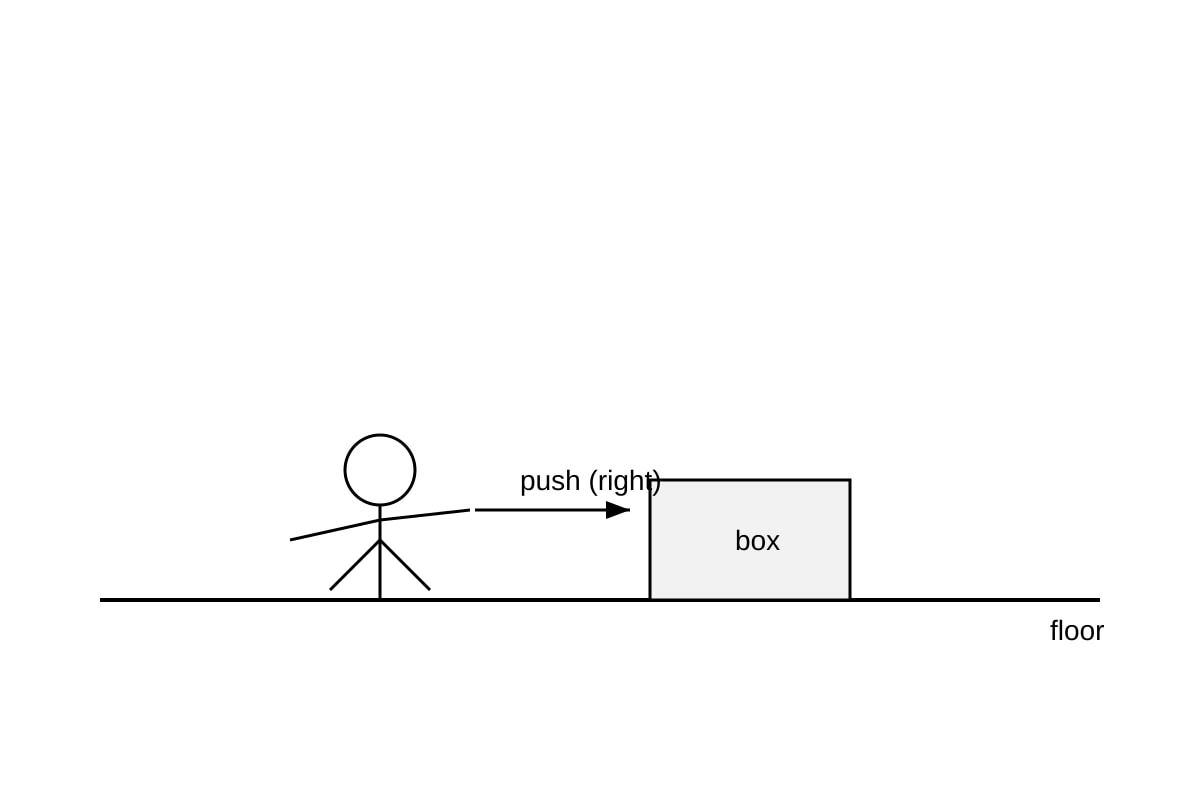
Figure 1 shows a box resting on a horizontal floor. A girl pushes it to the right with a force.
Image pending generation: diagram for Q12.
(a) Draw and label the friction force acting on the box. [1] (b) If the box moves at constant speed, state the size of the friction force compared to the push force. [1]
-
State the principle of conservation of energy. [2]
-
Table 1 shows three solutions and their pH values. | Solution | pH | |----------|----| | X | 3 | | Y | 7 | | Z | 11 | (a) Which solution is acidic? [1] (b) Which solution is alkaline? [1]
-
A lamp is connected to two cells in series. Describe what happens to the brightness of the lamp compared to one cell. [2]
-
A metal rod is heated and expands. State one everyday problem this expansion may cause and one application that uses expansion. [2]
Section C (14 marks)
Answer all questions. Marks shown per question.
-
A 2 kg ball is dropped from a height of 5 m. (Use g=10 m/s2) (a) Calculate the gravitational potential energy before it is dropped. [2] (b) State the kinetic energy just before it hits the ground, assuming no air resistance. [1] (c) Explain your answer in (b) using the principle of conservation of energy. [1]
-
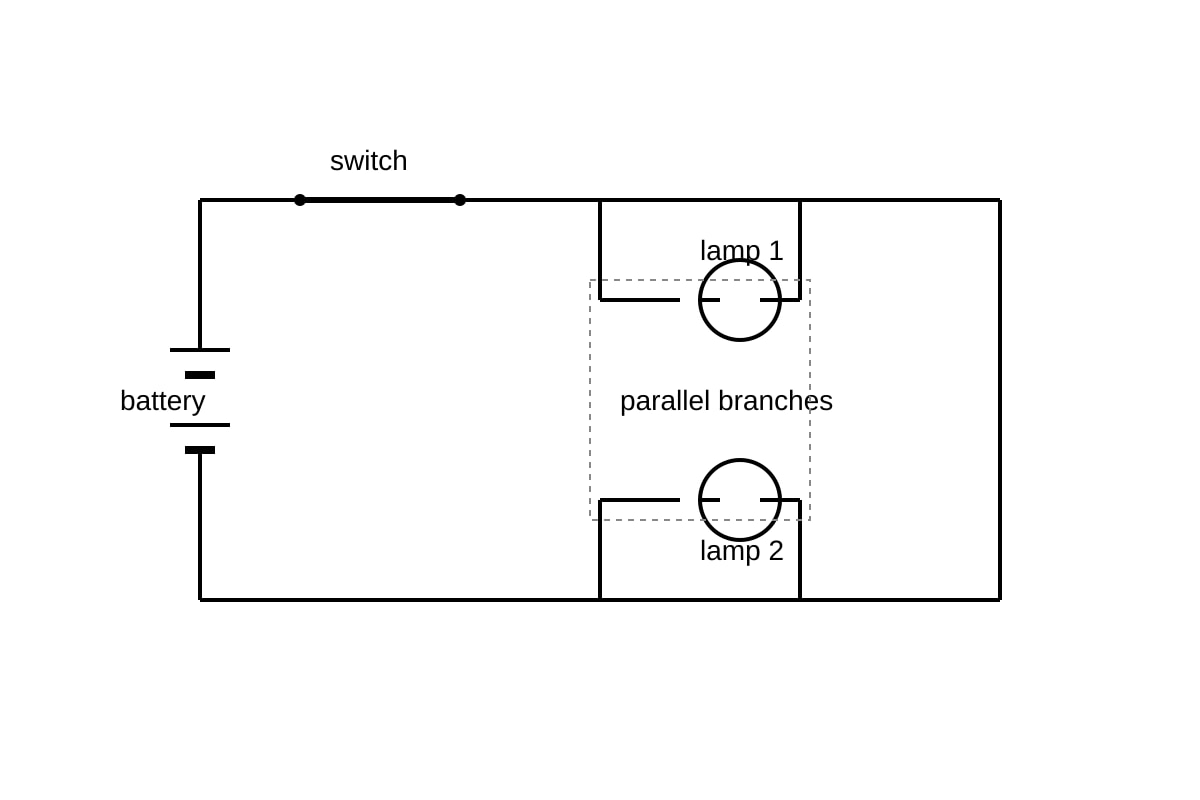
Figure 2 shows a simple circuit with a battery, switch, and two lamps in parallel.
Image pending generation: circuit_diagram for Q18.
(a) State one advantage of connecting lamps in parallel. [1] (b) If one lamp is removed, what happens to the other lamp? Explain. [2] (c) Name the instrument used to measure the voltage across one lamp and how it is connected. [1]
-
A student uses a spring balance to pull a wooden block across a rough table. She records the force needed on different surfaces. (a) State how frictional force depends on the texture of the surface. [1] (b) Explain why a larger force is needed on a rougher surface. [2] (c) Suggest one way to reduce friction without changing the surface. [1]
-
A kettle rated 2.0 kW is used for 5 minutes to boil water. (a) Convert 5 minutes to seconds. [1] (b) Calculate the electrical energy used in kWh. [2] (c) State one way to reduce energy wastage when boiling water. [1]
Answers
TuitionGoWhere Practice Paper — Answer Key (Version 2)
Subject: Science
Level: Secondary 2
Paper: Practice Paper (Physical Sciences)
Total Marks: 40
Section A Answers (10 marks)
-
newton (N) [1]
Teaching note: The SI unit of force is the newton, symbol N. A spring balance measures force in newtons. -
gravitational force (or gravity) [1]
Teaching note: Earth pulls objects down by gravitational force; weight is the gravitational force on the object. -
gravitational potential energy [1]
Teaching note: Energy stored due to position above ground is gravitational potential energy (GPE). -
coal / crude oil / natural gas (any one) [1]
Teaching note: Fossil fuels are non-renewable because they take millions of years to form. -
electric charges (or electrons) [1]
Teaching note: Current is the flow of electric charges in a closed circuit. -
230 V [1]
Teaching note: Singapore household voltage is 230 volts. -
higher; lower [1]
Teaching note: Heat always flows from hotter to colder until same temperature. -
to maintain a constant temperature [1]
Teaching note: A thermostat switches heating/cooling on or off to keep temperature steady. -
circuit breaker / fuse (any one) [1]
Teaching note: Both break the circuit when current is too high to prevent fire. -
ammeter [1]
Teaching note: Ammeter measures current in amperes; connected in series.
Section B Answers (16 marks)
-
(a) Total height = 3×3=9 m [1]
(b) Gain in GPE = mgh=40×10×9=3600 J [2]
Teaching note: Count flights not floors. GPE = mass × g × height. Use g=10. Unit joules (J). -
(a) Arrow pointing left from box, labelled "friction" [1]
(b) Equal in size to push force [1]
Teaching note: Friction opposes motion (left). At constant speed, forces balance so friction = push. -
Energy cannot be created or destroyed; it can only be converted from one form to another (or total energy is constant). [2]
Marking: 1 mark for non-creation/destruction, 1 mark for conversion/constancy. -
(a) X [1] (b) Z [1]
Teaching note: pH < 7 acidic, pH = 7 neutral, pH > 7 alkaline. -
Brightness increases because two cells in series give higher voltage and thus more current. [2]
Marking: 1 for brighter, 1 for reason (more voltage/current). -
Problem: railway tracks may buckle when heated. Application: bimetallic strip in thermostat. [2]
Marking: 1 each.
Section C Answers (14 marks)
-
(a) GPE = mgh=2×10×5=100 J [2]
(b) 100 J [1]
(c) No air resistance, so all GPE converts to KE; total energy conserved. [1]
Teaching note: Conservation: loss in GPE = gain in KE. -
(a) If one lamp fails, the other still lights. [1]
(b) Other lamp stays on because parallel branches have own path; current still flows. [2]
(c) Voltmeter; connected in parallel across lamp. [1] -
(a) Friction is greater on rougher surfaces. [1]
(b) Rough surfaces have more irregularities that interlock, needing more force to overcome. [2]
(c) Use wheels / ball bearings / lubricant. [1] -
(a) 5×60=300 s [1]
(b) Energy = P×t=2.0 kW×605 h=0.167 kWh [2]
(c) Cover kettle / use only needed water. [1]
Teaching note: kWh = kW × hours; convert minutes to hours (÷60).
Free quiz and exam paper access
Enter your details to view this paper
Your access is remembered on this device.