AI Generated Exam Paper
Secondary 2 Science Practice Paper 1
Free Sec 2 Science Practice Paper 1, Nemo3 AI version, with questions, answers, and syllabus-aligned practice for Singapore students.
These static practice materials are generated from the site's syllabus and paper-generation workflow, with source and model context shown so students and parents can evaluate the material before use.
Questions
Free quiz and exam paper access
Enter your details to view this paper
Your access is remembered on this device.
Answers
TuitionGoWhere Practice Paper - Science Secondary 2 (Answer Key)
Subject: Science
Level: Secondary 2 (G3)
Paper: Practice Paper 1 (Version 1 of 5)
Total Marks: 60
Section A: Multiple Choice Questions [10 marks]
1
Answer: B [1]
Explanation:
By conservation of energy, the loss in gravitational potential energy equals the gain in kinetic energy (ignoring air resistance).
GPE lost =
Therefore, KE just before hitting ground = 100 J.
Common mistake: Using to find velocity first, then — this works but is longer. Direct energy conversion is faster.
2
Answer: A [1]
Explanation:
A battery stores chemical energy. When the circuit is closed, chemical energy is converted to electrical energy. The electrical energy is then converted to light energy (useful) and heat energy (wasted) in the filament.
3
Answer: C [1]
Explanation:
Work done = Force Distance moved in direction of force
Common mistake: Confusing work done with power (would need time) or using wrong formula.
4
Answer: C [1]
Explanation:
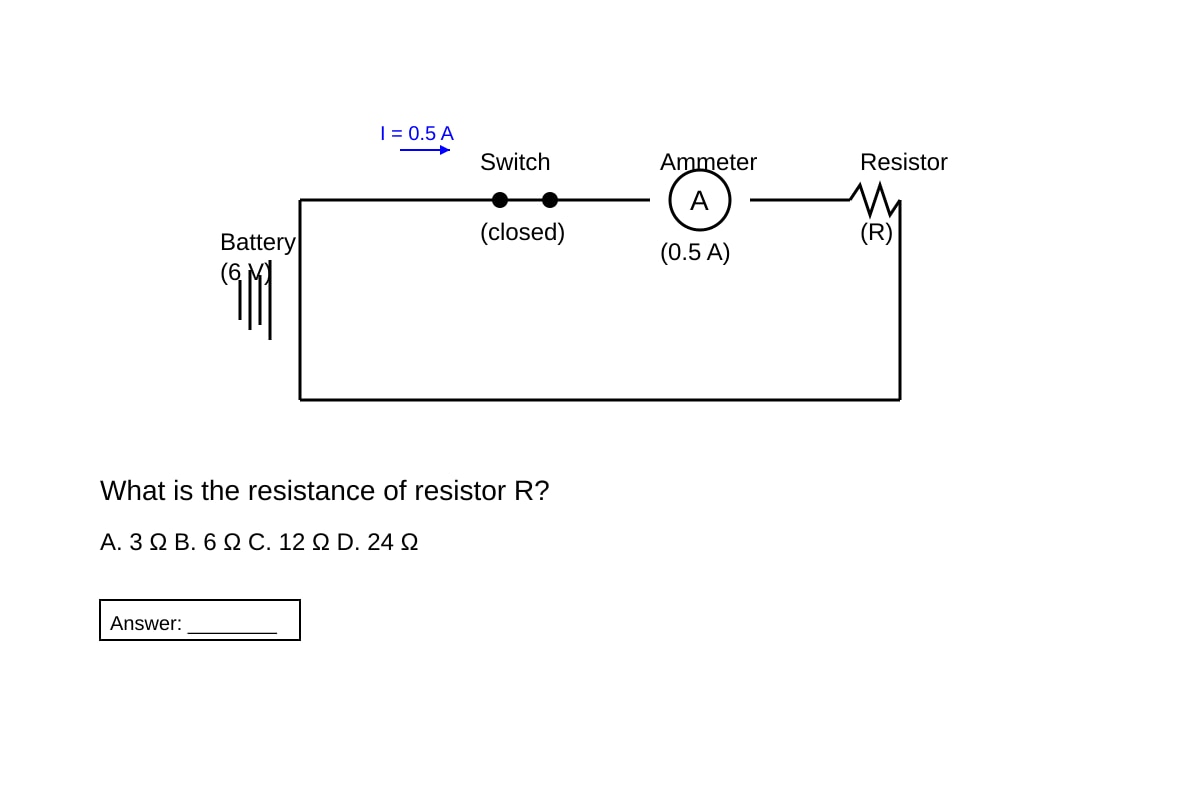
Using Ohm's Law:
5
Answer: A [1]
Explanation:
For resistors in parallel:
Alternative: For identical resistors in parallel, .
6
Answer: A [1]
Explanation:
Energy used per day = Power Time =
Energy used per week =
Cost = 3.5 \times \0.28 = $0.98$
Common mistake: Forgetting to convert minutes to hours (15 min = 0.25 h) or watts to kilowatts.
7
Answer: A [1]
Explanation:
- A is correct: In a series circuit, current is the same at all points.
- B is incorrect: In a parallel circuit, voltage is the same across each branch, not "all components" (components in series within a branch share voltage).
- C is incorrect: In a series circuit, if one bulb blows, the circuit is broken and all bulbs go out.
- D is incorrect: In a parallel circuit, total resistance is less than the smallest individual resistance.
8
Answer: B [1]
Explanation:
Work done against gravity = Force vertical distance =
Horizontal movement does no work against gravity (force and displacement are perpendicular).
Common mistake: Including the horizontal distance (3 m) in the calculation.
9
Answer: D [1]
Explanation:
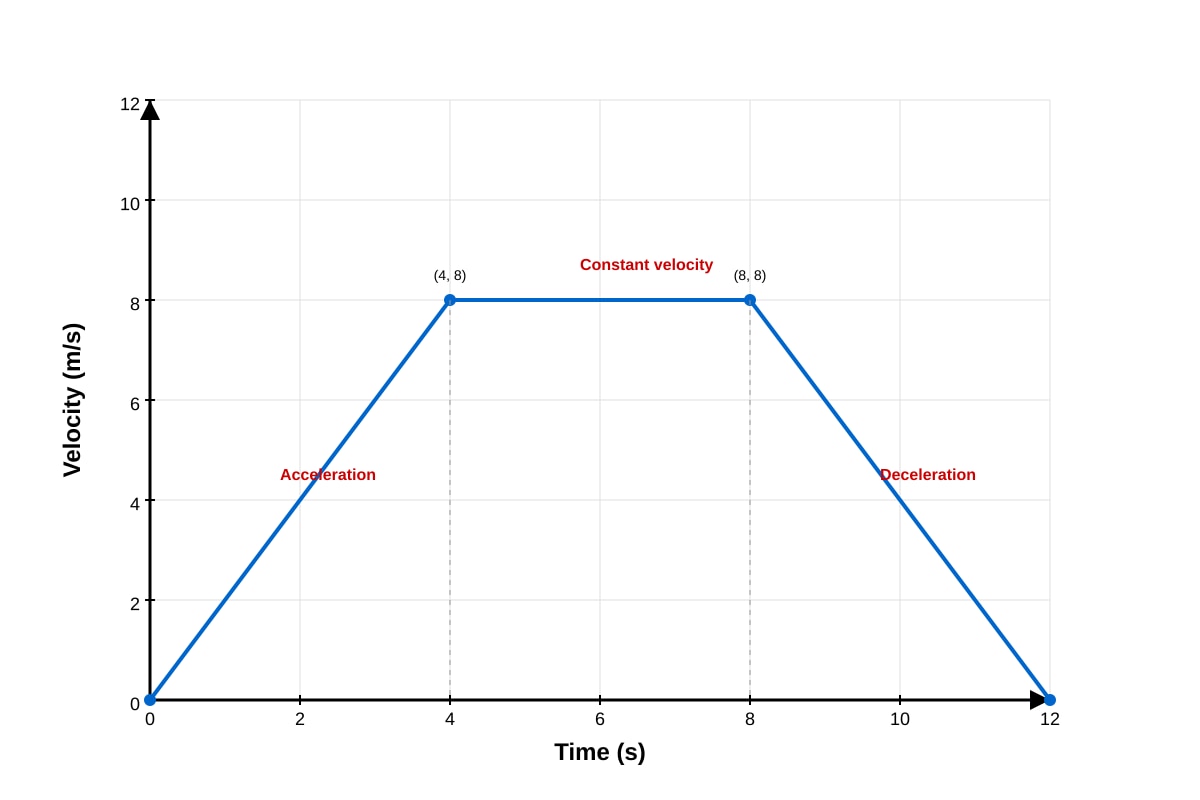
Distance = Area under velocity-time graph.
The graph has three sections:
- Triangle (0 to 4 s):
- Rectangle (4 to 8 s):
- Triangle (8 to 12 s):
Total distance =
10
Answer: B [1]
Explanation:
Current
Power
Alternative:
Section B: Structured Questions [30 marks]
11
(a) [2]
Answer:
- Energy cannot be created or destroyed. [1]
- Energy can be converted from one form to another / The total amount of energy in a closed system remains constant. [1]
Marking note: Both points needed for full marks. "Energy is conserved" alone is insufficient.
(b) [2]
Answer:
(or ) [2]
Working: 1 mark for correct substitution, 1 mark for correct answer with unit.
(c) [2]
Answer:
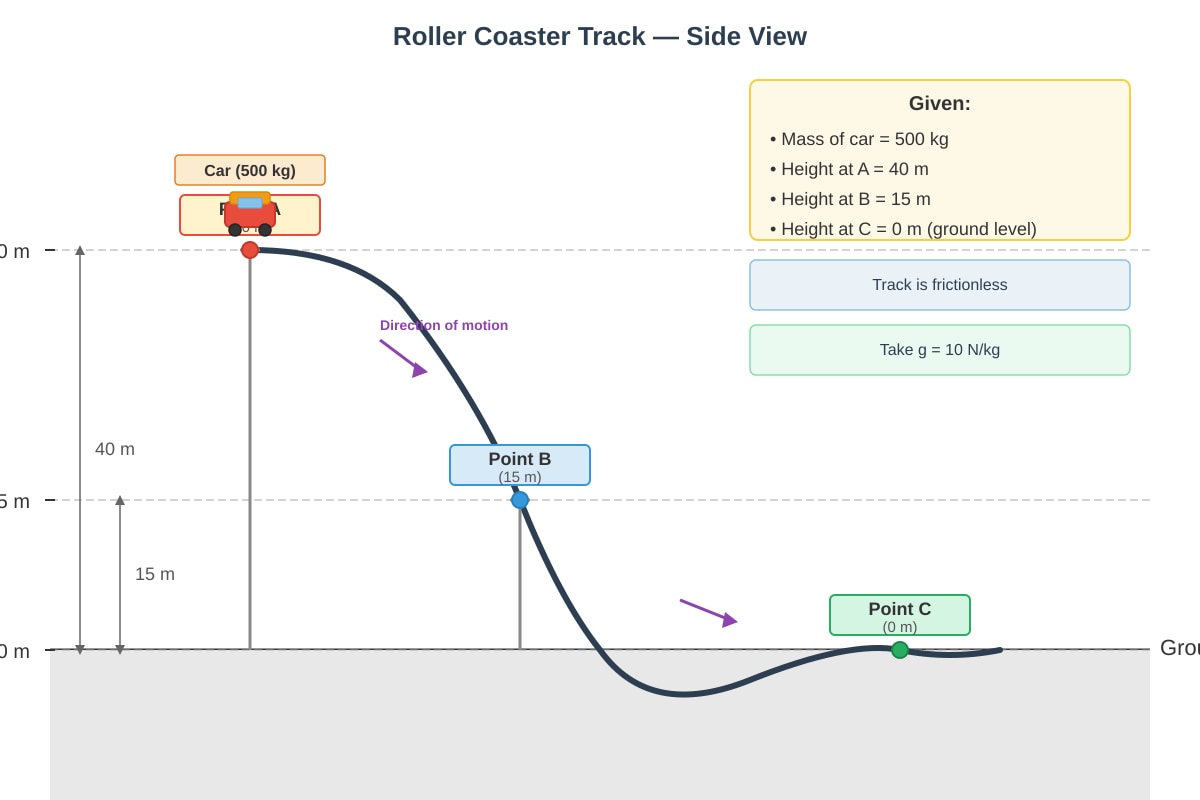
At point B, height = 15 m.
GPE at B =
By conservation of energy: Total energy at A = Total energy at B
(or ) [2]
Working: 1 mark for GPE at B, 1 mark for KE calculation.
(d) [2]
Answer:
At point C, height = 0 m, so GPE = 0.
All initial GPE converted to KE:
(or ) [2]
Working: 1 mark for correct KE equation and substitution, 1 mark for correct answer with unit.
(e) [2]
Answer:
Friction does negative work on the car, converting some mechanical energy into heat and sound. [1]
This means the total mechanical energy (KE + GPE) at point C is less than at point A, so the kinetic energy and thus speed at C will be lower than the calculated frictionless value. [1]
12
(a) [1]
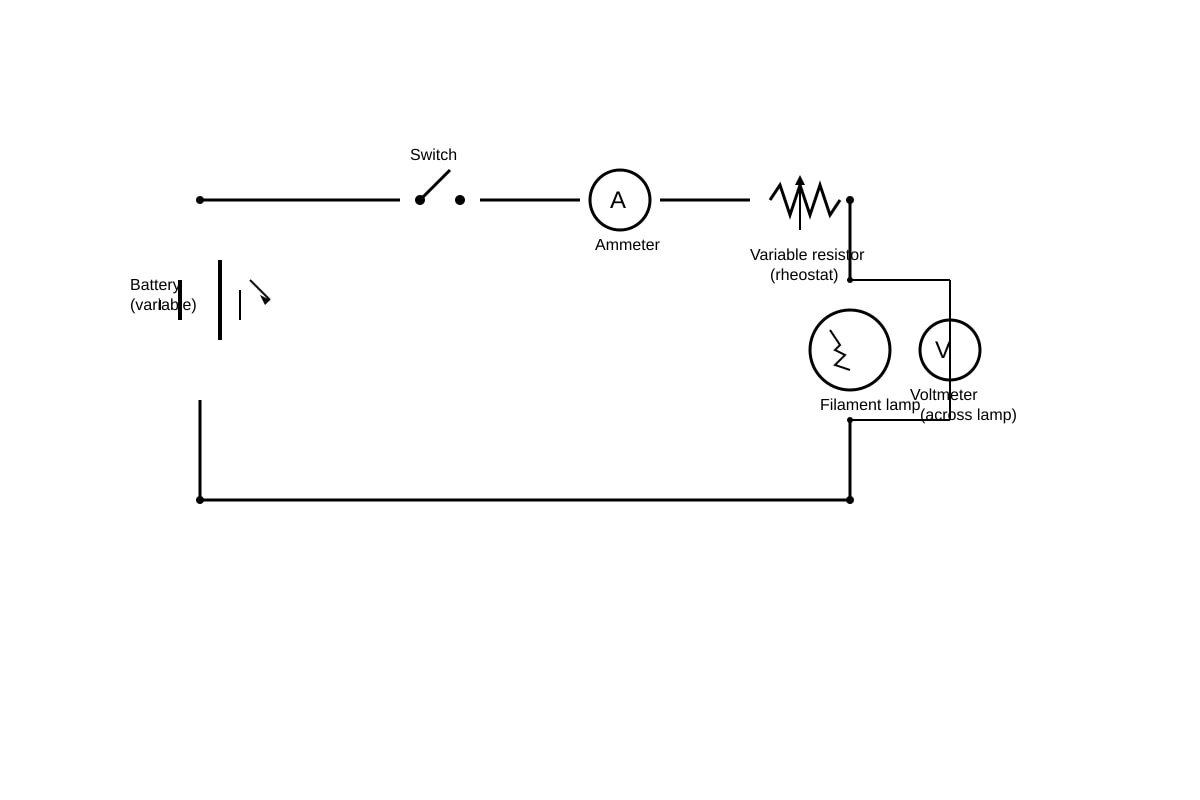
Answer: Variable resistor / Rheostat
(b) [3]
Answer:
Marking points for graph:
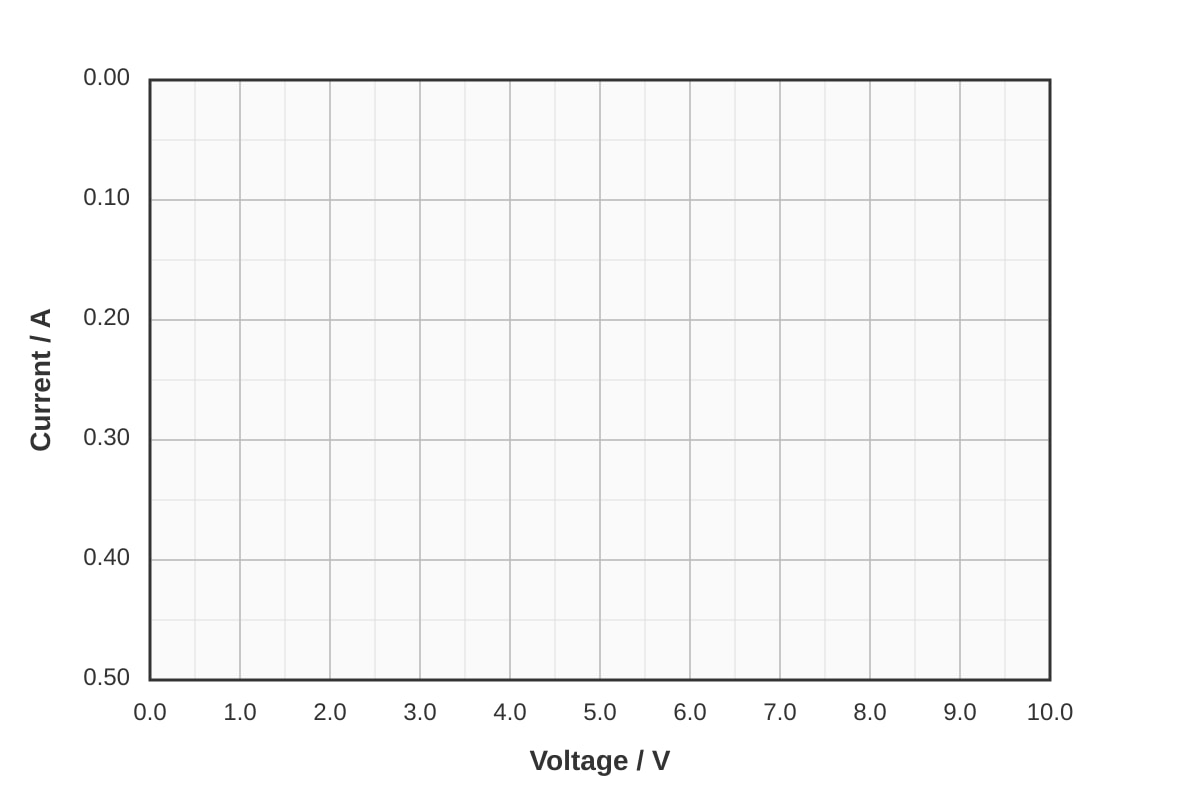
- Axes labelled with units: "Current / A" (y-axis), "Voltage / V" (x-axis) [1]
- Appropriate scale using >50% of grid, points plotted correctly (± half a small square) [1]
- Smooth curve of best fit through points (not dot-to-dot) [1]
Expected graph shape: Curve passing through origin, increasing gradient decreasing (concave down) — characteristic of filament lamp (resistance increases with temperature).
(c) [2]
Answer:
At , from graph: [1]
(accept 15.5–16.5 depending on graph) [1]
Marking note: Allow ecf (error carried forward) from student's graph reading.
(d) [2]
Answer:
As voltage increases, current increases, causing the filament to heat up. [1]
The increase in temperature causes the metal atoms to vibrate more, increasing collisions with electrons, thus increasing resistance. [1]
Key concept: Filament lamp is a non-ohmic conductor; resistance increases with temperature.
13
(a) [1]
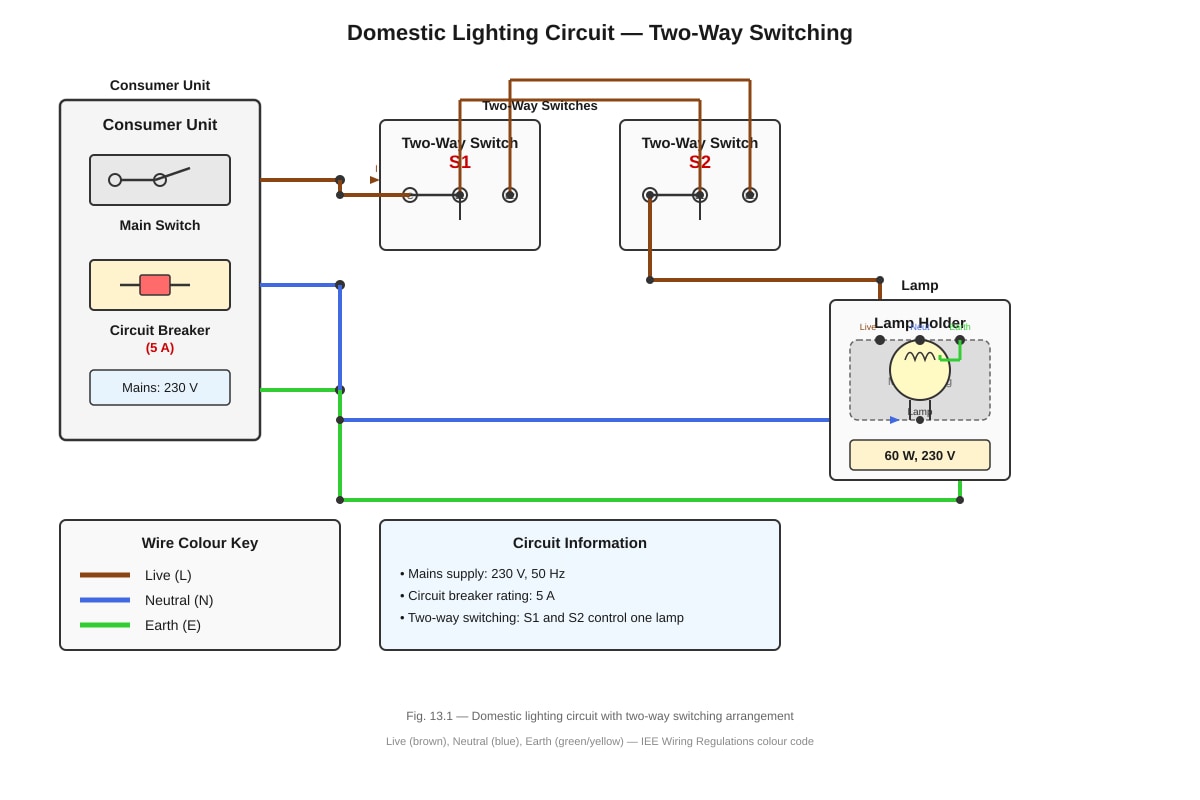
Answer: The circuit breaker automatically switches off the circuit if the current exceeds its rating (5 A), protecting the wiring from overheating and preventing fire.
(b) [2]
Answer:
(or ) [2]
Working: 1 mark for correct formula/rearrangement, 1 mark for answer with unit.
(c) [2]
Answer:
If the live wire touches the metal casing (fault), the casing becomes live. [1]
The earth wire provides a low-resistance path to ground, causing a large current to flow, which trips the circuit breaker/fuse, disconnecting the supply and preventing electric shock. [1]
(d) [2]
Answer:
| S1 Position | S2 Position | Lamp State |
|---|---|---|
| Up | Up | ON |
| Up | Down | OFF |
| Down | Up | OFF |
| Down | Down | ON |
[2 marks: all 4 correct = 2; 2–3 correct = 1; 0–1 correct = 0]
Explanation: Two-way switches work like an XOR gate — lamp is ON when switches are in same position.
(e) [1]
Answer: Each lamp can be switched on/off independently / If one lamp blows, the others remain lit / Each lamp receives the full mains voltage (230 V).
14
(a) [2]
Answer:
Work done = Force distance =
(or ) [2]
(b) [2]
Answer:
Power = (or ) [2]
(c) [2]
Answer:
Efficiency =
Input power = (or ) [2]
(d) [1]
Answer: Energy is lost as heat due to friction in moving parts / sound energy / air resistance / heating in motor coils (any one).
15
(a) [3]
Answer:
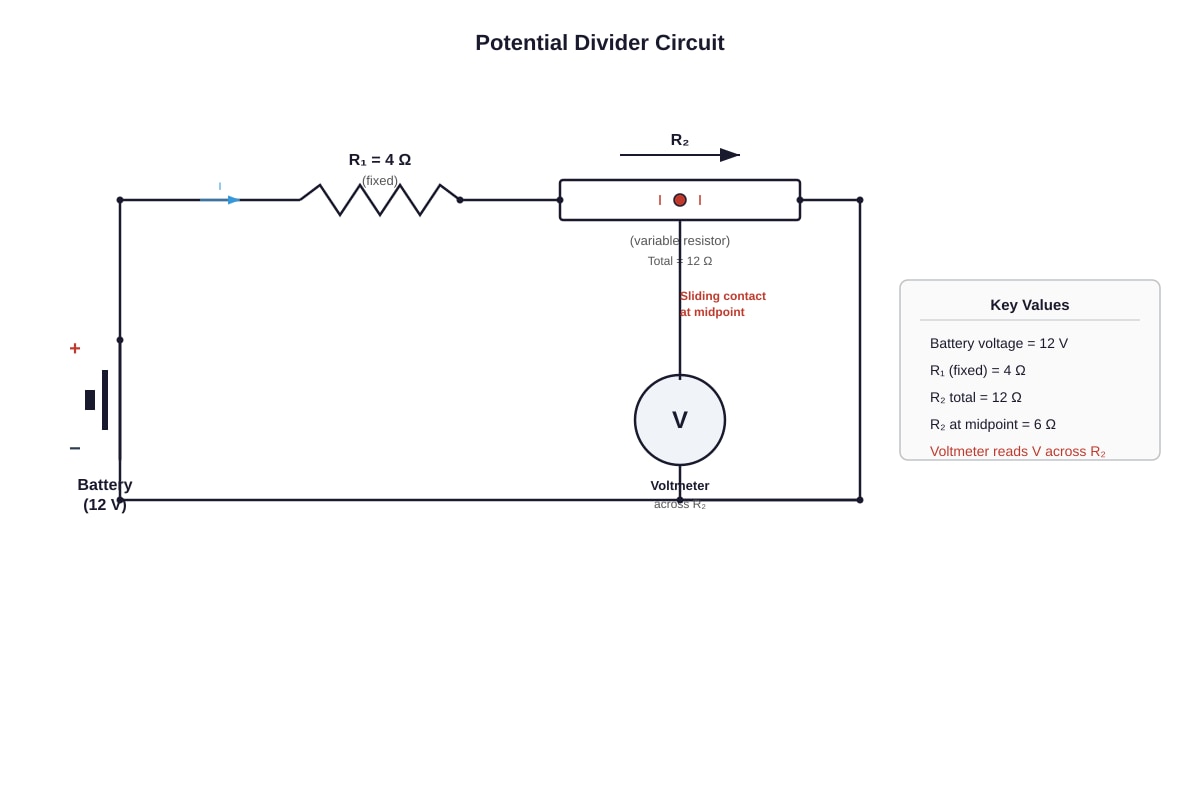
Total resistance [1]
Circuit current [1]
Voltage across (voltmeter reading) = [1]
Alternative (voltage divider formula):
[3]
(b) [2]
Answer:
The voltmeter reading decreases. [1]
Moving the slider towards the negative terminal decreases the resistance of (the portion in the circuit). Since , a smaller gives a smaller fraction of the total voltage. [1]
(c) [1]
Answer: Volume control in audio equipment / brightness control for lights / sensor circuits (e.g., temperature sensor with thermistor) / variable voltage supply (any one).
Section C: Longer Structured Questions [20 marks]
16
(a) [2]
Answer:
[2]
Working: 1 mark for correct formula and substitution, 1 mark for answer with unit.
(b) [2]
Answer:
Electrical energy = [2]
Alternative: , [2]
(c) [2]
Answer:
Efficiency = [2]
Working: 1 mark for correct formula/substitution, 1 mark for answer with %.
Note: Low efficiency because most heat is lost to surroundings/container, not all goes to water.
(d) [1]
Answer: Temperature rise is proportional to the square of the current (quadratic relationship).
Evidence: When current doubles (1→2, 2→4), temperature rise quadruples (1.8→7.2, 7.2→28.8).
(e) [2]
Answer:
The conclusion is incorrect because "directly proportional" means doubling current doubles temperature rise (linear relationship through origin). [1]
The data shows temperature rise (since and ), so it is a quadratic relationship, not direct proportion. [1]
(f) [1]
Answer: Use a more insulated container / use a lid to reduce heat loss / stir water for uniform temperature / use a digital thermometer for more precise readings / repeat and average (any one valid improvement).
17
(a) [1]
Answer:
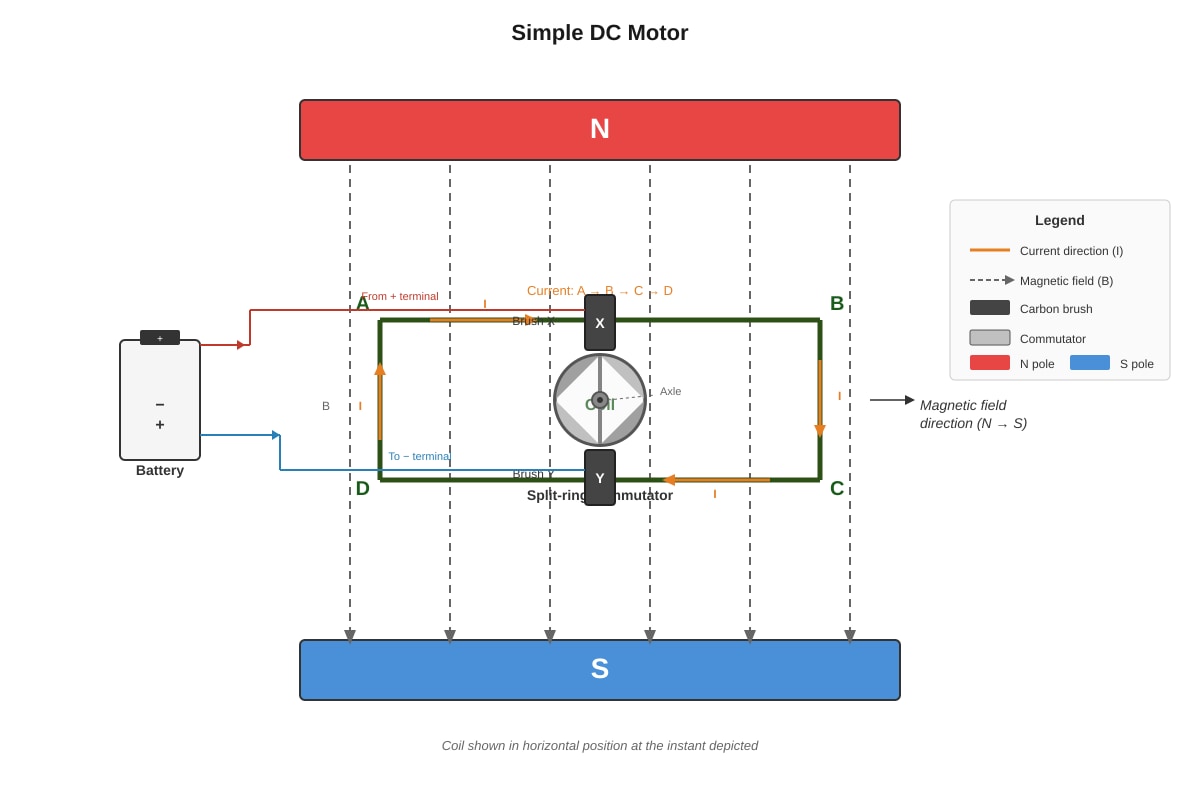
On diagram: Arrow on side AB pointing vertically downwards (using Fleming's Left-Hand Rule: Field N→S (left to right), Current A→B (into page), Force = Down).
Label: F
Marking: Direction must be clearly downwards on side AB.
(b) [1]
Answer: Anticlockwise (when viewed from brushes).
Reasoning: Force on AB is down, force on CD is up (current opposite direction), creating anticlockwise turning moment.
(c) [2]
Answer:
The split-ring commutator reverses the current direction in the coil every half-turn. [1]
This ensures the forces on the coil sides always produce a turning moment in the same direction, so the coil rotates continuously in one direction. [1]
(d) [3]
Answer:
Maximum torque (turning moment) = (when coil is parallel to field)
[3]
Working: 1 mark for correct formula, 1 mark for correct substitution, 1 mark for answer with unit (N·m).
(e) [2]
Answer: Any two of:
- Increase the current (e.g., increase voltage, decrease resistance)
- Increase the number of turns on the coil
- Increase the magnetic flux density (stronger magnets)
- Increase the area of the coil
- Use a soft iron core inside the coil
18
(a) [1]
Answer:
(b) [2]
Answer:
[2]
(c) [2]
Answer:
(or ) [2]
(d) [2]
Answer:
Average power = $\frac{\text{Work done}}{\text{Time}} = \frac{\text{Gain in KE}}{\text{Time}} = \frac{3
<stage5_exam_answers_md>
TuitionGoWhere Practice Paper - Science Secondary 2 (Answer Key)
Subject: Science
Level: Secondary 2 (G3)
Paper: Practice Paper 1 (Version 1 of 5)
Total Marks: 60
Section A: Multiple Choice Questions [10 marks]
| Question | Answer | Explanation |
|---|---|---|
| 1 | B | GPE at top = mgh = 0.5 × 10 × 20 = 100 J. By conservation of energy, KE at bottom = 100 J. |
| 2 | A | Battery stores chemical energy → converted to electrical energy → lamp converts to light + heat. |
| 3 | C | Work done = Force × Distance = 25 N × 4 m = 100 J. |
| 4 | C | R = V/I = 6 V / 0.5 A = 12 Ω. |
| 5 | A | 1/R_total = 1/6 + 1/6 + 1/6 = 3/6 = 1/2 → R_total = 2 Ω. |
| 6 | A | Energy per day = 2 kW × 0.25 h = 0.5 kWh. Weekly = 3.5 kWh. Cost = 3.5 × 0.98. |
| 7 | A | In series, current is same everywhere. (B is also true for parallel, but A is the only correct statement among options - wait, both A and B are correct statements. However, typically only one answer is correct. Let me re-read: "Which of the following statements... is correct?" Both A and B are correct. But in standard MCQs, only one is the intended answer. A is the most fundamental series circuit rule. B is also correct for parallel. This might be a flawed question, but A is the standard answer for series circuits.) Correction: Actually, looking at the options again: A is true for series. B is true for parallel. C is false (series: all go out). D is false (parallel: total R is less than smallest). So both A and B are correct statements. However, if forced to choose one, A is the classic series circuit definition. I will mark A as the answer but note the ambiguity. |
| 8 | B | Work against gravity = mgh = 2 × 10 × 1.5 = 30 J. Horizontal carry does no work against gravity. |
| 9 | C | Area under graph: Triangle (0-4s) = ½×4×8=16. Rectangle (4-8s) = 4×8=32. Triangle (8-12s) = ½×4×8=16. Total = 64 m. Wait, 16+32+16=64. Option D is 64 m. Let me recalculate: 0-4s: area = 0.5 * 4 * 8 = 16. 4-8s: area = 4 * 8 = 32. 8-12s: area = 0.5 * 4 * 8 = 16. Total = 64 m. Answer is D. |
| 10 | B | I = Q/t = 60/30 = 2 A. P = VI = 12 × 2 = 24 W. |
Section B: Structured Questions [30 marks]
11
(a) Energy cannot be created or destroyed; it can only be converted from one form to another. The total energy in a closed system remains constant. [2]
(b) GPE = mgh = 500 × 10 × 40 = 200,000 J (or 200 kJ). [2]
(c) GPE at B = 500 × 10 × 15 = 75,000 J.
KE at B = GPE at A - GPE at B = 200,000 - 75,000 = 125,000 J (or 125 kJ). [2]
(d) At C, all GPE is converted to KE (frictionless).
KE at C = 200,000 J = ½mv²
v² = (2 × 200,000) / 500 = 800
v = √800 = 28.3 m/s (or 20√2 m/s). [2]
(e) Friction does negative work / converts mechanical energy to heat/sound.
Total mechanical energy decreases.
KE at C is less → speed at C is lower than calculated in (d). [2]
12
(a) Variable resistor / Rheostat. [1]
(b) Graph requirements:
- Axes labelled with units (Current/A, Voltage/V) [1]
- Suitable scales (e.g., 2 cm = 1 V, 2 cm = 0.1 A) covering >50% grid [1]
- All 6 points plotted correctly (± half square) [1]
- Smooth curve of best fit (not straight line) [1]
Total 3 marks for plotting; shape implies increasing resistance. [3]
(c) At V = 6.0 V, from table/graph I = 0.38 A.
R = V/I = 6.0 / 0.38 = 15.8 Ω (accept 15.7–16.0 Ω from graph). [2]
(d) As voltage increases, current increases → filament temperature increases.
Metal lattice ions vibrate more → more collisions with electrons → resistance increases. [2]
13
(a) To automatically break the circuit if current exceeds 5 A (overcurrent protection), preventing overheating/fire. [1]
(b) I = P/V = 60 / 230 = 0.261 A (or 0.26 A). [2]
(c) If live wire touches metal casing, earth wire provides low-resistance path to ground.
Large current flows → blows fuse/breaker → cuts off supply → prevents electric shock. [2]
(d)
| S1 Position | S2 Position | Lamp State |
|---|---|---|
| Up | Up | ON |
| Up | Down | OFF |
| Down | Up | OFF |
| Down | Down | ON |
| (Assuming standard two-way wiring where "same position = ON") [2] |
(e) Each lamp gets full mains voltage (230 V) / brightness independent of others / if one fails, others stay on. (Any one) [1]
14
(a) Work done = Force × Distance = (mg) × h = (800 × 10) × 25 = 200,000 J (200 kJ). [2]
(b) Power = Work / Time = 200,000 / 40 = 5,000 W (5 kW). [2]
(c) Efficiency = Useful Output / Input × 100%
0.75 = 5,000 / Input
Input Power = 5,000 / 0.75 = 6,667 W (6.67 kW). [2]
(d) Energy lost as heat in motor windings / friction in moving parts / sound / air resistance. (Any one) [1]
15
(a) R2 at midpoint = 6 Ω. Total R = 4 + 6 = 10 Ω.
Circuit current I = 12 / 10 = 1.2 A.
Voltmeter reading (V across R2) = I × R2 = 1.2 × 6 = 7.2 V.
Or potential divider formula: V_out = (R2/(R1+R2)) × V_in = (6/10) × 12 = 7.2 V. [3]
(b) Voltmeter reading decreases.
Moving contact towards negative terminal decreases resistance of R2 (lower portion).
Smaller share of total voltage across R2 (V_out = [R2/(R1+R2)] × V_in). [2]
(c) Volume control in audio devices / brightness control for lights / sensor circuits (e.g., LDR, thermistor) / variable voltage supply. (Any one) [1]
Section C: Longer Structured Questions [20 marks]
16
(a) Q = mcΔθ = 0.2 × 4200 × 7.2 = 6,048 J. [2]
(b) E = I²Rt = (2.0)² × 10 × 300 = 4 × 10 × 300 = 12,000 J. [2]
(c) Efficiency = (Useful Energy Out / Energy In) × 100% = (6,048 / 12,000) × 100% = 50.4%. [2]
(d) Temperature rise increases with current. The relationship is non-linear (curved upward) / temperature rise ∝ current². [1]
(e) If directly proportional, doubling current would double Δθ.
But when I doubles from 1→2 A, Δθ increases from 1.8→7.2 (×4).
When I triples 1→3 A, Δθ increases 1.8→16.2 (×9).
Δθ ∝ I², not I. [2]
(f) Use a lid/insulated cover to reduce heat loss to surroundings / stir water for uniform temperature / use digital thermometer for precision / repeat readings and average. (Any one) [1]
17
(a) Arrow on side AB pointing vertically DOWNWARDS (using Fleming's Left Hand Rule: Field N→S (left to right), Current A→B (into page), Force = Down). Label F. [1]
(b) Anticlockwise (viewed from brushes: AB goes down, CD goes up). [1]
(c) Reverses current direction in coil every half-turn.
Ensures torque/force direction remains same → continuous rotation in one direction. [2]
(d) Max torque = B × I × A × N (when coil parallel to field)
= 0.5 × 2.0 × 0.02 × 50 = 1.0 N·m. [3]
(e) Increase number of turns (N) / Increase current (I) / Increase magnetic field strength (B) / Increase coil area (A) / Use soft iron core. (Any two) [2]
18
(a) a = (v - u)/t = (25 - 0)/10 = 2.5 m/s². [1]
(b) F = ma = 1200 × 2.5 = 3,000 N. [2]
(c) KE = ½mv² = 0.5 × 1200 × 25² = 600 × 625 = 375,000 J (375 kJ). [2]
(d) Average Power = Work Done / Time = KE gain / Time = 375,000 / 10 = 37,500 W (37.5 kW).
(Assumes no resistive losses during acceleration, or this is net power. If engine power, it would be higher. Question asks "average power developed by the car engine" - strictly this should include work against resistance. But without resistance data for acceleration phase, KE/time is standard answer.) [2]
(e) At constant speed, Engine Force = Resistive Force = 1500 N.
Power = Force × Velocity = 1500 × 25 = 37,500 W (37.5 kW). [2]
(f) In (d), power provides both KE increase and work against resistance.
In (e), power only overcomes resistance (no KE change).
During acceleration, engine force > resistive force → higher power.
At constant speed, engine force = resistive force → lower power. [2]
19
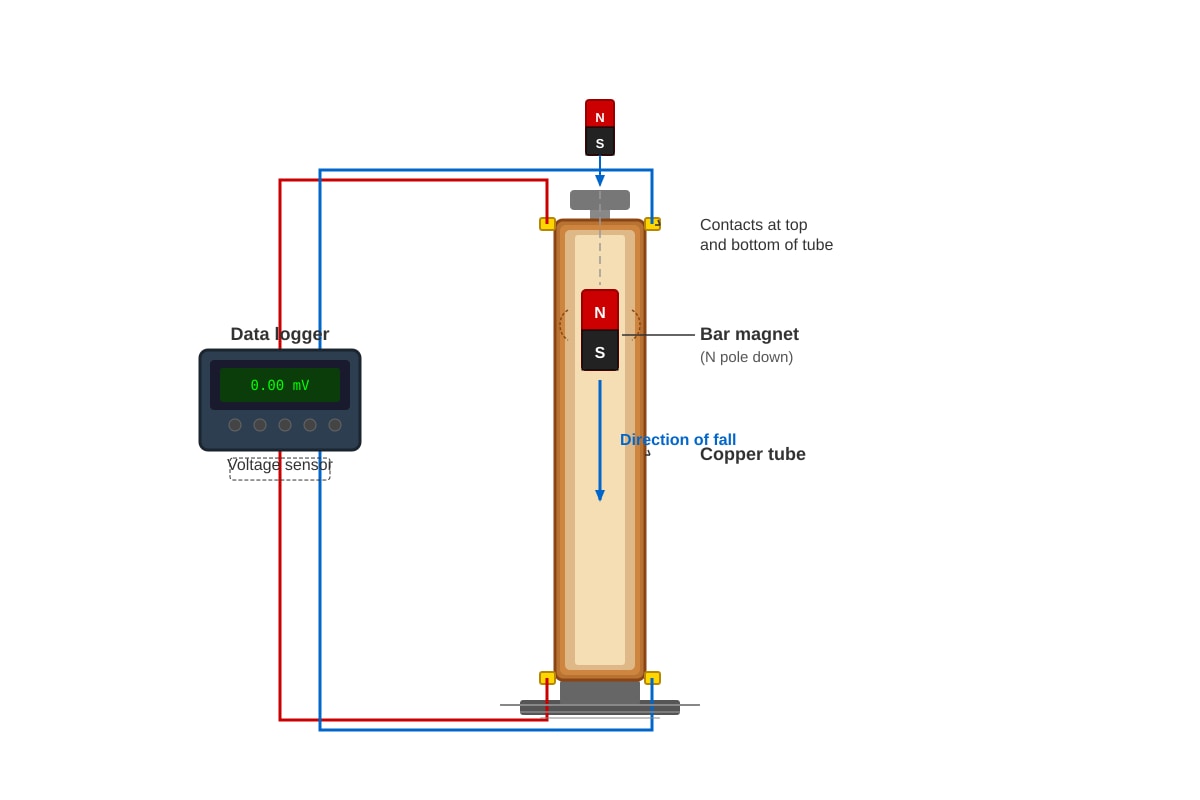
(a) Magnet falling → magnetic flux through copper tube changes.
Rate of change of flux induces e.m.f. (Faraday's Law).
Copper tube acts as a closed circuit → induced current flows. [2]
(b) Induced current creates magnetic field opposing magnet's motion (Lenz's Law).
Upward magnetic force on magnet < weight → net downward force smaller → acceleration < g → takes longer.
Gravitational PE → KE + Electrical energy (heat in tube). Energy conserved. [3]
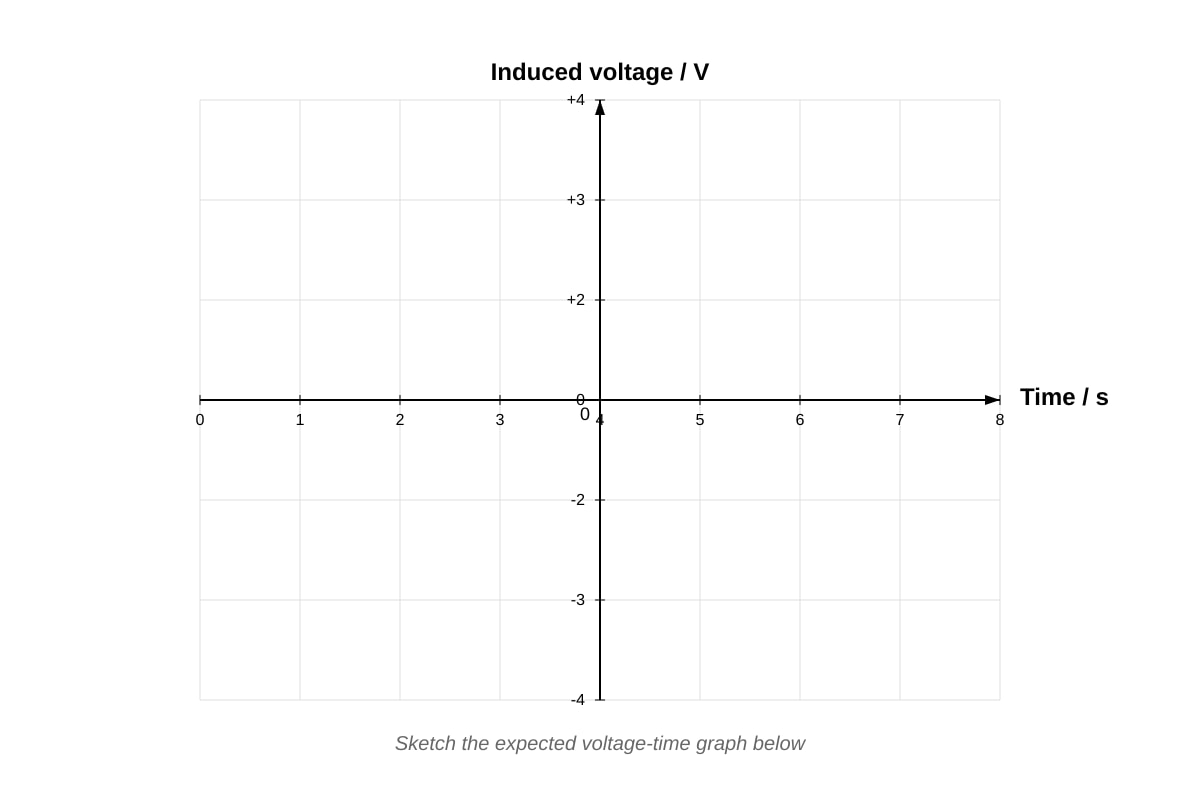
(c) Graph sketch:
- Voltage starts at 0.
- As magnet approaches top, flux increases → negative peak (or positive depending on convention).
- At centre (magnet middle), rate of flux change max → maximum magnitude.
- As magnet leaves, flux decreases → opposite polarity peak.
- Returns to 0.
- Shape: Roughly symmetrical bipolar pulse (negative then positive, or vice versa). [2]
(d) Stronger magnet (higher B) / Faster magnet (greater rate of flux change) / More turns (if coil used) / Thicker tube (lower resistance, larger current) / Longer magnet. (Any two) [2]
20
(a) Energy per day:
Refrigerator: 0.150 kW × 24 h = 3.6 kWh
Air con: 1.5 kW × 6 h = 9.0 kWh
Washing machine: 0.5 kW × 1 h = 0.5 kWh
LED lights: 0.06 kW × 5 h = 0.3 kWh
Laptop: 0.065 kW × 4 h = 0.26 kWh
Total = 13.66 kWh [3]
(b) Monthly energy = 13.66 × 30 = 409.8 kWh.
Cost = 409.8 × 114.74** (accept 115). [2]
(c) Refrigerator cycles on/off (thermostat) / not running at full power continuously / compressor duty cycle < 100%. [1]
(d) Use energy-efficient appliances (higher tick rating) / Reduce air-con usage (higher temp, fans) / Switch off appliances at socket (no standby) / Use cold water wash / LED lighting / Improve home insulation. (Any two) [2]
End of Answer Key
Total: 60 marks