From Real Exams Exam Paper
Secondary 2 Science Semestral Assessment 2 (End of Year) Paper 5
Free Sec 2 Science SA2 Paper 5, Nemo3 Exam version, with questions, answers, and syllabus-aligned practice for Singapore students.
These static practice materials are generated from the site's syllabus and paper-generation workflow, with source and model context shown so students and parents can evaluate the material before use.
Questions
Free quiz and exam paper access
Enter your details to view this paper
Your access is remembered on this device.
Answers
TuitionGoWhere Practice Paper - Science Secondary 2 (SA2 Version 5) - Answer Key
Total Marks: 60
Section A: Multiple Choice Questions [10 marks]
1
Answer: B [1]
Working:
- Loss in GPE = Gain in KE (conservation of energy)
- GPE =
- KE just before hitting ground = 100 J
Key concept: For a falling object with no air resistance, all gravitational potential energy converts to kinetic energy.
2
Answer: B [1]
Explanation: In a hydroelectric power station, water stored at height has gravitational potential energy → flows down gaining kinetic energy → turns turbines connected to generators producing electrical energy.
Energy conversion chain: Potential energy → Kinetic energy → Electrical energy
3
Answer: C [1]
Working:
- Work done = Force × Distance moved in direction of force
4
Answer: C [1]
Working:
- GPE gained =
5
Answer: B [1]
Explanation: Work done = Force × Distance moved in direction of force. When holding a bag stationary, there is no displacement in the direction of the upward force, so no work is done (even though the person gets tired - this is due to internal muscular work, not mechanical work on the bag).
Common mistake: Confusing "effort" with "work done" in the physics sense.
6
Answer: B [1]
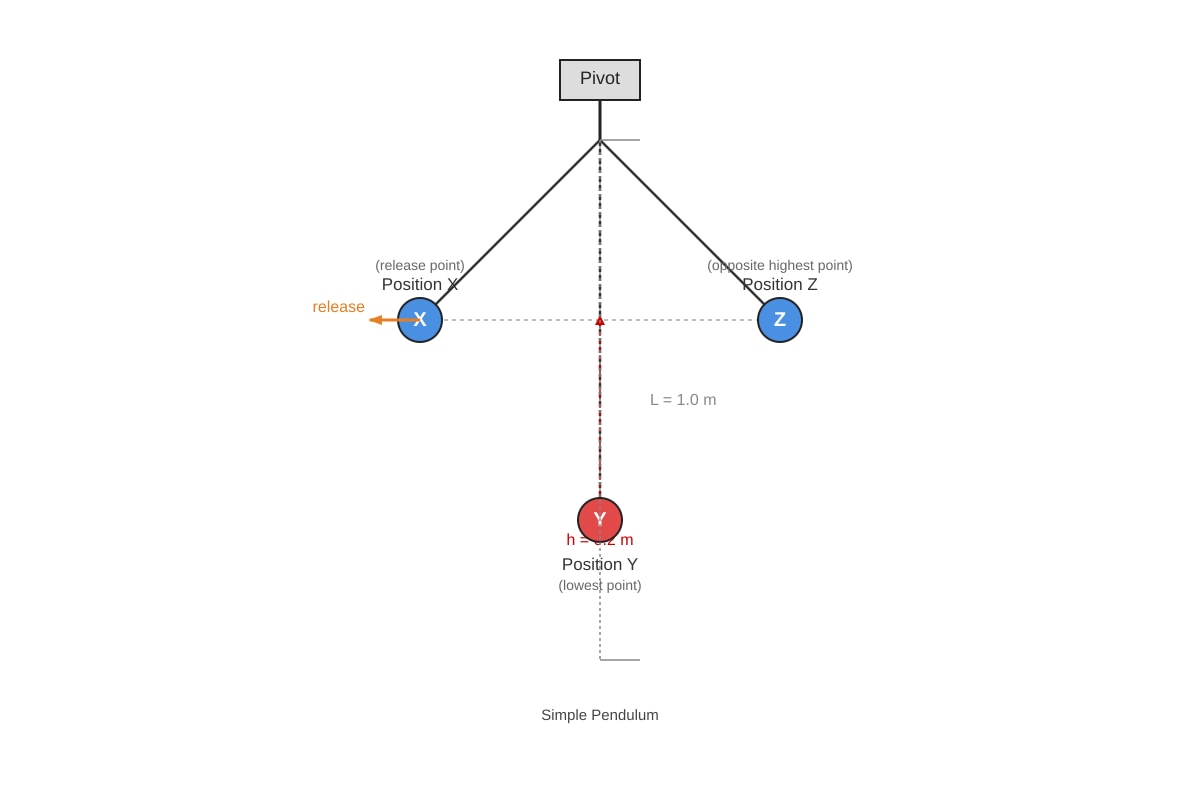
Explanation: At position Y (lowest point), all gravitational potential energy has been converted to kinetic energy (maximum speed). At positions X and Z, the bob is momentarily at rest (zero kinetic energy, maximum potential energy).
7
Answer: B [1]
Working:
- Power = 2000 W = 2000 J/s
- Time = 10 minutes = 600 s
- Energy = Power × Time = 2000 × 600 = 1,200,000 J
8
Answer: B [1]
Working:
- Final KE =
- Average power = Work done / Time = 200,000 / 10 = 20,000 W
9
Answer: C [1]
Explanation: The principle of conservation of energy states that energy cannot be created or destroyed; the total energy of an isolated system remains constant. Energy can only be converted from one form to another.
10
Answer: C [1]
Working:
Section B: Structured Questions [30 marks]
11
(a) [1] Answer: 1.0 J
Working:
- GPE =
(b) [2] Answer: 1.0 J
Explanation: By conservation of energy on a frictionless ramp, all GPE at A converts to KE at B. Since GPE at A = 1.0 J, KE at B = 1.0 J.
Mark breakdown:
- 1 mark for correct value (1.0 J)
- 1 mark for correct explanation (conservation of energy / no energy loss on frictionless ramp)
(c) [2] Answer: 0.1 m (or 10 cm)
Working:
- At maximum compression, all KE converts to elastic potential energy in spring
Mark breakdown:
- 1 mark for correct equation
- 1 mark for correct calculation and answer with unit
(d) [1] Answer: Friction does negative work on the car, converting some mechanical energy to heat/sound. Less energy is available to compress the spring, so maximum compression decreases.
Key concept: Non-conservative forces (friction) dissipate mechanical energy.
12
(a) [2] Answer: 2400 J
Working:
- Work done = Force × Distance = Weight × Height
Mark breakdown:
- 1 mark for correct force (weight = 1200 N)
- 1 mark for correct work calculation with unit
(b) [1] Answer: 1600 W
Working:
- Power = Work / Time = 2400 / 1.5 = 1600 W
(c) [1] Answer: 0 J. No displacement occurs while holding the barbell stationary, so no work is done on the barbell.
Key concept: Work requires displacement in the direction of the force.
(d) [2] Answer: Negative work.
Explanation: The weightlifter exerts an upward force while the barbell moves downward. The force and displacement are in opposite directions, so work done by the weightlifter is negative. The weightlifter is controlling the descent, absorbing energy.
Mark breakdown:
- 1 mark for "negative"
- 1 mark for correct explanation (force opposite to displacement)
13
(a) [1] Answer: 400,000 J (or )
Working:
- GPE lost =
(b) [2] Answer: 75%
Working:
- Input power (rate of GPE loss) = 400,000 J/s = 400 kW
- Output power = 300 kW
- Efficiency =
Mark breakdown:
- 1 mark for calculating input power (400 kW)
- 1 mark for correct efficiency calculation with %
(c) [1] Answer: Heat and sound (or kinetic energy of water turbulence, heat in bearings/generator)
Acceptable answers: Heat, sound, kinetic energy of splashing water, electrical resistance losses in generator.
14
(a) [1] Answer: 5.76 (already filled in table)
Working:
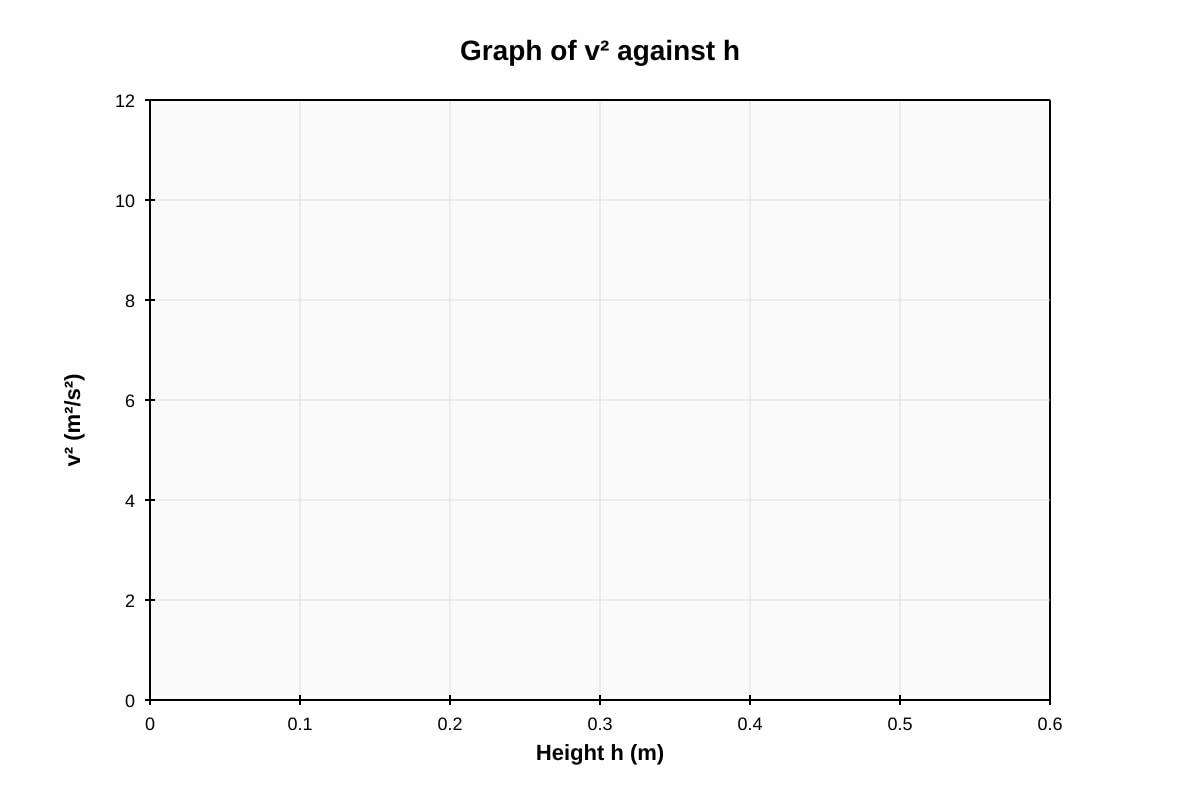
(b) [2] Answer: Correctly plotted points with best-fit straight line through origin.
Mark breakdown:
- 1 mark for all 5 points plotted correctly (± half a small square)
- 1 mark for best-fit straight line passing through origin (0,0)
(c) [1] Answer: 20 m/s² (or 20.0 m/s²)
Working:
- Gradient =
- Accept range 20–21 m/s² depending on plotted points
(d) [1] Answer: 10 m/s²
Working:
- Theory: , so gradient =
(e) [1] Answer: Friction between trolley and ramp / air resistance / rotational kinetic energy of wheels not accounted for / measurement errors in height or speed.
Any one valid reason accepted.
15
(a) [1] Answer: 0.25 A
Working:
(b) [1] Answer: 0.3 kWh
Working:
- Energy = Power × Time = 60 W × 5 h = 300 Wh = 0.3 kWh
(c) [1] Answer: $0.084 (or 8.4 cents)
Working:
- Cost = 0.3 kWh × 0.084
(d) [2] Answer: 648,000 J (or )
Working:
- Total electrical energy = Power × Time = 60 W × (5 × 3600 s) = 60 × 18,000 = 1,080,000 J
- Useful light energy = 10% × 1,080,000 = 108,000 J
Wait, let me recalculate:
- 5 hours = 5 × 3600 = 18,000 s
- Total energy = 60 × 18,000 = 1,080,000 J
- 10% efficient → Light energy = 0.10 × 1,080,000 = 108,000 J
Mark breakdown:
- 1 mark for total electrical energy in joules (1,080,000 J)
- 1 mark for correct useful energy (108,000 J)
Section C: Longer Structured and Data-Based Questions [20 marks]
16
(a) [1] Answer: 300,000 J (or )
Working:
- Total mechanical energy at A = GPE (since KE = 0 at rest)
(b) [2] Answer: 34.6 m/s (or )
Working:
- At B (height 0), all energy is KE
Mark breakdown:
- 1 mark for correct energy equation
- 1 mark for correct calculation and unit
(c) [2] Answer: 100,000 J (or )
Working:
- At C (height 40 m): GPE =
- Total energy = 300,000 J (conserved)
- KE at C = Total - GPE = 300,000 - 200,000 = 100,000 J
Mark breakdown:
- 1 mark for GPE at C (200,000 J)
- 1 mark for KE = 100,000 J
(d) [2] Answer: Yes, it is consistent. At point E (height 30 m), GPE = . Since speed is zero, KE = 0. Total mechanical energy = 150,000 J, which is less than the initial 300,000 J. This means the car cannot reach point E with zero speed if energy is conserved — it would need 300,000 J total energy to reach 60 m height.
Wait, let me re-read the question: "The car just reaches the top of Hill 3 (point E) with zero speed. Explain whether this is consistent with the principle of conservation of energy."
If the car reaches height 30 m with zero speed, its total energy is 150,000 J. But initial energy was 300,000 J. This violates conservation of energy unless energy was lost. So the statement "car just reaches top of Hill 3 with zero speed" is NOT consistent with conservation of energy on a frictionless track.
Corrected Answer: No, it is not consistent. On a frictionless track, total mechanical energy is conserved (300,000 J). At point E (30 m), GPE would be 150,000 J. With zero speed (KE = 0), total energy would be 150,000 J, which is less than the initial 300,000 J. For conservation of energy to hold, the car would have 150,000 J of KE at point E, meaning it would still be moving.
Mark breakdown:
- 1 mark for "No / not consistent"
- 1 mark for correct explanation using energy values
(e) [2] Answer: In reality, friction between wheels/track and air resistance do negative work, converting mechanical energy to heat and sound. The "missing" mechanical energy is dissipated as thermal energy (heat) and sound energy.
Mark breakdown:
- 1 mark for identifying friction/air resistance as cause
- 1 mark for stating energy converted to heat/sound
17
(a) [1] Answer: 0.5 J
Working:
- Elastic PE =
(b) [2] Answer: 5.0 m
Working:
- Elastic PE → GPE at max height
Mark breakdown:
- 1 mark for correct energy equation
- 1 mark for correct calculation with unit
(c) [2] Answer: Some energy is lost to air resistance during the up and down motion, and possibly to heat/sound when the pellet hits the spring. The pellet has less kinetic energy when it returns to the spring, so it compresses the spring less (0.04 m vs 0.05 m).
Mark breakdown:
- 1 mark for identifying energy loss (air resistance / impact)
- 1 mark for linking less energy to less compression
18
(a) [1] Answer: 30,000 J (or )
Working:
- GPE gain =
(b) [1] Answer: 6,400 J (or )
Working:
- KE =
(c) [2] Answer: 606.7 W (or 607 W)
Working:
- Total energy per minute = GPE + KE = 30,000 + 6,400 = 36,400 J
- Power = Energy / Time = 36,6,6400 J / 60 s = 606.67 W ≈ 607 W
Mark breakdown:
- 1 mark for total energy per minute (36,400 J)
- 1 mark for power calculation with unit (W)
(d) [1] Answer: 50.6% (or 51%)
Working:
- Efficiency =
19
(a) [2] Answer: 0.134 m (or 13.4 cm)
Working:
Mark breakdown:
- 1 mark for correct method ( or equivalent)
- 1 mark for correct calculation with unit
(b) [2] Answer: 1.64 m/s (or 1.6 m/s)
Working:
- GPE at max displacement = KE at bottom
Mark breakdown:
- 1 mark for correct energy equation
- 1 mark for correct calculation with unit
(c) [2] Answer:
- At release: GPE (maximum) → converts to KE as bob swings down
- At bottom: KE (maximum) → converts to GPE as bob swings up
- At each swing: Some energy lost to air resistance (and friction at pivot) → heat/sound
- Eventually: All mechanical energy dissipated as heat and sound; bob comes to rest at bottom with zero KE and zero GPE (relative to bottom)
Mark breakdown:
- 1 mark for describing GPE ↔ KE conversions during oscillation
- 1 mark for mentioning energy loss to air resistance/friction and final dissipation
<stage3_exam_answers_md>
TuitionGoWhere Practice Paper - Science Secondary 2
TuitionGoWhere Secondary School (AI)
Subject: Science
Level: Secondary 2 (G3)
Paper: SA2 Version 5
Duration: 1 hour 30 minutes
Total Marks: 60
Marking Scheme and Model Answers
Section A: Multiple Choice Questions [10 marks]
| Question | Answer | Explanation |
|---|---|---|
| 1 | B | GPE at top = mgh = 0.5 × 10 × 20 = 100 J. By conservation of energy, KE at bottom = 100 J. |
| 2 | B | Water at height has GPE → flows down gaining KE → turns turbine generating electrical energy. |
| 3 | C | Work done = Force × Distance = 25 N × 4 m = 100 J. |
| 4 | C | GPE gained = mgh = 3 × 10 × 1.5 = 45 J. |
| 5 | B | Work done = Force × Distance moved in direction of force. No displacement while holding stationary. |
| 6 | B | Maximum KE at lowest point (Y) where GPE is minimum and speed is maximum. |
| 7 | B | Energy = Power × Time = 2000 W × (10 × 60) s = 2000 × 600 = 1,200,000 J. |
| 8 | B | KE gained = ½mv² = 0.5 × 1000 × 20² = 200,000 J. Average Power = Work/Time = 200,000/10 = 20,000 W. |
| 9 | C | Principle of conservation of energy: Total energy of an isolated system remains constant. |
| 10 | C | mgh = ½mv² → v = √(2gh) = √(2 × 10 × 50) = √1000 ≈ 31.6 m/s ≈ 32 m/s. |
Section B: Structured Questions [30 marks]
11
(a) GPE at A = mgh = 0.2 × 10 × 0.5 = 1.0 J [1]
(b) KE at B = 1.0 J [1]
Explanation: By conservation of energy on a frictionless ramp, all GPE at A is converted to KE at B. [1]
(c) At maximum compression, KE at B = Elastic PE in spring
1.0 = ½kx² = ½ × 200 × x²
x² = 1.0 / 100 = 0.01
x = 0.10 m (or 10 cm) [2]
(d) Friction does negative work / dissipates energy as heat/sound. [½]
Less energy reaches the spring, so maximum compression is smaller. [½]
12
(a) Work done = Force × Distance = Weight × Height = mg × h = 120 × 10 × 2.0 = 2400 J [2]
(b) Average Power = Work / Time = 2400 / 1.5 = 1600 W [1]
(c) Work done = 0 J [½]
Explanation: No displacement while holding stationary, so no work done (Work = Force × Distance). [½]
(d) Work done is negative. [1]
Explanation: The weightlifter exerts an upward force, but the displacement is downward. Force and displacement are in opposite directions, so work done is negative. [1]
13
(a) GPE lost = mgh = 500 × 10 × 80 = 400,000 J (or 400 kJ) [1]
(b) Input power = Rate of GPE loss = 400,000 J/s = 400 kW
Efficiency = (Output Power / Input Power) × 100% = (300 / 400) × 100% = 75% [2]
(c) Heat and sound (also accept: kinetic energy of water turbulence, internal energy) [1]
14
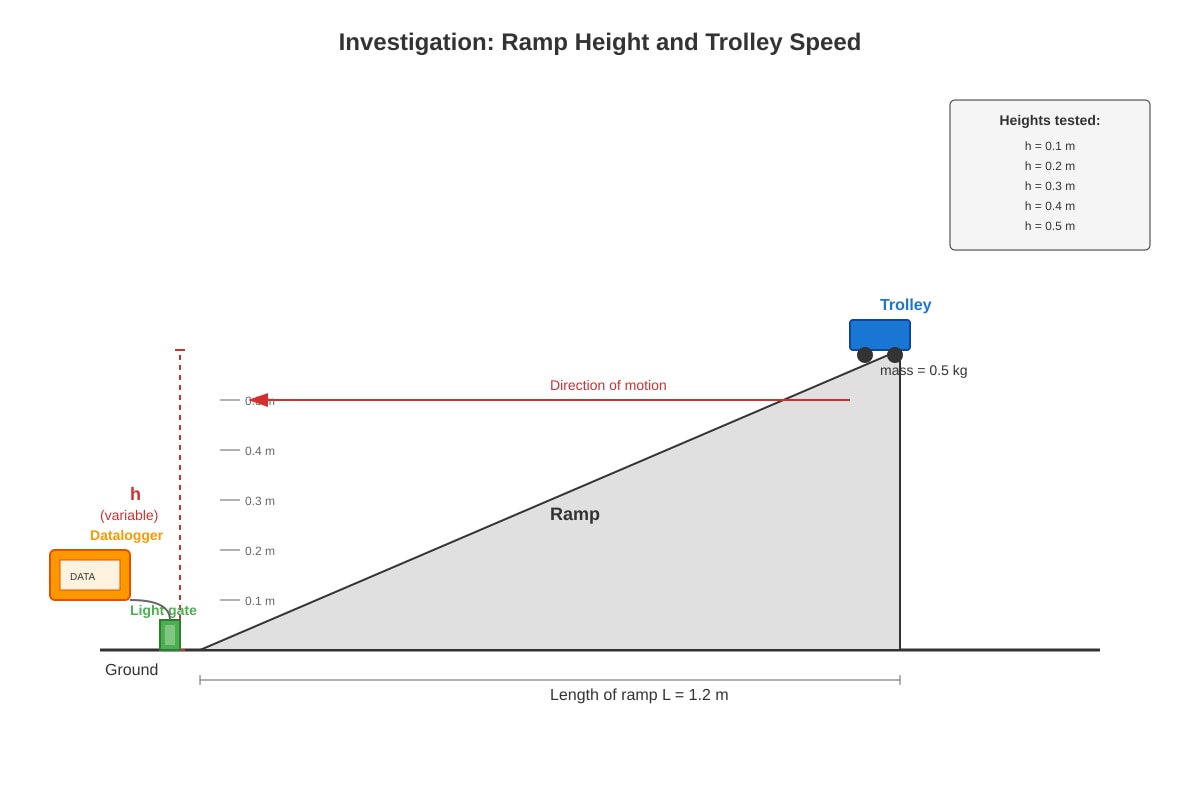
(a) For h = 0.30 m, v = 2.4 m/s → v² = 2.4² = 5.76 m²/s² [1] (Already filled in table)
(b) Graph plotting: [2]
- Axes labelled with units: x-axis "Height h (m)", y-axis "v² (m²/s²)" [½]
- Appropriate scales covering data range [½]
- All 5 points plotted correctly [½]
- Best-fit straight line through origin [½]
(c) Gradient = Δv² / Δh = (10.24 - 1.96) / (0.50 - 0.10) = 8.28 / 0.40 = 20.7 m/s² (accept 20–21) [1]
(d) Theoretical: v² = 2gh → Gradient = 2g
g = Gradient / 2 = 20.7 / 2 = 10.35 m/s² (accept 10–10.5) [1]
(e) Any one: Friction between trolley and ramp / air resistance / light gate measurement error / ramp not perfectly rigid / trolley wobble / rotational KE of wheels not accounted for. [1]
15
(a) P = VI → I = P/V = 60 / 240 = 0.25 A [1]
(b) Energy = Power × Time = 60 W × 5 h = 300 Wh = 0.3 kWh [1]
(c) Cost = 0.3 kWh × 0.084** (or 8.4 cents) [1]
(d) Total electrical energy = 0.3 kWh = 0.3 × 3.6 × 10⁶ = 1,080,000 J
Useful light energy = 10% × 1,080,000 = 108,000 J [2]
Section C: Longer Structured and Data-Based Questions [20 marks]
16
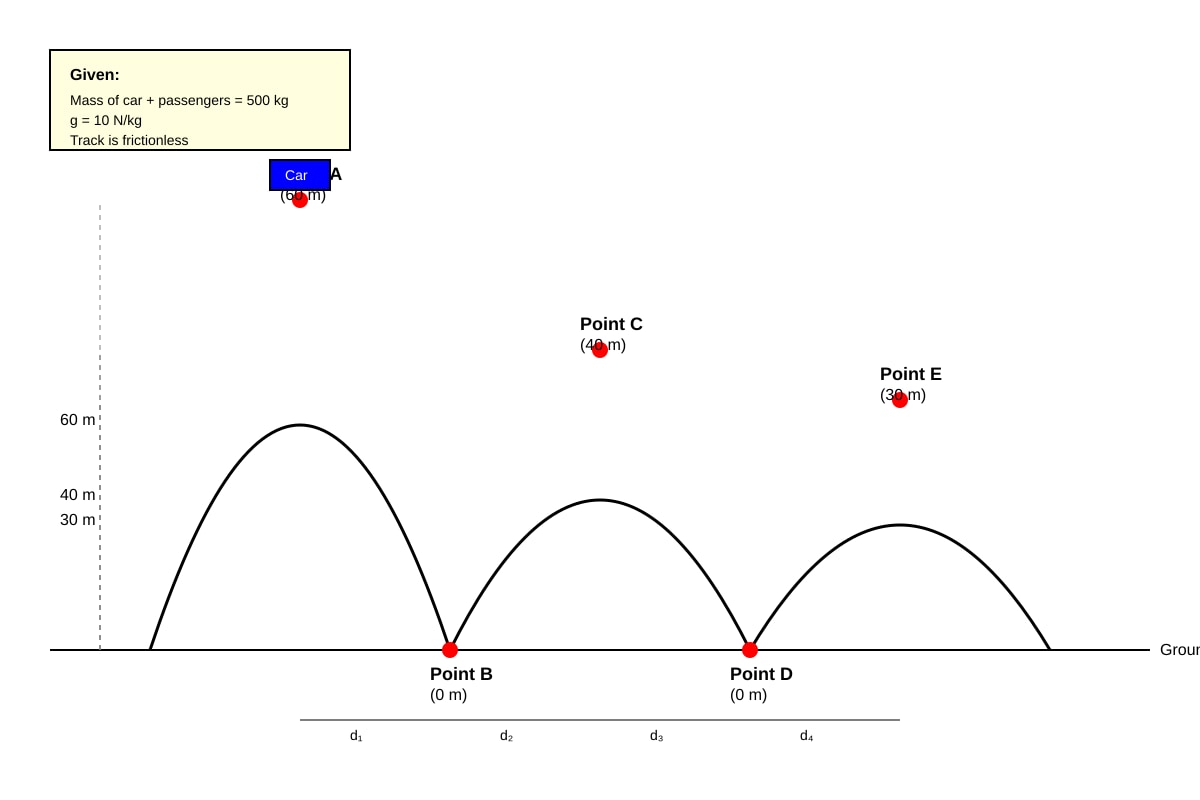
(a) Total mechanical energy at A = GPE at A (KE = 0) = mgh = 500 × 10 × 60 = 300,000 J (or 300 kJ) [1]
(b) At B (h = 0), all GPE → KE
½mv² = 300,000
v² = 600,000 / 500 = 1200
v = √1200 = 34.6 m/s (accept 34.6–35) [2]
(c) At C (h = 40 m), GPE = mgh = 500 × 10 × 40 = 200,000 J
KE = Total Energy - GPE = 300,000 - 200,000 = 100,000 J [2]
(d) Yes, it is consistent. [1]
At point E (h = 30 m), GPE = 500 × 10 × 30 = 150,000 J.
If speed is zero, KE = 0, so total mechanical energy = 150,000 J.
This is less than the initial 300,000 J, so energy is not conserved if the track is frictionless.
Correction: The car cannot reach point E with zero speed on a frictionless track because total mechanical energy must remain 300,000 J. At h = 30 m, it would still have KE = 150,000 J and would continue past point E. [1]
(e) In reality, friction (between wheels/track) and air resistance do negative work. [1]
The "missing" mechanical energy is converted to heat and sound (internal energy of track/air). [1]
17
(a) Elastic PE = ½kx² = ½ × 400 × (0.05)² = 200 × 0.0025 = 0.5 J [1]
(b) Elastic PE → GPE at max height
0.5 = mgh = 0.01 × 10 × h
h = 0.5 / 0.1 = 5.0 m [2]
(c) During flight, air resistance does negative work on the pellet. [1]
Some mechanical energy is lost as heat, so the pellet returns with less KE than it left with. [1]
Less KE → less elastic PE stored at maximum compression → smaller compression (0.04 m < 0.05 m). [Implied in explanation]
18
(a) Gain in GPE = mgh = 200 × 10 × 15 = 30,000 J [1]
(b) KE = ½mv² = ½ × 200 × 8² = 100 × 64 = 6,400 J [1]
(c) Total energy per minute = GPE + KE = 30,000 + 6,400 = 36,400 J
Power = Energy / Time = 36,400 / 60 = 606.7 W (accept 607 W) [2]
(d) Efficiency = (Output Power / Input Power) × 100% = (606.7 / 1200) × 100% = 50.6% (accept 50–51%) [1]
19
(a) h = L - L cosθ = L(1 - cosθ) = 1.0 × (1 - cos30°) = 1.0 × (1 - 0.866) = 0.134 m [2]
(b) GPE at top = KE at bottom
mgh = ½mv²
v = √(2gh) = √(2 × 10 × 0.134) = √2.68 = 1.64 m/s [2]
(c) The bob eventually comes to rest due to air resistance. Describe the energy conversions from the moment it is released until it comes to rest. [2]
Answer: GPE → KE (and back to GPE) repeatedly. With each swing, mechanical energy is dissipated as heat due to air resistance (and friction at pivot). Eventually, all initial GPE is converted to heat/internal energy of the surrounding air and support. [2]
Summary of Marks Allocation
| Section | Questions | Total Marks |
|---|---|---|
| A | 1–10 | 10 |
| B | 11–15 | 30 |
| C | 16–19 | 20 |
| Total | 60 |
End of Marking Scheme