From Real Exams Exam Paper
Secondary 2 Science Semestral Assessment 2 (End of Year) Paper 5
Free Sec 2 Science SA2 Paper 5, HY3 Exam version, with questions, answers, and syllabus-aligned practice for Singapore students.
These static practice materials are generated from the site's syllabus and paper-generation workflow, with source and model context shown so students and parents can evaluate the material before use.
Questions
TuitionGoWhere Practice Paper - Science Secondary 2 (SA2)
TuitionGoWhere Secondary School (AI)
Subject: Science
Level: Secondary 2
Paper: SA2 Practice Paper (Version 5 of 5)
Duration: 60 minutes
Total Marks: 60
Name: ________________________
Class: ________
Date: ________
Instructions:
- Answer all questions in the spaces provided.
- Show your working clearly for calculation questions.
- Use appropriate units in your answers.
- Section A: Multiple Choice (10 questions, 1 mark each, Total 10 marks)
- Section B: Structured Questions (6 questions, Total 30 marks)
- Section C: Free Response (4 questions, Total 20 marks)
Section A: Multiple Choice (10 marks)
-
Which of the following is a renewable source of energy? [1]
A. Coal
B. Natural gas
C. Wind
D. Crude oil -
The unit of electrical resistance is the ________. [1]
A. ampere
B. volt
C. ohm
D. watt -
A block of wood floats in water. This means its density is ________ the density of water. [1]
A. greater than
B. equal to
C. less than
D. unrelated to -
Which force always pulls objects toward the centre of the Earth? [1]
A. Magnetic force
B. Elastic force
C. Frictional force
D. Gravitational force -
In a parallel circuit with two lamps, if one lamp breaks, the other lamp will ________. [1]
A. become brighter
B. become dimmer
C. remain lit
D. go out -
Heat flows from a region of ________ temperature to a region of ________ temperature. [1]
A. lower, higher
B. higher, lower
C. same, higher
D. higher, same -
A universal indicator turns green in a solution. The solution is ________. [1]
A. strongly acidic
B. neutral
C. strongly alkaline
D. weakly acidic -
Which simple machine is shown by a sloping ramp used to load boxes onto a lorry? [1]
A. Lever
B. Pulley
C. Inclined plane
D. Wheel and axle -
The energy stored in a stretched rubber band is ________ energy. [1]
A. kinetic
B. chemical
C. elastic potential
D. thermal -
What is the voltage supplied to homes in Singapore? [1]
A. 110 V
B. 230 V
C. 240 V
D. 415 V
Section B: Structured Questions (30 marks)
-
(a) State the principle of conservation of energy. [2]
(b) A ball of mass 0.5 kg is dropped from a height of 4 m. Calculate its gravitational potential energy before it is dropped. (Take g = 10 m/s²) [2] -
A student connects three cells in series with a lamp and an ammeter.
(a) Draw a circuit diagram using standard symbols to show this arrangement. [2]
(b) If each cell provides 1.5 V, state the total voltage in the circuit. [1]
(c) The ammeter reads 0.3 A. Calculate the resistance of the lamp. [2] -
(a) Name two types of forces that can change the shape of an object. [1]
(b) A spring balance measures a force of 2 N acting on a mass. What is the mass if g = 10 m/s²? [2]
(c) State one everyday example where frictional force is useful. [1] -
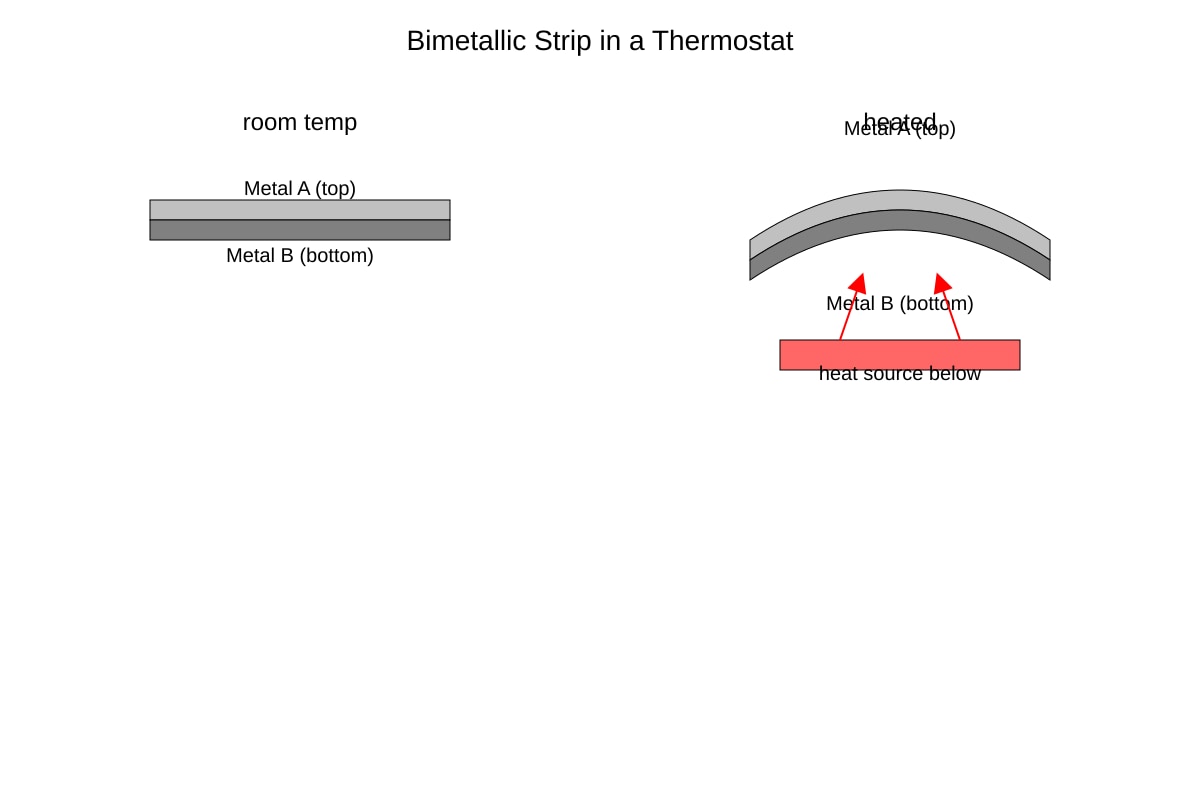
The diagram below shows a bimetallic strip in a thermostat.
Image pending generation: diagram for 14.
(a) What happens to the strip when it is heated? [1]
(b) Explain how this property is used in a thermostat to maintain temperature. [2]
15. A student places 50 g of a solid into 100 mL of water and stirs. After 5 minutes, the solid has dissolved completely.
(a) State whether the resulting mixture is a solution, suspension, or colloid. [1]
(b) Describe one method to recover the solid if it were insoluble. [1]
(c) The density of the solid is 2.5 g/cm³. Calculate its volume. [2]
- (a) State two hazards of using electricity in the home. [2]
(b) Name one safety feature that protects against overloaded circuits and explain how it works. [2]
Section C: Free Response (20 marks)
-
A pendulum swings from its highest point A to the lowest point B.
(a) State the energy conversion that occurs as it moves from A to B. [2]
(b) At point B, the pendulum has kinetic energy of 0.8 J. If the mass is 0.2 kg, calculate its speed at B. (Use KE = ½mv²) [3]
(c) Explain why the pendulum eventually stops swinging. [2] -
A circuit has two lamps connected in parallel to a 6 V battery. Lamp X has resistance 4 Ω, Lamp Y has resistance 2 Ω.
(a) Calculate the current through each lamp. [3]
(b) State one advantage of connecting lamps in parallel rather than series. [1]
(c) If the battery voltage is increased to 12 V, describe what happens to the brightness of the lamps. [1] -
(a) Define "density" in your own words. [1]
(b) An object of mass 300 g has volume 100 cm³. Will it float in water? Show your working. [3]
(c) State one everyday application of knowledge of density. [1] -
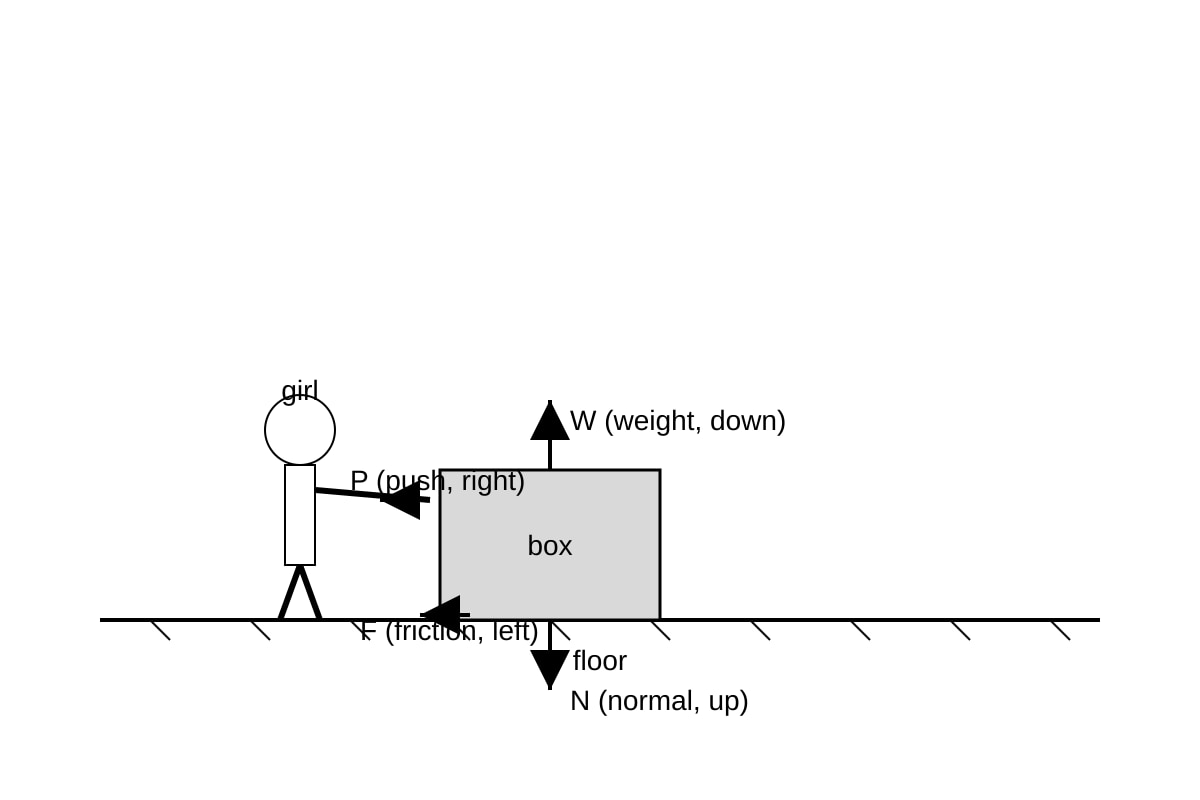
The figure shows a girl pushing a box across a rough floor.
Image pending generation: diagram for 20.
(a) Draw and label the force of friction acting on the box. [1]
(b) State what happens to the motion of the box if the push P is greater than friction F. [1]
(c) Explain how increasing the roughness of the floor affects the frictional force. [2]
End of Paper
Answers
Answer Key: TuitionGoWhere Practice Paper - Science Secondary 2 (SA2) Version 5
Total Marks: 60
Section A: Multiple Choice
-
C — Wind [1]
Teaching note: Renewable sources are naturally replenished (wind, sun, biomass, hydro). Coal, natural gas, crude oil are fossil fuels (non-renewable). -
C — ohm [1]
Teaching note: Resistance unit is ohm (Ω). Ampere = current, volt = voltage, watt = power. -
C — less than [1]
Teaching note: Object floats if its density < density of fluid. Wood density ~0.6 g/cm³ < water 1 g/cm³. -
D — Gravitational force [1]
Teaching note: Gravity pulls toward Earth's centre; weight = gravitational force. -
C — remain lit [1]
Teaching note: Parallel branches are independent; one breaks, current still flows in other. -
B — higher, lower [1]
Teaching note: Heat transfer is from hot to cold until thermal equilibrium. -
B — neutral [1]
Teaching note: Universal indicator green = pH 7 (neutral). Red = acid, purple = alkali. -
C — Inclined plane [1]
Teaching note: Ramp reduces effort force over longer distance; simple machine. -
C — elastic potential [1]
Teaching note: Stretched/compressed elastic stores elastic potential energy. -
B — 230 V [1]
Teaching note: Singapore mains = 230 V AC.
Section B: Structured Questions
-
(a) Principle: Energy cannot be created or destroyed; it can only be converted from one form to another (or total energy is constant). [2]
Marking: 1 mark for non-creation/destruction, 1 mark for conversion/constancy.
(b) GPE = mgh = 0.5 × 10 × 4 = 20 J [2]
Working: m=0.5 kg, g=10, h=4 m. Substitute. Unit J. -
(a) Circuit: 3 cells (long/short lines) in series, connected to lamp (circle with X) and ammeter (A in circle), closed loop. [2]
(b) Total V = 1.5 × 3 = 4.5 V [1]
(c) R = V/I = 4.5 / 0.3 = 15 Ω [2]
Working: Ohm's law V=IR → R=V/I. -
(a) Elastic force, compressive force (or stretching, pressing) [1]
(b) Weight = 2 N = mg → m = 2/10 = 0.2 kg [2]
(c) e.g., brakes on bicycle, gripping objects [1] -
(a) Strip bends/curves due to different expansion of metals [1]
(b) Bending breaks/completes circuit at set temp, cutting off/heating to maintain temp [2]
Note: Image shows Metal A expands more, curving away. -
(a) Solution (dissolved completely) [1]
(b) Filtration / evaporation [1]
(c) Volume = mass/density = 50/2.5 = 20 cm³ [2] -
(a) Damaged insulation, damp conditions, overload, wrong voltage (any 2) [2]
(b) Circuit breaker: trips/open when current too high, stopping flow [2]
Section C: Free Response
-
(a) Gravitational PE → Kinetic energy [2]
(b) KE = ½mv² → 0.8 = ½ × 0.2 × v² → v² = 8 → v = 2.83 m/s [3]
Steps: rearrange, substitute, square root.
(c) Air resistance/friction loses energy as heat; amplitude decreases [2] -
(a) X: I = V/R = 6/4 = 1.5 A; Y: I = 6/2 = 3 A [3]
(b) If one fails, other works [1]
(c) Brighter (more voltage → more current) [1] -
(a) Mass per unit volume [1]
(b) Density = 300/100 = 3 g/cm³ > 1 → sinks [3]
(c) Ship design, hydrometer, etc. [1] -
(a) Arrow left at box base labelled F [1]
(b) Box accelerates to right [1]
(c) Rougher = larger friction (more interlocking) [2]
End of Answer Key
Free quiz and exam paper access
Enter your details to view this paper
Your access is remembered on this device.