From Real Exams Exam Paper
Secondary 2 Science Semestral Assessment 2 (End of Year) Paper 5
Free Exam-Derived Secondary 2 Science Semestral Assessment 2 (End of Year) Paper 5 practice paper with questions and answers for Singapore students. This page is rendered as a direct URL so the questions and answers can be discovered without pressing in-page buttons.
These static practice materials are generated from the site's syllabus and paper-generation workflow, with source and model context shown so students and parents can evaluate the material before use.
Questions
TuitionGoWhere Practice Paper - Science Secondary 2
TuitionGoWhere Secondary School (AI)
Subject: Science
Level: Secondary 2
Paper: SA2 Practice Paper (Version 5)
Duration: 1 hour 30 minutes
Total Marks: 70 marks
Name: _________________________ Class: ___________ Date: ___________
Instructions
- This paper consists of Section A (Multiple Choice), Section B (Structured Questions), and Section C (Extended Response).
- Answer ALL questions.
- Write your answers in the spaces provided.
- Show all working for calculations.
- The use of calculators is allowed.
Section A: Multiple Choice Questions [10 marks]
For each question, choose the best answer and write the letter in the box provided.
1. Which of the following correctly states the principle of conservation of energy?
A. Energy can be created but not destroyed
B. Energy cannot be created or destroyed, only converted from one form to another
C. Energy is always lost as heat during conversions
D. Energy can only exist in kinetic and potential forms
Answer: [ ]
2. A student climbs from the ground floor to the 4th floor of a building. Each floor is 3.5 m high. What is the total vertical distance climbed?
A. 10.5 m
B. 14.0 m
C. 17.5 m
D. 21.0 m
Answer: [ ]
3. When copper is heated strongly in air, a black substance forms on its surface. This is an example of:
A. A physical change because the copper changes colour
B. A chemical change because a new substance is formed
C. A physical change because the copper can be cooled down
D. A chemical change because heat is involved
Answer: [ ]
4. Universal Indicator turns which colour in a solution with pH 3?
A. Green
B. Blue
C. Red
D. Purple
Answer: [ ]
5. In a series circuit with two identical bulbs and a 6V battery, the voltage across each bulb is:
A. 6V
B. 3V
C. 12V
D. 1.5V
Answer: [ ]
Section B: Structured Questions [45 marks]
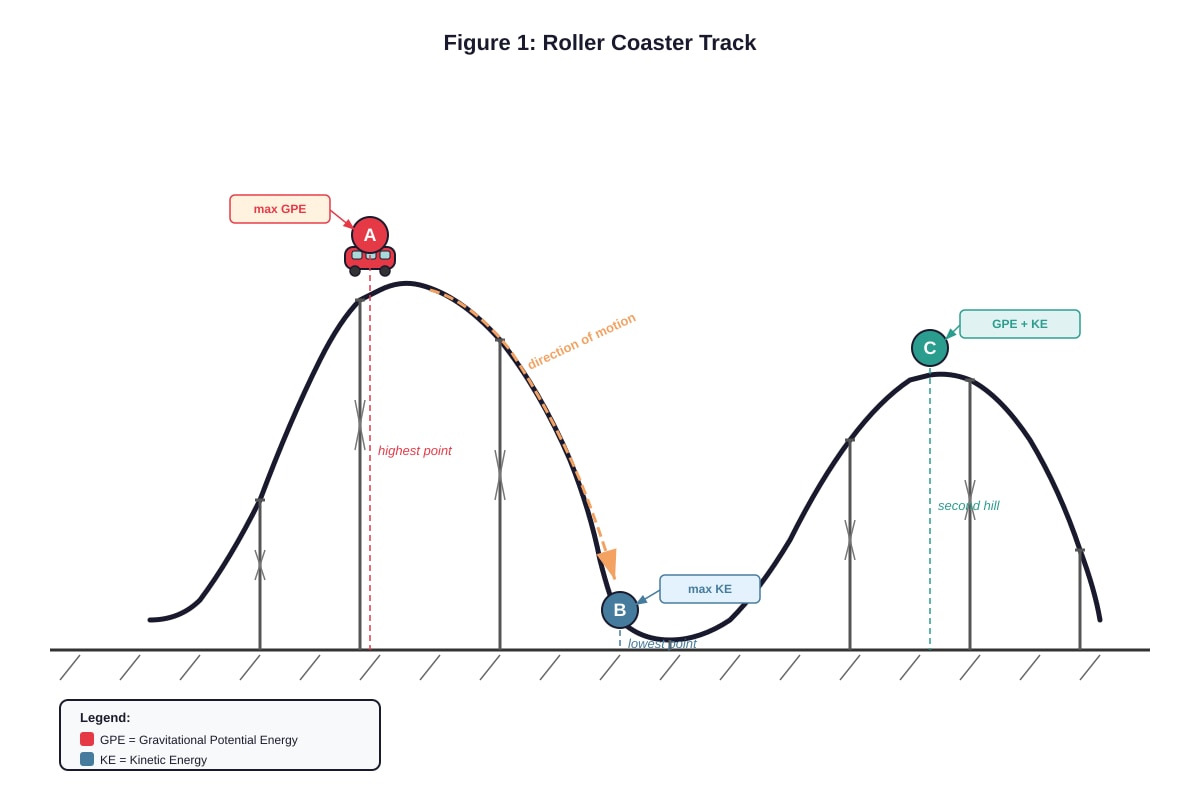
6. A roller coaster car moves along a track as shown in Figure 1.
[Figure shows a roller coaster track with points A (top of hill), B (bottom), and C (top of second hill)]
(a) State the principle of conservation of energy. [2]
(b) At point A, the car has maximum gravitational potential energy. Describe the energy changes as the car moves from A to B. [3]
(c) The car has a mass of 500 kg and is at a height of 25 m at point A. Calculate the gravitational potential energy at this point. (Take g = 10 m/s²) [2]
Working:
Answer: _________________ J
7. A student investigates the reaction between magnesium and different acids.
(a) The student adds magnesium ribbon to hydrochloric acid. State whether this is a physical or chemical change. Explain your answer. [2]
Type of change: _________________________________
Explanation: ___________________________________________________________________
(b) The student observes that the reaction is faster when the acid is heated. Name two other factors that could increase the rate of this reaction. [2]
(c) Balance the following chemical equation for the reaction: [1]
Mg + _____ HCl → _____ MgCl₂ + _____ H₂
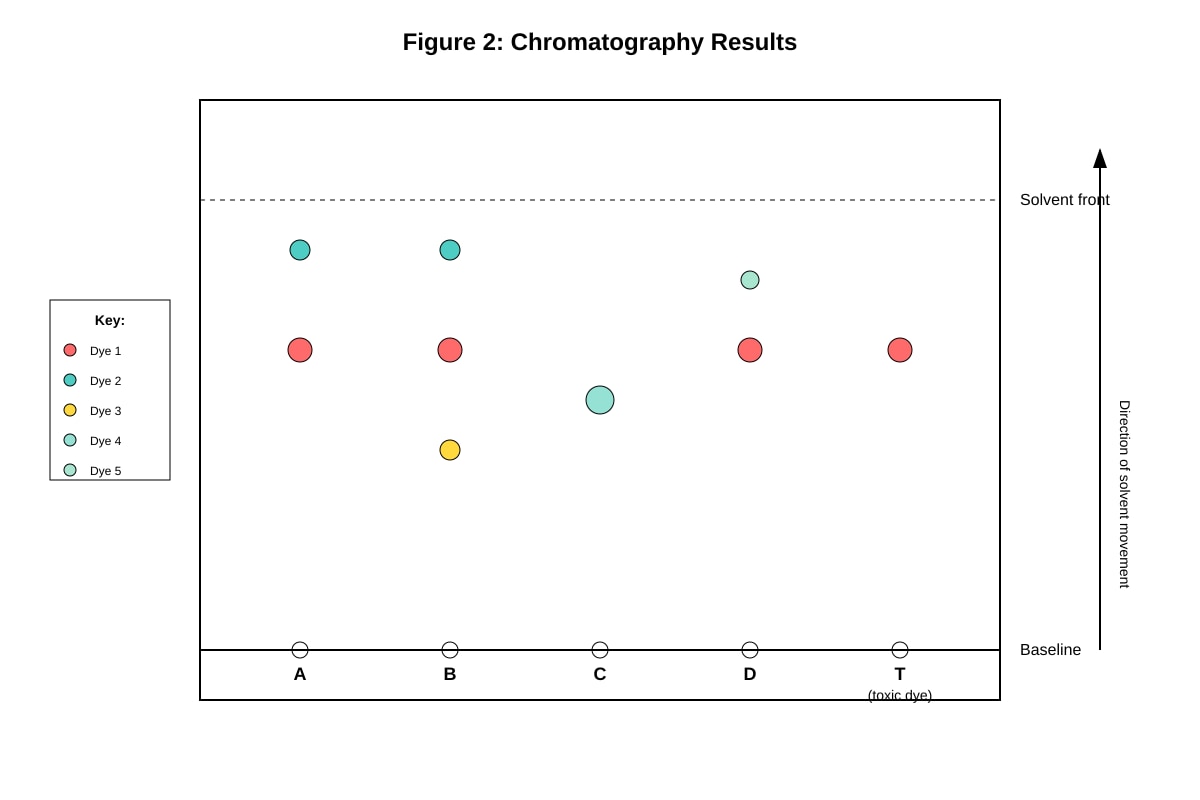
8. Figure 2 shows the results of a chromatography experiment to test food colourings.
[Figure shows chromatography results with spots at different heights for samples A, B, C, D, and a known toxic dye T]
(a) A toxic dye was identified in sample T. Based on the chromatography results, which food sample(s) contain the toxic dye? [1]
Answer: _________________________________
(b) Explain how you arrived at your conclusion in part (a). [2]
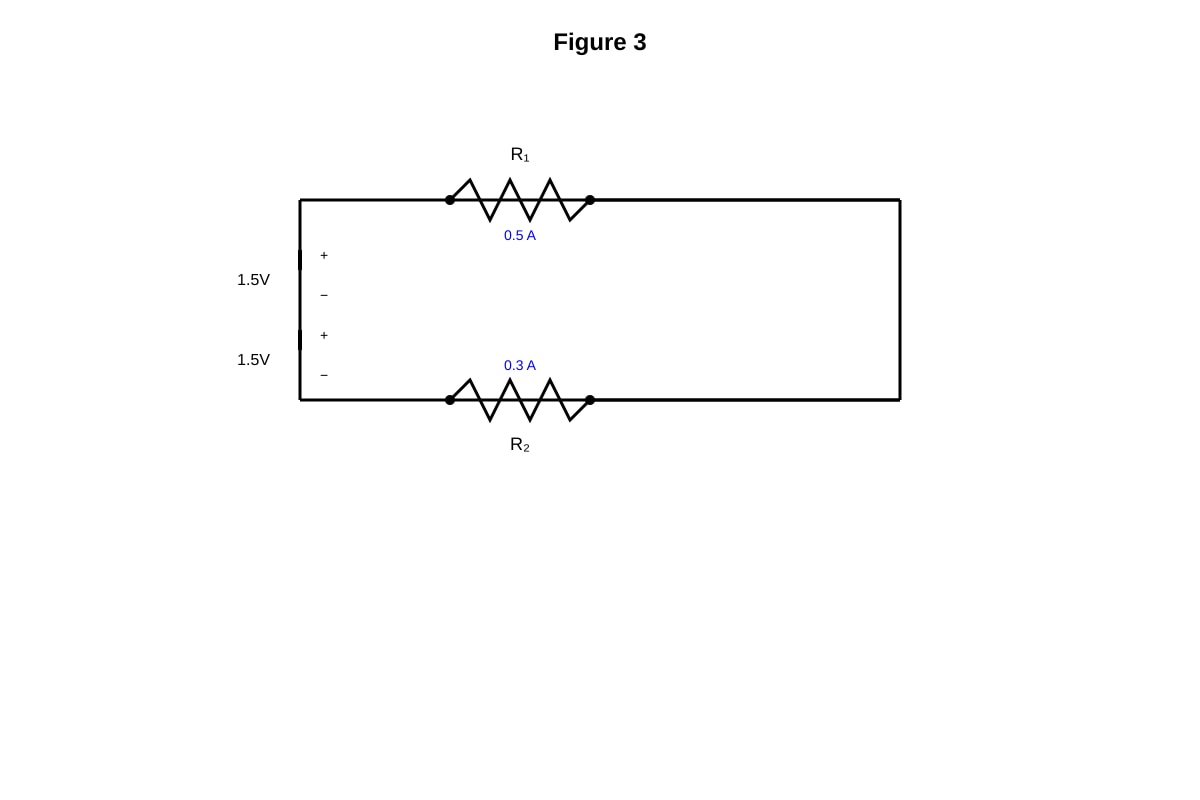
9. A student sets up the electrical circuit shown in Figure 3.
[Figure shows a circuit with two 1.5V cells in series, connected to two resistors in parallel]
(a) Calculate the total voltage provided by the two cells. [1]
Answer: _________________ V
(b) The current through resistor R₁ is 0.5 A and through resistor R₂ is 0.3 A. Calculate the total current in the circuit. [1]
Answer: _________________ A
(c) If the circuit operates for 2 hours, calculate the total energy consumed. Use the formula E = VIt. [2]
Working:
Answer: _________________ J
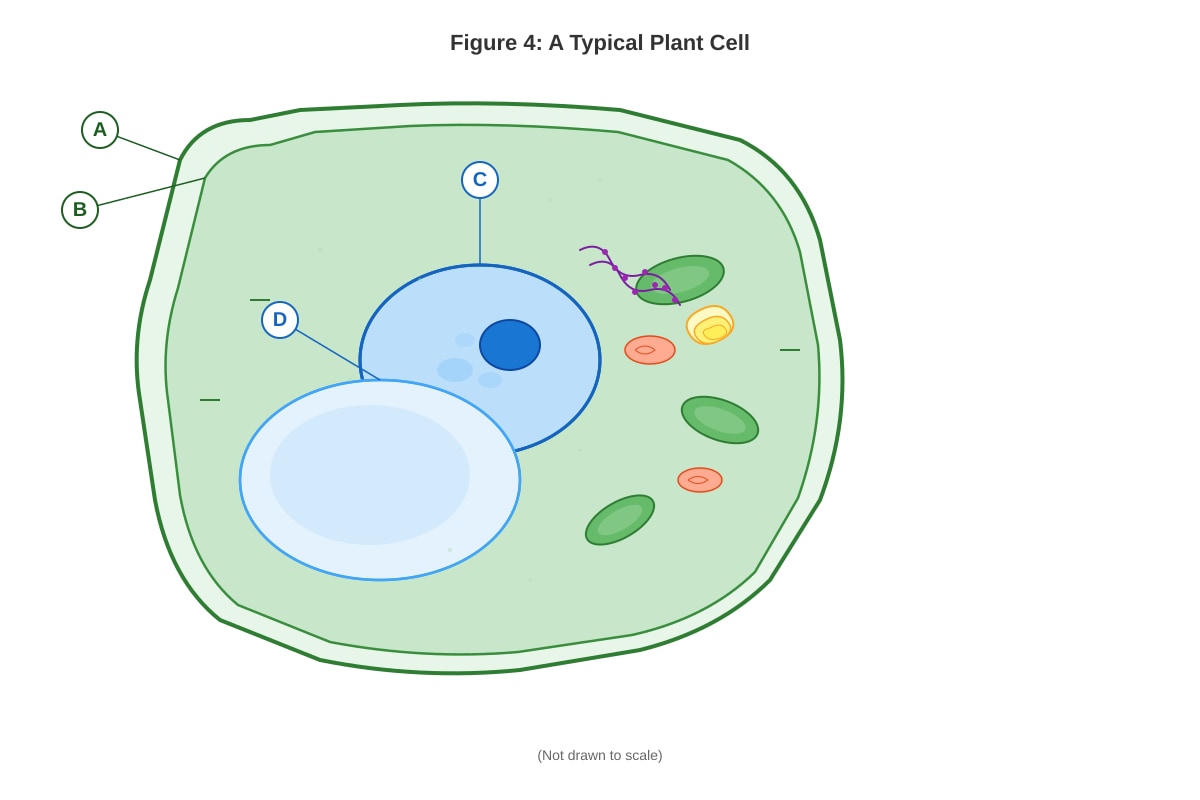
10. Figure 4 shows a plant cell as seen under a microscope.
[Figure shows a typical plant cell with labeled structures A, B, C, and D]
(a) Name the structures labeled A, B, C, and D. [4]
A: _________________________________
B: _________________________________
C: _________________________________
D: _________________________________
(b) State one function of structure C. [1]
11. A student investigates the separation of a mixture containing salt, sand, and iron filings.
(a) Describe the steps needed to separate this mixture completely. [4]
Step 1: _________________________________________________________________
Step 2: _________________________________________________________________
Step 3: _________________________________________________________________
Step 4: _________________________________________________________________
(b) Explain why filtration can be used to separate sand from salt solution. [2]
Section C: Extended Response [15 marks]
12. A student investigates how the height of a ramp affects the speed of a toy car at the bottom.
(a) Design an experiment to investigate this relationship. In your answer, include:
- The independent variable
- The dependent variable
- Two controlled variables
- The method you would use [8]
Independent variable: _________________________________________________
Dependent variable: _________________________________________________
Controlled variables:
Method:
(b) Predict the relationship between ramp height and car speed. Explain your prediction using the principle of conservation of energy. [4]
Prediction: _________________________________________________________________
Explanation: _________________________________________________________________
(c) Suggest one way to improve the reliability of this experiment. [1]
(d) State one safety precaution that should be taken during this experiment. [2]
END OF PAPER
Answers
TuitionGoWhere Practice Paper - Science Secondary 2
Answer Key and Marking Scheme
Section A: Multiple Choice Questions [10 marks]
1 mark each
- B - Energy cannot be created or destroyed, only converted from one form to another
- B - 14.0 m (4 floors × 3.5 m = 14.0 m)
- B - A chemical change because a new substance is formed
- C - Red (pH 3 is acidic, Universal Indicator shows red)
- B - 3V (In series, voltage divides equally: 6V ÷ 2 = 3V)
Section B: Structured Questions [45 marks]
Question 6: Energy and Roller Coaster [7 marks]
(a) State the principle of conservation of energy. [2]
- Energy cannot be created or destroyed [1]
- Energy can only be converted from one form to another [1]
Alternative acceptable answers:
- Total energy in a system remains constant
- Energy can be transformed but the total amount stays the same
(b) Energy changes from A to B [3]
- Gravitational potential energy decreases [1]
- Kinetic energy increases [1]
- Some energy may be lost as heat/sound due to friction [1]
(c) Calculate gravitational potential energy [2] Working:
- PE = mgh [1]
- PE = 500 × 10 × 25 = 125,000 J [1]
Question 7: Chemical Reactions [5 marks]
(a) Physical or chemical change [2]
- Chemical change [1]
- A new substance (hydrogen gas) is formed / bubbles of gas produced / magnesium dissolves [1]
(b) Factors affecting reaction rate [2] Any two from:
- Increase concentration of acid [1]
- Increase surface area of magnesium (smaller pieces) [1]
- Add a catalyst [1]
- Increase pressure (accept but less likely in this context)
(c) Balance equation [1] Mg + 2 HCl → 1 MgCl₂ + 1 H₂ [1]
Question 8: Chromatography [3 marks]
(a) Identify toxic samples [1]
- Sample B [1] (or whichever sample matches the Rf value of T in the diagram)
(b) Explanation [2]
- Sample B has a spot at the same height as the toxic dye T [1]
- This means they have the same Rf value / travel the same distance [1]
Question 9: Electrical Circuits [4 marks]
(a) Total voltage [1]
- 3.0 V (1.5 + 1.5) [1]
(b) Total current [1]
- 0.8 A (0.5 + 0.3) [1]
(c) Energy calculation [2] Working:
- E = VIt = 3.0 × 0.8 × (2 × 3600) [1]
- E = 17,280 J [1]
Question 10: Plant Cell [5 marks]
(a) Label structures [4] Marking depends on diagram provided, typical answers:
- A: Cell wall [1]
- B: Chloroplast [1]
- C: Nucleus [1]
- D: Vacuole [1]
(b) Function of structure C [1]
- Controls cell activities / Contains genetic material / Controls what enters and leaves the nucleus [1]
Question 11: Separation Techniques [6 marks]
(a) Separation steps [4]
- Use a magnet to remove iron filings [1]
- Add water to dissolve the salt [1]
- Filter to separate sand from salt solution [1]
- Evaporate water to obtain salt crystals [1]
(b) Why filtration works [2]
- Sand particles are larger than the holes in filter paper [1]
- Salt is dissolved so passes through with water [1]
Section C: Extended Response [15 marks]
Question 12: Experimental Design [15 marks]
(a) Experimental design [8]
Independent variable: Height of ramp [1]
Dependent variable: Speed of car at bottom of ramp [1]
Controlled variables: [2] Any two from:
- Same car used
- Same ramp surface/material
- Same starting position on ramp
- Same method of release
- Same distance measured
Method: [4] Award marks for logical sequence including:
- Set up ramp at different heights [1]
- Release car from same position each time [1]
- Measure speed at bottom (using timing gates/stopwatch and distance) [1]
- Repeat for reliability / Record results [1]
(b) Prediction and explanation [4]
Prediction: As ramp height increases, car speed increases [1]
Explanation: [3]
- Higher ramp gives car more gravitational potential energy [1]
- As car moves down, PE converts to kinetic energy [1]
- More PE means more KE, so higher speed at bottom [1]
(c) Improve reliability [1]
- Repeat experiment multiple times and calculate average [1]
- Use more accurate timing equipment
- Ensure ramp surface is smooth
(d) Safety precaution [2]
- Ensure ramp is stable/secure [1]
- Clear area at bottom of ramp / Stand away from car path [1]
Total: 70 marks
Mark Distribution:
- Section A (Multiple Choice): 10 marks
- Section B (Structured): 45 marks
- Section C (Extended Response): 15 marks
Grade Boundaries (Suggested):
- A: 63-70 marks (90-100%)
- B: 56-62 marks (80-89%)
- C: 49-55 marks (70-79%)
- D: 42-48 marks (60-69%)
- E: 35-41 marks (50-59%)