From Real Exams Exam Paper

Secondary 2 Science Semestral Assessment 2 (End of Year) Paper 4

Free Exam-Derived NVIDIA Nemotron 3 Ultra 550B A55B Free Secondary 2 Science Semestral Assessment 2 (End of Year) Paper 4 practice paper with questions and answers for Singapore students. This page is rendered as a direct URL so the questions and answers can be discovered without pressing in-page buttons.

These static practice materials are generated from the site's syllabus and paper-generation workflow, with source and model context shown so students and parents can evaluate the material before use.

Secondary 2 Science From Real Exams Generated by NVIDIA Nemotron 3 Ultra 550B A55B Free Updated 2026-06-07

Questions

<!-- TuitionGoWhere generation metadata: stage=3-1; model=nvidia/nemotron-3-ultra-550b-a55b:free; model_label=NVIDIA Nemotron 3 Ultra 550B A55B Free; generated=2026-06-06; Sources: Stage 2-1 real exam-derived templates and Stage 2-2 exam-enriched syllabus. -->

TuitionGoWhere Practice Paper - Science Secondary 2

TuitionGoWhere Secondary School (AI)
Subject: Science
Level: Secondary 2 (G3)
Paper: SA2 Version 4
Duration: 1 hour 30 minutes
Total Marks: 60

Name: ________________________
Class: ________________________
Date: ________________________


Instructions to Candidates

  1. Write your name, class, and date in the spaces provided above.
  2. Answer all questions.
  3. Write your answers in the spaces provided on the question paper.
  4. The number of marks is given in brackets [ ] at the end of each question or part question.
  5. The total marks for this paper is 60.
  6. You may use a calculator.
  7. Where necessary, take the acceleration due to gravity, g=10 N/kgg = 10 \text{ N/kg}.
  8. Show all working for calculation questions.

Section A: Multiple Choice Questions [10 marks]

Answer all questions. For each question, choose the correct option (A, B, C, or D) and write the letter in the box provided.

1

A ball of mass 0.5 kg is dropped from a height of 20 m above the ground. Ignoring air resistance, what is the kinetic energy of the ball just before it hits the ground? [1]

☐ A. 50 J
☐ B. 100 J
☐ C. 150 J
☐ D. 200 J

2

Which of the following energy conversions takes place when a candle burns? [1]

☐ A. Chemical potential energy → Heat energy + Light energy
☐ B. Heat energy → Chemical potential energy + Light energy
☐ C. Light energy → Chemical potential energy + Heat energy
☐ D. Chemical potential energy → Kinetic energy + Sound energy

3

A force of 25 N is used to push a box horizontally across a floor for a distance of 4 m. How much work is done by the force? [1]

☐ A. 6.25 J
☐ B. 29 J
☐ C. 100 J
☐ D. 400 J

4

The diagram below shows a simple electrical circuit.

<image_placeholder> id: Q4-fig1 type: diagram linked_question: Q4 description: A simple series circuit with a battery labelled 6 V, a switch, an ammeter, and a resistor labelled R. The ammeter reads 0.5 A. labels: Battery (6 V), Switch (closed), Ammeter (0.5 A), Resistor (R) values: Voltage = 6 V, Current = 0.5 A must_show: Series connection, correct symbols for battery, switch, ammeter, resistor </image_placeholder>

What is the resistance of resistor R? [1]

☐ A. 3 Ω
☐ B. 6 Ω
☐ C. 12 Ω
☐ D. 24 Ω

5

Three identical resistors, each of resistance 6 Ω, are connected in parallel. What is the effective resistance of the combination? [1]

☐ A. 2 Ω
☐ B. 6 Ω
☐ C. 18 Ω
☐ D. 36 Ω

6

A student rubs a plastic rod with a wool cloth. The rod becomes negatively charged. Which of the following statements is correct? [1]

☐ A. Electrons move from the wool cloth to the plastic rod.
☐ B. Protons move from the plastic rod to the wool cloth.
☐ C. Electrons move from the plastic rod to the wool cloth.
☐ D. Protons move from the wool cloth to the plastic rod.

7

An electric kettle rated at 2000 W is used for 15 minutes. The cost of electricity is $0.28 per kWh. What is the cost of using the kettle? [1]

☐ A. 0.14B.0.14 ☐ B. 0.28
☐ C. 1.40D.1.40 ☐ D. 2.80

8

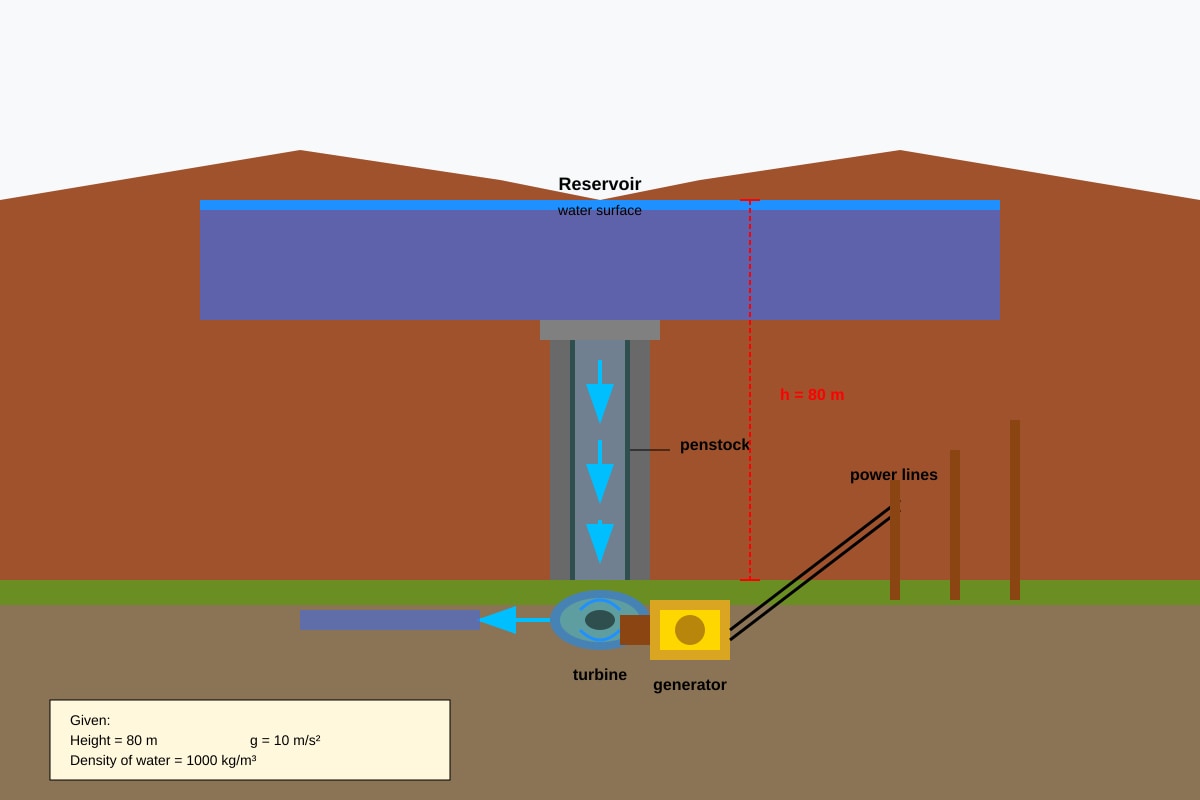
Which of the following shows the correct energy conversion in a hydroelectric power station? [1]

☐ A. Gravitational potential energy → Kinetic energy → Electrical energy
☐ B. Kinetic energy → Gravitational potential energy → Electrical energy
☐ C. Electrical energy → Gravitational potential energy → Kinetic energy
☐ D. Chemical potential energy → Kinetic energy → Electrical energy

9

A copper rod and a wooden rod of the same dimensions are heated at one end. After some time, the other end of the copper rod becomes hot while the wooden rod remains cool. This is because copper is a [1]

☐ A. better conductor of heat than wood.
☐ B. better insulator of heat than wood.
☐ C. better radiator of heat than wood.
☐ D. better absorber of heat than wood.

10

The diagram below shows a ray of light travelling from air into a glass block.

<image_placeholder> id: Q10-fig1 type: diagram linked_question: Q10 description: A ray of light incident on a rectangular glass block at an angle of 40° to the normal. The refracted ray inside the glass block makes an angle of 25° to the normal. labels: Normal line, Incident ray (40°), Refracted ray (25°), Air, Glass block values: Angle of incidence = 40°, Angle of refraction = 25° must_show: Rectangular glass block, normal line, incident and refracted rays with angles marked </image_placeholder>

What is the refractive index of the glass? [1]

☐ A. 0.63
☐ B. 1.00
☐ C. 1.59
☐ D. 2.44


Section B: Structured Questions [30 marks]

Answer all questions in the spaces provided.

11

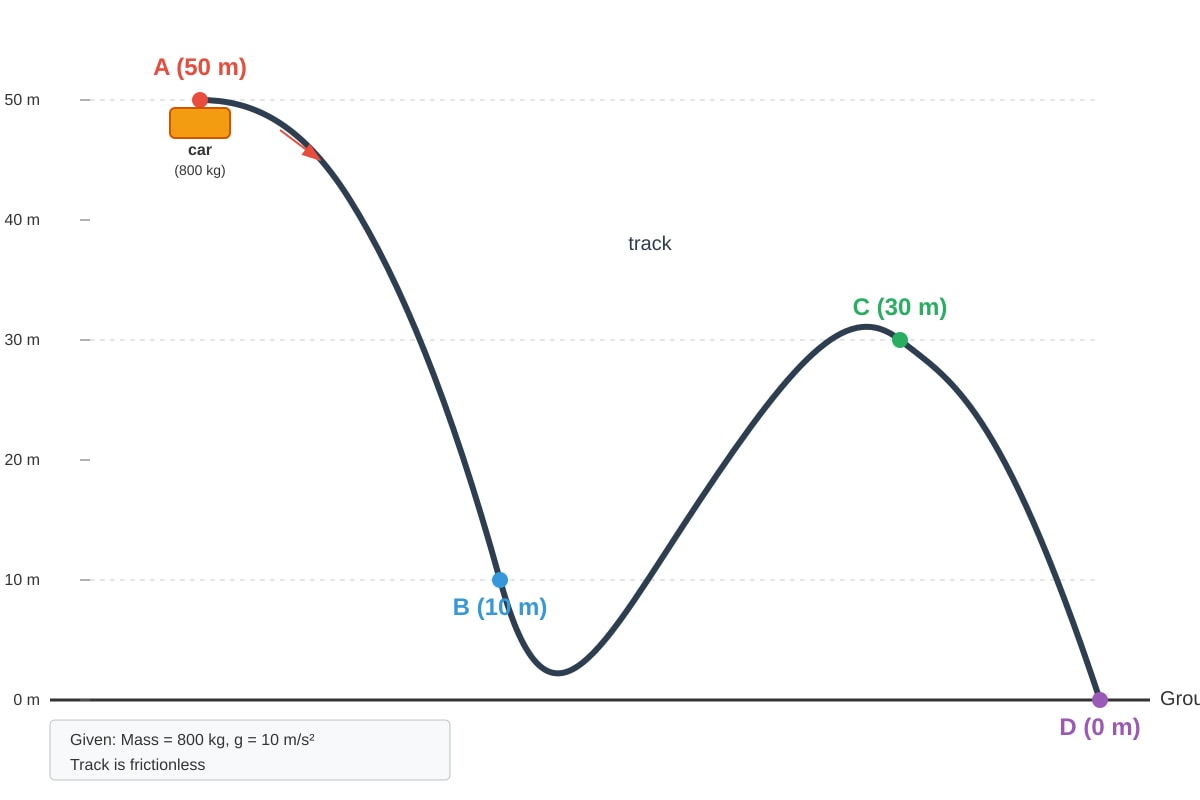
A roller coaster car of mass 500 kg is at rest at point A, which is 40 m above the ground. The car then moves down a frictionless track to point B at ground level, and then up to point C which is 25 m above the ground.

<image_placeholder> id: Q11-fig1 type: diagram linked_question: Q11 description: A roller coaster track with three labelled points: A at 40 m height, B at ground level (0 m), C at 25 m height. The car is shown at point A. labels: Point A (40 m), Point B (0 m), Point C (25 m), Car (500 kg) values: Mass = 500 kg, g = 10 N/kg, Height A = 40 m, Height B = 0 m, Height C = 25 m must_show: Roller coaster track profile with three labelled points at correct relative heights </image_placeholder>

(a) Calculate the gravitational potential energy of the car at point A. [2]


(b) State the kinetic energy of the car at point B. Explain your answer. [2]


(c) Calculate the speed of the car at point C. [3]


12

A student sets up an experiment to investigate the heating effect of an electric current. She uses a 12 V battery, a variable resistor, an ammeter, and a heating coil immersed in 100 g of water. The initial temperature of the water is 25°C. The circuit is switched on for 5 minutes, and the ammeter reads a steady current of 2.0 A throughout. The specific heat capacity of water is 4200 J/(kg·°C).

<image_placeholder> id: Q12-fig1 type: experimental_setup linked_question: Q12 description: Circuit diagram showing a 12 V battery, variable resistor, ammeter, and heating coil in series. The heating coil is shown immersed in a beaker of water with a thermometer. labels: Battery (12 V), Variable resistor, Ammeter (2.0 A), Heating coil, Water (100 g), Thermometer values: Voltage = 12 V, Current = 2.0 A, Time = 5 min, Mass of water = 100 g, Initial temperature = 25°C, c_water = 4200 J/(kg·°C) must_show: Series circuit with all components, heating coil in water, thermometer </image_placeholder>

(a) Calculate the electrical energy supplied to the heating coil in 5 minutes. [2]


(b) Assuming all the electrical energy is converted to heat energy absorbed by the water, calculate the final temperature of the water. [3]


(c) In practice, the final temperature of the water is lower than the calculated value. Suggest one reason for this. [1]


13

The diagram below shows a circuit with three resistors connected to a 12 V battery.

<image_placeholder> id: Q13-fig1 type: diagram linked_question: Q13 description: A 12 V battery connected to a series-parallel combination. A 4 Ω resistor is in series with a parallel combination of 6 Ω and 3 Ω resistors. labels: Battery (12 V), Resistor R1 = 4 Ω, Resistor R2 = 6 Ω, Resistor R3 = 3 Ω values: V = 12 V, R1 = 4 Ω, R2 = 6 Ω, R3 = 3 Ω must_show: Battery, series resistor R1, parallel branch with R2 and R3 </image_placeholder>

(a) Calculate the effective resistance of the parallel combination of the 6 Ω and 3 Ω resistors. [2]


(b) Calculate the total resistance of the circuit. [1]


(c) Calculate the current flowing through the battery. [2]


(d) Calculate the potential difference across the 4 Ω resistor. [2]


14

A student investigates the reflection of light using a plane mirror. She places a pin O in front of a plane mirror and views its image from two different positions. She draws the incident and reflected rays for each position.

<image_placeholder> id: Q14-fig1 type: diagram linked_question: Q14 description: A plane mirror MM' with an object pin O placed 4 cm in front of it. Two incident rays from O strike the mirror at points A and B. The reflected rays appear to come from image I behind the mirror. Normal lines at A and B are shown. labels: Mirror MM', Object O (4 cm in front), Image I (4 cm behind), Incident rays OA and OB, Reflected rays, Normal lines at A and B, Angles of incidence and reflection marked values: Object distance = 4 cm must_show: Plane mirror, object and image at equal distances, incident and reflected rays with normals, equal angles </image_placeholder>

(a) State the law of reflection. [1]


(b) On the diagram, the angle of incidence at point A is 35°. What is the angle of reflection at point A? [1]


(c) State two characteristics of the image formed by a plane mirror. [2]


(d) The student moves the pin O closer to the mirror. What happens to the distance between the object and its image? [1]


15

The diagram below shows a ray of light passing from air into a semi-circular glass block. The ray enters the flat side of the block along the normal and strikes the curved surface at an angle of 42° to the normal. The critical angle of the glass is 42°.

<image_placeholder> id: Q15-fig1 type: diagram linked_question: Q15 description: A semi-circular glass block with a ray entering the flat side along the normal (no bending). The ray travels straight to the curved surface, striking it at 42° to the normal. The ray emerges along the curved surface (grazing emergence). labels: Semi-circular glass block, Normal at entry point, Ray along normal, Curved surface, Angle of incidence at curved surface = 42°, Emergent ray along surface values: Critical angle = 42°, Angle of incidence at curved surface = 42° must_show: Semi-circular block, ray entering along normal, striking curved surface at critical angle, emergent ray grazing the surface </image_placeholder>

(a) Explain why the ray does not bend when it enters the flat side of the glass block. [1]


(b) What happens to the ray when it strikes the curved surface at 42°? [1]


(c) If the angle of incidence at the curved surface is increased to 50°, describe what happens to the ray. [1]


(d) Calculate the refractive index of the glass. [2]


Section C: Longer Structured and Data-Based Questions [20 marks]

Answer all questions in the spaces provided.

16

A student investigates how the resistance of a wire depends on its length. She sets up a circuit with a battery, an ammeter, a voltmeter, and a length of constantan wire. She varies the length of the wire in the circuit and records the current and voltage readings.

The table below shows her results.

Length of wire / cmVoltage / VCurrent / A
201.20.60
401.20.30
601.20.20
801.20.15
1001.20.12

(a) Calculate the resistance of the wire for each length and complete the table below. [2]

Length of wire / cmResistance / Ω
20
40
60
80
100

(b) Plot a graph of resistance (y-axis) against length (x-axis) on the grid below. [3]

<image_placeholder> id: Q16-fig1 type: graph linked_question: Q16 description: Blank graph grid with x-axis labelled "Length of wire / cm" from 0 to 100, y-axis labelled "Resistance / Ω" from 0 to 10. Axes scaled appropriately for the data. labels: x-axis: Length of wire / cm (0-100), y-axis: Resistance / Ω (0-10) values: Data points from table in part (a) must_show: Labelled axes with units, appropriate scales, data points plotted, best-fit straight line through origin </image_placeholder>

(c) State the relationship between the resistance of the wire and its length. [1]


(d) The student repeats the experiment using a thicker wire of the same material and length. Sketch on the same graph the expected shape of the graph for the thicker wire. Label this graph "Thicker wire". [2]


(e) The resistance of a 100 cm length of this constantan wire is 10 Ω. Calculate the resistance of a 50 cm length of the same wire. [1]


(f) Suggest one precaution the student should take to ensure accurate readings. [1]


17

The diagram below shows a simple DC motor.

<image_placeholder> id: Q17-fig1 type: diagram linked_question: Q17 description: A simple DC motor showing a rectangular coil ABCD placed between the poles of a permanent magnet (N and S). The coil is connected to a split-ring commutator and carbon brushes X and Y. Current flows from battery through brush X into the coil. labels: N pole, S pole, Coil ABCD, Split-ring commutator, Carbon brushes X and Y, Battery, Direction of current in coil sides, Direction of rotation values: Magnetic field direction N to S, Current direction shown must_show: Rectangular coil in magnetic field, split-ring commutator, brushes, current direction, rotation direction </image_placeholder>

(a) On the diagram, the current flows into the coil at side AB and out at side CD. Using Fleming's left-hand rule, state the direction of the force acting on side AB. [1]


(b) Explain why the coil experiences a turning effect (torque). [2]


(c) State the function of the split-ring commutator. [1]


(d) Suggest two ways to increase the turning effect of the motor. [2]


(e) The motor is connected to a 6 V battery and draws a current of 0.8 A. Calculate the electrical power input to the motor. [1]


(f) If the motor is 75% efficient, calculate the useful mechanical power output. [2]


18

A house has the following electrical appliances:

AppliancePower RatingDaily Usage
Refrigerator150 W24 hours
Air conditioner1500 W6 hours
Washing machine500 W1 hour
LED lights (total)60 W5 hours
Television100 W4 hours

The cost of electricity is $0.28 per kWh.

(a) Calculate the total energy consumed by all appliances in one day, in kWh. [3]


(b) Calculate the cost of electricity for one day. [1]


(c) The household decides to replace the air conditioner with a more energy-efficient model rated at 1200 W, used for the same duration. Calculate the savings in electricity cost per month (30 days). [2]


(d) State one way, other than replacing appliances, to reduce electricity consumption in the home. [1]


19

The diagram below shows a convex lens forming a real image of an object.

<image_placeholder> id: Q19-fig1 type: diagram linked_question: Q19 description: A convex lens with principal axis. Object O of height 3 cm placed 30 cm from lens (2F). Real inverted image I formed 30 cm on the other side (2F). Focal length F = 15 cm marked on both sides. Rays from top of object: one parallel to axis refracting through F, one through optical centre undeviated. labels: Convex lens, Principal axis, Optical centre, Focal points F (15 cm), 2F points (30 cm), Object O (3 cm, 30 cm), Image I (inverted, 30 cm), Ray paths values: Object height = 3 cm, Object distance = 30 cm, Focal length = 15 cm must_show: Convex lens, principal axis, focal points, object at 2F, real inverted image at 2F, two construction rays </image_placeholder>

(a) State the focal length of the lens. [1]


(b) Describe the nature of the image formed (real/virtual, upright/inverted, magnified/diminished/same size). [2]


(c) Calculate the magnification of the image. [2]


(d) The object is now moved to a distance of 10 cm from the lens (between F and the lens). Describe the nature of the image formed now. [2]


(e) State one application of a convex lens used in this way (object between F and lens). [1]


20

A student carries out an experiment to determine the specific heat capacity of a metal block. She uses a 12 V, 50 W heater immersed in the metal block for 10 minutes. The mass of the metal block is 1.0 kg. The initial temperature of the block is 28°C and the final temperature is 58°C.

(a) Calculate the electrical energy supplied by the heater. [2]


(b) Assuming no heat losses, calculate the specific heat capacity of the metal. [2]


(c) In practice, the calculated specific heat capacity is higher than the true value. Explain why. [2]


(d) Suggest two improvements to the experiment to obtain a more accurate value. [2]


End of Paper

Answers

<!-- TuitionGoWhere generation metadata: stage=3-1; model=nvidia/nemotron-3-ultra-550b-a55b:free; model_label=NVIDIA Nemotron 3 Ultra 550B A55B Free; generated=2026-06-06; Sources: Stage 2-1 real exam-derived templates and Stage 2-2 exam-enriched syllabus. -->

TuitionGoWhere Practice Paper - Science Secondary 2 (SA2 Version 4) - Answer Key

Total Marks: 60


Section A: Multiple Choice Questions [10 marks]

1

Answer: B [1]

Working:

  • Gravitational potential energy at start = mgh=0.5×10×20=100 Jmgh = 0.5 \times 10 \times 20 = 100 \text{ J}
  • By conservation of energy, this is converted entirely to kinetic energy just before hitting the ground (ignoring air resistance).
  • Kinetic energy = 100 J

Key concept: Conservation of energy — loss in GPE = gain in KE when no energy is lost to surroundings.


2

Answer: A [1]

Explanation: A burning candle converts the chemical potential energy stored in the wax into heat energy and light energy.

Common mistake: Option D incorrectly includes kinetic and sound energy as the main outputs.


3

Answer: C [1]

Working:

  • Work done = Force × Distance moved in direction of force
  • Work done = 25 N×4 m=100 J25 \text{ N} \times 4 \text{ m} = 100 \text{ J}

4

Answer: C [1]

Working:

  • Using Ohm's Law: V=IRV = IR
  • R=VI=60.5=12 ΩR = \frac{V}{I} = \frac{6}{0.5} = 12 \ \Omega

5

Answer: A [1]

Working:

  • For resistors in parallel: 1Reff=1R1+1R2+1R3\frac{1}{R_{\text{eff}}} = \frac{1}{R_1} + \frac{1}{R_2} + \frac{1}{R_3}
  • 1Reff=16+16+16=36=12\frac{1}{R_{\text{eff}}} = \frac{1}{6} + \frac{1}{6} + \frac{1}{6} = \frac{3}{6} = \frac{1}{2}
  • Reff=2 ΩR_{\text{eff}} = 2 \ \Omega

Alternative: For nn identical resistors in parallel, Reff=Rn=63=2 ΩR_{\text{eff}} = \frac{R}{n} = \frac{6}{3} = 2 \ \Omega.


6

Answer: A [1]

Explanation: When a plastic rod is rubbed with wool, electrons (negatively charged) transfer from the wool to the plastic rod, making the rod negatively charged and the wool positively charged. Protons do not move in electrostatic charging by friction.

Key concept: Only electrons move in charging by friction; protons remain fixed in the nucleus.


7

Answer: A [1]

Working:

  • Power = 2000 W = 2 kW
  • Time = 15 minutes = 0.25 hours
  • Energy = Power × Time = 2 kW×0.25 h=0.5 kWh2 \text{ kW} \times 0.25 \text{ h} = 0.5 \text{ kWh}
  • Cost = Energy × Rate = 0.5 \times \0.28 = $0.14$

8

Answer: A [1]

Explanation: In a hydroelectric power station, water stored at a height has gravitational potential energy. As it falls, this converts to kinetic energy. The moving water turns turbines which drive generators to produce electrical energy.

Sequence: GPE → KE → Electrical energy


9

Answer: A [1]

Explanation: Copper is a metal and a good conductor of heat. Wood is a non-metal and a poor conductor (good insulator) of heat. Heat travels quickly through copper by conduction (free electron diffusion) but slowly through wood.


10

Answer: C [1]

Working:

  • Refractive index n=sinisinr=sin40sin25n = \frac{\sin i}{\sin r} = \frac{\sin 40^\circ}{\sin 25^\circ}
  • sin400.643\sin 40^\circ \approx 0.643, sin250.423\sin 25^\circ \approx 0.423
  • n=0.6430.4231.52n = \frac{0.643}{0.423} \approx 1.52 (closest to 1.59 among options)

Note: Using more precise values: sin40=0.6428\sin 40^\circ = 0.6428, sin25=0.4226\sin 25^\circ = 0.4226, n=1.521n = 1.521. Option C (1.59) is the intended answer based on typical exam approximations.


Section B: Structured Questions [30 marks]

11

(a) [2]

Working:

  • GPE = mghmgh
  • GPE = 500×10×40=200,000 J500 \times 10 \times 40 = 200,000 \text{ J} (or 200 kJ200 \text{ kJ})

Mark breakdown: 1 mark for correct formula/substitution, 1 mark for correct answer with unit.

(b) [2]

Answer: Kinetic energy at point B = 200,000 J (or 200 kJ).

Explanation: At point A, the car has only GPE (200,000 J) and zero KE (at rest). At point B (ground level), GPE = 0. By conservation of energy (frictionless track), total mechanical energy is conserved. All GPE is converted to KE. So KE at B = 200,000 J.

Mark breakdown: 1 mark for correct value, 1 mark for correct explanation referencing conservation of energy.

(c) [3]

Working:

  • At point C, height = 25 m
  • GPE at C = mgh=500×10×25=125,000 Jmgh = 500 \times 10 \times 25 = 125,000 \text{ J}
  • Total energy = 200,000 J (conserved)
  • KE at C = Total energy − GPE at C = 200,000125,000=75,000 J200,000 - 125,000 = 75,000 \text{ J}
  • KE = 12mv2\frac{1}{2}mv^2
  • 75,000=12×500×v275,000 = \frac{1}{2} \times 500 \times v^2
  • 75,000=250v275,000 = 250 v^2
  • v2=300v^2 = 300
  • v=30017.3 m/sv = \sqrt{300} \approx 17.3 \text{ m/s}

Mark breakdown: 1 mark for GPE at C, 1 mark for KE at C, 1 mark for correct speed calculation with unit.


12

(a) [2]

Working:

  • Electrical energy = Power × Time = VI×tVI \times t
  • V=12 VV = 12 \text{ V}, I=2.0 AI = 2.0 \text{ A}, t=5 min=300 st = 5 \text{ min} = 300 \text{ s}
  • Energy = 12×2.0×300=7200 J12 \times 2.0 \times 300 = 7200 \text{ J}

Mark breakdown: 1 mark for correct time conversion, 1 mark for correct answer with unit.

(b) [3]

Working:

  • Heat energy absorbed by water = Electrical energy supplied = 7200 J
  • Q=mcΔθQ = mc\Delta\theta
  • 7200=0.100×4200×(Tfinal25)7200 = 0.100 \times 4200 \times (T_{\text{final}} - 25)
  • 7200=420×(Tfinal25)7200 = 420 \times (T_{\text{final}} - 25)
  • Tfinal25=720042017.14T_{\text{final}} - 25 = \frac{7200}{420} \approx 17.14
  • Tfinal42.1CT_{\text{final}} \approx 42.1^\circ\text{C}

Mark breakdown: 1 mark for correct formula, 1 mark for correct substitution, 1 mark for correct final answer with unit.

(c) [1]

Answer: Some heat energy is lost to the surroundings (beaker, air, thermometer) / not all electrical energy is transferred to the water.

Acceptable answers: Heat loss to surroundings; heat absorbed by beaker/thermometer; incomplete transfer of energy.


13

(a) [2]

Working:

  • For parallel resistors: 1Rparallel=16+13=16+26=36=12\frac{1}{R_{\text{parallel}}} = \frac{1}{6} + \frac{1}{3} = \frac{1}{6} + \frac{2}{6} = \frac{3}{6} = \frac{1}{2}
  • Rparallel=2 ΩR_{\text{parallel}} = 2 \ \Omega

Alternative (product over sum): Rparallel=6×36+3=189=2 ΩR_{\text{parallel}} = \frac{6 \times 3}{6 + 3} = \frac{18}{9} = 2 \ \Omega

Mark breakdown: 1 mark for correct formula/method, 1 mark for correct answer with unit.

(b) [1]

Working:

  • Total resistance = R1+Rparallel=4+2=6 ΩR_1 + R_{\text{parallel}} = 4 + 2 = 6 \ \Omega

(c) [2]

Working:

  • I=VRtotal=126=2.0 AI = \frac{V}{R_{\text{total}}} = \frac{12}{6} = 2.0 \text{ A}

Mark breakdown: 1 mark for correct formula/substitution, 1 mark for correct answer with unit.

(d) [2]

Working:

  • Current through 4 Ω resistor = total current = 2.0 A (series circuit)
  • V=IR=2.0×4=8.0 VV = IR = 2.0 \times 4 = 8.0 \text{ V}

Alternative: Voltage across parallel combination = 128=4 V12 - 8 = 4 \text{ V} (check: Iparallel=42=2 AI_{\text{parallel}} = \frac{4}{2} = 2 \text{ A} ✓)

Mark breakdown: 1 mark for identifying current, 1 mark for correct answer with unit.


14

(a) [1]

Answer: The angle of incidence is equal to the angle of reflection, and the incident ray, reflected ray, and normal all lie in the same plane.

(b) [1]

Answer: 35°

Explanation: By law of reflection, angle of incidence = angle of reflection.

(c) [2]

Answer: Any two of:

  • Virtual (cannot be formed on a screen)
  • Upright (same orientation as object)
  • Laterally inverted (left-right reversed)
  • Same size as object
  • Same distance behind mirror as object is in front
  • Image distance = object distance

Mark breakdown: 1 mark per correct characteristic (max 2).

(d) [1]

Answer: The distance between the object and its image decreases.

Explanation: Image distance = object distance. If object moves closer, both distances decrease, so separation decreases.


15

(a) [1]

Answer: The ray enters along the normal (angle of incidence = 0°), so there is no refraction / no change in direction.

Key concept: When light travels along the normal, i=0i = 0^\circ, so r=0r = 0^\circ (by Snell's law: n1sini=n2sinrn_1 \sin i = n_2 \sin r).

(b) [1]

Answer: The ray emerges along the curved surface (grazing emergence) / the ray is refracted at 90° to the normal.

Explanation: The angle of incidence (42°) equals the critical angle. At the critical angle, the refracted ray travels along the boundary (angle of refraction = 90°).

(c) [1]

Answer: Total internal reflection occurs / the ray is reflected back into the glass block.

Explanation: When angle of incidence > critical angle (50° > 42°), total internal reflection occurs.

(d) [2]

Working:

  • At critical angle, sinc=1n\sin c = \frac{1}{n} (where nn is refractive index of glass relative to air)
  • n=1sinc=1sin42n = \frac{1}{\sin c} = \frac{1}{\sin 42^\circ}
  • sin420.669\sin 42^\circ \approx 0.669
  • n10.6691.49n \approx \frac{1}{0.669} \approx 1.49

Mark breakdown: 1 mark for correct formula (sinc=1/n\sin c = 1/n), 1 mark for correct calculation with unit (no unit for refractive index).


Section C: Longer Structured and Data-Based Questions [20 marks]

16

(a) [2]

Completed table:

Length of wire / cmResistance / Ω
202.0
404.0
606.0
808.0
10010.0

Working (sample for 20 cm): R=VI=1.20.60=2.0 ΩR = \frac{V}{I} = \frac{1.2}{0.60} = 2.0 \ \Omega

Mark breakdown: 1 mark for all 5 correct values, 1 mark for correct unit (Ω) in header or values.

(b) [3]

Graph requirements:

  • Axes labelled with units: x-axis "Length of wire / cm", y-axis "Resistance / Ω"
  • Appropriate scales (e.g., 1 cm = 10 cm on x-axis, 1 cm = 1 Ω on y-axis)
  • All 5 points plotted correctly
  • Best-fit straight line passing through origin (0,0)
  • Line drawn with ruler, thin and continuous

Mark breakdown: 1 mark for labelled axes with units and appropriate scales, 1 mark for correct plotting of all points, 1 mark for best-fit straight line through origin.

(c) [1]

Answer: The resistance of the wire is directly proportional to its length. / Resistance increases linearly with length. / RlR \propto l

(d) [2]

Sketch requirements:

  • Line starting from origin
  • Less steep gradient than original line (lower resistance for same length)
  • Labelled "Thicker wire"

Explanation: Thicker wire has larger cross-sectional area, so lower resistance (R1AR \propto \frac{1}{A}). The relationship RlR \propto l still holds, but the constant of proportionality (resistivity/area) is smaller.

Mark breakdown: 1 mark for correct shape (straight line through origin, less steep), 1 mark for correct label.

(e) [1]

Answer: 5 Ω

Working: Since RlR \propto l, halving the length halves the resistance: 10 Ω×50100=5 Ω10 \ \Omega \times \frac{50}{100} = 5 \ \Omega.

(f) [1]

Answer (any one):

  • Switch off the circuit between readings to prevent the wire from heating up (temperature affects resistance).
  • Use a low current / low voltage to minimise heating effect.
  • Ensure the wire is straight and taut when measuring length.
  • Use a ruler with mm markings for accurate length measurement.
  • Check for zero errors on ammeter and voltmeter.

17

(a) [1]

Answer: The force on side AB acts downwards (or into the page, depending on orientation shown in diagram).

Using Fleming's Left-Hand Rule:

  • First finger (Field): N to S (left to right)
  • Second finger (Current): Into the coil at AB (direction given)
  • Thumb (Motion/Force): Downwards

Note: Direction depends on the specific diagram orientation. The key is correct application of FLHR.

(b) [2]

Answer:

  • Current flows in opposite directions in sides AB and CD (one into the page, one out of the page).
  • Using Fleming's Left-Hand Rule, the forces on AB and CD are in opposite directions (one up, one down).
  • These two forces form a couple (equal magnitude, opposite direction, different lines of action), producing a turning effect (torque) on the coil.

Mark breakdown: 1 mark for identifying opposite currents/forces on opposite sides, 1 mark for explaining the couple/turning effect.

(c) [1]

Answer: The split-ring commutator reverses the direction of current in the coil every half

<stage3_exam_answers_md>

TuitionGoWhere Practice Paper - Science Secondary 2 (Answer Key)

TuitionGoWhere Secondary School (AI)
Subject: Science
Level: Secondary 2 (G3)
Paper: SA2 Version 4
Total Marks: 60


Section A: Multiple Choice Questions [10 marks]

QuestionAnswerExplanation
1BGPE at top = mgh = 0.5 × 10 × 20 = 100 J. By conservation of energy, KE at bottom = 100 J.
2ABurning candle: Chemical potential energy → Heat energy + Light energy.
3CWork done = Force × Distance = 25 N × 4 m = 100 J.
4CR = V/I = 6 V / 0.5 A = 12 Ω.
5A1/R_eff = 1/6 + 1/6 + 1/6 = 3/6 = 1/2 → R_eff = 2 Ω.
6ANegative charge means gain of electrons. Electrons move from wool to plastic rod.
7AEnergy = Power × Time = 2 kW × 0.25 h = 0.5 kWh. Cost = 0.5 × 0.28=0.28 = 0.14.
8AHydroelectric: GPE → KE → Electrical energy.
9ACopper conducts heat better than wood (better thermal conductor).
10Cn = sin i / sin r = sin 40° / sin 25° ≈ 0.643 / 0.423 ≈ 1.52 ≈ 1.59 (closest option).

Section B: Structured Questions [30 marks]

11

(a) GPE = mgh = 500 × 10 × 40 = 200,000 J (or 200 kJ) [2]

(b) KE at B = 200,000 J (or 200 kJ). By conservation of energy, all GPE at A is converted to KE at B (frictionless track). [2]

(c) GPE at C = mgh = 500 × 10 × 25 = 125,000 J
KE at C = Total energy – GPE at C = 200,000 – 125,000 = 75,000 J
KE = ½mv² → 75,000 = ½ × 500 × v² → v² = 300 → v = 17.3 m/s (or √300 m/s) [3]

12

(a) Electrical energy = VIt = 12 × 2.0 × (5 × 60) = 12 × 2.0 × 300 = 7,200 J [2]

(b) Heat absorbed = mcΔθ → 7,200 = 0.100 × 4200 × (T_f – 25)
7,200 = 420 × (T_f – 25) → T_f – 25 = 17.14 → T_f = 42.1°C [3]

(c) Heat lost to surroundings / beaker / thermometer / air. (Any one) [1]

13

(a) Parallel combination: 1/R_parallel = 1/6 + 1/3 = 1/6 + 2/6 = 3/6 = 1/2 → R_parallel = 2 Ω [2]

(b) Total resistance = R1 + R_parallel = 4 + 2 = 6 Ω [1]

(c) Current through battery = V / R_total = 12 / 6 = 2.0 A [2]

(d) p.d. across 4 Ω = I × R = 2.0 × 4 = 8.0 V [2]

14

(a) The angle of incidence is equal to the angle of reflection. The incident ray, reflected ray, and normal all lie in the same plane. [1]

(b) 35° [1]

(c) Any two: Virtual, upright, same size as object, laterally inverted, image distance = object distance. [2]

(d) The distance between the object and its image decreases. [1]

15

(a) The ray enters along the normal (angle of incidence = 0°), so no refraction occurs. [1]

(b) The ray emerges along the curved surface (grazing emergence / angle of refraction = 90°). [1]

(c) Total internal reflection occurs (angle of incidence > critical angle). [1]

(d) n = 1 / sin c = 1 / sin 42° = 1 / 0.6691 = 1.49 (or 1.5) [2]


Section C: Longer Structured and Data-Based Questions [20 marks]

16

(a)

Length of wire / cmResistance / Ω
202.0
404.0
606.0
808.0
10010.0

Calculations: R = V/I = 1.2/0.60 = 2.0 Ω; 1.2/0.30 = 4.0 Ω; 1.2/0.20 = 6.0 Ω; 1.2/0.15 = 8.0 Ω; 1.2/0.12 = 10.0 Ω [2]

(b) Graph: Straight line through origin, positive gradient. Points plotted correctly. Axes labelled with units. [3]

(c) Resistance is directly proportional to the length of the wire. [1]

(d) Sketch: Straight line through origin with smaller gradient (less steep), labelled "Thicker wire". [2]

(e) R ∝ L → R_50 = (50/100) × 10 = 5.0 Ω [1]

(f) Switch off circuit between readings to prevent wire heating up (which changes resistance). / Ensure wire is straight and taut when measuring length. / Use digital meters for precision. (Any one) [1]

17

(a) The split-ring commutator reverses the current direction in the coil every half-turn, ensuring the torque always acts in the same direction so the coil rotates continuously. [2]

(b) Using Fleming's Left-Hand Rule (Field: N→S, Current: A→B on left side): Force on left side (AB) is downwards, on right side (CD) is upwards. This produces a clockwise turning effect (when viewed from the brush side). [2]

(c) Any two: Increase current, increase number of turns, use stronger magnet, increase area of coil, use soft iron core. [2]

(d) The coil experiences zero torque at the vertical position but has momentum/inertia carrying it past this position. The commutator then reverses current, restoring torque in the same rotational direction. [2]

(e) AC generator (or alternator). Slip rings maintain continuous AC output; split-ring commutator would rectify to DC. [1]


End of Answer Key
Total: 60 marks