From Real Exams Exam Paper

Secondary 2 Science Semestral Assessment 2 (End of Year) Paper 3

Free Exam-Derived NVIDIA Nemotron 3 Ultra 550B A55B Free Secondary 2 Science Semestral Assessment 2 (End of Year) Paper 3 practice paper with questions and answers for Singapore students. This page is rendered as a direct URL so the questions and answers can be discovered without pressing in-page buttons.

These static practice materials are generated from the site's syllabus and paper-generation workflow, with source and model context shown so students and parents can evaluate the material before use.

Secondary 2 Science From Real Exams Generated by NVIDIA Nemotron 3 Ultra 550B A55B Free Updated 2026-06-07

Questions

<!-- TuitionGoWhere generation metadata: stage=3-1; model=nvidia/nemotron-3-ultra-550b-a55b:free; model_label=NVIDIA Nemotron 3 Ultra 550B A55B Free; generated=2026-06-06; Sources: Stage 2-1 real exam-derived templates and Stage 2-2 exam-enriched syllabus. -->

TuitionGoWhere Practice Paper - Science Secondary 2

TuitionGoWhere Secondary School (AI)

Subject: Science
Level: Secondary 2 (G3)
Paper: SA2 Version 3
Duration: 1 hour 30 minutes
Total Marks: 60

Name: ________________________
Class: ________________________
Date: ________________________


Instructions to Candidates

  1. Write your name, class, and date in the spaces provided above.
  2. Answer all questions.
  3. Write your answers in the spaces provided on the question paper.
  4. The number of marks is given in brackets [ ] at the end of each question or part question.
  5. The total marks for this paper is 60.
  6. You may use a calculator.
  7. Where necessary, take the acceleration due to gravity, g=10 N/kgg = 10 \text{ N/kg}.

Section A: Multiple Choice Questions [15 marks]

Answer all questions. For each question, choose the correct option and write the letter (A, B, C, or D) in the box provided.

Question 1 [1]

A ball of mass 0.5 kg is dropped from a height of 20 m. Ignoring air resistance, what is the kinetic energy of the ball just before it hits the ground? (Take g=10 N/kgg = 10 \text{ N/kg})

A. 50 J
B. 100 J
C. 150 J
D. 200 J

Answer: \square

Question 2 [1]

Which of the following energy conversions takes place in a hydroelectric power station?

A. Electrical energy \rightarrow Kinetic energy \rightarrow Gravitational potential energy
B. Gravitational potential energy \rightarrow Kinetic energy \rightarrow Electrical energy
C. Chemical energy \rightarrow Heat energy \rightarrow Electrical energy
D. Nuclear energy \rightarrow Heat energy \rightarrow Kinetic energy

Answer: \square

Question 3 [1]

A force of 20 N is applied to push a box horizontally across a floor for a distance of 5 m. The work done by the force is:

A. 4 J
B. 25 J
C. 100 J
D. 400 J

Answer: \square

Question 4 [1]

A 60 W light bulb is switched on for 2 hours. How much electrical energy is consumed?

A. 0.12 kWh
B. 0.6 kWh
C. 1.2 kWh
D. 12 kWh

Answer: \square

Question 5 [1]

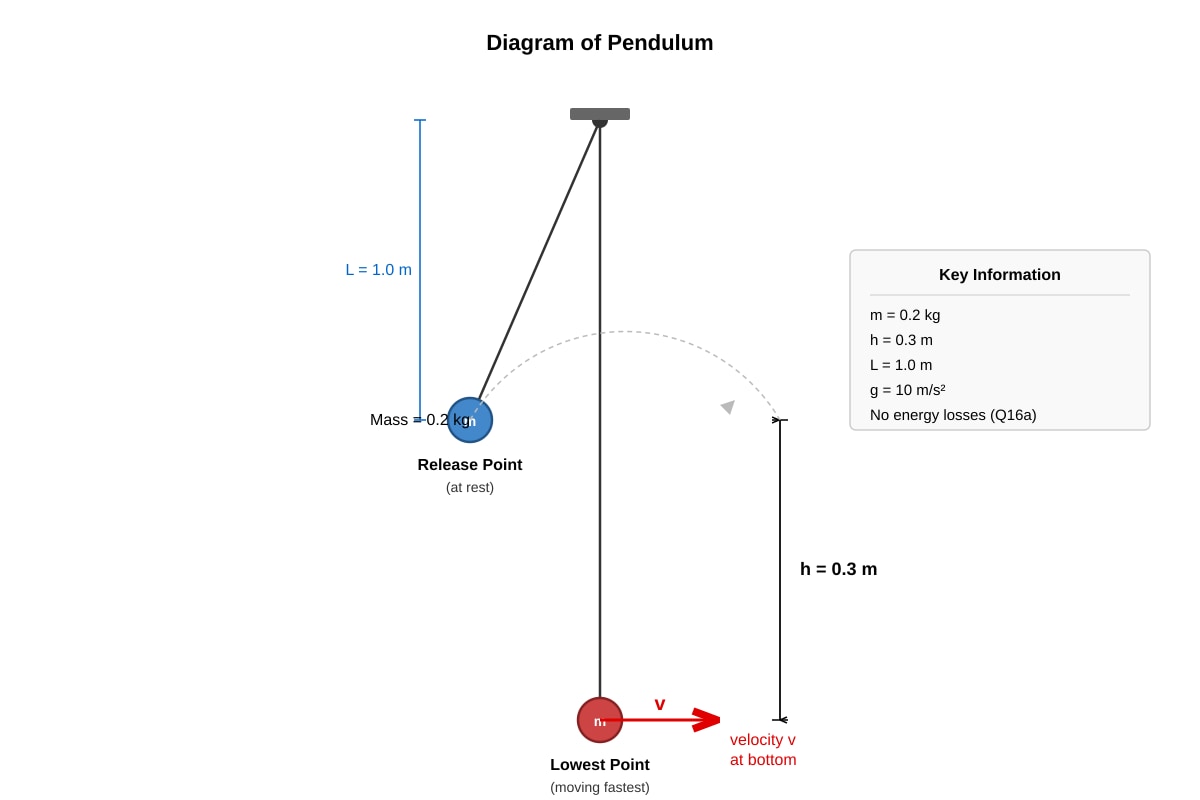
The diagram below shows a simple pendulum swinging from position P to Q to R.

<image_placeholder> id: Q5-fig1 type: diagram linked_question: Q5 description: Simple pendulum at three positions: P (highest left), Q (lowest centre), R (highest right). Label positions P, Q, R. Show string length and bob. labels: P, Q, R, string, bob values: must_show: Three distinct positions with P and R at equal height above Q </image_placeholder>

At which position does the pendulum bob have the maximum kinetic energy?

A. P only
B. Q only
C. R only
D. P and R

Answer: \square

Question 6 [1]

A car of mass 1000 kg accelerates uniformly from rest to 20 m/s in 10 s. The average power developed by the car engine is:

A. 2000 W
B. 20 000 W
C. 40 000 W
D. 200 000 W

Answer: \square

Question 7 [1]

Which of the following statements about energy efficiency is correct?

A. Energy efficiency can be greater than 100% if the machine is well-designed.
B. Energy efficiency = Total energy inputUseful energy output×100%\frac{\text{Total energy input}}{\text{Useful energy output}} \times 100\%
C. Energy efficiency = Useful energy outputTotal energy input×100%\frac{\text{Useful energy output}}{\text{Total energy input}} \times 100\%
D. A machine with 100% efficiency converts all input energy into useful output energy with no waste.

Answer: \square

Question 8 [1]

A student lifts a 2 kg book from the floor to a shelf 1.5 m high. The gravitational potential energy gained by the book is: (Take g=10 N/kgg = 10 \text{ N/kg})

A. 3 J
B. 15 J
C. 30 J
D. 300 J

Answer: \square

Question 9 [1]

In a filament lamp, electrical energy is converted to:

A. Light energy only
B. Heat energy only
C. Light energy and heat energy
D. Kinetic energy and light energy

Answer: \square

Question 10 [1]

A spring is compressed by a force of 10 N. The spring constant is 50 N/m. The elastic potential energy stored in the spring is:

A. 0.5 J
B. 1 J
C. 2 J
D. 5 J

Answer: \square

Question 11 [1]

Which of the following is a non-renewable energy resource?

A. Solar energy
B. Wind energy
C. Natural gas
D. Hydroelectric energy

Answer: \square

Question 12 [1]

A 500 g object is moving at a speed of 4 m/s. Its kinetic energy is:

A. 4 J
B. 8 J
C. 16 J
D. 32 J

Answer: \square

Question 13 [1]

The diagram shows a roller coaster car at four positions A, B, C, and D on a frictionless track.

<image_placeholder> id: Q13-fig1 type: diagram linked_question: Q13 description: Roller coaster track with four labelled positions: A (highest start), B (valley), C (medium hill), D (ground level end). Heights: A = 50 m, B = 0 m, C = 30 m, D = 10 m. labels: A, B, C, D, heights values: A: 50 m, B: 0 m, C: 30 m, D: 10 m must_show: Track profile with labelled positions and height values </image_placeholder>

At which position does the car have the greatest speed?

A. A
B. B
C. C
D. D

Answer: \square

Question 14 [1]

A machine lifts a load of 500 N through a height of 2 m. The effort applied is 200 N and moves through a distance of 6 m. The efficiency of the machine is:

A. 33.3%
B. 50%
C. 66.7%
D. 83.3%

Answer: \square

Question 15 [1]

Which energy conversion occurs when a battery-powered torch is switched on?

A. Chemical energy \rightarrow Electrical energy \rightarrow Light energy + Heat energy
B. Electrical energy \rightarrow Chemical energy \rightarrow Light energy
C. Light energy \rightarrow Electrical energy \rightarrow Chemical energy
D. Heat energy \rightarrow Electrical energy \rightarrow Light energy

Answer: \square


Section B: Structured Questions [30 marks]

Answer all questions in the spaces provided.

Question 16 [6]

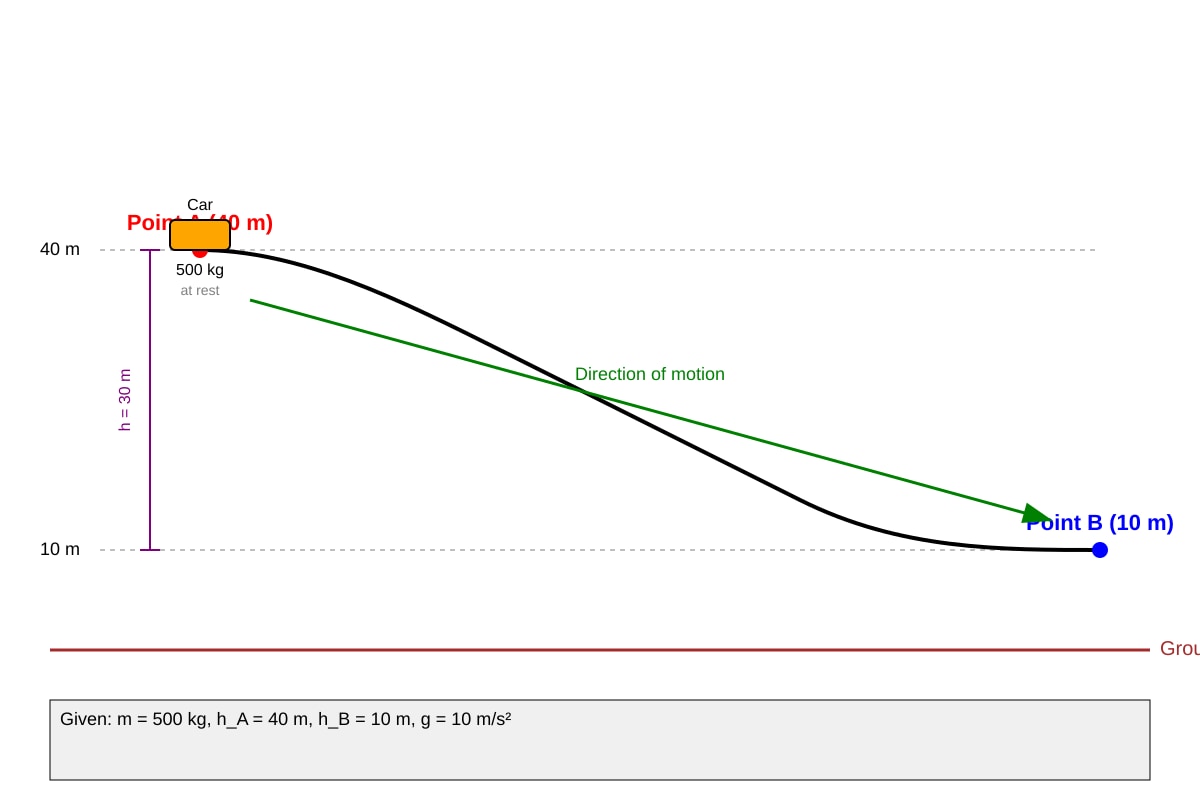
A roller coaster car of mass 500 kg is released from rest at point A, which is 40 m above the ground. The track is frictionless. (Take g=10 N/kgg = 10 \text{ N/kg})

<image_placeholder> id: Q16-fig1 type: diagram linked_question: Q16 description: Roller coaster track with points A, B, C. A at height 40 m, B at ground level (0 m), C at height 25 m. Car shown at A. labels: A (40 m), B (0 m), C (25 m), car, track values: Mass = 500 kg, g = 10 N/kg, heights as labelled must_show: Track profile with three labelled points and height values </image_placeholder>

(a) Calculate the gravitational potential energy of the car at point A. [2]


(b) State the total mechanical energy of the car at point A. [1]


(c) Calculate the speed of the car at point B. [2]


(d) Calculate the kinetic energy of the car at point C. [1]


Question 17 [5]

A student investigates the relationship between the extension of a spring and the force applied. The table shows the results.

Force / NExtension / cm
00
24
48
612
816
1020

(a) Plot a graph of force (y-axis) against extension (x-axis) on the grid below. [2]

<image_placeholder> id: Q17-fig1 type: graph linked_question: Q17 description: Blank graph grid for plotting Force (N) vs Extension (cm). X-axis: Extension (cm) from 0 to 22 cm. Y-axis: Force (N) from 0 to 12 N. Grid lines at 1 cm and 1 N intervals. labels: Force / N (y-axis), Extension / cm (x-axis) values: X: 0-22 cm, Y: 0-12 N must_show: Labelled axes with units, appropriate scale, grid lines </image_placeholder>

(b) Determine the spring constant of the spring from your graph. [2]


(c) Calculate the elastic potential energy stored in the spring when the extension is 10 cm. [1]


Question 18 [5]

An electric kettle rated at 2.2 kW is used to heat 1.5 kg of water from 25°C to 100°C. The specific heat capacity of water is 4200 J/(kg·°C). Assume no heat losses to the surroundings.

(a) Calculate the amount of heat energy required to heat the water. [2]


(b) Calculate the time taken for the kettle to heat the water. Give your answer in seconds. [2]


(c) In practice, the actual time taken is longer than the calculated time. Explain why. [1]


Question 19 [7]

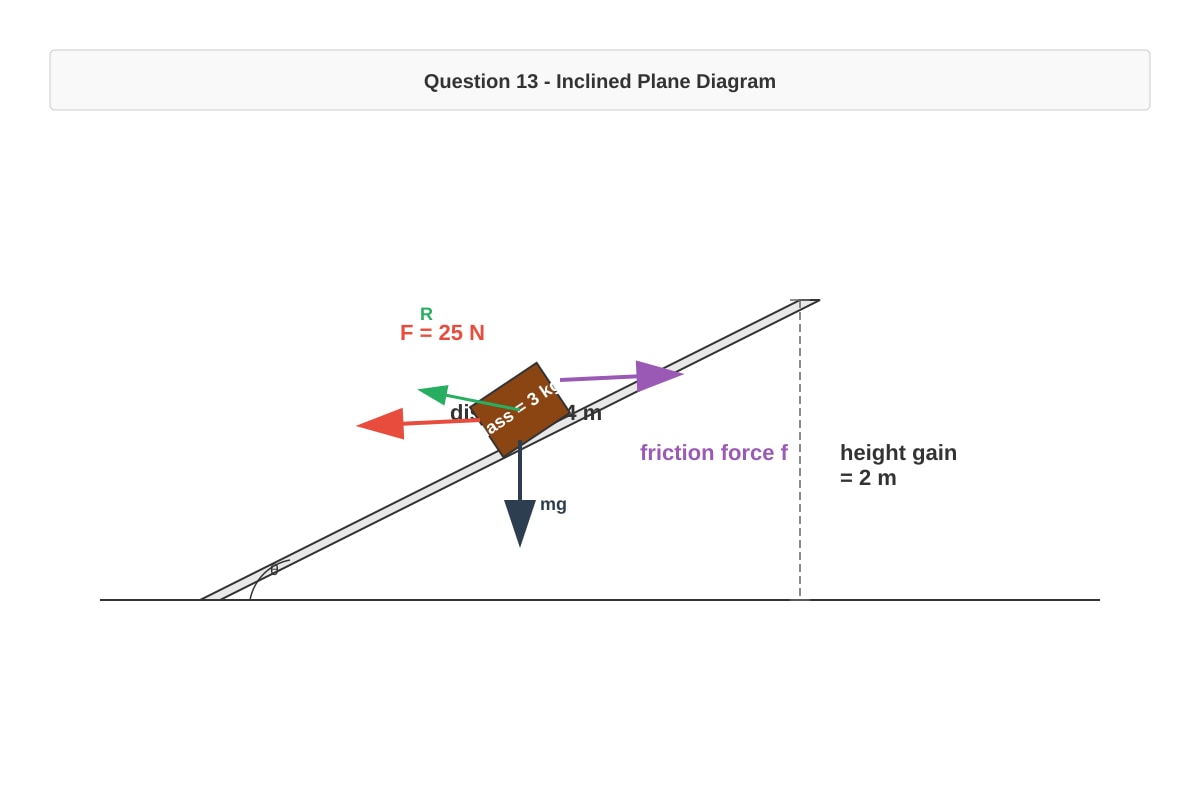
A block of mass 3 kg is pulled up a rough inclined plane by a constant force of 40 N acting parallel to the plane. The plane is inclined at 30° to the horizontal. The block moves a distance of 5 m along the plane from rest. The frictional force acting on the block is 8 N. (Take g=10 N/kgg = 10 \text{ N/kg}, sin30°=0.5\sin 30° = 0.5, cos30°=0.87\cos 30° = 0.87)

<image_placeholder> id: Q19-fig1 type: diagram linked_question: Q19 description: Inclined plane at 30° with block on it. Force of 40 N pulling up parallel to plane. Friction 8 N opposing motion. Weight mg vertically down. Components shown. labels: 3 kg block, 40 N force up plane, 8 N friction down plane, 30° angle, 5 m displacement values: Mass = 3 kg, Force = 40 N, Friction = 8 N, Angle = 30°, Distance = 5 m, g = 10 N/kg must_show: Inclined plane with all forces labelled, angle, displacement direction </image_placeholder>

(a) Calculate the work done by the applied force of 40 N. [1]


(b) Calculate the work done against friction. [1]


(c) Calculate the gain in gravitational potential energy of the block. [2]


(d) Using the work-energy principle, calculate the kinetic energy of the block after moving 5 m. [2]


(e) Calculate the speed of the block after moving 5 m. [1]


Question 20 [7]

A hydroelectric power station uses water falling from a height of 80 m to generate electricity. Water flows at a rate of 500 kg/s. The efficiency of the turbine-generator system is 85%. (Take g=10 N/kgg = 10 \text{ N/kg})

(a) Calculate the gravitational potential energy lost by the water per second. [2]


(b) Calculate the electrical power output of the power station. [2]


(c) The electrical energy generated is transmitted at high voltage over long distances. Explain why high voltage transmission reduces energy losses. [2]


(d) State one environmental advantage and one environmental disadvantage of hydroelectric power. [1]


Section C: Free Response / Data-Based Questions [15 marks]

Answer all questions in the spaces provided.

Question 21 [8]

A student conducts an experiment to investigate the bounce height of a tennis ball dropped from different heights. The ball is dropped from height hh and the rebound height HH is measured. The results are shown below.

Drop height hh / cmRebound height HH / cm
5032
6038
7044
8051
9057
10063

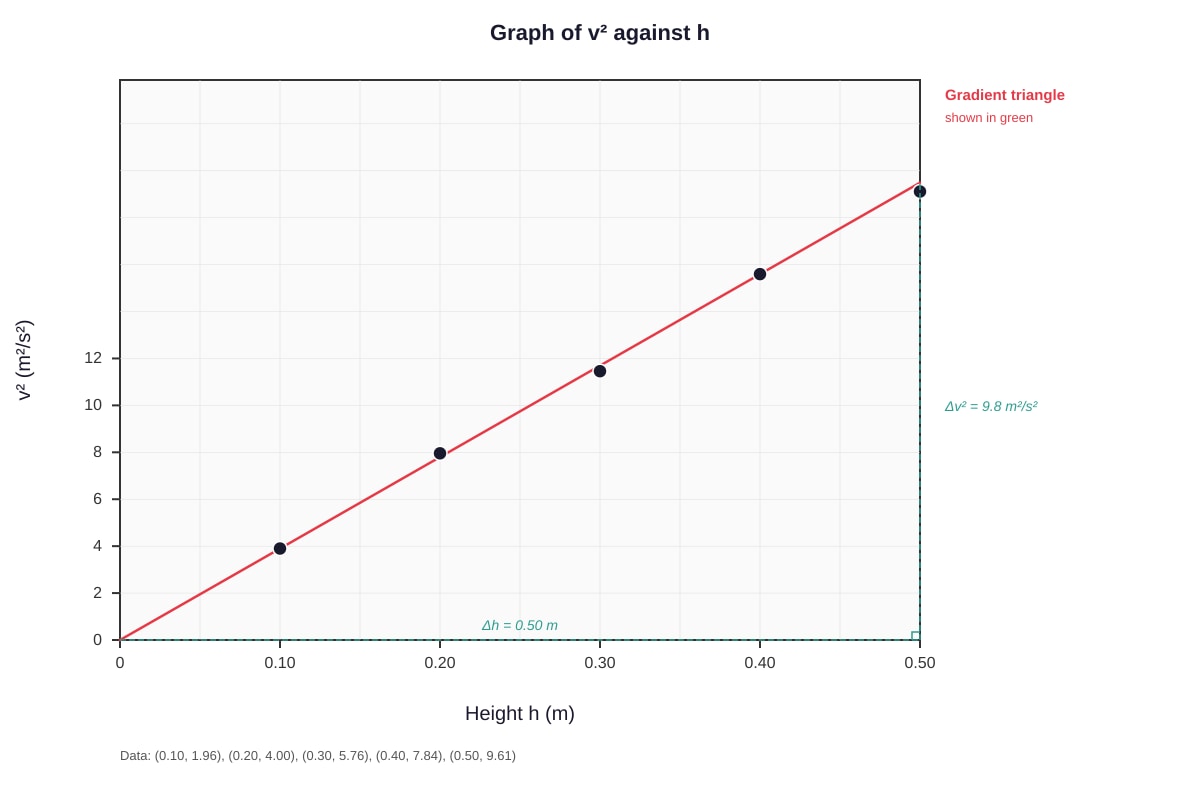
(a) Plot a graph of rebound height HH (y-axis) against drop height hh (x-axis) on the grid provided. Draw the best-fit line. [3]

<image_placeholder> id: Q21-fig1 type: graph linked_question: Q21 description: Blank graph grid for plotting Rebound height H (cm) vs Drop height h (cm). X-axis: Drop height h (cm) from 0 to 110 cm. Y-axis: Rebound height H (cm) from 0 to 70 cm. Grid lines at 5 cm intervals. labels: Rebound height H / cm (y-axis), Drop height h / cm (x-axis) values: X: 0-110 cm, Y: 0-70 cm must_show: Labelled axes with units, appropriate scale, grid lines, space for best-fit line </image_placeholder>

(b) Using your graph, determine the rebound height when the drop height is 75 cm. [1]


(c) Calculate the percentage of gravitational potential energy retained after one bounce when the ball is dropped from 100 cm. [2]


(d) Explain why the rebound height is always less than the drop height. [1]


(e) The student suggests that the ratio H/hH/h is constant. Use the data to comment on this suggestion. [1]


Question 22 [7]

The diagram shows a simple electric circuit used to investigate the heating effect of current. A resistor of resistance 10 Ω\Omega is immersed in 100 g of water in an insulated container. The initial temperature of the water is 20°C. A current of 2 A flows through the resistor for 5 minutes. The specific heat capacity of water is 4200 J/(kg·°C). Assume all electrical energy is converted to heat energy absorbed by the water.

<image_placeholder> id: Q22-fig1 type: experimental_setup linked_question: Q22 description: Circuit diagram: Battery, switch, ammeter (reading 2 A), resistor (10 Ω) immersed in water in insulated container. Thermometer in water showing initial 20°C. labels: Battery, switch, ammeter (2 A), resistor (10 Ω), water (100 g), insulated container, thermometer values: Resistance = 10 Ω, Current = 2 A, Time = 5 min, Mass of water = 100 g, c = 4200 J/(kg·°C), Initial temp = 20°C must_show: Complete circuit with all components labelled, resistor in water, thermometer </image_placeholder>

(a) Calculate the electrical power dissipated in the resistor. [1]


(b) Calculate the total electrical energy supplied in 5 minutes. [2]


(c) Calculate the final temperature of the water. [3]


(d) In a second experiment, the same current flows through a resistor of resistance 20 Ω\Omega for the same time. State and explain how the final temperature of the water would differ. [1]


End of Paper

Answers

<!-- TuitionGoWhere generation metadata: stage=3-1; model=nvidia/nemotron-3-ultra-550b-a55b:free; model_label=NVIDIA Nemotron 3 Ultra 550B A55B Free; generated=2026-06-06; Sources: Stage 2-1 real exam-derived templates and Stage 2-2 exam-enriched syllabus. -->

TuitionGoWhere Practice Paper - Science Secondary 2 (SA2 Version 3) - Answer Key

Total Marks: 60


Section A: Multiple Choice Questions [15 marks]

Question 1 [1] - Answer: B

Working:
Gravitational potential energy at start = mgh=0.5×10×20=100 Jmgh = 0.5 \times 10 \times 20 = 100 \text{ J}
By conservation of energy (ignoring air resistance), this is converted entirely to kinetic energy just before impact.
Kinetic energy = 100 J

Key concept: Energy conservation - gravitational potential energy converts to kinetic energy during free fall.


Question 2 [1] - Answer: B

Explanation:
In a hydroelectric power station:
Water stored at height \rightarrow Gravitational potential energy
Water flows down \rightarrow Kinetic energy
Turbine turns generator \rightarrow Electrical energy
Sequence: Gravitational potential energy \rightarrow Kinetic energy \rightarrow Electrical energy


Question 3 [1] - Answer: C

Working:
Work done = Force ×\times Distance moved in direction of force
W=20 N×5 m=100 JW = 20 \text{ N} \times 5 \text{ m} = 100 \text{ J}


Question 4 [1] - Answer: A

Working:
Energy = Power ×\times Time
E=60 W×2 h=120 Wh=0.12 kWhE = 60 \text{ W} \times 2 \text{ h} = 120 \text{ Wh} = 0.12 \text{ kWh}

Common mistake: Forgetting to convert watts to kilowatts (would give 120 kWh, not an option).


Question 5 [1] - Answer: B

Explanation:
At position Q (lowest point), gravitational potential energy is minimum, so kinetic energy is maximum (by conservation of mechanical energy). At P and R, the bob momentarily stops (kinetic energy = 0).


Question 6 [1] - Answer: B

Working:
Final kinetic energy = 12mv2=12×1000×202=200000 J\frac{1}{2}mv^2 = \frac{1}{2} \times 1000 \times 20^2 = 200\,000 \text{ J}
Average power = Work doneTime=20000010=20000 W\frac{\text{Work done}}{\text{Time}} = \frac{200\,000}{10} = 20\,000 \text{ W}


Question 7 [1] - Answer: C

Explanation:
Energy efficiency = Useful energy outputTotal energy input×100%\frac{\text{Useful energy output}}{\text{Total energy input}} \times 100\%
Option D describes an ideal machine but is not the definition of efficiency. Efficiency cannot exceed 100% (Option A is false). Option B has the formula inverted.


Question 8 [1] - Answer: C

Working:
GPE gained = mgh=2×10×1.5=30 Jmgh = 2 \times 10 \times 1.5 = 30 \text{ J}


Question 9 [1] - Answer: C

Explanation:
In a filament lamp, electrical energy heats the filament to a high temperature, causing it to glow. Most energy becomes heat, some becomes visible light. Both are produced.


Question 10 [1] - Answer: B

Working:
Extension x=Fk=1050=0.2 mx = \frac{F}{k} = \frac{10}{50} = 0.2 \text{ m}
Elastic potential energy = 12Fx=12×10×0.2=1 J\frac{1}{2}Fx = \frac{1}{2} \times 10 \times 0.2 = 1 \text{ J}
(Alternatively: 12kx2=12×50×0.22=1 J\frac{1}{2}kx^2 = \frac{1}{2} \times 50 \times 0.2^2 = 1 \text{ J})


Question 11 [1] - Answer: C

Explanation:
Natural gas is a fossil fuel (non-renewable). Solar, wind, and hydroelectric are renewable energy resources.


Question 12 [1] - Answer: A

Working:
Mass = 500 g = 0.5 kg
Kinetic energy = 12mv2=12×0.5×42=0.25×16=4 J\frac{1}{2}mv^2 = \frac{1}{2} \times 0.5 \times 4^2 = 0.25 \times 16 = 4 \text{ J}


Question 13 [1] - Answer: B

Explanation:
On a frictionless track, total mechanical energy is conserved. Speed is greatest where gravitational potential energy is lowest (lowest height). Point B is at 0 m (ground level), the lowest point.


Question 14 [1] - Answer: D

Working:
Useful work output = Load ×\times Height lifted = 500×2=1000 J500 \times 2 = 1000 \text{ J}
Work input = Effort ×\times Distance moved by effort = 200×6=1200 J200 \times 6 = 1200 \text{ J}
Efficiency = 10001200×100%=83.3%\frac{1000}{1200} \times 100\% = 83.3\%


Question 15 [1] - Answer: A

Explanation:
Battery stores chemical energy \rightarrow converted to electrical energy in circuit \rightarrow converted to light and heat energy in bulb filament.


Section B: Structured Questions [30 marks]

Question 16 [6]

(a) [2]
GPE at A = mgh=500×10×40=200000 Jmgh = 500 \times 10 \times 40 = 200\,000 \text{ J} (or 200 kJ)
Marks: 1 for correct formula/substitution, 1 for correct answer with unit.

(b) [1]
Total mechanical energy at A = 200 000 J (since released from rest, KE = 0, so total = GPE)
Mark: 1 for correct value with unit.

(c) [2]
At B, height = 0, so GPE = 0. By conservation of energy, KE at B = Total energy = 200 000 J
12mv2=200000\frac{1}{2}mv^2 = 200\,000
v2=2×200000500=800v^2 = \frac{2 \times 200\,000}{500} = 800
v=800=28.3 m/sv = \sqrt{800} = 28.3 \text{ m/s} (or 202 m/s20\sqrt{2} \text{ m/s})
Marks: 1 for correct use of energy conservation/KE formula, 1 for correct answer with unit.

(d) [1]
At C, height = 25 m
GPE at C = mgh=500×10×25=125000 Jmgh = 500 \times 10 \times 25 = 125\,000 \text{ J}
KE at C = Total energy - GPE at C = 200000125000=75000 J200\,000 - 125\,000 = 75\,000 \text{ J}
Mark: 1 for correct answer with unit.


Question 17 [5]

(a) [2]
Graph requirements:

  • Axes labelled with quantities and units: Force / N (y-axis), Extension / cm (x-axis)
  • Suitable scales (e.g., 1 cm = 1 N on y-axis, 1 cm = 2 cm on x-axis)
  • All 6 points plotted correctly
  • Best-fit straight line through origin
    Marks: 1 for axes and scales, 1 for correct plotting and best-fit line.

(b) [2]
Spring constant k=gradient of graph=ΔFΔxk = \text{gradient of graph} = \frac{\Delta F}{\Delta x}
Using points (0,0) and (20 cm, 10 N):
k=10 N0.20 m=50 N/mk = \frac{10 \text{ N}}{0.20 \text{ m}} = 50 \text{ N/m}
(Note: Must convert cm to m for standard unit N/m)
Marks: 1 for correct method (gradient), 1 for correct value with unit (N/m).

(c) [1]
At extension = 10 cm = 0.10 m
Elastic potential energy = 12kx2=12×50×(0.10)2=0.25 J\frac{1}{2}kx^2 = \frac{1}{2} \times 50 \times (0.10)^2 = 0.25 \text{ J}
OR = 12Fx=12×5×0.10=0.25 J\frac{1}{2}Fx = \frac{1}{2} \times 5 \times 0.10 = 0.25 \text{ J} (since at 10 cm, F = 5 N from table)
Mark: 1 for correct answer with unit.


Question 18 [5]

(a) [2]
Heat energy required Q=mcΔθQ = mc\Delta\theta
Q=1.5×4200×(10025)Q = 1.5 \times 4200 \times (100 - 25)
Q=1.5×4200×75Q = 1.5 \times 4200 \times 75
Q=472500 JQ = 472\,500 \text{ J} (or 472.5 kJ)
Marks: 1 for correct formula and substitution, 1 for correct answer with unit.

(b) [2]
Power P=2.2 kW=2200 WP = 2.2 \text{ kW} = 2200 \text{ W}
Energy E=PtE = Pt
t=EP=4725002200=214.77 s215 st = \frac{E}{P} = \frac{472\,500}{2200} = 214.77 \text{ s} \approx 215 \text{ s}
Marks: 1 for correct formula and unit conversion, 1 for correct answer with unit (s).

(c) [1]
Heat losses to surroundings / kettle body / not all electrical energy goes into heating water / water evaporates.
Mark: 1 for any valid reason.


Question 19 [7]

(a) [1]
Work done by applied force = Force ×\times Distance = 40×5=200 J40 \times 5 = 200 \text{ J}
Mark: 1 for correct answer with unit.

(b) [1]
Work done against friction = Frictional force ×\times Distance = 8×5=40 J8 \times 5 = 40 \text{ J}
Mark: 1 for correct answer with unit.

(c) [2]
Vertical height gained h=5×sin30°=5×0.5=2.5 mh = 5 \times \sin 30° = 5 \times 0.5 = 2.5 \text{ m}
Gain in GPE = mgh=3×10×2.5=75 Jmgh = 3 \times 10 \times 2.5 = 75 \text{ J}
Marks: 1 for correct height calculation, 1 for correct GPE with unit.

(d) [2]
Work-energy principle: Net work done = Change in kinetic energy
Work done by applied force = Work against friction + Gain in GPE + Gain in KE
200=40+75+KE200 = 40 + 75 + \text{KE}
KE=200115=85 J\text{KE} = 200 - 115 = 85 \text{ J}
Marks: 1 for correct equation/setup, 1 for correct answer with unit.

(e) [1]
KE=12mv2\text{KE} = \frac{1}{2}mv^2
85=12×3×v285 = \frac{1}{2} \times 3 \times v^2
v2=1703=56.67v^2 = \frac{170}{3} = 56.67
v=56.67=7.53 m/sv = \sqrt{56.67} = 7.53 \text{ m/s}
Mark: 1 for correct answer with unit.


Question 20 [7]

(a) [2]
Mass of water per second = 500 kg
Height = 80 m
GPE lost per second = mgh=500×10×80=400000 J/s=400 kWmgh = 500 \times 10 \times 80 = 400\,000 \text{ J/s} = 400 \text{ kW}
Marks: 1 for correct formula/substitution, 1 for correct answer with unit (J/s or W).

(b) [2]
Input power = 400 000 W
Efficiency = 85% = 0.85
Electrical power output = 0.85×400000=340000 W=340 kW0.85 \times 400\,000 = 340\,000 \text{ W} = 340 \text{ kW}
Marks: 1 for correct efficiency calculation, 1 for correct answer with unit.

(c) [2]
High voltage transmission reduces current for the same power (P=VIP = VI).
Power loss in cables = I2RI^2R. Lower current \rightarrow much lower I2RI^2R losses.
Marks: 1 for stating reduced current, 1 for linking to reduced I2RI^2R heating losses.

(d) [1]
Advantage: No greenhouse gas emissions during operation / renewable / no air pollution.
Disadvantage: Flooding of land / disruption of ecosystems / methane from rotting vegetation / displacement of communities.
Mark: 1 for one valid advantage AND one valid disadvantage.


Section C: Free Response / Data-Based Questions [15 marks]

Question 21 [8]

(a) [3]
Graph requirements:

  • Axes labelled: Rebound height H / cm (y-axis), Drop height h / cm (x-axis)
  • Suitable scales covering data range
  • All 6 points plotted accurately
  • Best-fit straight line (should pass near origin, positive gradient)
    Marks: 1 for axes and scales, 1 for correct plotting, 1 for best-fit line.

(b) [1]
From graph, at h=75 cmh = 75 \text{ cm}, H47.5 cmH \approx 47.5 \text{ cm} (accept 47-48 cm)
Mark: 1 for correct reading from candidate's graph (ecf).

(c) [2]
At h=100 cmh = 100 \text{ cm}, H=63 cmH = 63 \text{ cm}
GPE before bounce h\propto h, GPE after bounce H\propto H
Percentage retained = Hh×100%=63100×100%=63%\frac{H}{h} \times 100\% = \frac{63}{100} \times 100\% = 63\%
Marks: 1 for correct method (ratio of heights), 1 for correct answer with %.

(d) [1]
Energy is lost during impact (converted to sound, heat, deformation of ball and floor).
Mark: 1 for mentioning energy conversion to sound/heat/deformation.

(e) [1]
Ratios: 32/50=0.6432/50 = 0.64, 38/60=0.6338/60 = 0.63, 44/70=0.6344/70 = 0.63, 51/80=0.6451/80 = 0.64, 57/90=0.6357/90 = 0.63, 63/100=0.6363/100 = 0.63
The ratio is approximately constant (~0.63), so the suggestion is largely supported by the data.
Mark: 1 for calculating ratios and concluding they are approximately constant.


Question 22 [7]

(a) [1]
Electrical power P=I2R=22×10=40 WP = I^2R = 2^2 \times 10 = 40 \text{ W}
Mark: 1 for correct answer with unit.

(b) [2]
Time = 5 minutes = 300 s
Energy E=Pt=40×300=12000 JE = Pt = 40 \times 300 = 12\,000 \text{ J}
Marks: 1 for time conversion to seconds, 1 for correct answer with unit.

(c) [3]
Electrical energy = Heat energy absorbed by water
E=mcΔθE = mc\Delta\theta
12000=0.100×4200×(Tf20)12\,000 = 0.100 \times 4200 \times (T_f - 20)
12000=420×(Tf20)12\,000 = 420 \times (T_f - 20)
Tf20=12000420=28.57T_f - 20 = \frac{12\,000}{420} = 28.57
Tf=48.57°C48.6°CT_f = 48.57°C \approx 48.6°C
Marks: 1 for equating electrical energy to heat energy, 1 for correct substitution and rearrangement, 1 for correct final temperature with unit.

(d) [1]
Power P=I2RP = I^2R. With same current (2 A) but double resistance (20 Ω\Omega), power doubles to 80 W.
Energy supplied doubles, so temperature rise doubles. Final temperature would be higher.
Mark: 1 for stating final temperature would be higher with correct explanation (power/energy doubles).


End of Answer Key