From Real Exams Exam Paper
Secondary 2 Science Semestral Assessment 2 (End of Year) Paper 3
Free Sec 2 Science SA2 Paper 3, HY3 Exam version, with questions, answers, and syllabus-aligned practice for Singapore students.
These static practice materials are generated from the site's syllabus and paper-generation workflow, with source and model context shown so students and parents can evaluate the material before use.
Questions
TuitionGoWhere Exam Practice (AI) — SA2 Science Secondary 2 (Version 3)
School: TuitionGoWhere Secondary School (AI)
Subject: Science
Level: Secondary 2
Paper: SA2 Practice Paper (Version 3 of 5)
Duration: 60 minutes
Total Marks: 60
Name: ______________________
Class: _________
Date: ____________
Instructions:
- Answer all questions in the spaces provided.
- Use a blue or black pen.
- Show your working clearly for calculation questions.
- Units must be given in your final answers where required.
- The quiz contains 20 questions across Sections A, B, and C.
Section A: Multiple Choice and Short Structured (Questions 1–8) [16 marks]
1. Which of the following is an example of a renewable energy source? [1]
A. Coal
B. Natural gas
C. Wind
D. Crude oil
2. A spring balance is used to measure a force of 2 N acting on a book. What is the unit of this measurement? [1]
A. Joule
B. Newton
C. Volt
D. Ohm
3. State one effect of frictional force on the motion of a rolling ball. [1]
4. The voltage supplied to homes in Singapore is ______ V. [1]
5. An object has a mass of 4 kg and is lifted by 5 m. Using g=10 m/s2, calculate the gain in gravitational potential energy. [2]
Working:
Answer: ____________
6. Name the safety device in a mains plug that protects users from electric shock by connecting the appliance to the ground. [1]
7. Heat flows from a region of ______ temperature to a region of ______ temperature. [1]
8. A parallel circuit has two lamps. If one lamp breaks, the other lamp will ______. [1]
A. go off
B. stay lit
C. become brighter
D. become dimmer
Section B: Structured Response and Diagram Interpretation (Questions 9–14) [22 marks]
9. (a) State the principle of conservation of energy. [2]
(b) A pendulum swings from its highest point to its lowest point. Describe the energy conversion that takes place. [2]
10.
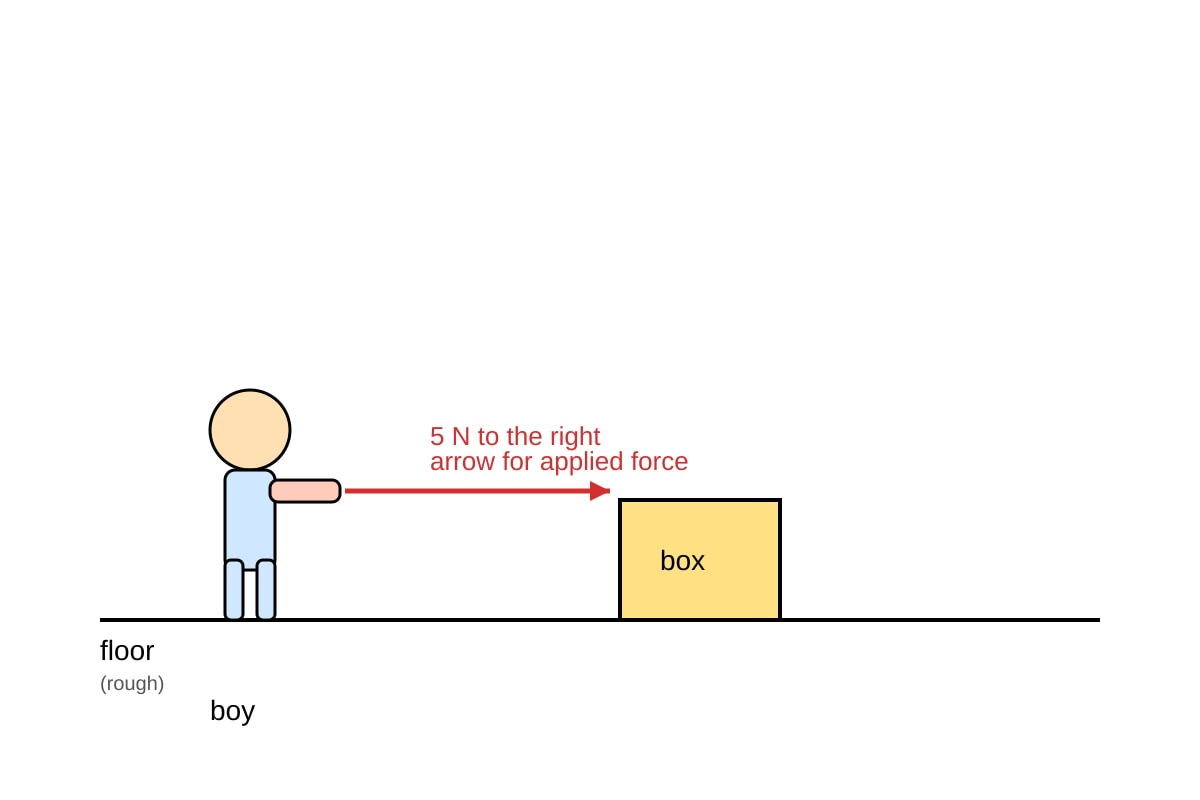
Image pending generation: diagram for Q10.
Draw, on the diagram, the frictional force acting on the box. Label this force F. [1]
11. A girl climbs 3 flights of stairs from the first floor to the fourth floor. Each floor is 3 m high. Her mass is 40 kg. Using g=10 m/s2, calculate the work done against gravity. [3]
Working:
Answer: ____________
12.
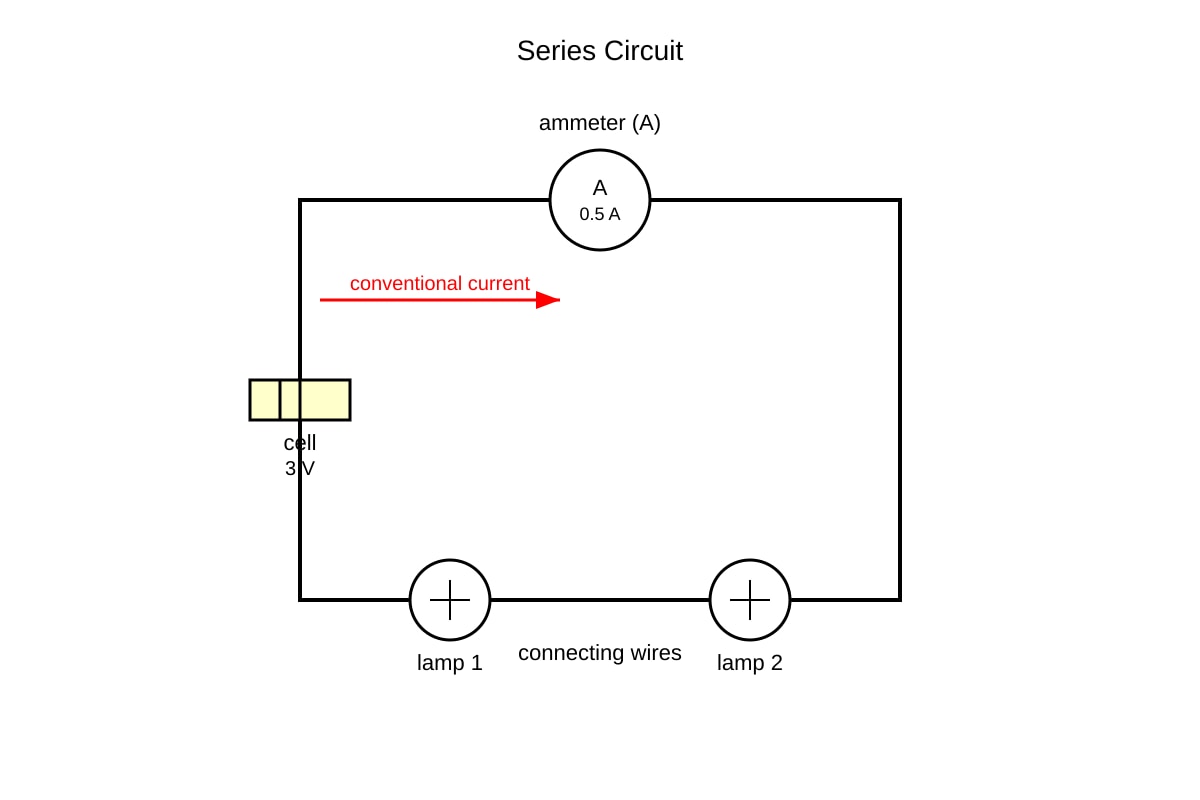
Image pending generation: circuit for Q12.
(a) State the current at lamp 2. [1]
(b) Explain why adding a third lamp in series makes all lamps dimmer. [2]
13. A metal rod is heated and expands. State one everyday problem caused by expansion of materials and name a device that uses expansion to control temperature. [3]
14. A ball of mass 2 kg is dropped from a height of 10 m. Using g=10 m/s2, calculate its kinetic energy just before it hits the ground, assuming no air resistance. [3]
Working:
Answer: ____________
Section C: Application and Extended Response (Questions 15–20) [22 marks]
15. List two advantages and two disadvantages of using fossil fuels as an energy source. [4]
16.
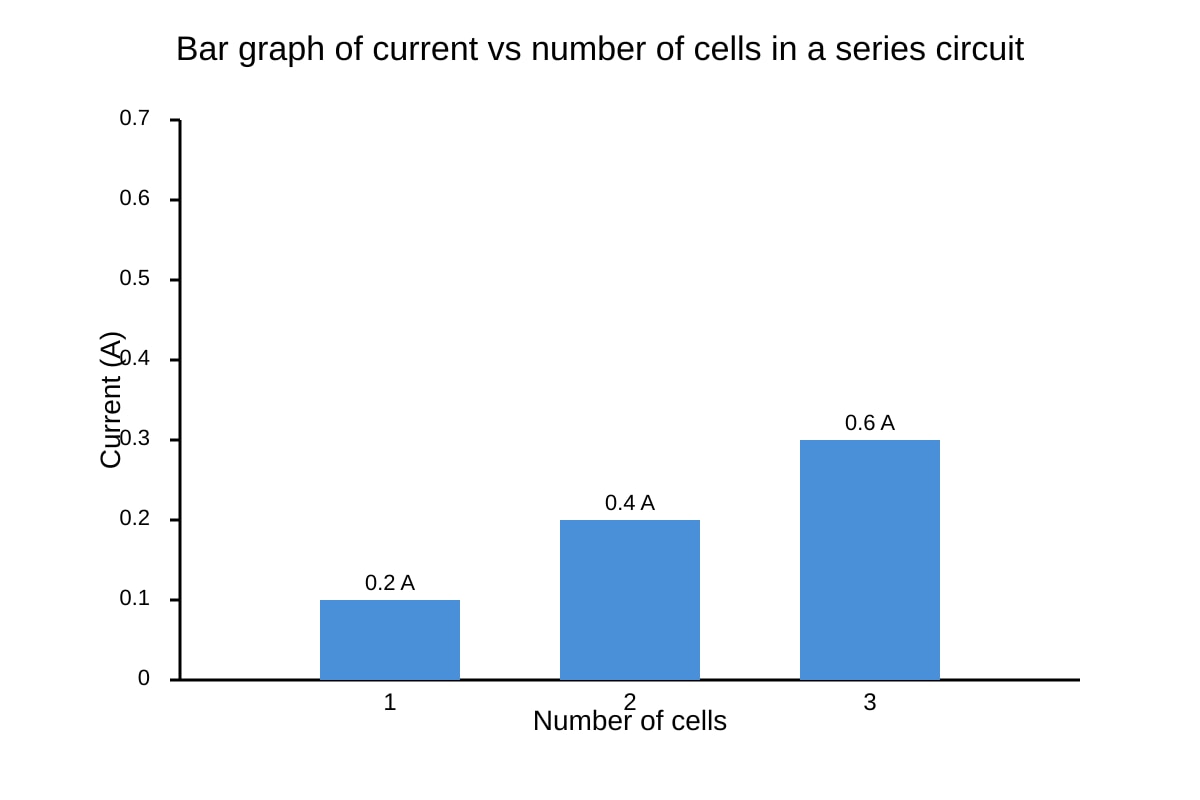
Image pending generation: graph for Q16.
Describe the relationship between the number of cells and the current in the circuit. [2]
17. A heater uses 230 V and draws 4 A. Calculate the power of the heater and the electrical energy used in 2 hours. [4]
Working:
Answers: Power = ____________, Energy = ____________
18. Explain how a fuse protects an electrical circuit. Include the term "overload" in your answer. [3]
19. A block has mass 600 g and volume 300 cm³. Determine if it will float in water (density of water = 1 g/cm³). Show your working. [3]
Working:
Answer: ____________
20. A student says: "Energy is lost as heat when a machine works, so the conservation of energy is wrong." Explain why the student is incorrect. [3]
Answers
TuitionGoWhere Exam Practice (AI) — SA2 Science Secondary 2 (Version 3) Answer Key
Total Marks: 60
Duration: 60 minutes
Section A Answers (Q1–8) [16 marks]
1. C [1]
Wind is a renewable source. Coal, natural gas, crude oil are fossil (non-renewable).
Teaching note: Renewable sources can be replenished naturally (sun, wind, biomass, hydropower).
2. B [1]
Newton (N) is the unit of force. Joule is energy, Volt is voltage, Ohm is resistance.
3. [1]
Example: It slows the ball down / reduces its speed.
Marking: Any one correct effect (slows, stops, changes direction) accepted.
4. [1] 230 V
Singapore mains voltage is 230 V.
5. [2]
ΔPE=mgh=4×10×5=200 J
Answer: 200 J
Marks: 1 for substitution, 1 for answer with unit.
6. [1] Earth wire
The earth wire connects metal parts to ground to prevent shock.
7. [1] higher, lower
Heat flows from higher to lower temperature.
8. B [1]
In parallel, each lamp has its own path; one breaking does not stop the other.
Section B Answers (Q9–14) [22 marks]
9. (a) [2]
Energy cannot be created or destroyed; it can be converted from one form to another (or total energy is constant).
2 marks: 1 each point.
(b) [2]
At highest point: max gravitational potential energy, min kinetic. At lowest: potential converted to kinetic.
Marks: 1 for stating PE→KE, 1 for context.
10. [1]
Friction arrow drawn on box opposite to motion (left), labelled F.
Marking: arrow opposite applied force, label F.
11. [3]
Total height = 3 flights × 3 m = 9 m
W=mgh=40×10×9=3600 J
Answer: 3600 J
Marks: 1 height, 1 formula/sub, 1 answer.
12. (a) [1] 0.5 A (series current same everywhere)
(b) [2] Adding lamp increases total resistance; current drops; all lamps receive less current so dimmer.
Marks: 1 resistance, 1 current/effect.
13. [3]
Problem: railway tracks buckle in heat. Device: bimetallic strip in thermostat.
Marks: 1 problem, 1 device, 1 function/link.
14. [3]
Loss in PE = mgh = 2 × 10 × 10 = 200 J
Gain in KE = 200 J (no air resistance)
Answer: 200 J
Marks: 1 PE calc, 1 conversion, 1 answer.
Section C Answers (Q15–20) [22 marks]
15. [4]
Advantages: high energy output, reliable. Disadvantages: non-renewable, produce CO₂/global warming.
Marks: 1 each point.
16. [2]
Current increases proportionally with number of cells (double cells → double current).
Marks: 1 trend, 1 proportional.
17. [4]
P=IV=230×4=920 W
E=Pt=920×(2×3600)=6.624×10⁶ J or 6.624 MJ
Marks: 2 power, 2 energy with time conversion.
18. [3]
Fuse melts when current too high (overload), breaking circuit and preventing fire/damage.
Marks: overload 1, melt 1, protect 1.
19. [3]
Density = m/V = 600/300 = 2 g/cm³. Since 2 > 1, sinks.
Answer: sinks.
Marks: 1 density, 1 compare, 1 conclusion.
20. [3]
Energy not lost; converted to heat (still present). Total energy conserved.
Marks: 1 not lost, 1 converted, 1 total constant.
Free quiz and exam paper access
Enter your details to view this paper
Your access is remembered on this device.