From Real Exams Exam Paper
Secondary 2 Science Semestral Assessment 2 (End of Year) Paper 1
Free Exam-Derived NVIDIA Nemotron 3 Ultra 550B A55B Free Secondary 2 Science Semestral Assessment 2 (End of Year) Paper 1 practice paper with questions and answers for Singapore students. This page is rendered as a direct URL so the questions and answers can be discovered without pressing in-page buttons.
These static practice materials are generated from the site's syllabus and paper-generation workflow, with source and model context shown so students and parents can evaluate the material before use.
Questions
TuitionGoWhere Practice Paper - Science Secondary 2
TuitionGoWhere Secondary School (AI)
Subject: Science
Level: Secondary 2 (G3)
Paper: SA2 Practice Paper Version 1
Duration: 1 hour 30 minutes
Total Marks: 60
Name: _______________________
Class: _______________________
Date: _______________________
Instructions to Candidates
- Write your name, class, and date in the spaces provided above.
- Answer all questions.
- Write your answers in the spaces provided on the question paper.
- The number of marks is given in brackets [ ] at the end of each question or part question.
- The total marks for this paper is 60.
- You may use a calculator.
- Where necessary, take the acceleration due to gravity, .
Section A: Multiple Choice Questions [15 marks]
Answer all questions. For each question, choose the correct answer and write the letter (A, B, C, or D) in the box provided.
1
A ball of mass 0.5 kg is dropped from a height of 20 m above the ground. Ignoring air resistance, what is the kinetic energy of the ball just before it hits the ground? [1]
A. 50 J
B. 100 J
C. 150 J
D. 200 J
Answer: □
2
Which of the following energy conversions takes place when a candle burns? [1]
A. Chemical potential energy → Heat energy + Light energy
B. Heat energy → Chemical potential energy + Light energy
C. Light energy → Chemical potential energy + Heat energy
D. Chemical potential energy → Electrical energy + Heat energy
Answer: □
3
A force of 25 N is used to push a box horizontally across a floor for a distance of 4 m. How much work is done by the force? [1]
A. 6.25 J
B. 29 J
C. 100 J
D. 400 J
Answer: □
4
The diagram below shows a simple pendulum swinging from position P to Q to R.
<image_placeholder> id: Q4-fig1 type: diagram linked_question: Q4 description: Simple pendulum at three positions - P (highest left), Q (lowest centre), R (highest right). Label positions P, Q, R. Show string length L and vertical height h from Q to P/R. labels: P, Q, R, L, h values: L = 1.0 m, h = 0.2 m must_show: Pendulum bob at three positions, string, vertical height difference marked </image_placeholder>
At which position does the pendulum bob have the maximum kinetic energy? [1]
A. P only
B. Q only
C. R only
D. P and R
Answer: □
5
A student lifts a 2 kg book from the floor to a shelf 1.5 m high. He then carries the book horizontally for 3 m before placing it on another shelf at the same height. Taking , what is the total work done against gravity? [1]
A. 0 J
B. 30 J
C. 60 J
D. 90 J
Answer: □
6
An electric kettle rated at 2000 W is used to boil water for 3 minutes. How much electrical energy is consumed? [1]
A. 6000 J
B. 180 000 J
C. 360 000 J
D. 600 000 J
Answer: □
7
A 500 g toy car moves at a constant speed of 2 m/s. What is its kinetic energy? [1]
A. 0.5 J
B. 1.0 J
C. 2.0 J
D. 4.0 J
Answer: □
8
Which of the following statements about power is correct? [1]
A. Power is the total amount of energy transferred.
B. Power is the rate of doing work.
C. Power is measured in joules.
D. Power increases when the time taken to do work increases.
Answer: □
9
A crane lifts a load of 500 kg through a vertical height of 10 m in 20 s. What is the useful power output of the crane? (Take ) [1]
A. 250 W
B. 2500 W
C. 25 000 W
D. 250 000 W
Answer: □
10
The diagram shows a roller coaster car at four positions A, B, C, and D on a frictionless track.
<image_placeholder> id: Q10-fig1 type: diagram linked_question: Q10 description: Roller coaster track with four labelled positions. A: start at height 30 m. B: bottom of first drop at height 0 m. C: top of second hill at height 15 m. D: bottom of second drop at height 0 m. labels: A, B, C, D, heights values: h_A = 30 m, h_B = 0 m, h_C = 15 m, h_D = 0 m must_show: Track profile with labelled positions and heights </image_placeholder>
If the car starts from rest at position A, at which position will it have the greatest speed? [1]
A. A
B. B
C. C
D. D
Answer: □
11
A motor has an efficiency of 80%. If the input energy is 500 J, what is the useful output energy? [1]
A. 100 J
B. 400 J
C. 500 J
D. 625 J
Answer: □
12
Which energy resource is non-renewable? [1]
A. Solar
B. Wind
C. Natural gas
D. Hydroelectric
Answer: □
13
A spring is compressed by a force of 10 N. The compression is 0.05 m. What is the elastic potential energy stored in the spring? [1]
A. 0.25 J
B. 0.50 J
C. 2.5 J
D. 5.0 J
Answer: □
14
The diagram shows a hydroelectric power station.
<image_placeholder> id: Q14-fig1 type: diagram linked_question: Q14 description: Hydroelectric dam with reservoir, penstock, turbine, generator, power lines. Water flows from reservoir through penstock to turbine. labels: Reservoir, Penstock, Turbine, Generator, Power lines values: must_show: Water flow direction, energy conversion labels </image_placeholder>
What is the main energy conversion that takes place in the turbine? [1]
A. Electrical energy → Kinetic energy
B. Kinetic energy → Electrical energy
C. Gravitational potential energy → Kinetic energy
D. Kinetic energy → Gravitational potential energy
Answer: □
15
A 60 W light bulb is switched on for 2 hours. How much electrical energy is used? [1]
A. 120 J
B. 432 000 J
C. 7200 J
D. 432 000 000 J
Answer: □
Section B: Structured Questions [30 marks]
Answer all questions in the spaces provided.
16
A roller coaster car of mass 500 kg is released from rest at point A, which is 40 m above the ground. The track is frictionless. The car passes through point B at a height of 10 m, then climbs to point C at a height of 25 m.
<image_placeholder> id: Q16-fig1 type: diagram linked_question: Q16 description: Roller coaster track with three labelled points. A at 40 m, B at 10 m, C at 25 m. Car shown at A. labels: A, B, C, heights values: h_A = 40 m, h_B = 10 m, h_C = 25 m, m = 500 kg, g = 10 N/kg must_show: Track profile with heights labelled, car at starting position </image_placeholder>
(a) State the principle of conservation of energy. [2]
(b) Calculate the gravitational potential energy of the car at point A. [2]
(c) Calculate the kinetic energy of the car at point B. [2]
(d) Calculate the speed of the car at point B. [2]
(e) Will the car reach point C? Explain your answer using energy considerations. [2]
17
A student investigates the relationship between the height of a ramp and the speed of a toy car at the bottom of the ramp. The car is released from rest at different heights.
The table shows the results.
| Height of ramp / m | Speed at bottom / m/s |
|---|---|
| 0.10 | 1.4 |
| 0.20 | 2.0 |
| 0.30 | 2.4 |
| 0.40 | 2.8 |
| 0.50 | 3.2 |
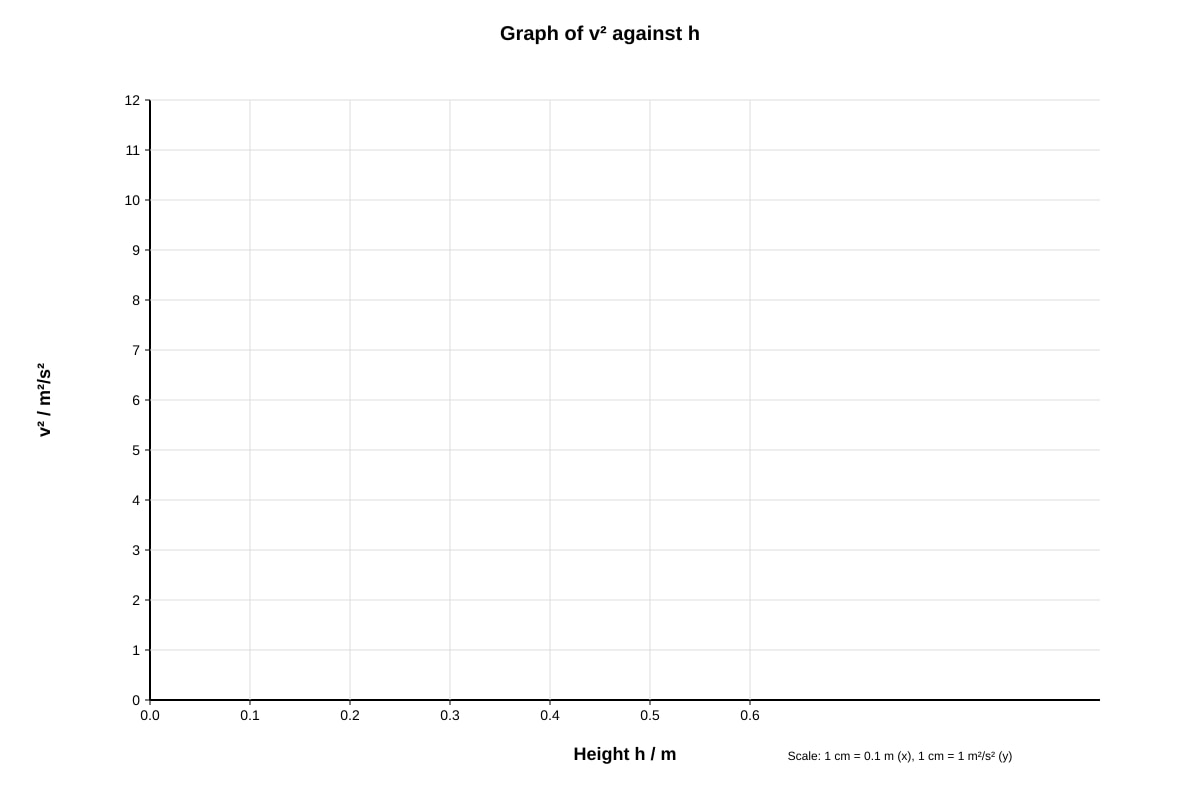
(a) Plot the data on the grid below and draw a best-fit curve. [3]
<image_placeholder> id: Q17-fig1 type: graph linked_question: Q17 description: Graph axes for plotting height vs speed. x-axis: Height of ramp (m), 0 to 0.6. y-axis: Speed at bottom (m/s), 0 to 4.0. Grid lines shown. labels: Height of ramp / m, Speed at bottom / m/s values: Data points from table must_show: Labelled axes with units, appropriate scale, grid </image_placeholder>
(b) State the relationship between the height of the ramp and the speed of the car at the bottom. [1]
(c) The student claims that the speed is directly proportional to the height. Use the data to explain why this claim is incorrect. [2]
(d) Assuming no energy losses, calculate the theoretical speed of the car at the bottom of a 0.50 m high ramp. (Take ) [2]
(e) Suggest one reason why the experimental speeds are lower than the theoretical values. [1]
18
An electric motor is used to lift a load of 200 N through a vertical height of 5 m in 10 s. The motor is connected to a 12 V power supply and draws a current of 10 A during this time.
(a) Calculate the work done on the load. [2]
(b) Calculate the electrical energy supplied to the motor. [2]
(c) Calculate the efficiency of the motor. [2]
(d) State what happens to the energy that is not converted to useful work. [1]
19
A pendulum consists of a 0.2 kg bob attached to a light string of length 1.0 m. The bob is pulled aside until the string makes an angle of 30° with the vertical, then released from rest.
<image_placeholder> id: Q19-fig1 type: diagram linked_question: Q19 description: Pendulum at 30° to vertical. Show string length L = 1.0 m, vertical height difference h from lowest point, angle 30° labelled. labels: L, h, 30°, bob values: m = 0.2 kg, L = 1.0 m, θ = 30°, g = 10 N/kg must_show: Pendulum at release position, vertical height difference clearly marked </image_placeholder>
(a) Calculate the vertical height through which the bob is raised. [2]
(b) Calculate the gravitational potential energy gained by the bob at the release position. [1]
(c) State the kinetic energy of the bob at the lowest point of its swing, assuming no air resistance. [1]
(d) Calculate the maximum speed of the bob. [2]
(e) In reality, the bob eventually comes to rest. Explain why this happens in terms of energy conversions. [2]
20
The diagram shows a simple electrical circuit used to investigate the heating effect of current.
<image_placeholder> id: Q20-fig1 type: experimental_setup linked_question: Q20 description: Circuit with battery, variable resistor, ammeter in series, voltmeter across resistor, and resistor immersed in water in a calorimeter with thermometer. labels: Battery, Variable resistor, Ammeter, Voltmeter, Resistor, Water, Calorimeter, Thermometer values: must_show: Complete circuit with all components labelled, water and thermometer in calorimeter </image_placeholder>
A current of 2.0 A flows through a resistor of resistance 5.0 Ω for 3 minutes. The resistor is immersed in 100 g of water. The specific heat capacity of water is 4.2 J/(g·°C).
(a) Calculate the power dissipated in the resistor. [2]
(b) Calculate the electrical energy converted to heat energy in 3 minutes. [2]
(c) Assuming all the heat energy is absorbed by the water, calculate the temperature rise of the water. [2]
(d) In practice, the temperature rise is less than the calculated value. Give one reason for this. [1]
Section C: Free Response / Data-Based Questions [15 marks]
Answer all questions in the spaces provided.
21
The table below shows the power ratings and typical daily usage of four electrical appliances in a household.
| Appliance | Power Rating / W | Daily Usage / hours |
|---|---|---|
| Refrigerator | 150 | 24 |
| Air Conditioner | 1500 | 6 |
| Washing Machine | 500 | 1 |
| LED TV | 80 | 4 |
(a) Calculate the energy consumed by the air conditioner in one day, in kWh. [2]
(b) Calculate the total energy consumed by all four appliances in one day, in kWh. [2]
(c) If electricity costs $0.28 per kWh, calculate the cost of running these appliances for 30 days. [2]
(d) The household decides to replace the air conditioner with a more efficient model rated at 1200 W but with the same cooling capacity. Calculate the savings in electricity cost per month (30 days) if the usage remains the same. [2]
(e) State two ways, other than replacing appliances, to reduce household electricity consumption. [2]
22
A student sets up an experiment to investigate the bounce height of a tennis ball dropped from different heights. The ball is dropped from height and rebounds to height . The ratio is calculated for each drop height.
The results are shown below.
| Drop Height / m | Rebound Height / m | Ratio |
|---|---|---|
| 0.5 | 0.35 | 0.70 |
| 1.0 | 0.68 | 0.68 |
| 1.5 | 0.99 | 0.66 |
| 2.0 | 1.28 | 0.64 |
(a) State the energy conversion that takes place when the ball falls from height to the ground. [1]
(b) Explain why the ratio is less than 1. [2]
(c) Suggest why the ratio decreases slightly as the drop height increases. [2]
(d) The student claims that "the ball loses the same amount of energy per bounce regardless of the drop height." Use the data to evaluate this claim. [3]
(e) Sketch a graph of rebound height (y-axis) against drop height (x-axis) for from 0 to 2.5 m. Label the axes and indicate the general shape. [2]
<image_placeholder> id: Q22-fig1 type: graph linked_question: Q22 description: Graph axes for sketching h vs H. x-axis: Drop Height H (m), 0 to 2.5. y-axis: Rebound Height h (m), 0 to 2.0. Grid lines shown. labels: Drop Height H / m, Rebound Height h / m values: must_show: Labelled axes with units, appropriate scale </image_placeholder>
23
Read the following passage and answer the questions that follow.
Singapore's Energy Story
Singapore is a small island nation with limited natural resources. Currently, about 95% of Singapore's electricity is generated from natural gas, a fossil fuel. The remaining 5% comes from solar, waste-to-energy, and other sources.
The government has set a target to achieve at least 2 GWp (gigawatt-peak) of solar energy deployment by 2030, which can meet around 3% of Singapore's projected electricity demand. To overcome land constraints, solar panels are being deployed on rooftops, reservoirs (floating solar), and vacant land.
Natural gas, while cleaner than coal or oil, still releases carbon dioxide when burnt. Singapore has committed to reducing its emissions intensity by 36% from 2005 levels by 2030, and to achieving net-zero emissions by 2050.
Energy efficiency is a key strategy. The Mandatory Energy Labelling Scheme (MELS) requires appliances like air conditioners, refrigerators, and clothes dryers to carry energy labels with tick ratings (1 to 5 ticks). More ticks indicate higher energy efficiency.
(a) State the main energy source for electricity generation in Singapore currently. [1]
(b) Explain why natural gas is considered "cleaner" than coal. [2]
(c) Singapore aims to deploy 2 GWp of solar by 2030. Explain one challenge Singapore faces in large-scale solar deployment. [2]
(d) A 5-tick air conditioner and a 2-tick air conditioner both have a cooling capacity of 2.5 kW. The 5-tick model consumes 0.7 kWh per hour of operation, while the 2-tick model consumes 1.0 kWh per hour. If the air conditioner runs for 8 hours a day, calculate the energy saved per day by using the 5-tick model. [2]
(e) Apart from using energy-efficient appliances, suggest one way households can reduce their carbon footprint related to electricity use. [1]
End of Paper
Total Marks: 60
Answers
TuitionGoWhere Practice Paper - Science Secondary 2 (Answer Key)
TuitionGoWhere Secondary School (AI)
Subject: Science
Level: Secondary 2 (G3)
Paper: SA2 Practice Paper Version 1
Total Marks: 60
Section A: Multiple Choice Questions [15 marks]
1
Answer: B
Marks: 1
Working:
Gravitational potential energy at start =
By conservation of energy (ignoring air resistance), all GPE converts to KE just before impact.
KE = 100 J
Teaching Note: When an object falls from rest, its initial GPE is converted entirely to KE at ground level (assuming no air resistance). The mass cancels out if you use , but using energy is more direct.
2
Answer: A
Marks: 1
Explanation: A candle burns wax (chemical potential energy) to produce heat and light. This is a classic example of chemical energy conversion.
3
Answer: C
Marks: 1
Working:
Work done = Force × Distance moved in direction of force =
4
Answer: B
Marks: 1
Explanation: At the lowest point Q, the pendulum bob has minimum gravitational potential energy and maximum kinetic energy (by conservation of energy). At P and R, the bob momentarily stops (KE = 0).
5
Answer: B
Marks: 1
Working:
Work done against gravity = Force × Vertical distance = Weight × Vertical height gain
=
Horizontal movement does no work against gravity because the force (weight) is perpendicular to the displacement.
Common Mistake: Adding the horizontal distance (3 m) to the calculation. Work against gravity only depends on vertical height change.
6
Answer: C
Marks: 1
Working:
Energy = Power × Time =
7
Answer: B
Marks: 1
Working:
(Note: 500 g = 0.5 kg)
8
Answer: B
Marks: 1
Explanation: Power is defined as the rate of doing work or rate of energy transfer. Unit: Watt (W) = J/s.
A is incorrect (that's energy). C is incorrect (joule is energy unit). D is incorrect (power decreases when time increases for same work).
9
Answer: B
Marks: 1
Working:
Work done = Force × Distance = Weight × Height =
Power = Work / Time =
10
Answer: B
Marks: 1
Explanation: On a frictionless track, total mechanical energy is conserved. The car has maximum kinetic energy (and thus maximum speed) at the lowest point, which is B (and D, both at height 0). Since it starts from rest at A, it reaches maximum speed at the first lowest point B.
11
Answer: B
Marks: 1
Working:
Efficiency = Useful output energy / Input energy
Output =
12
Answer: C
Marks: 1
Explanation: Natural gas is a fossil fuel (non-renewable). Solar, wind, and hydroelectric are renewable.
13
Answer: A
Marks: 1
Working:
Elastic potential energy = Average force × Extension =
(For a spring obeying Hooke's Law, the average force during compression is half the maximum force.)
14
Answer: C
Marks: 1
Explanation: In a hydroelectric power station, water loses gravitational potential energy as it falls, gaining kinetic energy. The turbine converts this kinetic energy of moving water into mechanical rotation, which the generator converts to electrical energy. The question asks about the turbine specifically: water's kinetic energy → mechanical energy (rotation). However, the main conversion at the turbine is kinetic energy of water to mechanical energy. Option C describes the conversion before the turbine (GPE → KE of water). Option B describes the generator. The most accurate answer for the overall process at the turbine is that the kinetic energy of water drives the turbine. But in many school contexts, they simplify: GPE → KE (in penstock) → Electrical. Given the options, C is the best description of the energy conversion of the water as it reaches the turbine.
Marking Note: This question tests understanding of the energy chain: GPE → KE → Electrical. The turbine is where KE of water becomes mechanical energy.
15
Answer: B
Marks: 1
Working:
Energy = Power × Time =
Or in kWh:
Section B: Structured Questions [30 marks]
16
(a) Principle of Conservation of Energy [2 marks]
- Energy cannot be created or destroyed. [1]
- It can only be converted from one form to another / The total amount of energy in a closed system remains constant. [1]
Teaching Note: Always state both parts for full marks. "Energy is conserved" alone is insufficient.
(b) GPE at A [2 marks]
[1 for formula/substitution, 1 for answer with unit]
Answer: 200 000 J (or 200 kJ)
(c) KE at B [2 marks]
At B, height = 10 m.
GPE at B =
By conservation of energy: Total energy at A = Total energy at B
[1 for method, 1 for answer]
Answer: 150 000 J
(d) Speed at B [2 marks]
(or ) [1 for substitution, 1 for answer]
Answer: 24.5 m/s
(e) Will it reach C? [2 marks]
GPE at C =
Total energy available = 200 000 J (from A).
Since GPE at C (125 000 J) < Total energy (200 000 J), the car has enough energy to reach C. It will still have KE = 75 000 J at C. [1 for comparison, 1 for conclusion with reasoning]
Answer: Yes, because the total energy (200 000 J) is greater than the GPE required at C (125 000 J).
17
(a) Plot graph [3 marks]
- Axes labelled with units: "Height of ramp / m" (x-axis), "Speed at bottom / m/s" (y-axis) [1]
- All 5 points plotted correctly (± half a small square) [1]
- Smooth best-fit curve drawn (curving upward, not straight line) [1]
Teaching Note: The relationship is , so the graph curves upward with decreasing gradient.
(b) Relationship [1 mark]
As the height of the ramp increases, the speed at the bottom increases. The speed is proportional to the square root of the height (or: speed increases with height but not directly proportional).
Answer: Speed increases with height; the relationship is non-linear (speed ∝ √height).
(c) Why not directly proportional? [2 marks]
- If directly proportional, doubling height should double speed. But when height doubles from 0.10 m to 0.20 m, speed increases from 1.4 to 2.0 (ratio 1.43, not 2). [1]
- The ratio is not constant (e.g., , ). [1]
Answer: The speed does not increase at a constant rate with height; the ratio v/h changes.
(d) Theoretical speed at 0.50 m [2 marks]
[1 for formula, 1 for answer]
Answer: 3.16 m/s (or √10 m/s)
(e) Reason for lower experimental speeds [1 mark]
Energy losses due to friction between car and ramp / air resistance / sound energy / rotational kinetic energy of wheels (not all GPE converts to translational KE).
Answer: Friction / air resistance converts some energy to heat/sound.
18
(a) Work done on load [2 marks]
Work = Force × Distance = [1 for formula, 1 for answer]
Answer: 1000 J
(b) Electrical energy supplied [2 marks]
Electrical energy = [1 for formula, 1 for answer]
Answer: 1200 J
(c) Efficiency [2 marks]
Efficiency = [1 for formula/substitution, 1 for answer]
Answer: 83.3%
(d) Energy not converted to useful work [1 mark]
Converted to heat (and sound) in the motor due to friction in moving parts and resistance in coils.
Answer: Heat energy (dissipated to surroundings).
19
(a) Vertical height h [2 marks]
[1 for method, 1 for answer]
Answer: 0.134 m (or 0.13 m)
(b) GPE gained [1 mark]
Answer: 0.268 J
(c) KE at lowest point [1 mark]
By conservation of energy (no air resistance), KE at bottom = GPE at release = 0.268 J
Answer: 0.268 J
(d) Maximum speed [2 marks]
[1 for substitution, 1 for answer]
Answer: 1.64 m/s
(e) Why bob comes to rest [2 marks]
- Air resistance and friction at the pivot convert mechanical energy (KE + GPE) into heat and sound energy. [1]
- This energy is dissipated to the surroundings, so the total mechanical energy decreases with each swing until it becomes zero. [1]
Answer: Energy is lost to surroundings as heat/sound due to air resistance and friction.
20
(a) Power dissipated [2 marks]
[1 for formula, 1 for answer]
Answer: 20 W
(b) Electrical energy in 3 minutes [2 marks]
[1 for time conversion, 1 for answer]
Answer: 3600 J
(c) Temperature rise of water [2 marks]
[1 for formula/substitution, 1 for answer]
Answer: 8.6 °C (or 8.57 °C)
(d) Reason for lower temperature rise [1 mark]
Heat loss to surroundings (calorimeter, air) / not all heat absorbed by water / thermometer absorbs some heat.
Answer: Heat lost to surroundings / calorimeter.
Section C: Free Response / Data-Based Questions [15 marks]
21
(a) Air conditioner energy per day [2 marks]
<stage3_exam_answers_md>
TuitionGoWhere Practice Paper - Science Secondary 2
Answer Key and Marking Scheme
Subject: Science
Level: Secondary 2 (G3)
Paper: SA2 Practice Paper Version 1
Total Marks: 60
Section A: Multiple Choice Questions [15 marks]
| Question | Answer | Explanation |
|---|---|---|
| 1 | B | GPE at top = mgh = 0.5 × 10 × 20 = 100 J. By conservation of energy, KE at bottom = 100 J. |
| 2 | A | Burning candle: Chemical potential energy → Heat energy + Light energy. |
| 3 | C | Work done = Force × Distance = 25 N × 4 m = 100 J. |
| 4 | B | Maximum KE at lowest point Q (minimum GPE). |
| 5 | B | Work against gravity = mgh = 2 × 10 × 1.5 = 30 J. Horizontal movement does no work against gravity. |
| 6 | C | Energy = Power × Time = 2000 W × (3 × 60) s = 2000 × 180 = 360,000 J. |
| 7 | B | KE = ½mv² = 0.5 × 0.5 kg × (2)² = 1.0 J. |
| 8 | B | Power is the rate of doing work (or rate of energy transfer). Unit: Watt (J/s). |
| 9 | B | Work done = mgh = 500 × 10 × 10 = 50,000 J. Power = Work/Time = 50,000/20 = 2,500 W. |
| 10 | B | Greatest speed at lowest point B (minimum height = maximum KE). |
| 11 | B | Useful output = Efficiency × Input = 0.80 × 500 = 400 J. |
| 12 | C | Natural gas is a fossil fuel (non-renewable). Solar, wind, hydroelectric are renewable. |
| 13 | A | Elastic PE = ½Fx = 0.5 × 10 × 0.05 = 0.25 J. |
| 14 | C | In turbine: Kinetic energy of water → Kinetic energy of turbine rotation. But the main conversion in the turbine is Kinetic energy (water) → Kinetic energy (turbine). However, the question asks for main energy conversion in the turbine. Water loses GPE → KE in penstock. In turbine, KE of water → KE of turbine → Electrical in generator. Best answer: C (GPE → KE overall for the moving water hitting turbine). Clarification: The water loses GPE to gain KE before turbine. In turbine, KE → Electrical (via generator). But typical syllabus: Turbine converts kinetic energy of water to kinetic energy of rotation, then generator to electrical. Option C describes the conversion for the water approaching turbine. Option B describes generator. Given options, C is the intended answer for the hydroelectric station's turbine step. |
| 15 | B | Energy = Power × Time = 60 W × (2 × 3600) s = 60 × 7200 = 432,000 J. |
Section B: Structured Questions [30 marks]
16
(a) Energy cannot be created or destroyed; it can only be converted from one form to another. The total energy in a closed system remains constant. [2]
(1 mark for "cannot be created or destroyed", 1 mark for "converted/transferred" or "total constant")
(b) GPE = mgh = 500 × 10 × 40 = 200,000 J (or 200 kJ) [2]
(1 mark for formula/substitution, 1 mark for answer with unit)
(c) By conservation of energy: Total energy at A = Total energy at B
GPE_A = GPE_B + KE_B
KE_B = GPE_A - GPE_B = mg(h_A - h_B) = 500 × 10 × (40 - 10) = 150,000 J [2]
(1 mark for concept/equation, 1 mark for answer)
(d) KE = ½mv² → v = √(2KE/m) = √(2 × 150,000 / 500) = √600 = 24.5 m/s (or 10√6 m/s) [2]
(1 mark for formula/rearrangement, 1 mark for answer with unit)
(e) Yes, the car will reach point C. [1]
Total energy at A = 200,000 J. GPE at C = mgh_C = 500 × 10 × 25 = 125,000 J.
Since total energy (200,000 J) > GPE at C (125,000 J), the car has sufficient energy to reach C (with 75,000 J remaining as KE). [1]
(1 mark for correct yes/no with comparison, 1 mark for energy values/comparison)
17
(a) Graph plotting: [3]
- Axes labelled with units: x-axis "Height of ramp / m", y-axis "Speed at bottom / m/s" [1]
- Appropriate scale covering data range (e.g., x: 0–0.6, y: 0–4.0) [1]
- All 5 points plotted correctly (± half square) [1]
- Smooth best-fit curve through origin (not straight line) [1]
Total 3 marks (typically 1 for axes+scale, 1 for points, 1 for curve)
(b) As the height of the ramp increases, the speed of the car at the bottom increases. The relationship is non-linear (speed increases with the square root of height). [1]
(Accept: "Speed increases as height increases" or "Speed is proportional to the square root of height")
(c) If speed were directly proportional to height, doubling the height would double the speed.
At h = 0.10 m, v = 1.4 m/s. At h = 0.20 m (×2), v = 2.0 m/s (×1.43, not ×2).
At h = 0.50 m (×5 from 0.10), v = 3.2 m/s (×2.3, not ×5).
The ratio v/h is not constant (14, 10, 8, 7, 6.4), so not directly proportional. [2]
(1 mark for correct reasoning using data, 1 mark for conclusion)
(d) Theoretical: mgh = ½mv² → v = √(2gh) = √(2 × 10 × 0.50) = √10 = 3.16 m/s (or 3.2 m/s) [2]
(1 mark for formula/substitution, 1 mark for answer with unit)
(e) Energy losses due to friction between car wheels/axle and ramp, air resistance, sound energy, or rotational kinetic energy of wheels not accounted for. [1]
(Any one valid reason)
18
(a) Work done on load = Force × Distance = 200 N × 5 m = 1000 J [2]
(1 mark for formula, 1 mark for answer with unit)
(b) Electrical energy = VIt = 12 V × 10 A × 10 s = 1200 J [2]
(1 mark for formula/substitution, 1 mark for answer with unit)
(c) Efficiency = (Useful output energy / Input energy) × 100% = (1000 / 1200) × 100% = 83.3% [2]
(1 mark for formula/substitution, 1 mark for answer with %)
(d) The energy is dissipated as heat (thermal energy) in the motor windings (due to electrical resistance) and sound energy, and to overcome friction in moving parts. [1]
(Accept: "Heat and sound" or "Heat due to friction/resistance")
19
(a) Vertical height h = L - L cosθ = 1.0 - 1.0 cos30° = 1.0 - 0.866 = 0.134 m [2]
(1 mark for correct geometry/formula, 1 mark for answer with unit)
Alternative: h = L(1 - cosθ)
(b) GPE gained = mgh = 0.2 × 10 × 0.134 = 0.268 J [1]
(Accept 0.27 J or 0.268 J)
(c) By conservation of energy (no air resistance), KE at lowest point = GPE at release = 0.268 J [1]
(Follow-through from (b))
(d) KE = ½mv² → v = √(2KE/m) = √(2 × 0.268 / 0.2) = √2.68 = 1.64 m/s [2]
(1 mark for formula/substitution, 1 mark for answer with unit)
(e) As the pendulum swings, kinetic energy is gradually converted to heat and sound energy due to air resistance (drag) and friction at the pivot point. This energy is dissipated to the surroundings, causing the total mechanical energy (KE + GPE) to decrease until the bob comes to rest. [2]
(1 mark for identifying air resistance/friction, 1 mark for energy conversion to heat/sound/dissipation)
20
(a) Power dissipated P = I²R = (2.0)² × 5.0 = 4 × 5 = 20 W [2]
(1 mark for formula/substitution, 1 mark for answer with unit)
Alternative: P = VI, V = IR = 10 V, P = 10 × 2 = 20 W
(b) Energy = Power × Time = 20 W × (3 × 60) s = 20 × 180 = 3600 J [2]
(1 mark for time conversion, 1 mark for answer with unit)
Follow-through from (a)
(c) Heat absorbed by water = mcΔθ → Δθ = Energy / (mc) = 3600 / (100 × 4.2) = 3600 / 420 = 8.57 °C [2]
(1 mark for formula/substitution, 1 mark for answer with unit)
Follow-through from (b)
(d) Heat loss to the surroundings (calorimeter, air, thermometer), incomplete transfer of heat to water, or evaporation of water. [1]
(Any one valid reason)
Section C: Free Response / Data-Based Questions [15 marks]
21
(a) Energy = Power × Time = 1500 W × 6 h = 9000 Wh = 9.0 kWh [2]
(1 mark for calculation in Wh, 1 mark for conversion to kWh)
(b)
Refrigerator: 150 × 24 = 3600 Wh = 3.6 kWh
Air Conditioner: 9.0 kWh (from a)
Washing Machine: 500 × 1 = 500 Wh = 0.5 kWh
LED TV: 80 × 4 = 320 Wh = 0.32 kWh
Total = 3.6 + 9.0 + 0.5 + 0.32 = 13.42 kWh [2]
(1 mark for individual calculations/sum, 1 mark for final total with unit)
(c) Daily cost = 13.42 kWh × 3.7576
Monthly cost (30 days) = 112.73** (or 112.73 or $112.70 depending on rounding.*
(d) Old AC daily energy = 9.0 kWh. New AC daily energy = 1200 W × 6 h = 7.2 kWh.
Daily saving = 9.0 - 7.2 = 1.8 kWh.
Monthly saving = 1.8 × 30 = 54 kWh.
Cost saving = 54 × 15.12** [2]
(1 mark for energy saving calculation, 1 mark for cost saving)
(e) Any two of:
- Switch off appliances at the mains (avoid standby power).
- Use natural ventilation/fans instead of air conditioning when possible.
- Set air conditioner temperature higher (e.g., 25°C).
- Use energy-efficient LED lighting.
- Wash clothes in full loads / cold water.
- Reduce refrigerator door opening frequency.
- Use timer switches. [2]
(1 mark each, max 2)
22
(a) Renewable energy sources are naturally replenished on a human timescale (e.g., solar, wind, hydro) and are virtually inexhaustible. Non-renewable energy sources (e.g., coal, oil, natural gas, nuclear fission) exist in finite amounts and cannot be replenished once depleted. [2]
(1 mark for renewable definition, 1 mark for non-renewable definition)
(b) Advantages:
- No greenhouse gas emissions / carbon-free during operation (mitigates climate change).
- Inexhaustible / sustainable supply.
- Reduces dependence on imported fuels.
- Lower operating costs (no fuel cost).
Disadvantages:
- Intermittent / weather-dependent (sun doesn't always shine, wind doesn't always blow).
- Low energy density (requires large land area).
- High initial capital cost.
- Energy storage challenges (batteries needed for continuous supply).
- Visual/noise pollution (wind turbines). [4]
(1 mark each for any two distinct advantages and two distinct disadvantages, max 4)
(c) Energy storage systems (e.g., batteries, pumped hydro) store excess energy generated during peak production (sunny/windy periods) and release it during low production (night/calm periods), ensuring a stable and reliable electricity supply. [2]
(1 mark for naming storage, 1 mark for explaining how it addresses intermittency)
(d) Energy conversion in coal-fired power station:
Chemical potential energy (coal) → Heat energy (combustion) → Kinetic energy (steam/turbine) → Electrical energy (generator). [2]
(1 mark for correct sequence, 1 mark for all 4 forms correctly identified in order)
(e) Carbon capture and storage (CCS): Capture CO₂ emissions from flue gases, compress it, and inject it deep underground into geological formations (depleted oil/gas fields, saline aquifers) for permanent storage. [2]
(1 mark for capture process, 1 mark for storage/sequestration)
End of Marking Scheme
Total: 60 marks