From Real Exams Exam Paper
Secondary 2 Science Semestral Assessment 2 (End of Year) Paper 1
Free Sec 2 Science SA2 Paper 1, HY3 Exam version, with questions, answers, and syllabus-aligned practice for Singapore students.
These static practice materials are generated from the site's syllabus and paper-generation workflow, with source and model context shown so students and parents can evaluate the material before use.
Questions
Free quiz and exam paper access
Enter your details to view this paper
Your access is remembered on this device.
Answers
Answer Key — SA2 Practice Paper Physical Sciences (Version 1 of 5)
Level: Secondary 2
Subject: Science
Total Marks: 60
Section A: Forces and Motion (Q1–7)
Q1 [1]
Answer: Frictional force (or friction).
Teaching note: Friction acts opposite to the direction of motion when two surfaces slide past each other. Common mistake: writing "gravity" — gravity acts downward, not against horizontal motion.
Q2 [1]
Answer: Any correct example e.g. refrigerator door magnet, magnetic catch on a cupboard, maglev train, compass needle.
Teaching note: Magnetic force acts at a distance without contact. Accept any everyday, clearly magnetic example.
Q3 [1]
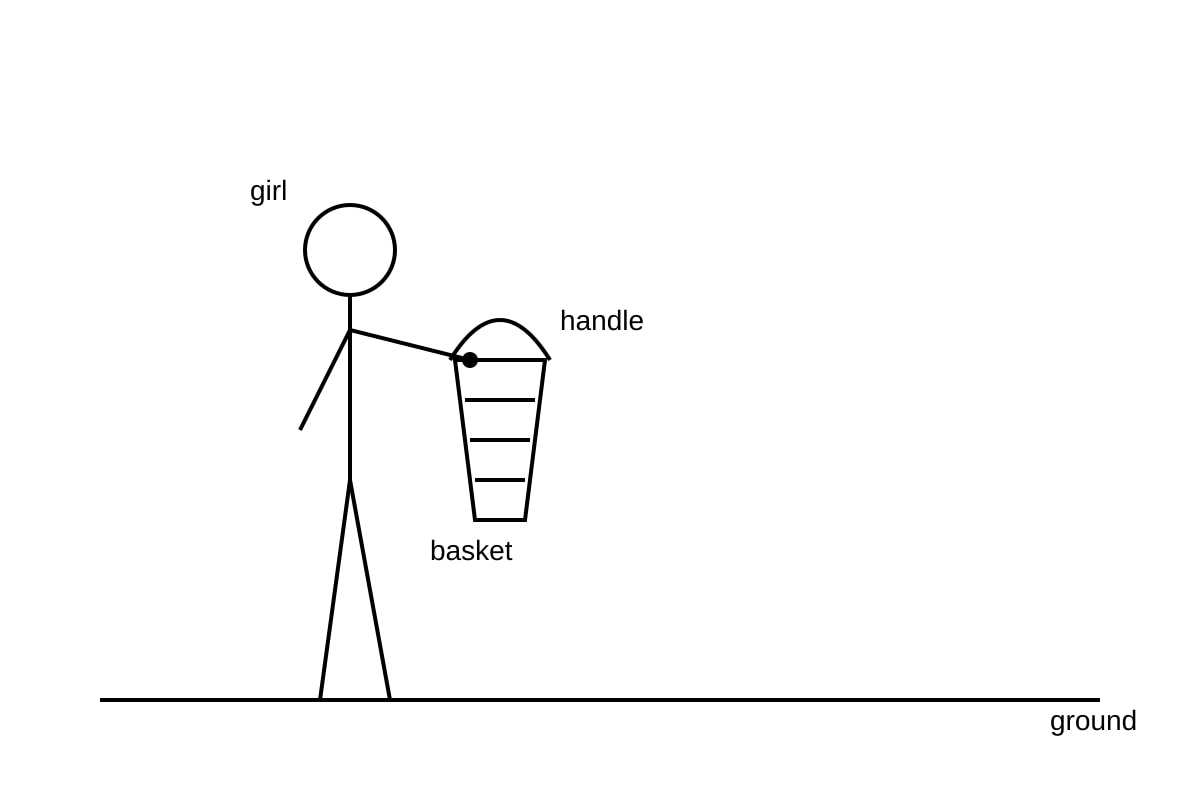
Answer: Arrow from basket handle downward (or from girl's hand through handle to basket) labelled F.
Expected visual: girl hand at handle, arrow down on basket.
Teaching note: The girl pulls up on handle; by Newton's third law the basket pulls down — but question asks force girl acts on basket, which is upward on handle. Mark arrow at handle pointing up labelled F. (If diagram shows basket as object, upward arrow on basket from handle.) Common mistake: drawing arrow on girl instead of basket.
Q4 [2]
(a) [1] newton (N)
(b) [1] weight (gravitational force)
Teaching note: Spring balance measures weight = gravitational force on mass. Unit of all forces is newton.
Q5 [2]
Working:
Resultant force = forward force − friction
= 1200 N − 300 N = 900 N forward.
Answer: 900 N forward.
Marking: 1 mark for subtraction, 1 mark for direction. Common mistake: adding friction.
Q6 [2]
Answer: In a vacuum there is no air resistance; all objects accelerate at same rate due to gravity (g ≈ 10 m/s²), so mass does not affect falling speed.
Marking: 1 mark no air resistance, 1 mark same acceleration/gravity. Common mistake: saying gravity is less for heavy objects.
Q7 [2]
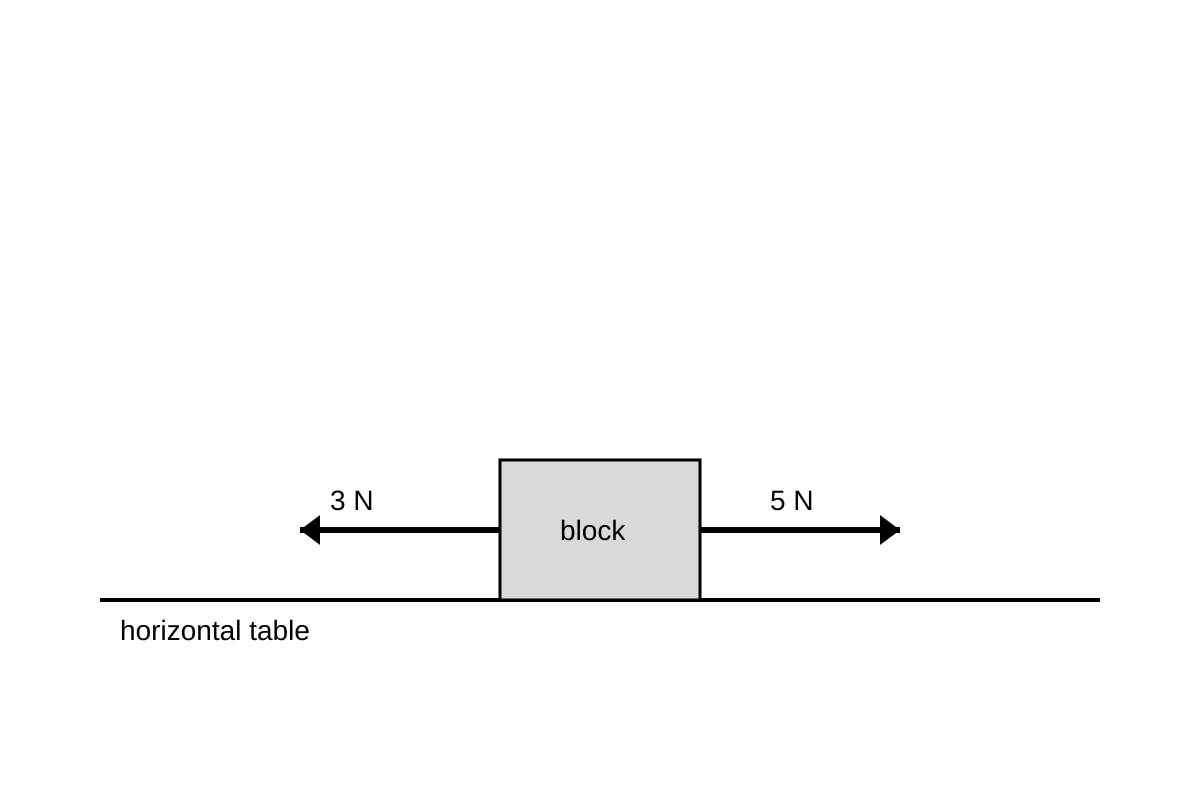
Working: Net = 5 N − 3 N = 2 N to the right.
Answer: 2 N right.
Marking: 1 mark value, 1 mark direction. From image: right arrow bigger, so net right.
Section B: Energy and Electricity (Q8–14)
Q8 [3]
Answer (2 points required for 3 marks; typically 1+2 or 2+1):
- Energy cannot be created or destroyed. [1.5]
- Energy can be converted from one form to another / total energy remains constant. [1.5]
Teaching note: Do not say "energy is saved" or "efficient". Precision matters.
Q9 [2]
Answer: Light energy and heat (thermal) energy.
Marking: 1 mark each. Common: sound (not main for lamp).
Q10 [3]
Working:
Height = 5 flights × 3.5 m = 17.5 m
ΔPE = mgh = 70 × 10 × 17.5 = 12 250 J
Answer: 12 250 J (or 12.25 kJ).
Marking: 1 height, 1 formula/sub, 1 answer+unit.
Q11 [2]
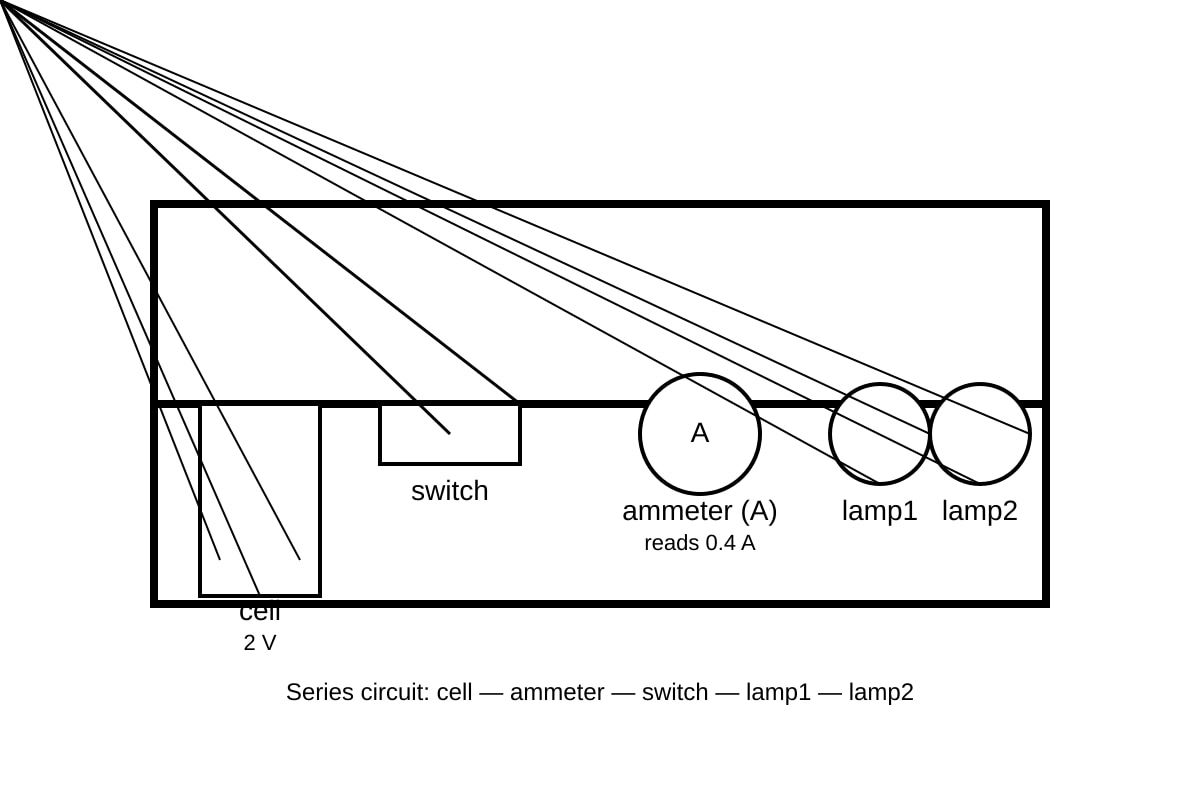
(a) [1] ampere (A)
(b) [1] 0.4 A
Teaching note: Series circuit same current everywhere. From image ammeter 0.4 A → lamp2 same.
Q12 [2]
Working: P = IV = 230 × 0.2 = 46 W
Answer: 46 W.
Marking: 1 formula, 1 answer.
Q13 [2]
Renewable: e.g. sun, wind, hydropower, biomass.
Non-renewable: e.g. coal, crude oil, natural gas.
1 mark each.
Q14 [2]
Working: P = E/t = 1000 / 20 = 50 W
Answer: 50 W.
Marking: 1 formula, 1 answer.
Section C: Heat, Matter and Applications (Q15–20)
Q15 [2]
Answer: higher, lower.
Marking: 1 each. Heat flows hot to cold until equal.
Q16 [2]
Problem: e.g. buckling of railway tracks, cracking of roads.
Application: e.g. bimetallic strip in thermostat, expansion joints in bridges.
1 mark each.
Q17 [3]
Density = mass/volume = 200/250 = 0.8 g/cm³.
Float? Yes (0.8 < 1.0).
Marking: 1 density calc, 1 compare, 1 conclusion.
Teaching note: Object denser than fluid sinks; less dense floats.
Q18 [2]
Answer: Acidic, pH ≈ 1–3 (red on UI).
Marking: 1 nature, 1 pH. Common: saying pH 7.
Q19 [2]
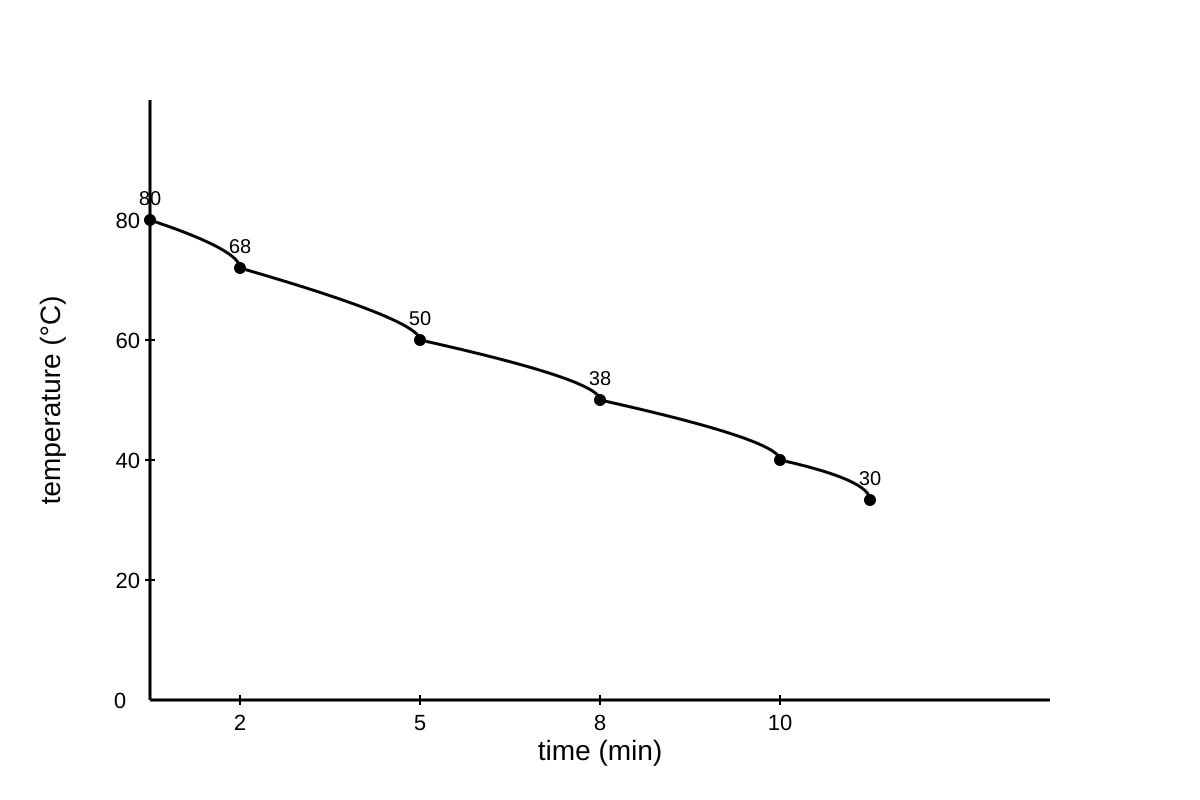
From graph: at 5 min temp = 50 °C. Trend: temperature decreases over time, cooling slows.
Marking: 1 value, 1 trend. Image shows curve descending.
Q20 [3]
Answer: A thermostat uses a bimetallic strip that bends when heated; at set temp it breaks circuit, stops heating; when cool it closes, resumes. Maintains temperature automatically.
Marking: 1 bimetallic/expansion, 1 break/make circuit, 1 maintain.
Teaching note: Link to expansion from Q16.