AI Generated Quiz
Secondary 2 Mathematics Statistics Probability Quiz
Free Sec 2 Maths Statistics quiz, Nemo3 AI version, with questions, answers, and syllabus-aligned practice for Singapore students.
These static practice materials are generated from the site's syllabus and paper-generation workflow, with source and model context shown so students and parents can evaluate the material before use.
Questions
Free quiz and exam paper access
Enter your details to view this paper
Your access is remembered on this device.
Answers
Secondary 2 Mathematics Quiz - Statistics Probability (Answer Key)
Total Marks: 40
Section A: Data Handling and Statistical Measures (Questions 1–5, 10 marks)
1. Frequency Table Analysis
(a) Mode
The mode is the value with the highest frequency.
Frequency: 0→2, 1→5, 2→6, 3→4, 4→2, 5→1. Highest frequency is 6 for 2 books.
Answer: 2 [1]
(b) Median
Total frequency = 20 (even). Median is the average of the 10th and 11th values.
Cumulative frequencies: 0→2, 1→7, 2→13. The 10th and 11th values both fall in the "2 books" category.
Median = (2 + 2) / 2 = 2.
Answer: 2 [1]
(c) Mean
Mean = Σ(fx) / Σf
= (0×2 + 1×5 + 2×6 + 3×4 + 4×2 + 5×1) / 20
= (0 + 5 + 12 + 12 + 8 + 5) / 20
= 42 / 20 = 2.1
Answer: 2.1 [2]
Marking: 1 mark for correct Σ(fx) = 42, 1 mark for correct division and answer.
2. Stem-and-Leaf Diagram and Range
(a) Ordered Stem-and-Leaf Diagram
Data sorted: 152, 154, 155, 156, 157, 158, 158, 159, 159, 160, 160, 161, 161, 162, 163
15 | 2 4 5 6 7 8 8 9 9
16 | 0 0 1 1 2 3
Key: 15 | 2 = 152 cm
Answer: Diagram as above [2]
Marking: 1 mark for correct stems and leaves in order, 1 mark for key.
(b) Range
Range = Maximum − Minimum = 163 − 152 = 11 cm
Answer: 11 cm [1]
3. Mean with Additional Data
Let the sixth number be .
Sum of original 5 numbers = 5 × 12 = 60.
Sum of 6 numbers = 6 × 13 = 78.
.
Answer: 18 [2]
Marking: 1 mark for finding sum of 5 numbers (60) or sum of 6 numbers (78), 1 mark for correct subtraction and answer.
4. Grouped Frequency Table
(a) Modal Class
The modal class is the class with the highest frequency: 20 < t ≤ 30 (frequency 12).
Answer: 20 < t ≤ 30 [1]
(b) Estimated Mean
Use midpoints: 5, 15, 25, 35, 45.
Σ(fx) = 3(5) + 8(15) + 12(25) + 5(35) + 2(45)
= 15 + 120 + 300 + 175 + 90 = 700
Mean = 700 / 30 = 23.3 min (or 70/3 min)
Answer: 23.3 min [2]
Marking: 1 mark for correct midpoints and Σ(fx) = 700, 1 mark for correct division and answer.
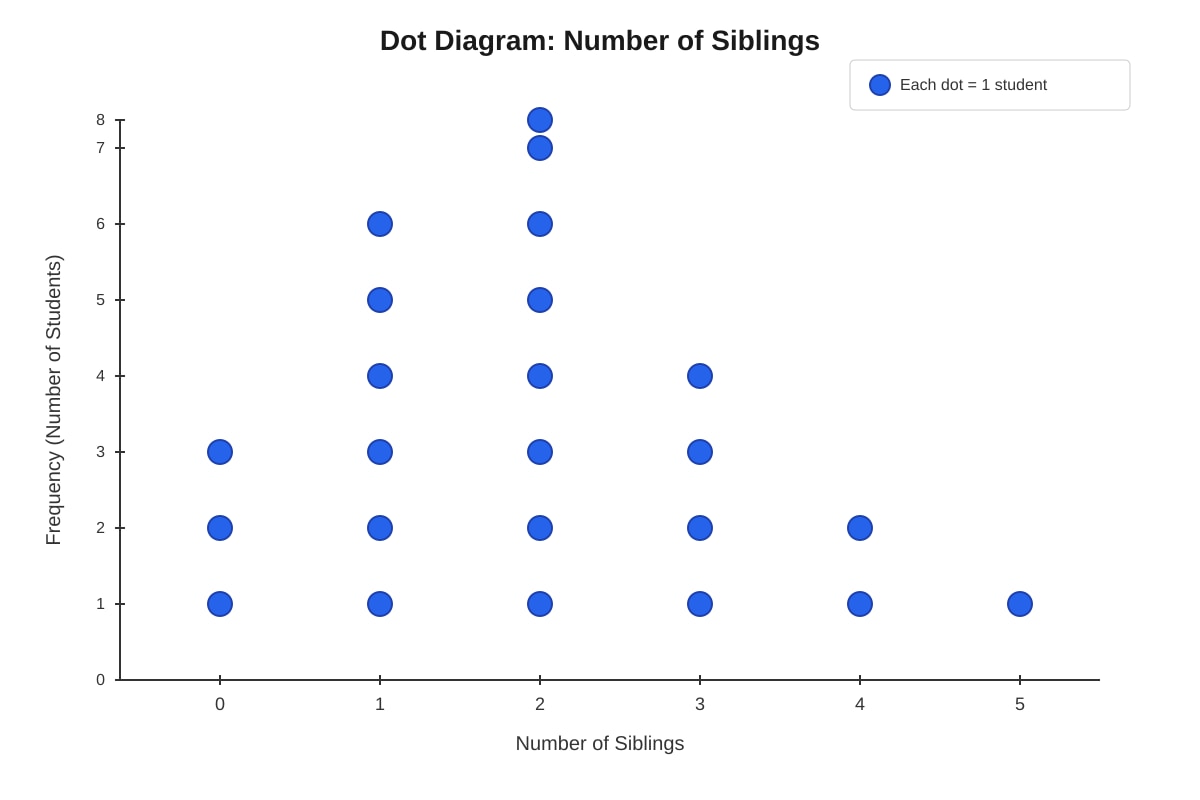
5. Dot Diagram Interpretation
(a) Total Students
Count all dots: 3 + 6 + 8 + 4 + 2 + 1 = 24
Answer: 24 [1]
(b) Median
24 students (even). Median = average of 12th and 13th values.
Cumulative: 0→3, 1→9, 2→17. The 12th and 13th values are both "2 siblings".
Median = 2
Answer: 2 [1]
Section B: Probability (Questions 6–15, 20 marks)
6. Simple Probability (Bag of Balls)
Total balls = 4 + 5 + 3 = 12.
(a) P(red) = 4/12 = 1/3
Answer: 1/3 [1]
(b) P(not blue) = 1 - P(blue) = 1 - 5/12 = 7/12
(Alternatively: red + green = 4 + 3 = 7, so 7/12)
Answer: 7/12 [1]
7. Die Roll
Sample space = {1,2,3,4,5,6}, n(S) = 6.
(a) Prime numbers on a die: 2, 3, 5. P(prime) = 3/6 = 1/2
Answer: 1/2 [1]
(b) Numbers > 4: 5, 6. P(>4) = 2/6 = 1/3
Answer: 1/3 [1]
8. Letters in "MATHEMATICS"
Word: M-A-T-H-E-M-A-T-I-C-S (11 letters).
Vowels: A, E, A, I → 4 vowels. M appears twice.
(a) P(vowel) = 4/11
Answer: 4/11 [1]
(b) P(M) = 2/11
Answer: 2/11 [1]
9. Spinner (1–8)
Sample space = {1,2,3,4,5,6,7,8}, n(S) = 8.
(a) Even numbers: 2,4,6,8 → 4 outcomes. P(even) = 4/8 = 1/2
Answer: 1/2 [1]
(b) Multiples of 3: 3, 6 → 2 outcomes. P(multiple of 3) = 2/8 = 1/4
Answer: 1/4 [1]
10. Without Replacement (Marbles)
Total = 10 marbles (6W, 4B).
(a) P(both white) = (6/10) × (5/9) = 30/90 = 1/3
Answer: 1/3 [2]
Marking: 1 mark for correct first probability (6/10), 1 mark for correct second probability (5/9) and final answer.
(b) P(one white, one black) = P(W then B) + P(B then W)
= (6/10)(4/9) + (4/10)(6/9) = 24/90 + 24/90 = 48/90 = 8/15
Answer: 8/15 [2]
Marking: 1 mark for identifying both orders, 1 mark for correct calculation and simplification.
11. Combined Events (Rain/Cloudy)
Given: P(R) = 0.3, P(C) = 0.6, P(R ∩ C) = 0.2.
(a) P(R ∪ C) = P(R) + P(C) - P(R ∩ C) = 0.3 + 0.6 - 0.2 = 0.7
Answer: 0.7 [1]
(b) P(neither) = 1 - P(R ∪ C) = 1 - 0.7 = 0.3
Answer: 0.3 [1]
12. Venn Diagram / Two-Way Table (Subjects)
Total = 30. Math = 18, Physics = 15, Both = 8.
Math only = 18 - 8 = 10. Physics only = 15 - 8 = 7. Neither = 30 - (10+8+7) = 5.
(a) P(Math but not Physics) = 10/30 = 1/3
Answer: 1/3 [1]
(b) P(neither) = 5/30 = 1/6
Answer: 1/6 [1]
13. Coin Toss (Three Times)
(a) Sample space (8 outcomes):
HHH, HHT, HTH, HTT, THH, THT, TTH, TTT
Answer: HHH, HHT, HTH, HTT, THH, THT, TTH, TTT [1]
(b) Exactly two heads: HHT, HTH, THH → 3 outcomes. P = 3/8.
Answer: 3/8 [1]
(c) At least one tail = 1 - P(no tails) = 1 - P(HHH) = 1 - 1/8 = 7/8.
Answer: 7/8 [1]
14. With Replacement (Counters)
Total = 8 (5R, 3B). Replacement means probabilities stay the same.
(a) P(both red) = (5/8) × (5/8) = 25/64
Answer: 25/64 [2]
Marking: 1 mark for (5/8)×(5/8), 1 mark for correct answer.
(b) P(different colours) = P(R then B) + P(B then R)
= (5/8)(3/8) + (3/8)(5/8) = 15/64 + 15/64 = 30/64 = 15/32
Answer: 15/32 [2]
Marking: 1 mark for both orders identified, 1 mark for correct calculation and simplification.
15. Conditional Probability (Two-Way Table)
Table totals: Basketball = 40, Football = 45, Both = 25, Total = 75.
(a) P(Basketball | Football) = P(B ∩ F) / P(F) = (25/75) / (45/75) = 25/45 = 5/9
Answer: 5/9 [2]
Marking: 1 mark for correct conditional probability formula/identification of values, 1 mark for correct simplification.
(b) P(Football | Not Basketball) = P(F ∩ B') / P(B')
Not Basketball row: Football = 20, Total = 35.
P = (20/75) / (35/75) = 20/35 = 4/7
Answer: 4/7 [2]
Marking: 1 mark for correct values from table (20 and 35), 1 mark for correct simplification.
Section C: Combined Statistics and Probability Problems (Questions 16–20, 10 marks)
16. Mean, Standard Deviation, and Probability
Data: 2.1, 2.3, 2.5, 2.2, 2.4, 2.6, 2.3, 2.5, 2.4, 2.7 (n=10)
(a) Mean = (2.1+2.3+2.5+2.2+2.4+2.6+2.3+2.5+2.4+2.7) / 10 = 24.0 / 10 = 2.4 kg
Answer: 2.4 kg [1]
(b) Standard Deviation
Deviations from mean (2.4): -0.3, -0.1, 0.1, -0.2, 0, 0.2, -0.1, 0.1, 0, 0.3
Squared deviations: 0.09, 0.01, 0.01, 0.04, 0, 0.04, 0.01, 0.01, 0, 0.09
Sum = 0.30
σ = √(0.30/10) = √0.03 = 0.173 kg (3 s.f.)
Answer: 0.173 kg [2]
Marking: 1 mark for correct squared deviations and sum (0.30), 1 mark for correct formula application and answer.
(c) Values > 2.4: 2.5, 2.6, 2.5, 2.7 → 4 values. P = 4/10 = 2/5 or 0.4
Answer: 2/5 [1]
17. Expected Value (Game)
(a) Probability Distribution Table
| Winnings ($x) | -1 | 2 |
|---|---|---|
| P(X=x) | 1/2 | 1/2 |
| Even numbers (2,4,6): win 1, P=3/6=1/2. | ||
| Answer: Table as above [2] | ||
| Marking: 1 mark for correct outcomes and probabilities, 1 mark for correct table format. |
(b) Expected Value E(X) = Σ x·P(x) = (-1)(1/2) + (2)(1/2) = -0.5 + 1 = 0.5
Answer: $0.50 [2]
Marking: 1 mark for correct formula/substitution, 1 mark for correct answer.
(c) 60 games: Expected total = 60 × 0.5 = 30 [1]
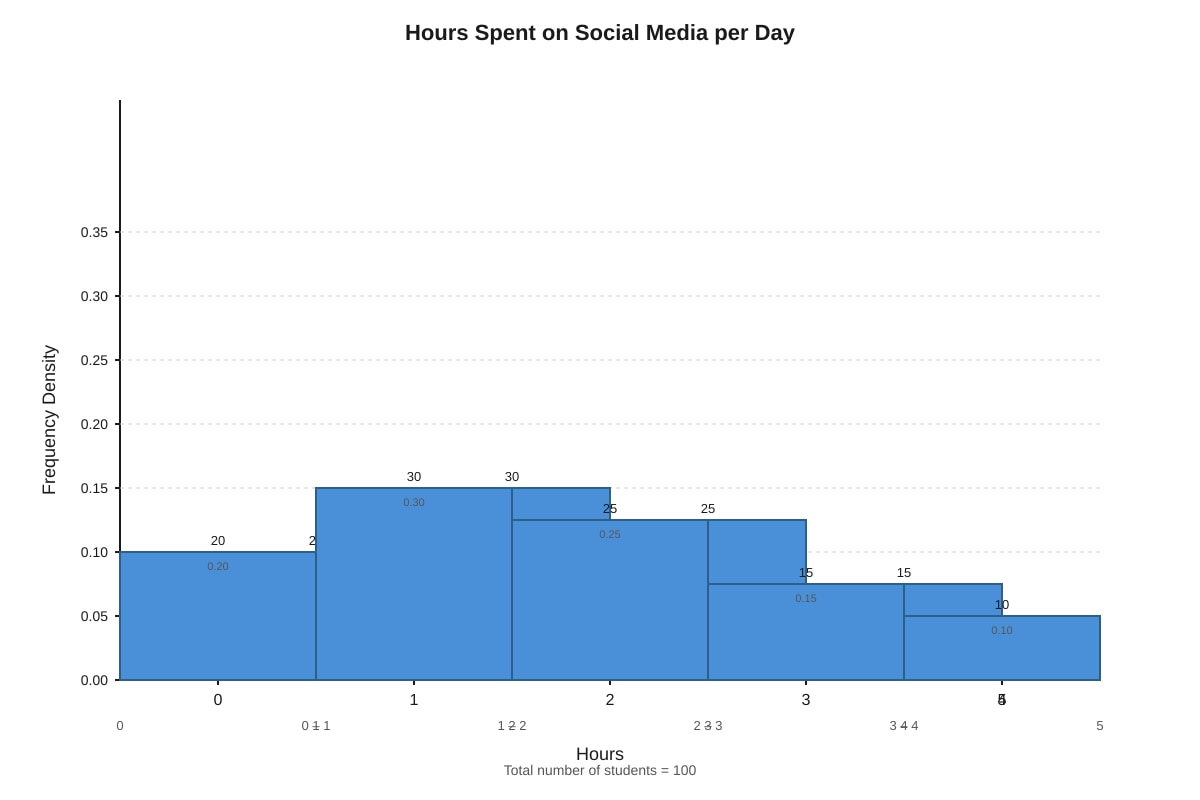
18. Histogram Interpretation
From image placeholder: Frequencies: 0–1: 20, 1–2: 30, 2–3: 25, 3–4: 15, 4–5: 10. Total = 100.
(a) At least 3 hours = 3–4 and 4–5 classes = 15 + 10 = 25 students.
Answer: 25 [1]
(b) Median = 50th/51st value (since n=100).
Cumulative: 0–1: 20, 1–2: 50, 2–3: 75.
The 50th value is at the upper boundary of 1–2 class (or last value in 1–2 class).
Using linear interpolation in the median class (1–2):
Median = L + ((n/2 - CF_before) / f_median) × w
= 1 + ((50 - 20) / 30) × 1 = 1 + 30/30 = 2 hours
(Alternatively: 50th value is the last in 1–2 class, so median ≈ 2 hours.)
Answer: 2 hours [2]
Marking: 1 mark for identifying median class (1–2) and correct cumulative frequency (20 before), 1 mark for correct interpolation/formula and answer.
19. Independence of Events
Given: P(A) = 0.4, P(B) = 0.5, P(A ∪ B) = 0.7.
(a) P(A ∩ B) = P(A) + P(B) - P(A ∪ B) = 0.4 + 0.5 - 0.7 = 0.2
Answer: 0.2 [1]
(b) Check independence: P(A) × P(B) = 0.4 × 0.5 = 0.2.
Since P(A ∩ B) = 0.2 = P(A) × P(B), A and B are independent.
Answer: Yes, they are independent because P(A ∩ B) = P(A) × P(B) = 0.2. [2]
Marking: 1 mark for computing P(A)×P(B) = 0.2, 1 mark for correct conclusion with reasoning.
20. Without Replacement (Defective Items)
Total = 10 (3D, 7N). Select 3 without replacement.
(a) P(all 3 non-defective) = (7/10) × (6/9) × (5/8) = 210/720 = 7/24
Answer: 7/24 [2]
Marking: 1 mark for correct sequence of probabilities (7/10, 6/9, 5/8), 1 mark for correct multiplication and simplification.
(b) P(exactly 1 defective) = P(D,N,N) + P(N,D,N) + P(N,N,D)
Each sequence: (3/10)(7/9)(6/8) = 126/720 = 7/40.
Three sequences: 3 × 7/40 = 21/40
Answer: 21/40 [2]
Marking: 1 mark for identifying 3 orders and correct probability for one order, 1 mark for correct multiplication by 3 and simplification.
End of Answer Key