AI Generated Quiz
Secondary 2 Mathematics Graphs Coordinate Geometry Quiz
Free Sec 2 Maths Graphs Geometry quiz, HY3 AI version, with questions, answers, and syllabus-aligned practice for Singapore students.
These static practice materials are generated from the site's syllabus and paper-generation workflow, with source and model context shown so students and parents can evaluate the material before use.
Questions
Secondary 2 Mathematics Quiz - Graphs Coordinate Geometry
Name: ___________________________
Class: ___________________________
Date: ___________________________
Score: _______ / 40
Duration: 50 minutes
Total Marks: 40
Instructions:
- Answer all 20 questions.
- Show your working clearly where required.
- Use the provided spaces to write your answers.
- Calculators may be used.
Section A (Questions 1–8) — Basic Coordinate Geometry (2 marks each)
1. Plot the point A(3,−2) on a Cartesian plane. What are the coordinates of the point B which is 4 units to the left of A and 5 units above A?
2. Find the gradient of the line passing through the points (2,5) and (6,13).
3. Write down the equation of a line with gradient 3 that passes through the point (0,−1).
4. The line y=−2x+7 cuts the y-axis at point P. State the coordinates of P.
5. Two points are C(−1,4) and D(5,4). What is the length of the line segment CD?
6. A line has gradient 0 and passes through (2,9). Write its equation.
7. Find the x-intercept of the line y=4x−8.
8. The coordinates of three vertices of a rectangle are (1,1), (1,5), and (4,1). What are the coordinates of the fourth vertex?
Section B (Questions 9–14) — Graphs of Linear Functions (3 marks each)
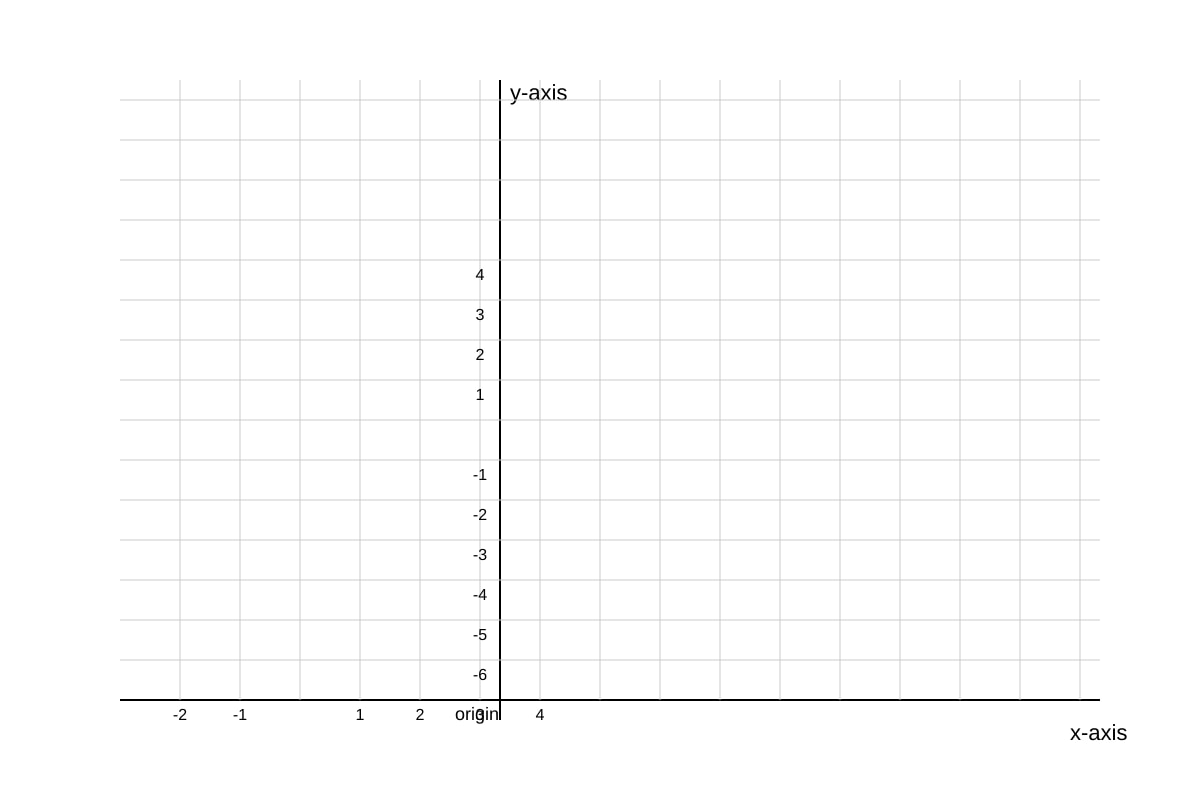
9. Draw the graph of y=2x−3 for x=−1,0,1,2,3 on the grid below. Use your graph to find the value of y when x=2.5.
Image pending generation: graph for Q9.
10. Find the gradient and y-intercept of the line 3y=6x+9.
11. A taxi company charges a flat fee of \3plus$2perkm.WriteanequationconnectingcostC(in$`) and distance d (in km). Hence find the cost of a 7 km ride.
12. The points E(0,2) and F(4,0) lie on a straight line. Find the equation of the line EF in the form y=mx+c.
13. Two lines have equations y=2x+1 and y=−x+7. Find the coordinates of their point of intersection.
14. A line passes through (1,3) and is parallel to the line y=4x−2. Find its equation.
Section C (Questions 15–20) — Application and Interpretation (4 marks each)
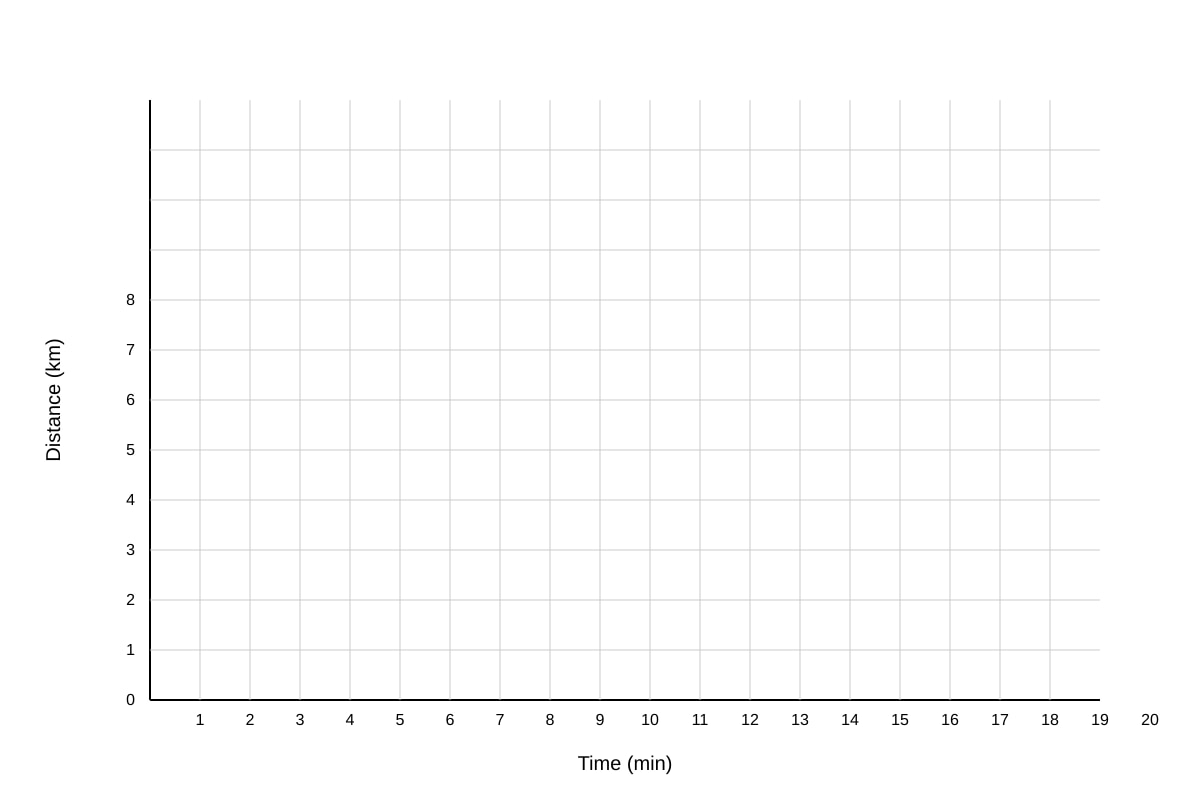
15. The table below shows the distance travelled by a cyclist over time.
| Time (min) | 0 | 5 | 10 | 15 | 20 |
|---|---|---|---|---|---|
| Distance (km) | 0 | 2 | 4 | 6 | 8 |
Plot the points on the grid and draw the best straight line. Find the gradient and explain what it represents.
Image pending generation: graph for Q15.
16. A line has equation 2x+5y=10. Find the x- and y-intercepts and use them to sketch the line.
17. Triangle PQR has vertices P(1,2), Q(1,6), R(5,2). Show that PQR is a right-angled triangle by using gradients.
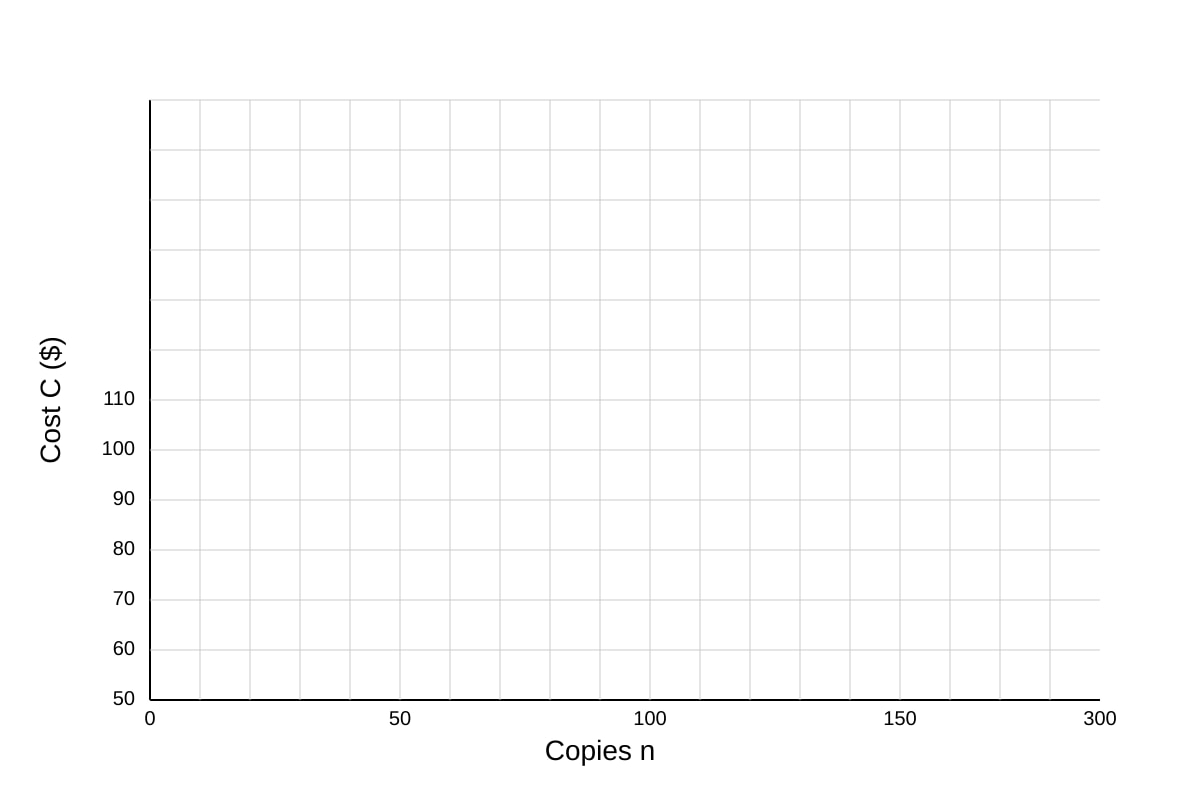
18. The cost C of printing n copies is given by C=50+0.20n. Draw the graph for n=0,100,200,300 and find the cost of 250 copies from your graph.
Image pending generation: graph for Q18.
19. Two points M(−2,3) and N(4,−1) are given. Find the midpoint of MN and the gradient of the line MN.
20. A mobile plan costs \20monthlyplus$0.10perSMS.Anotherplancosts$30$ monthly with unlimited SMS. Write equations for both and find the number of SMS where both cost the same.
Answers
Secondary 2 Mathematics Quiz - Graphs Coordinate Geometry (Answer Key)
Total Marks: 40
Topic: Graphs & Coordinate Geometry (Sec 2 G3 syllabus: N6 Functions and Graphs)
Q1. B(−1,3)
Marks: 2
Teaching note: Starting at A(3,−2), moving 4 left means subtract 4 from x: 3−4=−1. Moving 5 up means add 5 to y: −2+5=3. So B(−1,3). Common mistake: mixing up x (horizontal) and y (vertical) directions.
Q2. Gradient =2
Marks: 2
Teaching note: Gradient formula m=x2−x1y2−y1. Using (2,5) and (6,13): m=6−213−5=48=2. The gradient tells us the line rises 2 units for every 1 unit right.
Q3. y=3x−1
Marks: 2
Teaching note: Equation of line: y=mx+c, where m is gradient, c is y-intercept. Given m=3 and point (0,−1) means c=−1. So y=3x−1.
Q4. P(0,7)
Marks: 2
Teaching note: y-intercept occurs when x=0. Substitute: y=−2(0)+7=7. So P(0,7).
Q5. Length =6 units
Marks: 2
Teaching note: Both points have same y-coordinate (4), so distance is difference in x: ∣5−(−1)∣=6. Formula: length =(5+1)2+(4−4)2=6.
Q6. y=9
Marks: 2
Teaching note: Gradient 0 means horizontal line. It passes through (2,9) so y is always 9. Equation: y=9.
Q7. x=2
Marks: 2
Teaching note: x-intercept is where y=0. 0=4x−8⇒4x=8⇒x=2.
Q8. (4,5)
Marks: 2
Teaching note: Rectangle has opposite sides equal and parallel. Given (1,1), (1,5) vertical side, (1,1) to (4,1) horizontal. Fourth vertex shares x with (4,1) and y with (1,5): (4,5).
Q9. Points: (−1,−5),(0,−3),(1,−1),(2,1),(3,3); at x=2.5, y=2(2.5)−3=2
Marks: 3
Teaching note: Substitute each x into y=2x−3. Plot and join. For x=2.5: y=5−3=2. Marking: 1 for correct points, 1 for line, 1 for y=2.
Q10. Gradient =2, y-intercept =3
Marks: 3
Teaching note: Divide equation by 3: y=2x+3. So m=2, c=3. Marking: 1 for rearranging, 1 for gradient, 1 for intercept.
Q11. C=3+2d; for 7 km: C = 3 + 14 = \17∗Marks:3∗Teachingnote:Flatfeeisconstant(3),perkmisvariable(2d).EquationC = 3 + 2d.Atd=7:C = 3+2(7)=17$. Marking: 1 eqn, 1 sub, 1 answer.
Q12. y=−21x+2
Marks: 3
Teaching note: Gradient m=4−00−2=−21. Intercept c=2 (point E). So y=−21x+2. Marking: 1 grad, 1 intercept, 1 eqn.
Q13. (2,5)
Marks: 3
Teaching note: Set equal: 2x+1=−x+7⇒3x=6⇒x=2. Then y=2(2)+1=5. Intersection (2,5). Marking: 1 eqn, 1 x, 1 y.
Q14. y=4x−1
Marks: 3
Teaching note: Parallel lines have same gradient m=4. Through (1,3): 3=4(1)+c⇒c=−1. So y=4x−1. Marking: 1 parallel grad, 1 find c, 1 eqn.
Q15. Gradient =0.4 km/min (or 24 km/h); represents speed
Marks: 4
Teaching note: Plot points, line through them. Gradient =20−08−0=0.4 km per min. This is the cyclist's constant speed. Marking: 1 plot, 1 line, 1 grad, 1 meaning.
Q16. x-int =5, y-int =2
Marks: 4
Teaching note: For x-int set y=0: 2x=10⇒x=5. For y-int set x=0: 5y=10⇒y=2. Sketch line through (5,0) and (0,2). Marking: 1 each intercept, 2 for sketch.
Q17. Grad PQ=1−16−2 undefined (vertical); grad PR=5−12−2=0 (horizontal); perpendicular ⇒ right angle at P
Marks: 4
Teaching note: PQ vertical, PR horizontal, so angle at P is 90°. Marking: 2 for gradients, 2 for conclusion.
Q18. Points: (0,50),(100,70),(200,90),(300,110); at n=250, C=50+0.2(250)=100
Marks: 4
Teaching note: Substitute n. From graph or calc: C=100. Marking: 1 pts, 1 line, 1 read, 1 answer.
Q19. Midpoint =(1,1), gradient =−32
Marks: 4
Teaching note: Midpoint =(2−2+4,23+(−1))=(1,1). Grad =4−(−2)−1−3=−64=−32. Marking: 2 midpoint, 2 gradient.
Q20. Plan A: C=20+0.10s; Plan B: C=30; equal at s=100 SMS
Marks: 4
Teaching note: Set 20+0.10s=30⇒0.10s=10⇒s=100. Marking: 1 eqn A, 1 eqn B, 2 solve.
Free quiz and exam paper access
Enter your details to view this paper
Your access is remembered on this device.