AI Generated Quiz
Secondary 2 Mathematics Geometry Trigonometry Quiz
Free Sec 2 Maths Geometry Trigonometry quiz, Nemo3 AI version, with questions, answers, and syllabus-aligned practice for Singapore students.
These static practice materials are generated from the site's syllabus and paper-generation workflow, with source and model context shown so students and parents can evaluate the material before use.
Questions
Free quiz and exam paper access
Enter your details to view this paper
Your access is remembered on this device.
Answers
Secondary 2 Mathematics Quiz - Geometry Trigonometry (Answer Key)
Total Marks: 40
Section A: Basic Trigonometric Ratios and Right-Angled Triangles (Questions 1–5, 10 marks)
1. [2 marks]
Answer: 5/13 or 0.385
Working:
- Triangle ABC, right-angled at B.
- AB = 12 cm (adjacent to ∠A), BC = 5 cm (opposite to ∠A).
- Hypotenuse AC = √(12² + 5²) = √(144 + 25) = √169 = 13 cm.
- sin A = opposite/hypotenuse = BC/AC = 5/13.
Marking:
- 1 mark for correct hypotenuse (13 cm).
- 1 mark for correct sin A = 5/13.
Common mistake: Using wrong sides for opposite/adjacent.
2. [2 marks]
Answer: 15/8 or 1.875
Working:
- Triangle PQR, right-angled at Q.
- PQ = 8 cm, PR = 17 cm (hypotenuse).
- QR = √(17² - 8²) = √(289 - 64) = √225 = 15 cm.
- tan R = opposite/adjacent = PQ/QR = 8/15? Wait: ∠R is at vertex R. Opposite to ∠R is PQ = 8. Adjacent to ∠R is QR = 15. So tan R = 8/15.
Correction: tan R = PQ/QR = 8/15.
Marking:
- 1 mark for correct QR = 15 cm.
- 1 mark for correct tan R = 8/15.
Common mistake: Confusing which angle's tangent is needed; tan R uses sides relative to angle R.
3. [2 marks]
Answer: 5/13 or 0.385
Working:
- cos θ = 12/13, θ acute.
- Using sin²θ + cos²θ = 1: sin²θ = 1 - (12/13)² = 1 - 144/169 = 25/169.
- sin θ = √(25/169) = 5/13 (positive since θ acute).
Alternative: 5-12-13 triangle: adjacent = 12, hypotenuse = 13, opposite = 5.
Marking:
- 1 mark for correct use of identity or triangle.
- 1 mark for correct sin θ = 5/13.
Common mistake: Forgetting to take positive root for acute angle.
4. [2 marks]
Answer: 24/25 or 0.96
Working:
- Triangle XYZ, right-angled at Y.
- XY = 24 cm (adjacent to ∠X), YZ = 7 cm (opposite to ∠X).
- Hypotenuse XZ = √(24² + 7²) = √(576 + 49) = √625 = 25 cm.
- cos X = adjacent/hypotenuse = XY/XZ = 24/25.
Marking:
- 1 mark for correct hypotenuse (25 cm).
- 1 mark for correct cos X = 24/25.
5. [2 marks]
Answer: 53.1° (or 53.13°)
Working:
- Ladder = 10 m (hypotenuse), distance from wall = 6 m (adjacent to angle with ground).
- cos θ = adjacent/hypotenuse = 6/10 = 0.6.
- θ = cos⁻¹(0.6) = 53.1301...° ≈ 53.1°.
Marking:
- 1 mark for correct trigonometric ratio (cos θ = 6/10).
- 1 mark for correct angle (53.1°).
Common mistake: Using sin or tan incorrectly; not setting calculator to degree mode.
Section B: Finding Unknown Sides and Angles (Questions 6–12, 16 marks)
6. [2 marks]
Answer: 4.5 cm (or 9/2 cm)
Working:
- Triangle DEF, right-angled at E.
- DE = 9 cm (adjacent to ∠D), ∠D = 30°.
- tan 30° = opposite/adjacent = EF/DE.
- EF = DE × tan 30° = 9 × (1/√3) = 9/√3 = 3√3 ≈ 5.196? Wait.
Correction: In triangle DEF, right angle at E. ∠D = 30°. Side DE is adjacent to ∠D. Side EF is opposite to ∠D. tan 30° = EF/DE → EF = DE × tan 30° = 9 × (1/√3) = 9/√3 = 3√3 ≈ 5.20 cm.
But 30° triangle ratios: opposite:hypotenuse:adjacent = 1:2:√3. If adjacent = 9, then opposite = 9/√3 = 3√3.
Answer: 3√3 cm or 5.20 cm (3 s.f.)
Marking:
- 1 mark for correct trigonometric ratio (tan 30° = EF/9).
- 1 mark for correct answer (3√3 or 5.20).
Common mistake: Using sin or cos instead of tan; not rationalising denominator if required.
7. [2 marks]
Answer: 12.9 cm (3 s.f.)
Working:
- Triangle LMN, right-angled at M.
- LN = 20 cm (hypotenuse), ∠L = 40°.
- MN is opposite to ∠L.
- sin 40° = opposite/hypotenuse = MN/20.
- MN = 20 × sin 40° = 20 × 0.642787... = 12.8557... ≈ 12.9 cm.
Marking:
- 1 mark for correct ratio (sin 40° = MN/20).
- 1 mark for correct answer (12.9 cm).
8. [2 marks]
Answer: 8.60 cm (3 s.f.)
Working:
- Triangle ABC, right-angled at B.
- AC = 15 cm (hypotenuse), ∠A = 55°.
- AB is adjacent to ∠A.
- cos 55° = adjacent/hypotenuse = AB/15.
- AB = 15 × cos 55° = 15 × 0.573576... = 8.6036... ≈ 8.60 cm.
Marking:
- 1 mark for correct ratio (cos 55° = AB/15).
- 1 mark for correct answer (8.60 cm).
9. [2 marks]
Answer: 67.4° (or 67.38°)
Working:
- Triangle PQR, right-angled at Q.
- PQ = 12 cm (adjacent to ∠P), QR = 5 cm (opposite to ∠P).
- tan P = opposite/adjacent = 5/12.
- ∠P = tan⁻¹(5/12) = 22.619...°? Wait.
Correction: tan P = QR/PQ = 5/12 → P = tan⁻¹(5/12) ≈ 22.6°. But the question asks for ∠P. Let me check: In triangle PQR, right angle at Q. ∠P is at vertex P. Opposite is QR = 5. Adjacent is PQ = 12. So tan P = 5/12. P ≈ 22.6°.
But wait, the sides 5, 12, 13 give angles approx 22.6° and 67.4°. Since PQ=12, QR=5, the angle at P is opposite QR=5, so it's the smaller angle: 22.6°. The angle at R would be 67.4°.
Answer: 22.6° (3 s.f.)
Marking:
- 1 mark for correct ratio (tan P = 5/12).
- 1 mark for correct angle (22.6°).
Common mistake: Finding the wrong angle (67.4° instead of 22.6°).
10. [2 marks]
Answer: 21.0 m (3 s.f.)
Working:
- Flagpole height = h, distance from foot = 30 m, angle of elevation = 35°.
- tan 35° = height / 30.
- h = 30 × tan 35° = 30 × 0.700207... = 21.006... ≈ 21.0 m.
Marking:
- 1 mark for correct ratio (tan 35° = h/30).
- 1 mark for correct answer (21.0 m).
11. [3 marks]
Answer: 107 m (3 s.f.)
Working:
- Building height = 50 m, angle of depression = 25°.
- Angle of depression = angle of elevation from car to top of building = 25°.
- Let distance from foot of building to car = d.
- tan 25° = 50/d.
- d = 50 / tan 25° = 50 / 0.466307... = 107.218... ≈ 107 m.
Marking:
- 1 mark for recognising angle of depression = angle of elevation.
- 1 mark for correct ratio (tan 25° = 50/d).
- 1 mark for correct answer (107 m).
Common mistake: Using sin or cos; not converting angle of depression correctly.
12. [3 marks]
Answer: 4.8 cm
Working:
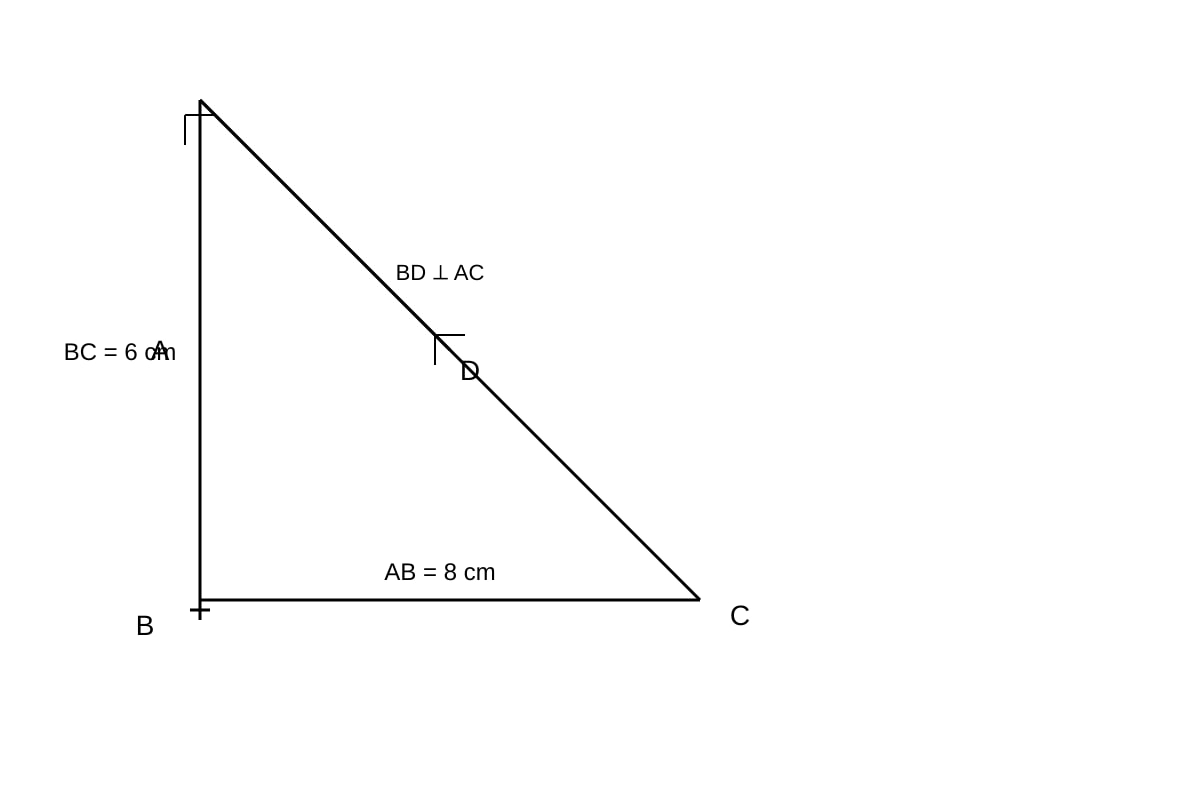
- Triangle ABC, right-angled at B. AB = 8, BC = 6.
- AC = √(8² + 6²) = √(64 + 36) = √100 = 10 cm.
- Area of triangle ABC = ½ × AB × BC = ½ × 8 × 6 = 24 cm².
- Also area = ½ × AC × BD = ½ × 10 × BD = 5 × BD.
- 5 × BD = 24 → BD = 24/5 = 4.8 cm.
Alternative: Using similar triangles: BD/BC = AB/AC → BD/6 = 8/10 → BD = 4.8 cm.
Marking:
- 1 mark for correct AC = 10 cm.
- 1 mark for correct method (area or similar triangles).
- 1 mark for correct answer (4.8 cm).
Common mistake: Using wrong formula for altitude; arithmetic errors.
Section C: Multi-Step Problems and Applications (Questions 13–20, 14 marks)
13. [3 marks]
Answer: 46.2 m (3 s.f.)
Working:
- Height = 40 m (opposite to 60°), string length = L (hypotenuse).
- sin 60° = 40/L.
- L = 40 / sin 60° = 40 / (√3/2) = 80/√3 = 80√3/3 ≈ 46.188... ≈ 46.2 m.
Marking:
- 1 mark for correct ratio (sin 60° = 40/L).
- 1 mark for correct manipulation (L = 40/sin 60°).
- 1 mark for correct answer (46.2 m).
14. [3 marks]
Answer: 68.3 m (3 s.f.)
Working:
- Let height of tower = h, initial distance from tower = x.
- From first position: tan 30° = h/x → x = h/tan 30° = h√3.
- After walking 50 m: new distance = x - 50, tan 45° = h/(x - 50) = 1 → h = x - 50.
- Substitute: h = h√3 - 50 → h√3 - h = 50 → h(√3 - 1) = 50.
- h = 50/(√3 - 1) = 50(√3 + 1)/(3 - 1) = 25(√3 + 1) = 25(1.732 + 1) = 25 × 2.732 = 68.3 m.
Marking:
- 1 mark for setting up two equations correctly.
- 1 mark for correct algebraic manipulation.
- 1 mark for correct answer (68.3 m).
Common mistake: Incorrect equation setup; algebraic errors when rationalising.
15. [3 marks]
Answer: 22.7 m (3 s.f.)
Working:
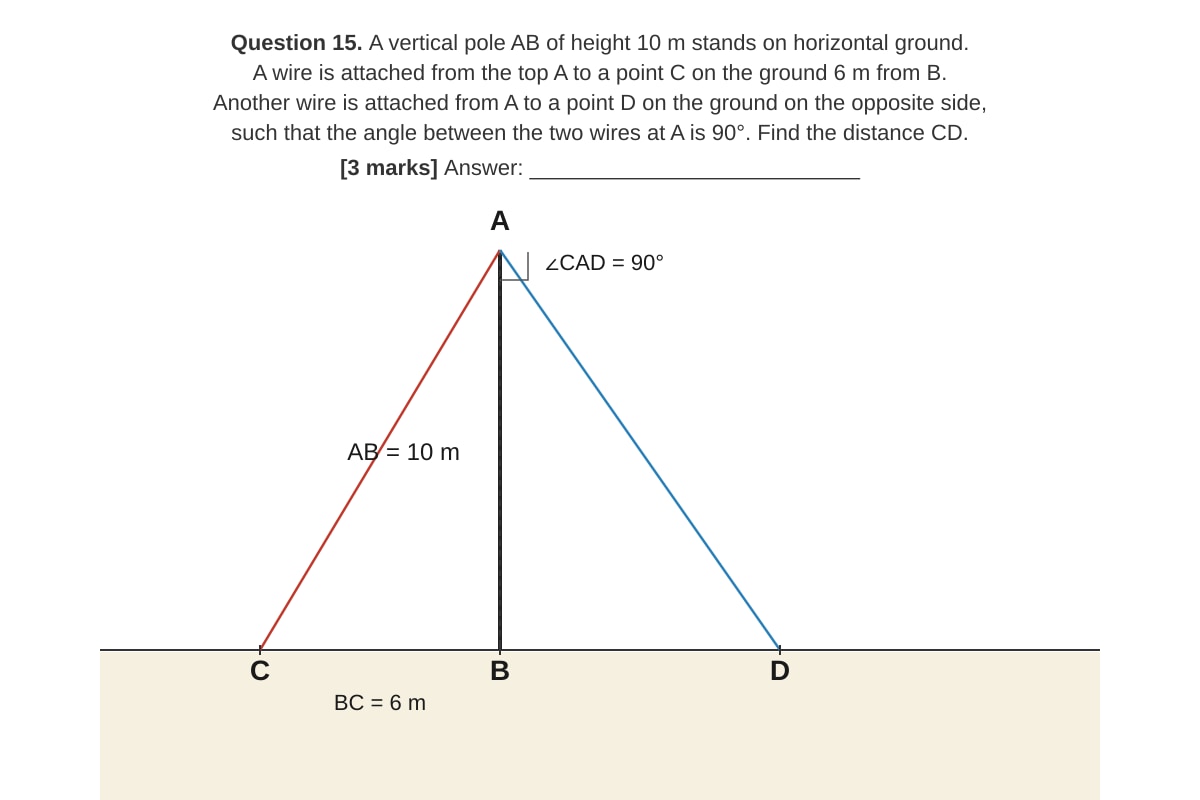
- Pole AB = 10 m, BC = 6 m.
- In right triangle ABC (right angle at B): AC = √(10² + 6²) = √136 = 2√34 ≈ 11.66 m.
- ∠CAD = 90°, so triangle ACD is right-angled at A.
- In triangle ACD: tan ∠ACD = AD/AC? Wait, we need CD.
- Actually, we have triangle ACD with right angle at A. AC is known. We need AD first.
- In triangle ABD: AB = 10, BD = ? We know ∠BAD = 90° - ∠BAC? No.
Better approach:
- ∠CAB = α, where tan α = BC/AB = 6/10 = 0.6 → α ≈ 30.96°.
- ∠DAB = 90° - α (since ∠CAD = 90°).
- In triangle ABD (right angle at B): tan(∠DAB) = BD/AB → BD = AB × tan(90° - α) = 10 × cot α = 10 × (10/6) = 100/6 = 50/3 ≈ 16.67 m.
- Then CD = BC + BD = 6 + 50/3 = 68/3 ≈ 22.67 m ≈ 22.7 m.
Alternative using similar triangles / geometry:
- Since ∠CAD = 90°, and ∠CAB + ∠DAB = 90°.
- Triangles ABC and DBA are similar (both right-angled, ∠CAB = ∠DBA? Let's check).
- Actually, ∠CAB = α, ∠DAB = 90° - α. In triangle ABD, ∠ADB = α.
- So triangle ABC ~ triangle DBA (AA).
- AB/BC = DB/AB → 10/6 = DB/10 → DB = 100/6 = 50/3.
- CD = CB + BD = 6 + 50/3 = 68/3 = 22.67 m.
Marking:
- 1 mark for finding AC or angle α.
- 1 mark for correct method (similar triangles or trigonometry).
- 1 mark for correct answer (22.7 m).
16. [3 marks]
Answer: 13.4 m (3 s.f.)
Working:
- Man's eye level = 1.8 m, distance from lamp post = 20 m, angle of elevation = 30°.
- Let height of lamp post = h. Vertical distance from man's eyes to top = h - 1.8.
- tan 30° = (h - 1.8)/20.
- h - 1.8 = 20 × tan 30° = 20/√3 = 20√3/3 ≈ 11.547.
- h = 11.547 + 1.8 = 13.347 ≈ 13.4 m.
Marking:
- 1 mark for correct setup (h - 1.8).
- 1 mark for correct ratio (tan 30° = (h - 1.8)/20).
- 1 mark for correct answer (13.4 m).
Common mistake: Forgetting to add man's height; using 1.8 as the opposite side.
17. [3 marks]
Answer: 12 cm
Working:
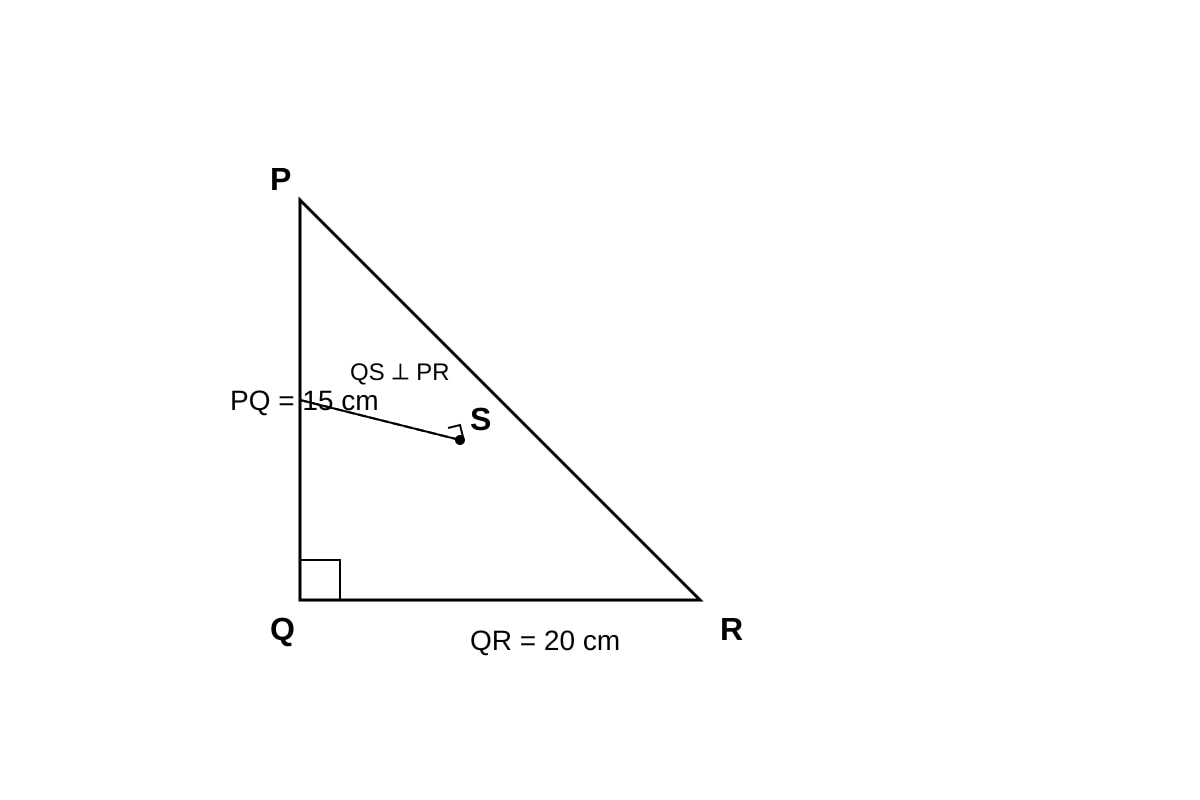
- Triangle PQR, right-angled at Q. PQ = 15, QR = 20.
- PR = √(15² + 20²) = √(225 + 400) = √625 = 25 cm.
- Area = ½ × 15 × 20 = 150 cm².
- Also area = ½ × PR × QS = ½ × 25 × QS = 12.5 × QS.
- 12.5 × QS = 150 → QS = 150/12.5 = 12 cm.
Alternative: QS = (PQ × QR)/PR = (15 × 20)/25 = 300/25 = 12 cm.
Marking:
- 1 mark for correct PR = 25 cm.
- 1 mark for correct method (area or formula).
- 1 mark for correct answer (12 cm).
18. [3 marks]
Answer: 21.8° (3 s.f.)
Working:
- Two poles: shorter = 8 m, taller = 12 m. Horizontal distance between feet = 10 m.
- Vertical difference = 12 - 8 = 4 m.
- Angle of elevation from top of shorter to top of taller = θ.
- tan θ = vertical difference / horizontal distance = 4/10 = 0.4.
- θ = tan⁻¹(0.4) = 21.801...° ≈ 21.8°.
Marking:
- 1 mark for correct vertical difference (4 m).
- 1 mark for correct ratio (tan θ = 4/10).
- 1 mark for correct answer (21.8°).
Common mistake: Using 12/10 or 8/10; not taking difference in heights.
19. [3 marks]
Answer: 50 km
Working:
- First leg: 30 km on bearing 045° (NE direction).
- Second leg: 40 km on bearing 135° (SE direction).
- The angle between the two legs = 135° - 45° = 90°.
- The path forms a right-angled triangle with legs 30 km and 40 km.
- Distance from start = √(30² + 40²) = √(900 + 1600) = √2500 = 50 km.
Marking:
- 1 mark for recognising 90° angle between bearings.
- 1 mark for correct application of Pythagoras' theorem.
- 1 mark for correct answer (50 km).
Common mistake: Not recognising the right angle; using cosine rule unnecessarily.
20. [2 marks]
Answer: 31/25 or 1.24
Working:
- Triangle ABC, right-angled at B. AB = 7, BC = 24.
- AC = √(7² + 24²) = √(49 + 576) = √625 = 25.
- sin A = opposite/hypotenuse = BC/AC = 24/25.
- cos A = adjacent/hypotenuse = AB/AC = 7/25.
- sin A + cos A = 24/25 + 7/25 = 31/25 = 1.24.
Marking:
- 1 mark for correct AC = 25.
- 1 mark for correct sum (31/25 or 1.24).
Common mistake: Arithmetic error in Pythagoras; wrong sides for sin/cos.
End of Answer Key