AI Generated Quiz
Secondary 2 Mathematics Calculus Quiz
Free Sec 2 Maths Calculus quiz, AI version, with questions, answers, and syllabus-aligned practice for Singapore students.
These static practice materials are generated from the site's syllabus and paper-generation workflow, with source and model context shown so students and parents can evaluate the material before use.
Questions
Free quiz and exam paper access
Enter your details to view this paper
Your access is remembered on this device.
Answers
Secondary 2 Mathematics Quiz - Calculus: Answer Key
Total Marks: 40
Section A: Short Questions (Questions 1 to 10)
Each question carries 2 marks.
1. Answer: 35 m/s
Explanation: The average rate of change is the change in distance divided by the change in time.
At : m At : m
Average rate of change m/s
Marking Notes:
- M1 for correct substitution into formula
- A1 for correct final answer with units
Common Mistake: Forgetting to square the time before multiplying by 5.
2. Answer: 17
Explanation: The gradient of a chord is the change in y divided by the change in x.
At : At :
Gradient
Marking Notes:
- M1 for correct substitution into function
- A1 for correct final answer
Common Mistake: Arithmetic error when calculating .
3. Answer: 0 m/s
Explanation: At : m At : m
Average rate of change m/s
Marking Notes:
- M1 for correct substitution
- A1 for correct answer (0)
Teaching Note: The height is the same at both times, meaning the ball is at the same height on the way up and on the way down. The average rate of change is zero.
4. Answer: 1
Explanation: At : At :
Gradient
Marking Notes:
- M1 for correct substitution
- A1 for correct answer
5. Answer: 9 cm²/cm
Explanation: At : cm² At : cm²
Average rate of change cm²/cm
Marking Notes:
- M1 for correct substitution
- A1 for correct answer with units
Teaching Note: The units are cm² per cm, which simplifies to cm, but it's better to write cm²/cm to show what is being measured.
6. Answer: 0
Explanation: At : At :
Gradient
Corrected Answer: -2
Explanation (corrected): At : At :
Gradient
Marking Notes:
- M1 for correct substitution
- A1 for correct answer
7. Answer: 28 cm³/cm
Explanation: At : cm³ At : cm³
Average rate of change cm³/cm
Marking Notes:
- M1 for correct substitution
- A1 for correct answer with units
Teaching Note: The volume changes much faster than the side length because volume is proportional to the cube of the side length.
8. Answer: 5
Explanation: At : At :
Gradient
Marking Notes:
- M1 for correct substitution (careful with negative signs)
- A1 for correct answer
Common Mistake: Sign error when subtracting -3: , not .
9. Answer: 0 °C/min
Explanation: At : °C At : °C
Average rate of change °C/min
Marking Notes:
- M1 for correct substitution
- A1 for correct answer
Teaching Note: The temperature returns to its starting value, so the average rate of change is zero. This doesn't mean the temperature didn't change—it went up then came back down.
10. Answer: -1
Explanation: At : At :
Gradient
Marking Notes:
- M1 for correct substitution
- A1 for correct answer
Section B: Structured Questions (Questions 11 to 15)
Each question carries 4 marks.
11. Answer: (a) 20 m [1] (b) 125 m [1] (c) 35 m/s [2]
Explanation: (a) At : m
(b) At : m
(c) Average speed m/s
Marking Notes:
- (a) A1 for correct answer
- (b) A1 for correct answer
- (c) M1 for correct formula, A1 for correct answer with units
Teaching Note: Average speed is the total distance divided by total time. This is the same as the average rate of change of distance with respect to time.
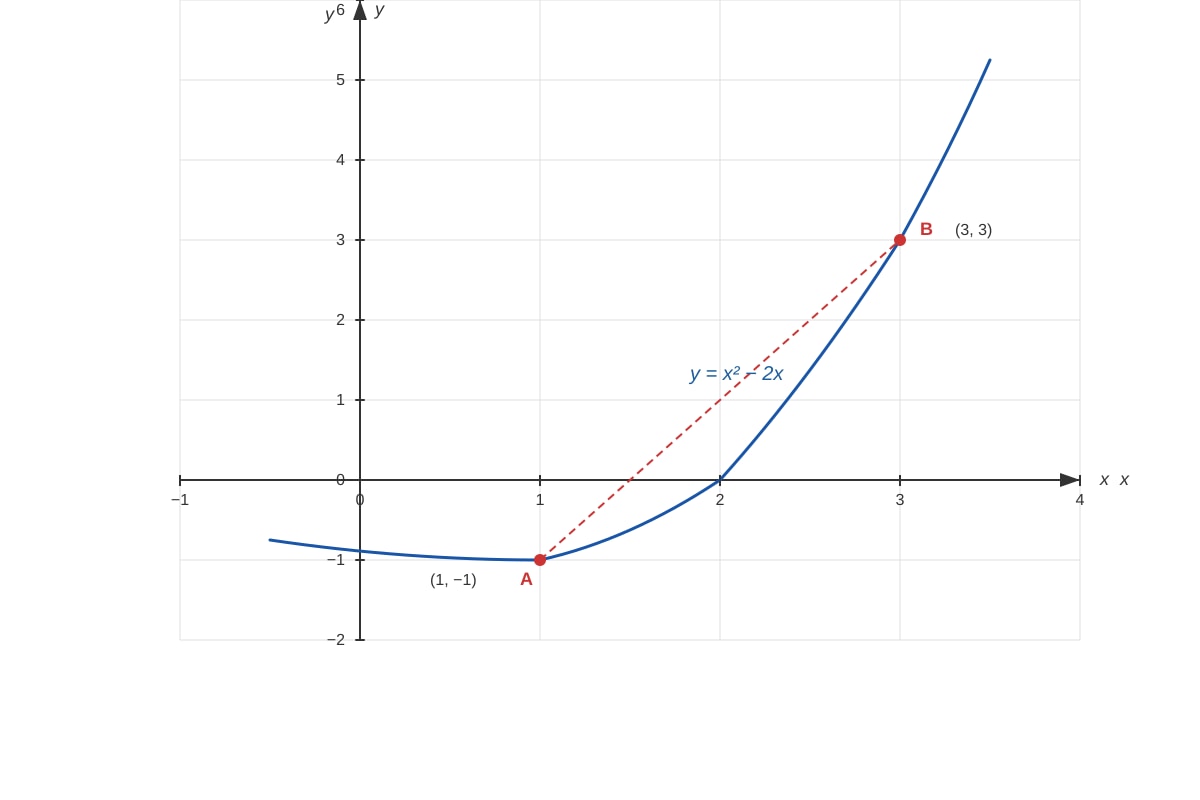
12. Answer: (a) A(1, -1), B(3, 3) [1] (b) 2 [2] (c) The average rate of change of y with respect to x between x = 1 and x = 3. [1]
Explanation: (a) From the graph, point A is at (1, -1) and point B is at (3, 3).
(b) Gradient
(c) The gradient of the chord AB represents the average rate of change of the function as increases from 1 to 3.
Marking Notes:
- (a) A1 for both correct coordinates
- (b) M1 for correct formula, A1 for correct answer
- (c) A1 for correct interpretation
Visual Placeholder Details: The graph must show the parabola with vertex at (1, -1). Points A(1, -1) and B(3, 3) must be clearly labelled on the curve. The chord AB must be drawn as a straight line segment connecting these two points. Axes must be labelled with appropriate scales.
13. Answer: (a) 64 m² [1] (b) 96 m² [1] (c) 8 m²/m [2]
Explanation: (a) At : m²
(b) At : m²
(c) Average rate of change m²/m
Marking Notes:
- (a) A1 for correct answer
- (b) A1 for correct answer
- (c) M1 for correct formula, A1 for correct answer with units
Teaching Note: The average rate of change tells us how much the area increases, on average, for each metre increase in width.
14. Answer: (a) 14 km/h [2] (b) 10 km/h [2]
Explanation: (a) Average speed km/h
(b) Average speed km/h
Marking Notes:
- (a) M1 for correct formula, A1 for correct answer with units
- (b) M1 for correct formula, A1 for correct answer with units
Teaching Note: The cyclist's average speed decreased in the second half of the journey, suggesting they may have slowed down.
15. Answer: (a) 105 m [1] (b) 105 m [1] (c) 0 m/s [2]
Explanation: (a) At : m
(b) At : m
(c) Average rate of change m/s
Marking Notes:
- (a) A1 for correct answer
- (b) A1 for correct answer
- (c) M1 for correct formula, A1 for correct answer
Teaching Note: The rocket is at the same height at and seconds—once on the way up and once on the way down. The average rate of change is zero.
Section C: Extended Problem-Solving (Questions 16 to 20)
Each question carries 4 marks.
16. Answer: (a) Table: 0, 2, 8, 18, 32 [2] (b) 12 m/s [2]
Explanation: (a) At : At : At : At : At :
(b) Average speed m/s
Marking Notes:
- (a) A1 for at least 3 correct values, A1 for all correct
- (b) M1 for correct formula, A1 for correct answer with units
17. Answer: (a) At : ; At : [1] (b) 0 [2] (c) The chord is horizontal (gradient is zero). [1]
Explanation: (a) At : At :
(b) Gradient
(c) The chord joining these two points is horizontal. These are the x-intercepts of the curve.
Marking Notes:
- (a) A1 for both correct
- (b) M1 for correct formula, A1 for correct answer
- (c) A1 for correct observation
Teaching Note: The curve crosses the x-axis at and . The chord joining these intercepts is the x-axis itself, which has gradient 0.
18. Answer: (a) 600 [1] (c) $10 per item [2]
Explanation: (a) At :
(b) At :
(c) Average rate of change dollars per item
Marking Notes:
- (a) A1 for correct answer with units
- (b) A1 for correct answer with units
- (c) M1 for correct formula, A1 for correct answer with units
Teaching Note: The average rate of change of profit tells us that, on average, each additional item sold between 10 and 30 items increases profit by $10.
19. Answer: (a) At : m; At : m [2] (b) 0 m/s [2]
Explanation: (a) At : m At : m
(b) Average velocity m/s
Marking Notes:
- (a) A1 for each correct height
- (b) M1 for correct formula, A1 for correct answer
Teaching Note: The ball reaches the same height at (going up) and (coming down). The average velocity is zero because the displacement (change in height) is zero.
20. Answer: (a) 900 [1] (c) $25 per unit [2]
Explanation: (a) At :
Corrected Answer: $500
Explanation (corrected): (a) At :
(b) At :
(c) Average rate of change dollars per unit
Corrected Answer (c): $40 per unit
Marking Notes:
- (a) A1 for correct answer with units
- (b) A1 for correct answer with units
- (c) M1 for correct formula, A1 for correct answer with units
Teaching Note: The average rate of change of cost is the average increase in cost for each additional unit produced. This is related to the concept of marginal cost in economics.
— End of Answer Key —