AI Generated Quiz
Secondary 2 Mathematics Calculus Quiz
Free Sec 2 Maths Calculus quiz, AI version, with questions, answers, and syllabus-aligned practice for Singapore students.
These static practice materials are generated from the site's syllabus and paper-generation workflow, with source and model context shown so students and parents can evaluate the material before use.
Questions
Free quiz and exam paper access
Enter your details to view this paper
Your access is remembered on this device.
Answers
Secondary 2 Mathematics Quiz - Calculus (Answer Key)
Total Marks: 50
Section A: Gradient of a Straight Line (Questions 1 - 5)
Question 1
(a) [2 marks]
The gradient of a line through two points and is given by:
Substituting and :
Answer: Gradient
Marking: M1 for correct substitution into gradient formula, A1 for correct answer.
(b) [1 mark]
Answer: The gradient represents that for every 1 unit increase in , increases by 2 units. It is the rate of change of with respect to .
Marking: A1 for a correct interpretation mentioning rate of change or "y increases by 2 for each increase of 1 in x".
Question 2
(a) [2 marks]
The equation of a line is . We know and the point lies on the line.
Substitute , , and :
Answer:
Marking: M1 for correct substitution of values into , A1 for correct value of .
(b) [1 mark]
Answer:
Marking: A1 for correct equation.
Question 3
(a) [1 mark]
The equation is in the form where .
Answer: Gradient
Marking: A1 for correct gradient.
(b) [1 mark]
Answer: The gradient represents the speed of the car, which is 15 metres per second. For every 1 second that passes, the car travels 15 metres.
Marking: A1 for a correct interpretation mentioning speed or "15 m per second".
Question 4
(a) [2 marks]
We know and the point lies on the line.
Substitute into :
Answer:
Marking: M1 for correct substitution to find , A1 for correct equation.
(b) [1 mark]
Answer: The -intercept is 11 (the point ).
Marking: A1 for correct answer.
Question 5
(a) [2 marks]
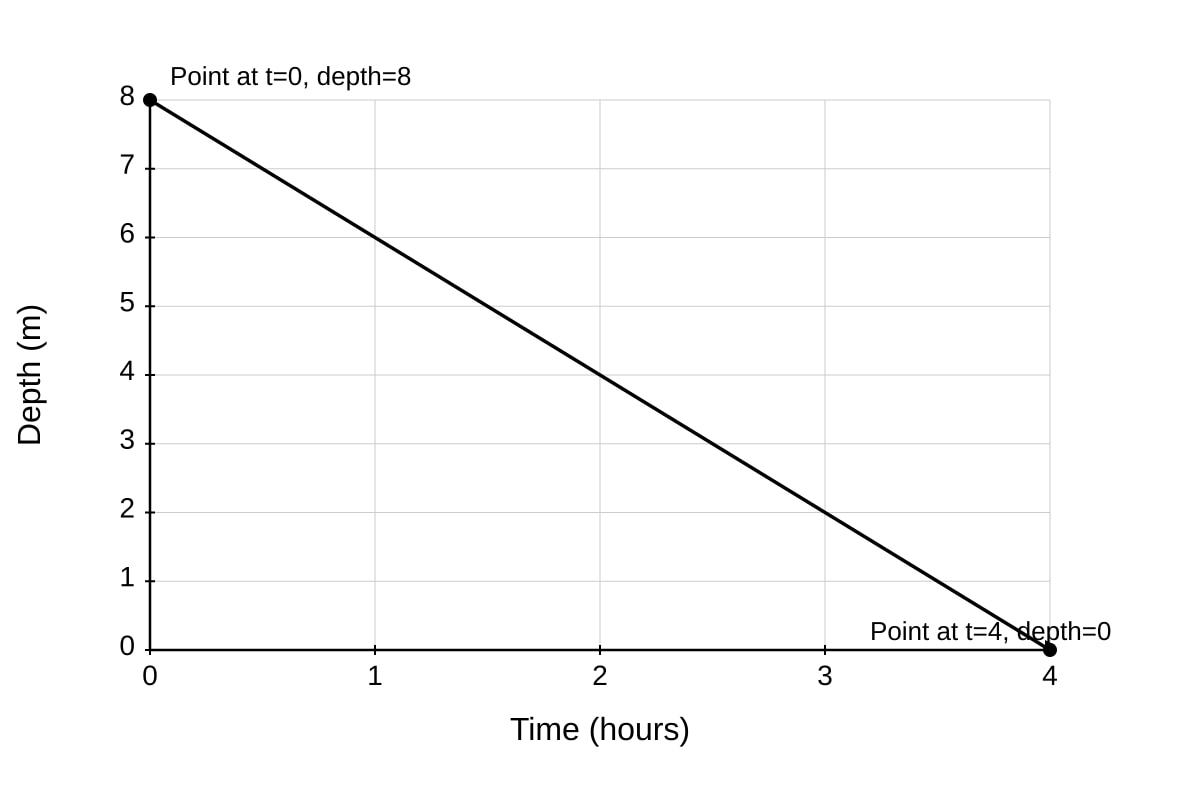
From the graph, the line passes through and .
Answer: Gradient
Marking: M1 for correct reading of two points from the graph, A1 for correct gradient.
(b) [1 mark]
Answer: The gradient represents that the depth of water decreases by 2 metres per hour. The water is draining out of the tank at a rate of 2 m/h.
Marking: A1 for a correct interpretation mentioning the decrease in depth at 2 m per hour.
Section B: Rate of Change and Average Rate (Questions 6 - 10)
Question 6
(a) [1 mark]
Substitute into :
Answer: °C
Marking: A1 for correct answer.
(b) [1 mark]
Answer: The temperature is increasing at a rate of 4°C per minute.
Marking: A1 for correct rate with units.
Question 7
(a) [1 mark]
Substitute into :
Answer: metres
Marking: A1 for correct answer.
(b) [1 mark]
Substitute :
Answer: metres
Marking: A1 for correct answer.
(c) [2 marks]
Average rate of change
Answer: Average rate of change m/s
Marking: M1 for correct formula for average rate of change, A1 for correct answer.
Teaching note: The ball is at the same height at and seconds, so on average, the height is not changing over this interval, even though the ball is moving.
Question 8
(a) [1 mark]
Substitute :
Answer: 100 bacteria
Marking: A1 for correct answer.
(b) [1 mark]
Substitute :
Answer: 800 bacteria
Marking: A1 for correct answer.
(c) [2 marks]
Average rate of increase
Answer: Average rate of increase bacteria per hour (3 s.f.)
Marking: M1 for correct formula, A1 for correct answer.
Question 9
(a) [1 mark]
Answer: The fixed cost is n = 0$).
Marking: A1 for correct answer.
(b) [1 mark]
Answer: The cost of producing one additional item is n$).
Marking: A1 for correct answer.
(c) [1 mark]
Substitute :
Answer: C = \110$
Marking: A1 for correct answer.
Question 10
(a) [1 mark]
Substitute :
Answer: metres
Marking: A1 for correct answer.
(b) [1 mark]
Substitute :
Answer: metres
Marking: A1 for correct answer.
(c) [2 marks]
Average speed
Answer: Average speed m/s
Marking: M1 for correct formula, A1 for correct answer.
Section C: Gradient of a Curve at a Point (Questions 11 - 15)
Question 11
(a) [1 mark]
Using the formula with :
Answer: Gradient
Marking: A1 for correct answer.
(b) [1 mark]
Using the formula with :
Answer: Gradient
Marking: A1 for correct answer.
Teaching note: The gradient of at is negative because the curve is sloping downward at that point.
Question 12
(a) [1 mark]
Using the formula with :
Answer: Gradient
Marking: A1 for correct answer.
(b) [2 marks]
Answer: The gradient formula is . Since is always greater than or equal to zero for any real value of (a square of any real number is never negative), and 3 is positive, the product is always greater than or equal to zero. Therefore, the gradient of is never negative.
Marking: M1 for recognising that for all real , A1 for a complete explanation.
Question 13
(a) [1 mark]
Using the formula with :
Answer: Gradient
Marking: A1 for correct answer.
(b) [2 marks]
Answer: The gradient at second represents the instantaneous velocity of the projectile at that moment. A gradient of 20 means the projectile is moving upward at a speed of 20 m/s at second.
Marking: M1 for identifying the gradient as velocity/rate of change of height, A1 for correct interpretation with the value 20 m/s.
Question 14
(a) [1 mark]
Using the formula with :
Answer: Gradient
Marking: A1 for correct answer.
(b) [2 marks]
Set the gradient formula equal to 11:
Answer:
Marking: M1 for setting up the equation , A1 for correct solution.
Question 15
(a) [1 mark]
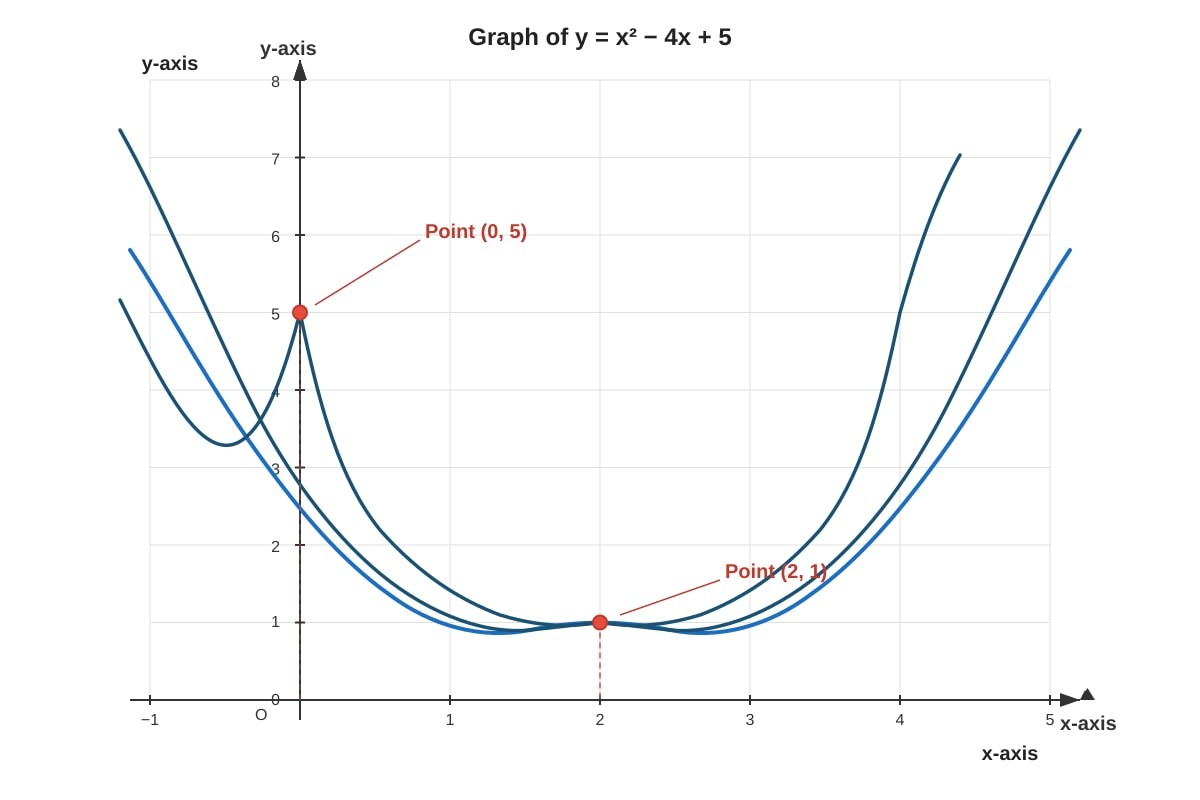
Answer: The gradient at the minimum point is 0. At a minimum (or maximum) point of a curve, the tangent is horizontal, so the gradient is zero.
Marking: A1 for correct answer.
(b) [2 marks]
Substitute into the gradient formula:
This confirms that the gradient at the minimum point is indeed zero.
Answer: Verified: gradient at .
Marking: M1 for correct substitution of , A1 for showing the result equals 0.
Section D: Introduction to Differentiation (Questions 16 - 20)
Question 16
(a) [1 mark]
Using the rule for :
For , and :
Answer:
Marking: A1 for correct answer.
(b) [1 mark]
For , and :
Answer:
Marking: A1 for correct answer.
Question 17
(a) [1 mark]
For :
Answer:
Marking: A1 for correct answer.
(b) [2 marks]
Differentiate each term separately:
Answer:
Marking: M1 for differentiating each term correctly, A1 for correct final answer.
Question 18
(a) [2 marks]
Differentiate with respect to :
Answer: m/s
Marking: M1 for differentiating each term correctly, A1 for correct final answer.
(b) [1 mark]
Substitute :
Answer: Velocity m/s
Marking: A1 for correct answer.
Question 19
(a) [2 marks]
Differentiate each term of :
Answer:
Marking: M1 for differentiating at least two terms correctly, A1 for correct final answer.
(b) [2 marks]
Substitute into the gradient function:
Answer: Gradient
Marking: M1 for correct substitution, A1 for correct answer.
Question 20
(a) [1 mark]
Differentiate with respect to :
Answer:
Marking: A1 for correct answer.
(b) [1 mark]
Substitute :
Answer: The area is increasing at a rate of 12 cm² per cm.
Marking: A1 for correct answer with units.
(c) [1 mark]
Answer: represents the rate of change of the area with respect to the side length. It tells us how much the area increases for each 1 cm increase in the side length. For a square, this is equal to twice the side length (which is the perimeter divided by 2, or the sum of two adjacent sides).
Marking: A1 for a correct interpretation mentioning rate of change of area with respect to side length.
END OF ANSWER KEY