From Real Exams Quiz
Secondary 2 Mathematics Geometry Trigonometry Quiz
Free Sec 2 Maths Geometry Trigonometry quiz, Exam version, with questions, answers, and syllabus-aligned practice for Singapore students.
These static practice materials are generated from the site's syllabus and paper-generation workflow, with source and model context shown so students and parents can evaluate the material before use.
Questions
Free quiz and exam paper access
Enter your details to view this paper
Your access is remembered on this device.
Answers
Secondary 2 Mathematics Quiz - Geometry Trigonometry: Answer Key
Total Marks: 50
Section A: Angle Properties and Polygons (Questions 1 - 5)
1.
- Answer:
- Marks: 1
- Working:
- Sum of exterior angles of any polygon = .
- For a regular octagon, number of sides .
- Each exterior angle = .
- Interior angle + exterior angle = .
- Interior angle = .
- Teaching Note: The interior and exterior angles of a polygon are supplementary (add up to ). For a regular polygon, all interior angles are equal, and all exterior angles are equal. The sum of exterior angles is always regardless of the number of sides.
- Common Mistake: Students sometimes use the formula directly but make arithmetic errors. The exterior angle method is often simpler.
2.
- Answer: 15 sides
- Marks: 1
- Working:
- Exterior angle = .
- Number of sides .
- Teaching Note: Since the sum of exterior angles is always , dividing by the measure of one exterior angle gives the number of sides. This works only for regular polygons where all exterior angles are equal.
- Common Mistake: Using the interior angle formula instead. If given the exterior angle, the direct division method is fastest.
3.
- Answer:
- Marks: 1
- Working:
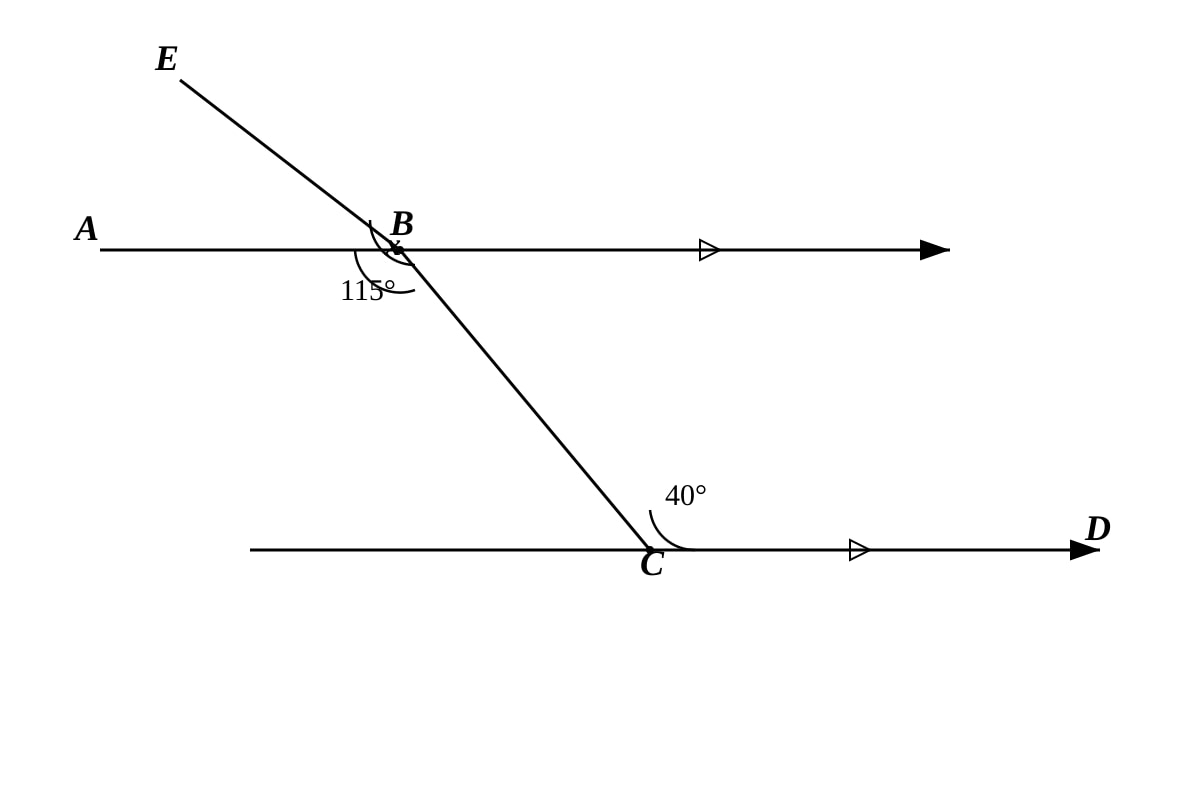
- Since , and are interior angles on the same side of the transversal .
- Interior angles on the same side of a transversal are supplementary: .
- However, we are given and .
- At point B, is the angle between AB and BC. The angle between BE and BC is .
- Since AB and BE form a straight line at point B, (angles on a straight line).
- .
- Correction: The diagram shows angle ABC = 115° and angle BCD = 40°. Since AB is parallel to CD, the alternate interior angle to angle ABC is angle BCD? No, alternate interior angles are equal only when the angles are on opposite sides of the transversal. Here, angle ABC and angle BCD are on the same side of BC, so they are supplementary: 115° + 40° = 155°, not 180°. This means the diagram is not drawn to scale or the angles are not interior angles on the same side. Let's re-examine.
- Actually, if AB ∥ CD, then angle ABC and angle BCD are interior angles on the same side of transversal BC. Their sum should be 180°. But 115° + 40° = 155° ≠ 180°. This suggests the diagram has a different configuration.
- Let's use the given angles directly. At point B, AB and BE form a straight line. So angle ABE = 180°. Angle ABC = 115°. Therefore, angle CBE = 180° - 115° = 65°. So x = 65°.
- The angle BCD = 40° is not needed for this calculation, but it confirms the parallel lines property if the diagram is consistent.
- Teaching Note: When parallel lines are cut by a transversal, corresponding angles are equal, alternate angles are equal, and interior angles on the same side are supplementary. Angles on a straight line sum to 180°.
- Common Mistake: Confusing which angle property to apply. Always check whether angles are corresponding, alternate, or interior on the same side.
4.
- Answer: 9 sides
- Marks: 1
- Working:
- Sum of interior angles = .
- .
- .
- .
- Teaching Note: The formula for the sum of interior angles of an n-sided polygon is . This works for any convex polygon, not just regular ones.
- Common Mistake: Forgetting to add 2 back after dividing.
5.
- Answer:
- Marks: 1
- Working:
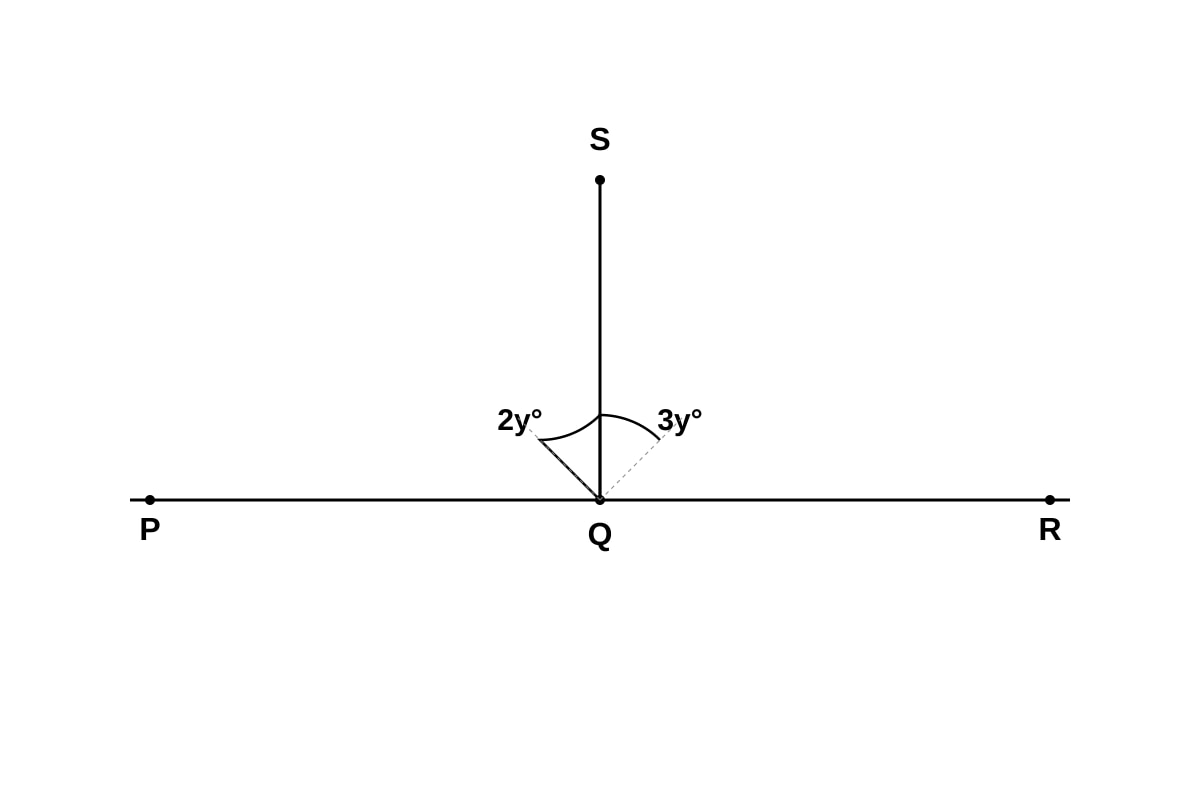
- is a straight line, so (angles on a straight line).
- Teaching Note: Angles on a straight line sum to 180°. This is a fundamental angle property.
- Common Mistake: Forgetting that the sum is 180°, not 90°.
Section B: Pythagoras' Theorem and Similarity (Questions 6 - 12)
6.
- Answer: 13 cm
- Marks: 2 (M1 for correct substitution into Pythagoras' theorem, A1 for correct answer)
- Working:
- Let the hypotenuse be .
- cm
- Teaching Note: Pythagoras' theorem states that in a right-angled triangle, the square of the hypotenuse equals the sum of the squares of the other two sides: , where is the hypotenuse.
- Common Mistake: Adding the sides without squaring them first, or forgetting to take the square root at the end.
7.
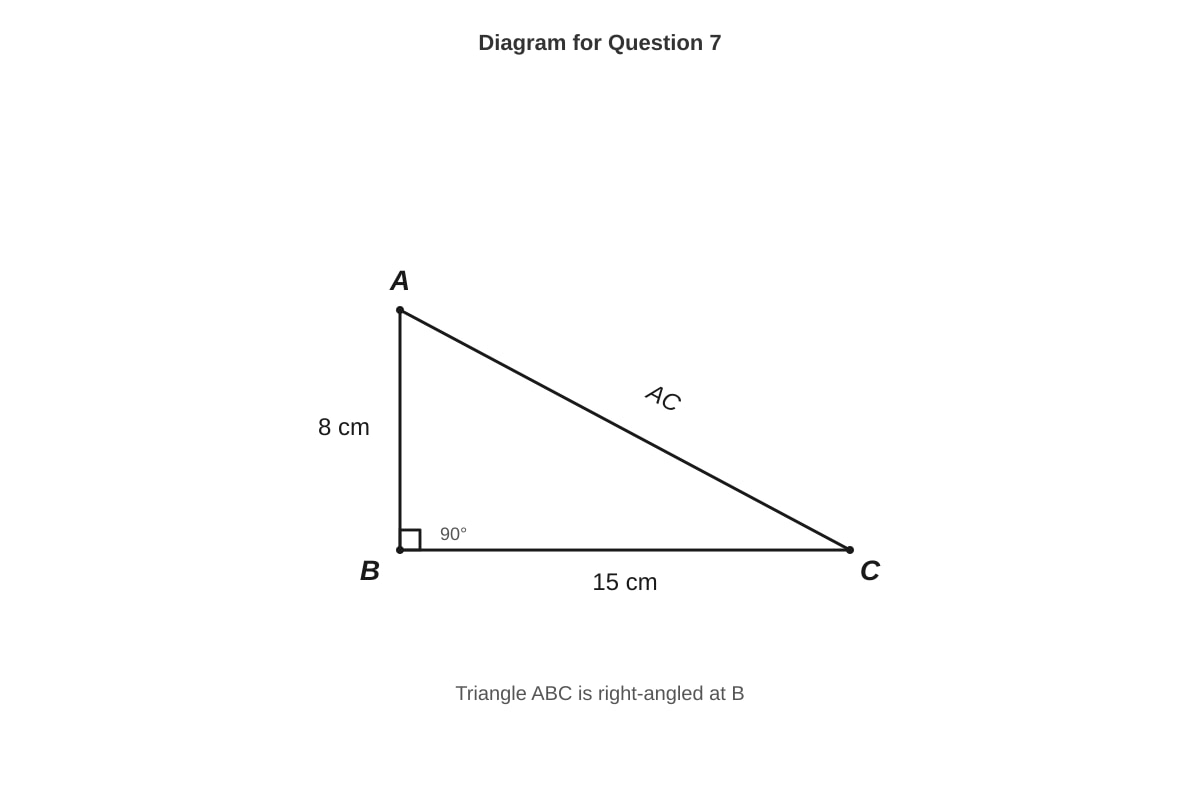
- Answer: cm
- Marks: 2 (M1 for correct substitution, A1 for correct answer)
- Working:
- cm
- Teaching Note: Identify the hypotenuse first. It is always opposite the right angle. Here, AC is the hypotenuse.
- Common Mistake: Using the wrong sides in the formula. Always check which side is the hypotenuse.
8.
- Answer: 12 m
- Marks: 2 (M1 for correct setup, A1 for correct answer)
- Working:
- Let the height be m.
- m
- Teaching Note: The ladder, wall, and ground form a right-angled triangle. The ladder is the hypotenuse (13 m), the distance from the wall is one side (5 m), and the height is the other side.
- Common Mistake: Adding instead of subtracting: is incorrect because the ladder is the longest side.
9.
- Answer: cm
- Marks: 2 (M1 for correct ratio, A1 for correct answer)
- Working:
- Since triangles and are similar, corresponding sides are in proportion.
- corresponds to , and corresponds to .
- cm
- Teaching Note: In similar triangles, the ratios of corresponding sides are equal. Identify which sides correspond by looking at the order of vertices in the similarity statement.
- Common Mistake: Matching the wrong sides. If the similarity is written as , then P↔X, Q↔Y, R↔Z.
10.
- Answer: cm
- Marks: 2 (M1 for correct similarity setup, A1 for correct answer)
- Working:
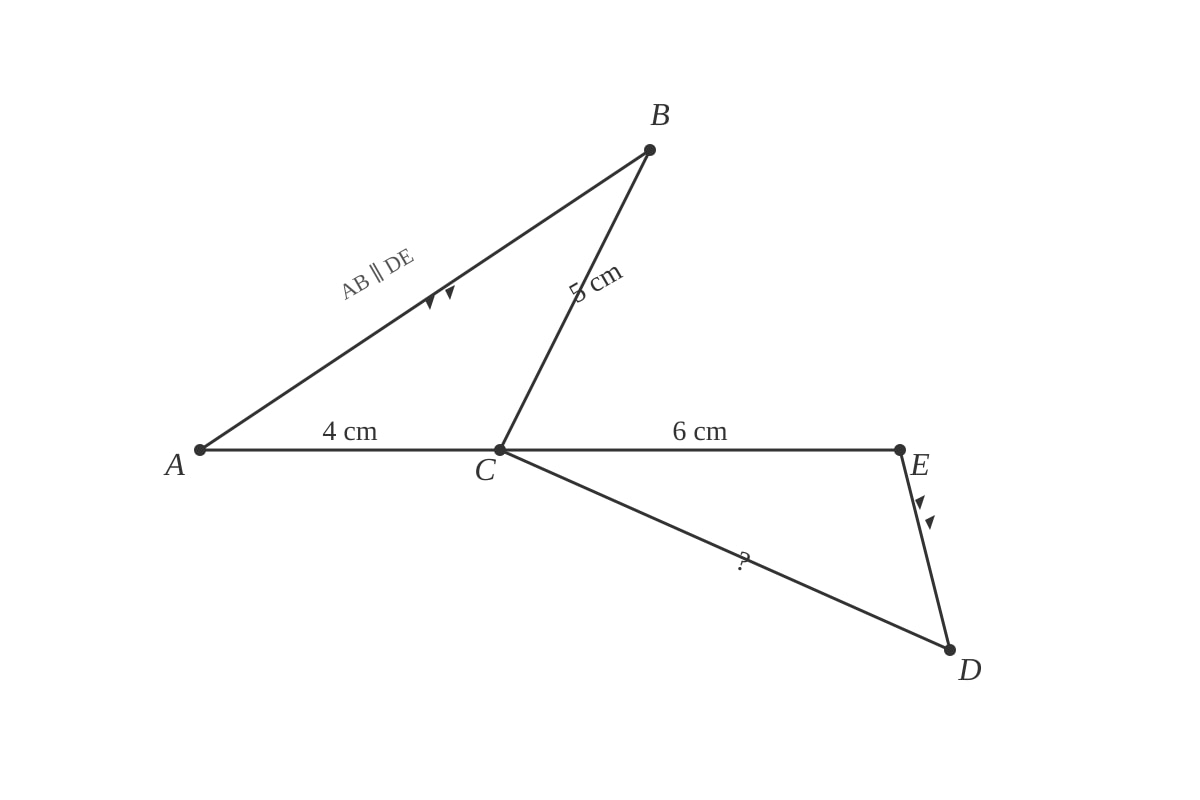
- Since , (AA similarity: and as alternate angles).
- Corresponding sides: corresponds to , corresponds to .
- cm
- Teaching Note: When a line is parallel to one side of a triangle, it creates a smaller similar triangle. The parallel line property gives equal angles, which proves similarity.
- Common Mistake: Using the wrong ratio. Note that AC and EC are on the same line, and BC and DC are on the same line.
11.
- Answer: Yes, the triangle is right-angled.
- Marks: 2 (M1 for checking Pythagoras' theorem, A1 for correct conclusion)
- Working:
- Check if .
- .
- .
- Since , the triangle satisfies Pythagoras' theorem, so it is right-angled.
- Teaching Note: The converse of Pythagoras' theorem states that if the square of the longest side equals the sum of the squares of the other two sides, then the triangle is right-angled. The longest side is the hypotenuse.
- Common Mistake: Checking or other incorrect combinations. Always check the longest side as the potential hypotenuse.
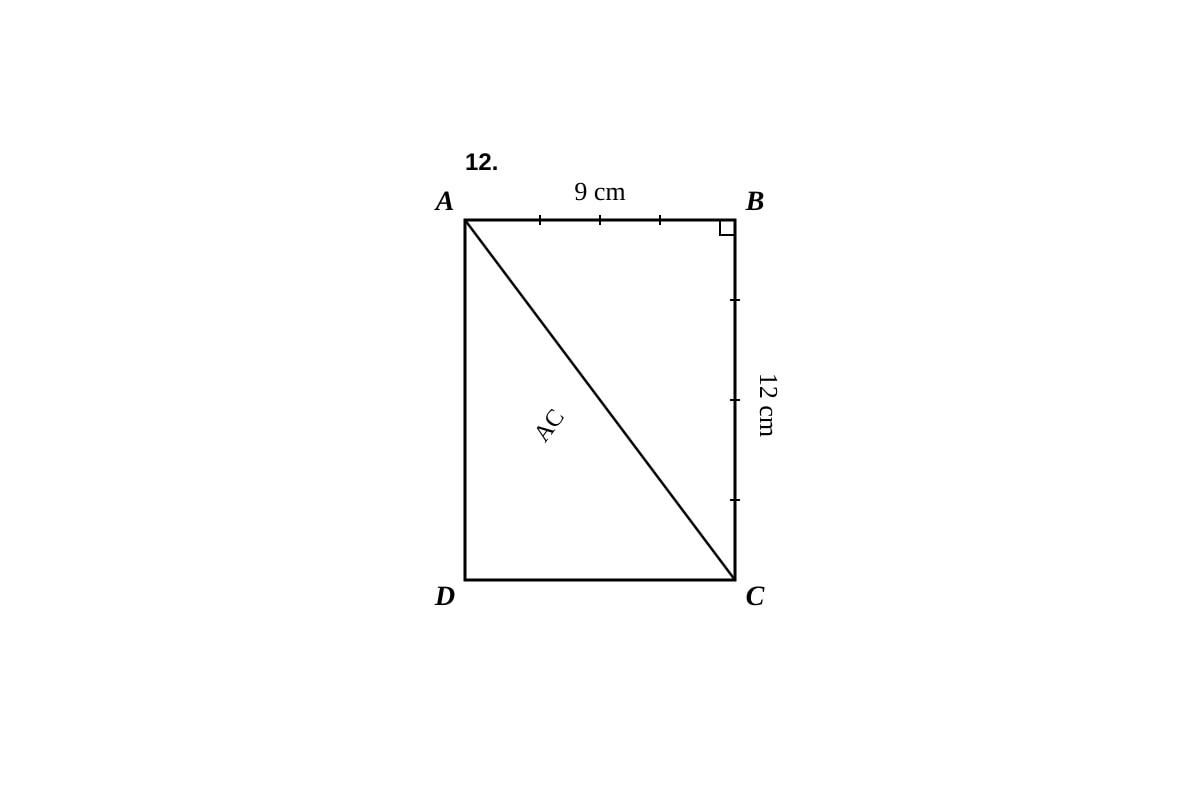
12.
- Answer: cm
- Marks: 2 (M1 for correct substitution, A1 for correct answer)
- Working:
- In rectangle , .
- cm
- Teaching Note: The diagonal of a rectangle divides it into two right-angled triangles. The diagonal is the hypotenuse of each triangle.
- Common Mistake: Forgetting that the diagonal is the hypotenuse, not one of the shorter sides.
Section C: Trigonometry of Right-Angled Triangles (Questions 13 - 20)
13.
- Answer:
- Marks: 1
- Working:
- Teaching Note: The sine of an angle in a right-angled triangle is the ratio of the length of the side opposite the angle to the length of the hypotenuse. Remember SOH CAH TOA: Sin = Opposite/Hypotenuse, Cos = Adjacent/Hypotenuse, Tan = Opposite/Adjacent.
- Common Mistake: Confusing opposite and adjacent sides. The opposite side is across from the angle, not touching it.
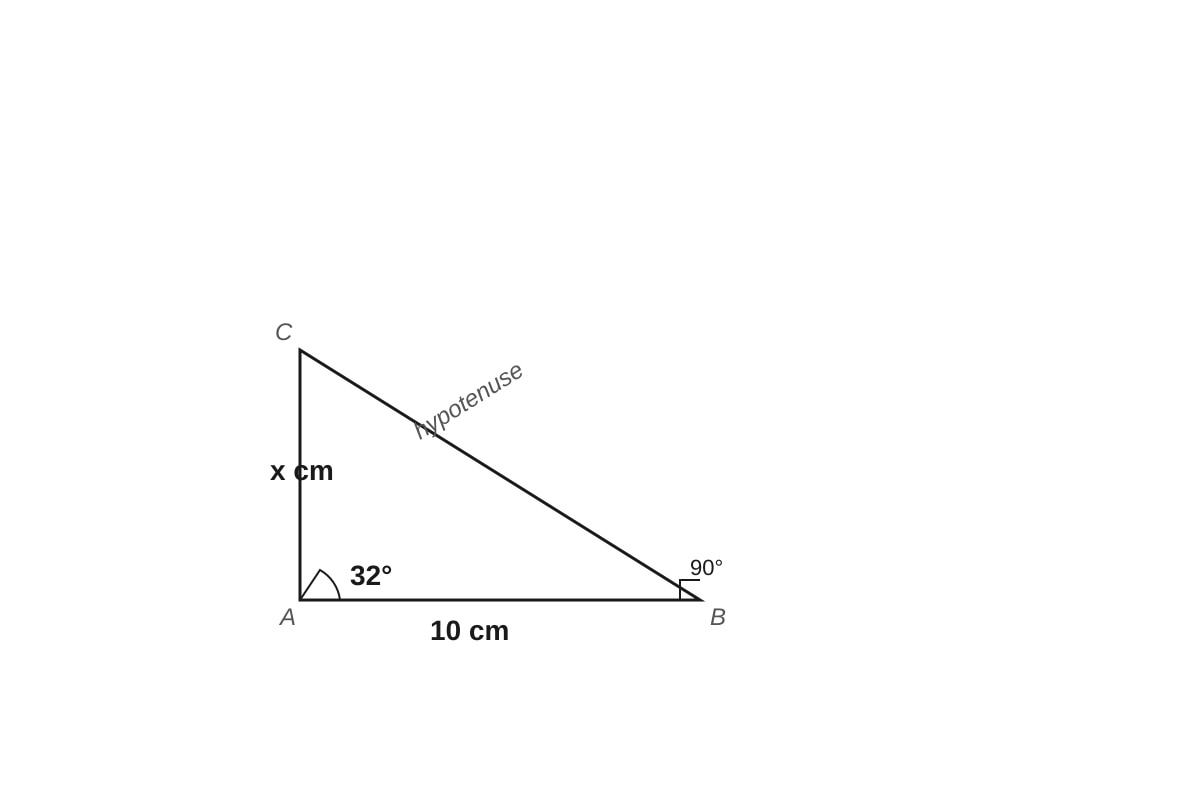
14.
- Answer: cm (to 1 decimal place)
- Marks: 2 (M1 for correct trigonometric ratio, A1 for correct answer)
- Working:
- We have the adjacent side (10 cm) and need the opposite side (). The angle is .
- cm (to 1 decimal place)
- Teaching Note: Use SOH CAH TOA to choose the correct ratio. Here, we have opposite and adjacent, so use tangent.
- Common Mistake: Using sine or cosine instead of tangent. Check which sides are given relative to the angle.
15.
- Answer: 32 m (to the nearest metre)
- Marks: 2 (M1 for correct trigonometric setup, A1 for correct answer)
- Working:
- The string is the hypotenuse (50 m). The height is opposite the angle.
- m (to the nearest metre)
- Teaching Note: The angle with the horizontal means the angle between the string and the ground. The height is the vertical distance, which is opposite the angle.
- Common Mistake: Using cosine instead of sine. The height is opposite the angle, not adjacent.
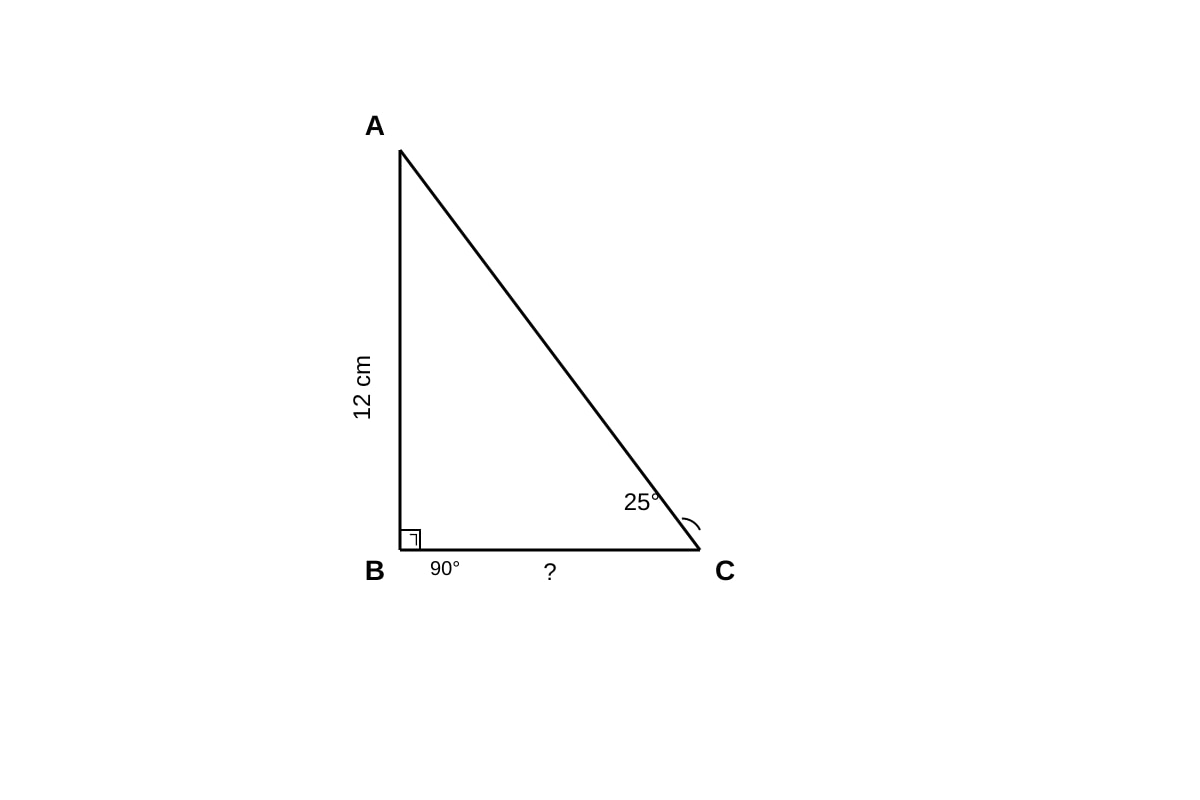
16.
- Answer: cm (to 1 decimal place)
- Marks: 3 (M1 for identifying correct ratio, M1 for correct substitution, A1 for correct answer)
- Working:
- In , , , cm.
- We need . Relative to at C:
- is the opposite side (12 cm).
- is the adjacent side (unknown).
- cm (to 1 decimal place)
- Teaching Note: Always identify which angle you are working with and label the sides (opposite, adjacent, hypotenuse) relative to that angle. Here, we use angle C, so AB is opposite and BC is adjacent.
- Common Mistake: Using the wrong angle or mixing up opposite and adjacent sides.
17.
- Answer: 299 m (to the nearest metre)
- Marks: 3 (M1 for understanding angle of depression, M1 for correct trigonometric setup, A1 for correct answer)
- Working:
- The angle of depression from the top of the cliff to the boat is .
- The angle of depression equals the angle of elevation from the boat to the top of the cliff (alternate angles with horizontal lines).
- So the angle of elevation from the boat to the top of the cliff is also .
- Let be the distance of the boat from the base of the cliff.
- m (to the nearest metre)
- Teaching Note: The angle of depression is measured from the horizontal downward. It equals the angle of elevation from the observer below. Draw a diagram to visualize the right-angled triangle.
- Common Mistake: Using sine or cosine instead of tangent. The height (80 m) is opposite the angle, and the distance from the base is adjacent.
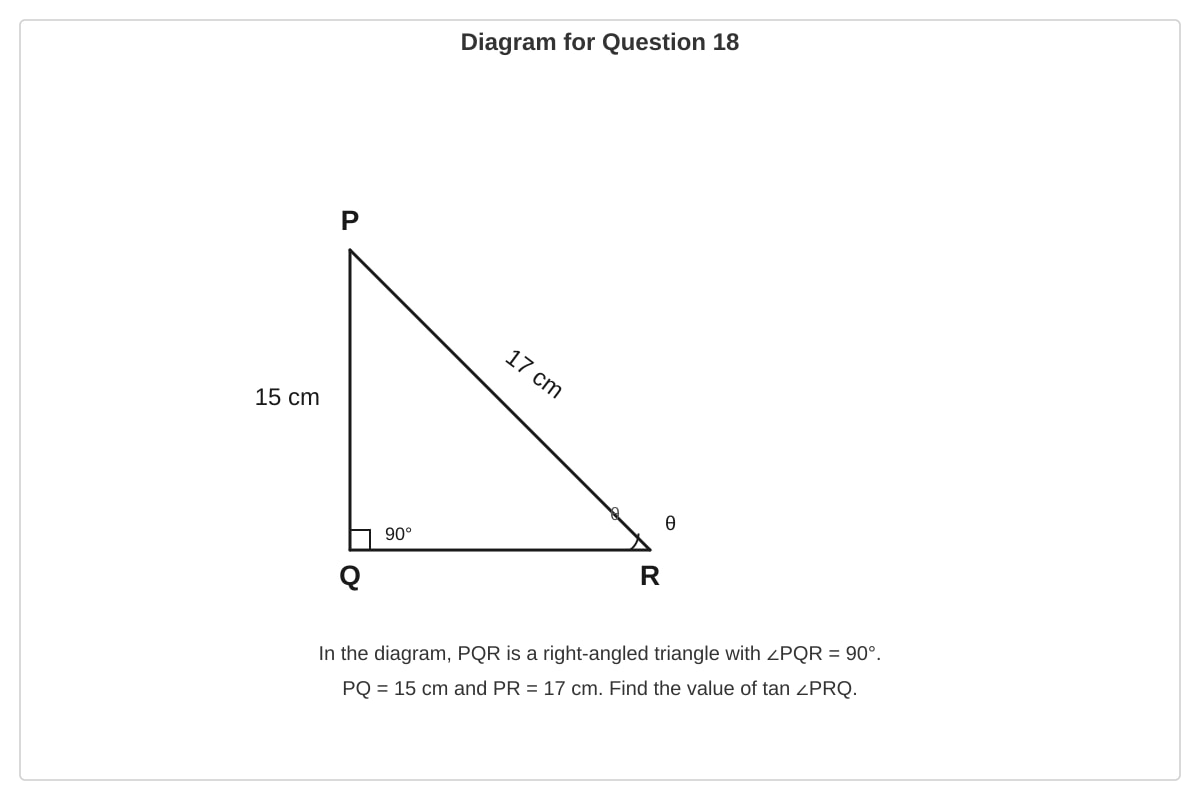
18.
- Answer:
- Marks: 3 (M1 for finding QR using Pythagoras, M1 for correct tan ratio, A1 for correct answer)
- Working:
- First, find using Pythagoras' theorem.
- cm
- Now, relative to at R.
- Opposite side to is cm.
- Adjacent side to is cm.
- Teaching Note: Sometimes you need to use Pythagoras' theorem first to find a missing side before applying trigonometry. Always label the sides relative to the angle you are working with.
- Common Mistake: Using the wrong sides for opposite and adjacent. At angle R, the side opposite is PQ (not touching R), and the adjacent is QR (touching R but not the hypotenuse).
19.
- Answer: (to the nearest degree)
- Marks: 4 (M1 for drawing the diagram, M1 for finding the angle, M1 for understanding bearings, A1 for correct answer)
- Working:
- Draw a diagram: Port A at origin. Ship sails 20 km east to B, then 15 km south to C.
- The bearing of C from A is the angle measured clockwise from north to the line AC.
- First, find the angle that AC makes with the east direction.
- In right-angled triangle ABC, km (east), km (south).
- (this is the angle south of east).
- Bearing is measured clockwise from north.
- From north, go clockwise: (to east) + (south of east) = .
- Alternatively, from north, the angle to the line AC going clockwise is .
- Wait, let's be careful. The bearing is the angle from north clockwise to the line AC.
- The angle from north to east is .
- The angle from east to AC is (south of east).
- So the bearing = .
- Correction: The bearing of C from A. A is at the origin. C is 20 km east and 15 km south of A.
- The angle from north to AC:
- Angle east of north = .
- Bearing = .
- Let's use the correct method: The bearing is the angle measured clockwise from north.
- The direction of C from A is southeast. The angle from north to the east direction is . The angle from east to the line AC (going south) is .
- Bearing = .
- Double-check: Using the tangent of the angle from north: . Angle from north = . Bearing = .
- Bearing to the nearest degree.
- Teaching Note: Bearings are measured clockwise from north and are always given as three-digit angles (e.g., 127°). Draw a diagram to visualize the position and the angle.
- Common Mistake: Forgetting that bearings are measured clockwise from north, not anticlockwise or from east.
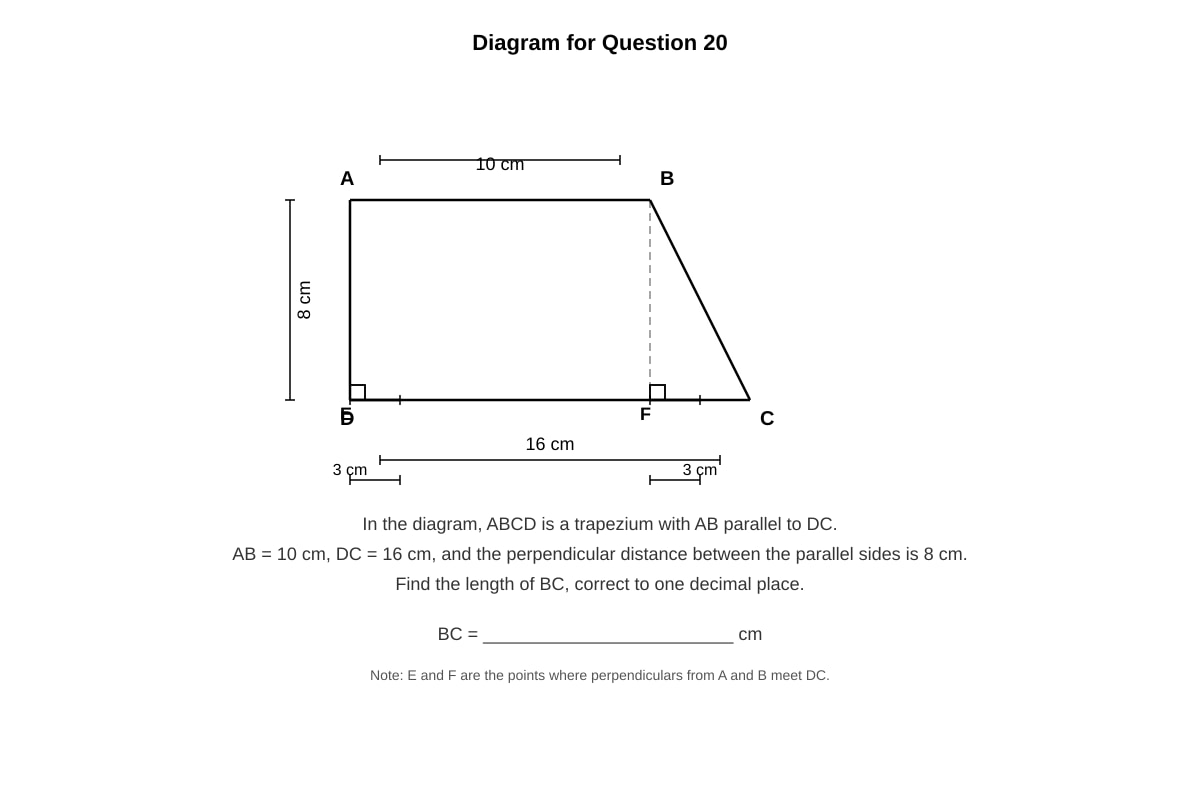
20.
- Answer: cm (to 1 decimal place)
- Marks: 5 (M1 for drawing perpendiculars, M1 for finding the horizontal difference, M1 for setting up Pythagoras, M1 for correct calculation, A1 for correct answer)
- Working:
- Draw perpendiculars from A and B to DC, meeting at E and F respectively.
- cm (perpendicular distance between parallel sides).
- cm.
- cm.
- cm.
- Since the trapezium is isosceles (not stated, but assumed from symmetry), cm.
- In right-angled triangle , cm, cm.
- cm (to 1 decimal place)
- Teaching Note: In a trapezium with parallel sides, dropping perpendiculars creates right-angled triangles. The difference in lengths of the parallel sides is split equally between the two ends if the trapezium is isosceles (non-parallel sides equal). Use Pythagoras' theorem to find the length of the non-parallel side.
- Common Mistake: Assuming the trapezium is isosceles without checking. If not stated, the problem usually implies it from symmetry or the diagram. Also, forgetting to divide the difference by 2.
END OF ANSWER KEY